
Understanding Club Fitting and Why It Matters for Golfers
This post contains affiliate links. As an Amazon Associate, we earn from qualifying purchases.
This post contains affiliate links. As an Amazon Associate, we earn from qualifying purchases.
Club fitting is a data-driven process where a trained expert uses a launch monitor to measure your swing, then matches your clubs’ specifications, head, shaft, loft, lie, length, and grip, to your unique delivery. It matters because a study showed every properly fit golfer gained driver distance, with an average pickup of 16 yards. It’s not about buying new gear; it’s about making the gear you have work for your swing.
That 16-yard figure comes from a controlled study where the only variable changed was the equipment spec. The gain comes from aligning six physical variables with your body’s mechanics and your swing’s ingrained pattern.A slice, a low ball flight, inconsistent gaps between your irons, these are symptoms of a mismatch.
What follows is a breakdown of the six specs a fitter changes, the three tiers of fitting you can choose from, and the specific mistakes that signal you’re overdue for an appointment. By the end, you’ll know exactly what to expect, what to ask for, and whether your current bag is helping or hurting your game.
Key Takeaways
- Every golfer in a controlled fitting study gained driver distance, averaging 16 extra yards from spec-matching alone.
- High-handicap players benefit more from fitting than low handicappers, because their pronounced swing tendencies (like a slice) can be directly accommodated by equipment.
- A proper fitting follows a specific order: head model first, then shaft, then length, with lie angle adjusted last because it’s affected by the other changes.
- Bring your current clubs to the session. The fitter needs a real baseline, and the best outcome might be a simple adjustment to what you already own.
- If your 7-iron and 8-iron carry the same distance, or there’s a 30-yard jump between wedges, your loft gapping is broken and needs a fitter’s attention.
What Actually Happens During a Fitting?
You hit real balls off a mat, into a net or screen, while a professional-grade launch monitor like a TrackMan or Foresight GCQuad captures everything. The fitter reads data: clubhead speed, ball speed, launch angle, spin rate, carry distance, and dispersion.
A proper fitting session requires hitting a minimum of 8–10 shots per club or combination being tested. For a single category like your driver, plan on 45–60 minutes. A full bag fitting takes 2–3 hours.
The process is a structured interview followed by systematic testing. First, the fitter asks about your game, your misses, and your goals.Then, you hit shots with your current club to establish a baseline. This is critical. You can’t know what “better” looks like if you don’t know where you start.
Next comes the variable swap. The fitter changes one thing at a time, maybe the shaft flex, then the shaft weight, then the driver loft, and you hit more shots. The data tells the story. Sometimes the change you “feel” isn’t the one the numbers favor. The session converges on the combination that produces the tightest dispersion, the optimal launch window, and the most efficient energy transfer.
The Six Levers a Fitter Pulls (And Why Order Matters)
A club is a system of six interacting parts. Changing one affects the others, which is why fitters follow a deliberate sequence.
1. Head Model & Design
This is always the starting point. The head design has the single biggest impact on performance. Are you using a game-improvement iron with a wide sole and low center of gravity to help get the ball airborne? Or a player’s distance iron that blends a compact look with hidden technology? The head dictates forgiveness, launch, and visual confidence at address. You pick the head that best suits your skill level and desired ball flight.
2. Shaft Selection
Once the head is chosen, the shaft dials in the feel. This is about two things: weight and flex. A heavier steel shaft offers stability for faster swingers. A lighter graphite shaft can help increase speed for others and dampen vibration. The flex. Regular, Stiff, etc., must match your swing tempo and speed. The Callaway OptiFit handbook provides a clear starting point: if your average drive is 210-240 yards, start with a Regular Flex shaft in the 55-65 gram range.
Shaft fitting is nuanced. The best shaft for your driver might not be the best for your irons. This is where consulting a detailed guide on club shafts or specifically iron shafts can provide useful background before your appointment.
3. Club Length
Standard lengths are built for a golfer about 5’9″ to 5’11”. If you’re taller, shorter, or have unusual arm length, this spec is wrong for you. Even a half-inch adjustment changes swing weight and where you make contact on the face. The fitter uses impact tape to see if a longer or shorter club helps you hit the sweet spot more often.
4. Loft
Loft is your launch and spin controller. For drivers, modern adjustable hosels let a fitter tweak loft by ±2 degrees to find your ideal launch angle. For irons, loft is about gapping. If your 7-iron goes 150 yards and your 8-iron goes 149 yards, the lofts are too close together. A fitter can bend them apart to create consistent, 10-15 yard gaps.
5. Lie Angle
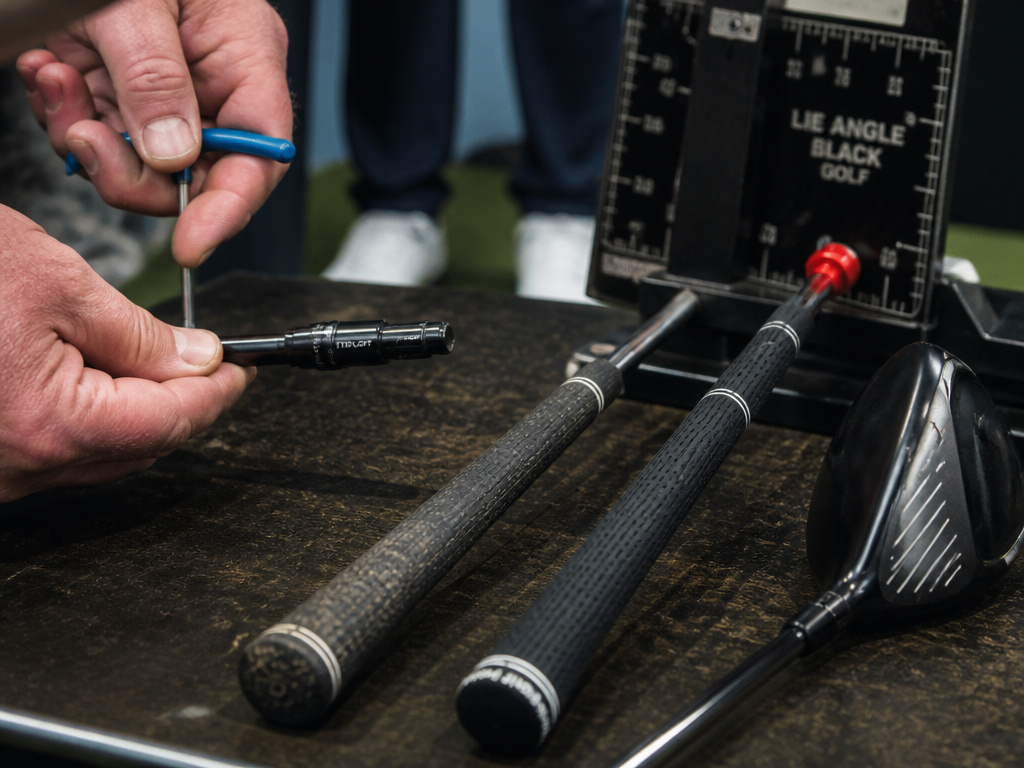
This is always adjusted last. Lie angle, how upright or flat the club sits, influences direction. If the lie is too upright for you, the toe is up at impact, pointing the face left and causing a pull. Too flat, and the heel is up, pointing the face right for a push. Because changing shaft length also dynamically alters the lie, it’s the final tuning step. Understanding the importance of lie angle in fitting is key to trusting this part of the process.
6. Grip Size & Style
The final point of contact. A grip that’s too small can encourage overactive hands; one that’s too large can restrict release. The right size promotes neutral grip pressure. It’s also a chance to choose a material or texture that feels secure in all conditions. The market for best golf club grips is vast, from corded to wrap-style.
Who Actually Needs a Club Fitting?
The short answer is any golfer with a repeatable swing pattern who plays regularly. Let’s bust the biggest myth right away.
Common mistake: “I’m not good enough to get fit.” High-handicap golfers benefit more from fitting than low handicappers. A 25-handicapper with a chronic slice gets immediate help from a draw-biased driver head and a softer shaft. Their swing has a pronounced tendency that equipment can directly address.
You are a candidate for a fitting if any of these are true: * You’re playing with hand-me-down clubs or a mismatched set. * Your swing has stabilized after your first year or two of learning. * You’ve undergone a significant physical change (weight loss, injury, aging). * Your driver is 10 or more years old. * You have inconsistent distance gaps between your irons.
What about beginners? If you’re in your first year, still building fundamentals, and using a starter set, wait. Your swing is a moving target. A fitting is most valuable once your pattern is somewhat consistent, even if it’s not pretty. A great beginner set is designed to be forgiving across a range of swings; use it to learn first.
| Golfer Profile | Fitting Priority | Likely Focus Area |
|---|---|---|
| New Beginner (<1 year) | Low | Learn swing first; use forgiving starter set |
| High Handicap (20+) | High | Driver forgiveness, iron launch, slice correction |
| Intermediate (10-19) | Very High | Distance gapping, wedge setup, shaft optimization |
| Low Handicap (<9) | High | Precision, spin control, combo sets, specialty wedges |
| Senior Player | Very High | Lighter senior shafts, higher loft, easier launch |
Retail, Brand, or Independent Fitter? The Three Tiers

Not all fittings are the same. Where you go changes the cost, selection, and expertise.
| Tier | Examples | Pros | Cons | Best For |
|---|---|---|---|---|
| Retail | Golf Galaxy, PGA Tour Superstore | Often free/inexpensive; convenient | Limited brand selection; can be rushed; fitter experience varies | First-time fitting, basic spec check |
| Brand-Specific | TaylorMade KINGDOM, Titleist Performance Center | Expert fitters for that brand; access to full lineup | You only see one brand’s products | Brand-loyal golfers wanting the best of one line |
| Independent | True Spec Golf, Club Champion, local pro shops | Widest selection across all brands; most experienced fitters | Highest cost (often $100-$350 per category) | Serious golfers wanting an unbiased, complete fitting |
The independent fitter is the gold standard for a full bag overhaul. You pay for their time and expertise, not for a product. There’s no incentive to sell you a particular brand, so the recommendation is based purely on your data.
What to Bring and How to Prepare
Walk into your fitting prepared, or you’re wasting time and money.
Bring your current clubs. This is non-negotiable. The fitter needs to measure them and use them as a baseline. You might discover your perfect driver is your old one with a new $200 shaft. Wear your golf shoes. Lie angle testing requires you to stand as you do on the course. Eat normally beforehand. A fitting is athletic. You’ll take 75-100 full swings. Being tired or hungry leads to unrepresentative swings late in the session. Know your goals. Be honest. “I want to carry that fairway bunker on my home course” is a better goal than “I want more distance.” It gives the fitter a specific problem to solve.
Where this goes sideways: Going in with a closed mind. As master fitter Craig Allan notes, specs don’t always transfer from brand to brand. That shaft you loved in your old driver might be wrong for the new head. Trust the data, not your preconceptions.
Frequently Asked Questions
Does a fitting mean I have to buy new clubs?
No. The purpose is to find the specs that work best for you. The result could be a recommendation to adjust the lie angle on your irons, regrip your woods, or simply keep gaming what you have. There’s no obligation to purchase.
How often should I get fit?
If your swing is stable, every time you buy a new major club (driver, irons). Otherwise, consider a check-up every 3-5 years, or after any significant physical change. Your swing speed and delivery can shift as you age.
Are new club models really that much better?
Year-over-year gains are marginal, maybe a yard or two. The big leap comes from fitting, not freshness. A 3-year-old driver that fits you perfectly will outperform a brand-new, off-the-rack driver every time.
Can a fitting fix my slice?
It can help manage it, but it won’t cure a fundamental swing flaw. A draw-biased driver head, more offset in irons, and the right shaft can reduce the slice’s severity. For a true fix, you need lessons combined with fitted equipment.
Is it worth fitting my wedges and putter?
Absolutely. Wedge fitting is highly personal, focusing on loft gapping, bounce, and grind for your typical turf conditions. Putter fitting is about length, loft, and head shape to match your stroke arc and eye alignment. They are often separate, shorter sessions.
The Bottom Line
Club fitting is the simplest way to lower your scores without changing your swing. It replaces guesswork with physics, turning your inconsistent misses into predictable patterns. The average male amateur drives the ball 217-225 yards. Leaving 16 yards on the table because your driver’s loft is wrong is a choice.
You don’t need to be a tour pro to benefit. You just need a swing you can repeat. The fitting meets you there and builds equipment around it. Whether you invest in a full bag fitting at an independent studio or start with a free driver check at a retail store, the act of measuring is what matters.
Stop fighting your gear. Get it to work for you. The difference isn’t just in the numbers on a screen; it’s in the confidence you feel standing over a shot, knowing the club in your hands is actually yours.
