
How to Break 100 in Golf | The 4-8 Week Plan That Works
This post contains affiliate links. As an Amazon Associate, we earn from qualifying purchases.
This post contains affiliate links. As an Amazon Associate, we earn from qualifying purchases.
To break 100 in golf, you must shoot 99 or lower on a par-72 course. This means averaging 5.5 strokes per hole and eliminating the catastrophic holes that inflate your score. The fastest path is a strategy shift: play from forward tees, use a 3-wood or hybrid off the tee for accuracy, cap every hole at double bogey, and dedicate 80% of your practice to chipping and lag putting.
The math is simple, but the discipline is hard. You have 27 strokes to spare over par. A single lost ball or a three-putt burns two of them. Two blow-up holes can use up your entire margin.
What follows is the counterintuitive part. You don’t need to hit the ball far or straight. You need to hit it forward, keep it in play, and avoid the two or three holes where you lose your mind. This guide walks through the exact stats to hit, the club choices that save penalties, and the practice routine that delivers results in 4 to 8 weeks.
Key Takeaways
- Break 100 means shooting 99 or lower on a par-72 course. You have 27 strokes to play with over 18 holes.
- Eliminate just two penalty strokes and two three-putts per round. That’s eight strokes saved, enough to drop from 107 to 99 instantly.
- Leave your driver in the bag on tight holes. A 3-wood or hybrid finds more fairways and keeps big numbers off your card.
- Practice with a 60/20/20 split: 60% of your time on putting (especially lag puts), 20% on chipping, and 20% on full swings with your most confident club.
- Aim for the center of every green. Pin-seeking is for players breaking 80, not 100.
The Math Behind 99 (and Why You’re Close)
Shooting 105 doesn’t mean you played 18 bad holes. It means you played 14 okay holes and then had four disasters. A lost ball here, a topped shot into water there, a couple of three-putts. Those blow-up holes are the entire game.
Breaking 100 isn’t about getting better at golf in some abstract sense. It’s about eliminating the blow-up holes. Cap every hole at double bogey and you’ll shoot 108 at worst. Cap most holes at double bogey and you’re in the mid-to-high 90s.
The arithmetic is forgiving. On a par-72 course, shooting 99 is 27 over par. That’s an average of 1.5 over par per hole. You can bogey every single hole (18 over par) and still have nine strokes in the bank. Those extra strokes are for the inevitable doubles. Your goal is to make sure no hole becomes a triple or worse.
The stats from platforms like Break X Golf give you tangible targets. If you’re within shouting distance of these numbers, you’re ready.
| Performance Metric | Target for Breaking 100 | What Happens If You Miss |
|---|---|---|
| Driving Distance | 191+ yards (Men), 150+ yards (Women) | Longer approach shots mean more chances to miss greens and compound errors. |
| Fairways Hit | 40% | Missing fairways isn’t fatal, but consistently hitting from rough increases difficulty and risk of penalty. |
| Greens in Regulation (GIR) | 15% (about 2-3 greens per round) | Missing more greens demands a reliable chip to avoid double bogey. |
| Putts per Round | 33 or fewer | More than 36 putts means 3-putts are killing you; lag putting is non-negotiable. |
| Up & Down % (from <50 yds) | 25% | A low percentage turns missed greens into certain bogeys or doubles. |
The short version: You don’t need to be good. You need to be less bad. Stop the bleeding before you worry about making birdies.
The Strategy Shift: Playing for 99
Most golfers playing over 100 have the strategy of a 5-handicap and the execution of a beginner. They pull driver on every par-4, aim at sucker pin placements, and try flop shots from tight lies. That has to stop.
Tee It Forward and Simplify Your Tee Shot
GOLF Top 100 Teacher Joey Wuertemberger’s first rule is to play a set of tees that leaves you an approach shot of 150 yards or less. If you’re hitting hybrid or 3-wood into most par-4s, you’re on the wrong tees. Moving up is not a concession; it’s a strategic requirement.
Common mistake: Reaching for the driver on every par-4 and par-5. The extra 20 yards isn’t worth the penalty stroke when you slice it out of bounds.
Your most important club off the tee is the one you can hit straight, not far. For most golfers chasing 100, that’s a 3 hybrid or a 5-wood. The modern 3 hybrid is designed for high, straight flight and forgiveness on mishits, exactly what you need. Leave the driver for the widest, most open hole on the course, if at all. Legendary teacher Hank Haney says the first step is to develop a tee shot that doesn’t cost penalty strokes several times a round. That’s often not a driver.
The “Bogey is Your Par” Mindset
Your par is 5. On a par-4, that means two shots to get within 50 yards of the green, a chip onto the putting surface, and two putts. That’s the blueprint. Swinging for the green in two on a 380-yard hole is a low-percentage play that often leads to a big number.
When you’re in trouble, be it trees, thick rough, or a fairway bunker, your only thought is “advance the ball back to the fairway.” Do not attempt a heroic shot. Take your medicine, chip out sideways, and play for a bogey or double. A smart bogey saves your round; a foolish triple ruins it.
Why Your Second Shot is a Green Light, Not a Pin Seeker
For approach shots, the pin is a distraction. Your target is the center of the green, every single time. The middle of the green has no bunkers, no water, and the most forgiving contours. Even a mediocre shot that finds the center leaves you a long two-putt for par. A shot aimed at a tight pin that misses leaves you a difficult chip and a likely double.
This is where a reliable 60-degree wedge or sand wedge becomes your best friend for those 50-yard-and-in shots, but the approach itself should be played with your most confident mid-iron.
The 4-8 Week Practice Blueprint
You can’t think your way to 99. You have to practice the right things. Most high-handicappers spend 80% of their range time hitting driver. That’s 80% of their practice wasted on the club that contributes least to breaking 100.
GOLF Top 100 Teacher David Woods outlines a game plan that can lead to breaking 100 within six weeks. The timeline from GolfLaunchLab agrees: with a structured approach, 4-8 weeks is realistic.
Phase 1: The Short Game Foundation (Weeks 1-2)
60% Putting, 40% Chipping. Your full swing is off-limits.
For putting, you have one job: eliminate three-putts. Set up three balls 30 feet from a hole. Your goal is to get all three within a 3-foot circle. Don’t worry about making them. Worry about speed. Do this drill for 20 minutes, three times a week. This single habit can save you 4-6 strokes per round.
For chipping, use one club, your sand wedge or 60-degree wedge. Use a basic, stock chip shot: ball back in your stance, weight forward, hands ahead. Practice from just off the green, trying to land the ball on the fringe and let it roll out. Your goal is to get 8 out of 10 chips onto the putting surface. Not close. Just on.
Phase 2: Integrating the Full Swing (Weeks 3-6)
20% Putting, 20% Chipping, 60% Full Swing.
Now you can go to the range. But you’re not just bashing balls. Start every session with 10 minutes of lag putting. Then, hit 20 chip shots.
For your full-swing work, focus on your 150-yard club. For most men, that’s a 7 or 8-iron; for women, a 5 or 6-iron. This is your most important scoring club for those “tee-it-forward” approach shots. Hit 50 balls with it, focusing on clean contact and a consistent, smooth swing, not distance.
Finish with your hybrid or 3-wood off a low tee. Hit 20 shots, imagining a 50-yard wide fairway. Accuracy is the only metric.
The Gear That Actually Helps
You don’t need a $500 driver. You need gear that promotes confidence and forgiveness.
Start with 2-piece golf balls like the Callaway Supersoft or the Srixon Soft Feel. They are longer off the tee for slower swing speeds and more durable, you’ll lose fewer to penalties. A good golf glove, like the FootJoy WeatherSof, ensures your grip doesn’t slip on your only practiced swing. And if your shoes are worn out, a pair of spikeless golf shoes for beginners from Skechers or Adidas provides the stability you need for those consistent chips.
Where this goes sideways: Practicing without a goal. Hitting a bucket of balls while mindlessly watching other people’s swings does nothing. Every shot in practice must have a specific target and a consequence for missing it.
The On-Course Game Plan
Strategy in the car park beats talent on the 10th tee. Your round starts before you step onto the first tee.
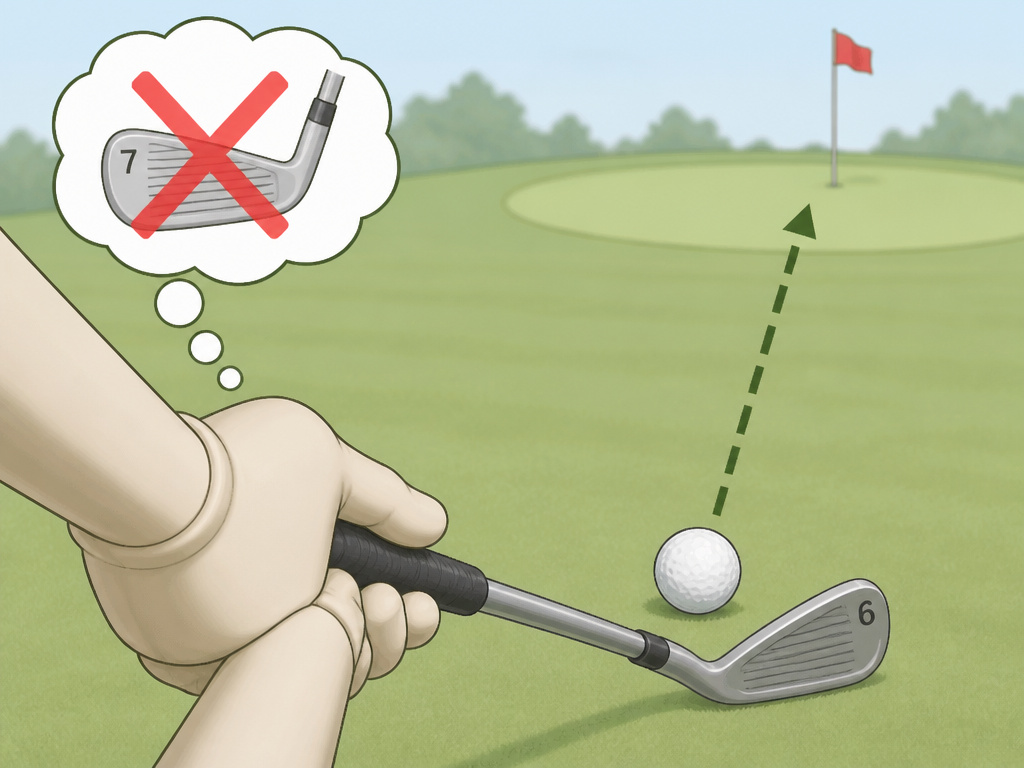
Club Up on Every Approach. If you think it’s a 7-iron, hit a 6-iron. Your miss with a longer club is usually short and straight, which is playable. Your miss with a short club is often long and offline, which is a penalty.
Have a Pre-Shot Routine for 3-Foot Putts. Stand behind the ball, pick a spot an inch in front of it on your line, and roll the ball over that spot. Do this every time. It turns knee-knockers into tap-ins.
Keep a “Bad Shot” Journal. After the round, note your two worst holes. What club did you hit? What was your decision? More often than not, you’ll see a pattern, a driver on a tight hole, a go-for-it shot over water. Awareness is the first step to elimination.
When you do break through, the next goal is consistency. The strategies to break 90 build directly on this foundation of course management and short-game proficiency.
Frequently Asked Questions
How long should it take to break 100?
For a golfer shooting 105-110, implementing the strategy changes in this guide, safer tee shots, smarter targets, can yield a sub-100 score within a few rounds. For someone shooting 115+, a focused practice plan on chipping and putting for 4-8 weeks (practicing twice a week) is the typical timeline. Consistency trumps marathon practice sessions.
Can I break 100 without hitting a driver?
Absolutely. For many golfers, it’s the fastest way. A 3 hybrid or 5-wood provides plenty of distance off the tee while drastically increasing your chance of finding the short grass. You can reintroduce the driver later, once breaking 100 is routine and you have a reliable fairway-finder swing.
What’s the most important skill for breaking 100?
Lag putting. The average golfer over 100 three-putts six or more times a round. If you can reduce that to two or three, you’ve saved 3-4 strokes without changing your swing. The second most important skill is a reliable basic chip that gets the ball on the green in one attempt.
Do I need new clubs to break 100?
Properly fitted gear helps. If your clubs are decades old or the wrong length, a fitting at a place like True Spec Golf can make the game easier.The first equipment upgrades to consider are 2-piece golf balls, a forgiving 3 hybrid, and a comfortable pair of golf shoes under $100 for better stability.
What should I aim for after breaking 100?
The next scoring milestone is breaking 90. The jump requires more consistent ball-striking and the ability to hit a few greens in regulation. Solidify your course management and short game from the 100-breaker plan first. Those habits are the bedrock for all lower scores, including the ultimate scoring goal of breaking 80.
Before You Go
Breaking 100 is a milestone of discipline, not talent. It’s the proof that you can manage your game and your emotions for four hours. The player who shoots 99 and the player who shoots 105 often have similar skill levels, but the 99-shooter is typically more stubborn about avoiding catastrophe.
Commit to the forward tees for a month. Lock your driver in the trunk. Spend your next three practice sessions on the putting green. Track your stats against the targets in the table. The formula is proven. The timeline of 4-8 weeks is real. The double-digit scorecard is waiting.
