
How to Lag Putt | The 8-4-4 System That Cuts 3-Putts in Half
This post contains affiliate links. As an Amazon Associate, we earn from qualifying purchases.
This post contains affiliate links. As an Amazon Associate, we earn from qualifying purchases.
Lag putting is about controlling distance, not making the putt. The direct method is to vary the length of your backstroke while keeping your tempo and forward-stroke acceleration consistent. Systems like the 8-4-4 framework turn guesswork into measured increments, letting you match a specific backstroke length to a predictable rollout distance.
That measurable framework is what separates a hopeful lag from a calculated one. You stop asking “how hard?” and start asking “how long?” The backstroke becomes your dial.
What follows is a breakdown of the two dominant professional philosophies, the one drill that gives you instant feedback, and the physical tool that eliminates the margin for error on your practice green. By the end, a 40-footer won’t feel like a lottery ticket.
Key Takeaways
- Lag putting starts at 25-30 feet, with the sole goal of leaving the ball within a 3-foot circle.
- Control distance by changing your backstroke length, not by manipulating stroke speed or force.
- The 8-4-4 system provides a calibrated baseline: an 8-inch backstroke rolls the ball about 10 feet on a medium-speed green; each added 4 inches of backstroke adds roughly 10 more feet of roll.
- Phil Mickelson’s method keeps the forward stroke length and acceleration constant, using only the backstroke length as the variable.
- A short backstroke and long follow-through often creates a “shove” stroke, killing distance control.
The Core Principle: Stroke Length, Not Force
Forget swinging harder or softer. Your putter is a pendulum. The length of the swing dictates how far the ball goes, provided the tempo stays even. Trying to add speed with your hands or shoulders on the through-stroke is the single most common mistake. It decouples the putter head from the natural arc and turns a smooth roll into a erratic skid.
Common mistake: Changing stroke speed to control distance. The speed of your stroke naturally changes based on backstroke length. Force it, and you’ll leave every lag putt either 10 feet short or 10 feet long.
This is why your first putt on a fast green always races past the hole. Your brain sees a long distance and tells your hands to add power. The solution is counterintuitive: make a longer, smoother swing, not a quicker, jabby one. Let the putter’s weight do the work.
The 8-4-4 Putting System: A Calibrated Framework
This is where guesswork ends. The 8-4-4 system, taught by GOLF Top 100 Teacher Joey Wuertemberger, replaces feel with geometry. It gives you a repeatable, scalable process for any distance.
Here’s how it works. Find a flat spot on a practice green. Make a putting stroke with an 8-inch backstroke and an 8-inch follow-through, using a smooth, even tempo. On a green rolling about 9 on the Stimpmeter, that stroke should make the ball roll roughly 10 feet. That’s your baseline.
From there, the system scales linearly. To make the ball roll about 20 feet total, you take the putter back 12 inches (8 + 4). For a 30-foot putt, take it back 16 inches (8 + 4 + 4). Every additional 4 inches of backstroke adds an estimated 10 feet of rollout.
| Target Putt Distance | Backstroke Length | Expected Rollout (on ~9 Stimpmeter) |
|---|---|---|
| 10 feet | 8 inches | 10 feet |
| 20 feet | 12 inches | 20 feet |
| 30 feet | 16 inches | 30 feet |
| 40 feet | 20 inches | 40 feet |
The genius of 8-4-4 is its consistency. Your stroke length and tempo stay the same whether the green is slow or fast. The only thing that changes is the resulting distance. On a slow green, your 8-inch stroke might only roll 8 feet. On a fast one, it might roll 12. But the relationship holds: add 4 inches of backstroke, gain roughly 10 feet of roll. This systematic approach is a powerful form of distance control.
Wuertemberger’s 8-4-4 system is built around matching stroke length to predictable rollout distances. “Every additional four inches that you take the putter back [beyond the initial eight inches], the ball will roll an additional 10 feet.”
How to Measure Your Stroke Without Guessing
Your perception of an 8-inch backstroke is probably wrong. This is the margin for error that wrecks the system. The fix is an alignment rod.
Place an alignment rod on the ground parallel to your putting line, just outside the putter head. Use a marker or tape to denote 8-inch, 12-inch, and 16-inch points along the rod. Now, practice taking the putter back until the head lines up with each mark. This trains your eyes and muscle memory to recognize the exact lengths. After a few sessions, you can put the rod away and trust your feel.
The Pro Debate: Backstroke vs. Follow-Through Ratio
Even experts disagree on the optimal stroke shape. Understanding this split helps you diagnose your own flaws.
The 60:40 Ratio (Longer Backstroke)
GOLF Top 100 Teacher Todd Sones advocates for a longer backstroke and a shorter follow-through, roughly a 60:40 ratio. He argues that most amateurs do the opposite, a short backswing and a long, forced through-stroke, which creates a “shove” that has no chance of consistent speed control. The longer backstroke allows the putter to rise slightly off the ground, letting gravity help accelerate it into impact naturally.
The Constant Follow-Through (Mickelson’s Method)
Phil Mickelson uses a different constant. He varies his backstroke length dramatically but keeps the length and acceleration of his forward stroke exactly the same on most lag putts. The forward stroke is his fixed variable; the backstroke is his dial. This method cuts the number of moving parts in half, which he claims makes lag putting “easy.”
Which is right? It depends on your miss. If you tend to jab at the ball and leave putts short, focus on Sones’ 60:40 ratio to promote a smoother release. If your distance control is wildly inconsistent, try Mickelson’s method to simplify the equation. Both philosophies reinforce the core rule: distance is governed by backstroke length.
Reading Greens for Lag Putts: The Adjustments
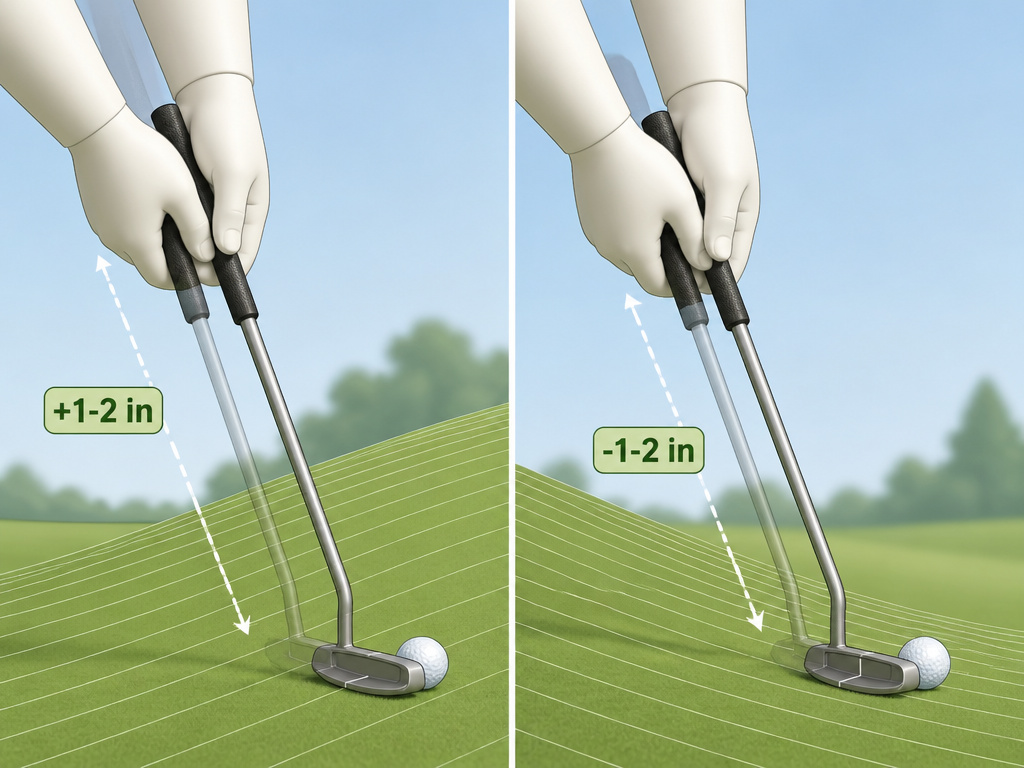
A perfect 16-inch stroke won’t get a 30-foot putt close if you don’t account for slope and speed. The system gives you the engine; your read provides the steering.
Uphill vs. Downhill
The 8-4-4 system assumes a flat putt. You must adjust the backstroke length for elevation. – Uphill Putt: Add 1-2 inches of backstroke length. The hill is stealing energy. – Downhill Putt: Subtract 1-2 inches of backstroke length. Gravity is adding energy.
A simple trick is to walk off the distance as described in one Golf.com instruction piece: for every step (about 3 feet) to the hole, plan for one inch of backstroke. On a 30-foot, slightly uphill putt, that’s 10 steps (10 inches), plus an extra inch for the hill = an 11-inch backstroke.
Green Speed (Stimpmeter)
The Stimpmeter reading changes the rollout, not the system. On a fast green (11+), your calibrated distances will roll farther. On a slow green (8 or less), they’ll roll shorter. The key is to find your baseline for that day’s conditions. Hit a few 8-4-4 putts on the practice green to see how far they actually go before your round.
Where this goes sideways: Not adjusting for grain on Bermuda greens. Putting down-grain (with the grass growing away from you) can add up to 20% more roll. Into the grain can subtract the same. Look for the sheen, a shiny, light-colored surface indicates you’re putting down-grain.
Drills to Lock in Your Lag Stroke
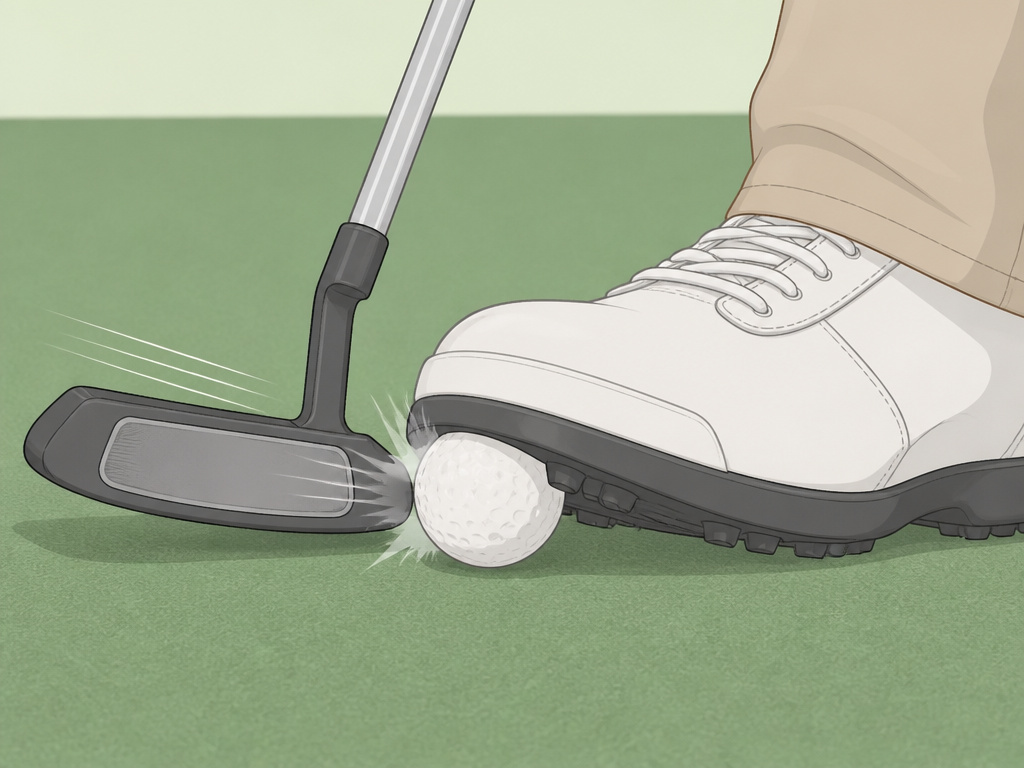
Theory is useless without feel. These two drills translate the system into a reliable stroke.
1. The Step Drill (For Acceleration)
Place a golf ball under the toe of your front shoe. Set up to putt it. Make a normal stroke, accelerating the putter into your shoe. This drill, endorsed by Todd Sones, instantly teaches you the momentum needed for longer putts. It prevents a decelerating stroke, which is a death sentence for distance.
2. The Ladder Drill (For Calibration)
On the practice green, place tees at 20, 30, 40, and 50 feet. Using the 8-4-4 system, hit three balls to each tee. – Focus on the backstroke length for each distance. – Pay zero attention to whether the ball hits the tee. Only care about the grouping. – A tight cluster around the 30-foot tee is a success, even if it’s 2 feet short. Scatter is a failure, even if one ball hits the tee.
This drill builds the muscle memory for each “gear” in your putting stroke, which is far more valuable than sinking a single lucky putt. Consistent proximity is how you break 80, not the occasional long bomb.
Frequently Asked Questions
What is considered a lag putt?
Lag putt is typically any putt from 25-30 feet or farther. The objective isn’t to make it, but to leave the ball within a 2-3 foot circle of the hole to guarantee an easy two-putt. It’s a stroke-saving strategy, not a scoring one.
Should I accelerate through the ball on a lag putt?
Yes, but the acceleration must be natural, not forced. In a pendulum stroke, the putter accelerates from the top of the backswing through impact due to gravity and momentum. You should not actively “hit” or “shove” the ball with your hands. Think of completing your backswing and then simply letting the putter fall through.
How do I stop leaving lag putts short?
Leaving putts short is almost always caused by one of two things: a decelerating through-stroke or a backstroke that’s simply too short. Commit to a longer, smoother backstroke and focus on a positive, unhurried forward motion. The Step Drill outlined above is the fastest fix for deceleration.
Does putter weight affect lag putting?
Absolutely. A heavier putter head (like a mallet) can promote a smoother, more pendulum-like stroke and is often more forgiving on distance control. A lighter blade putter requires more precise timing. If you struggle with consistent speed, testing a heavier mallet might help, but it’s no substitute for a sound putting stroke.
Can I use the 8-4-4 system on breaking putts?
Yes, but only for the distance component. The system tells you how hard to hit the putt. You must still read the break separately and aim accordingly. Judge the total “effective” distance, the path the ball will actually travel over the slope, and use your 8-4-4 backstroke length for that longer or shorter virtual distance.
The Bottom Line
Lag putting isn’t a mystical art. It’s a mechanical process of matching a measured backstroke length to a desired rollout distance. Pick one system, either the calibrated 8-4-4 framework or Phil Mickelson’s constant-follow-through method, and practice it with an alignment rod until the increments are automatic.
Your goal is to turn 40-foot anxiety into a routine calculation. Three-putts drop when you stop guessing and start measuring. The difference between a 5-foot comeback putt and a tap-in is just one inch of backstroke. Know your inches, and you’ll know your score.
