
Speed Control in Putting: The 0.24 MPH Variance That Changes All
This post contains affiliate links. As an Amazon Associate, we earn from qualifying purchases.
This post contains affiliate links. As an Amazon Associate, we earn from qualifying purchases.
Speed control in putting is matching your stroke’s output, clubhead speed, launch angle, and impact consistency, to the green’s speed and slope so the ball finishes within a three-foot circle of the hole. Elite putters show a variance of just 0.24 mph in ball speed over ten putts. On a 3% downhill slope, that tiny difference can create a three-foot gap in finishing distance.
That 0.24 mph figure comes from a study of a top-60 professional using a Quintic Ball Roll system. It’s the benchmark. Your variance is almost certainly wider, which means your distance control problem is mechanical, not mystical.
What follows is the breakdown: the physics that makes speed king, a repeatable stroke system you can scale, the tools that diagnose your flaws, and the drills that build the feel. By the end, you’ll know whether to change your stroke length or your tempo when a 20-footer races eight feet past.
Key Takeaways
- On a 3% downhill slope, a 0.41 mph variance in ball speed at 16 inches of roll creates a three-foot difference in where the ball stops. Uphill putts forgive speed mistakes; downhill putts punish them.
- The 8-4-4 putting system uses a fixed tempo. An 8-inch backstroke and follow-through rolls the ball about 10 feet on a Stimp 9 green. Add 4 inches of backstroke length for each additional 10 feet of required roll.
- Keeping green speeds above 10 feet on the Stimpmeter consistently causes difficult turf health problems and is not recommended by agronomists.
- A ball can lose up to 30% of its initial speed before it reaches “true roll.” Consistent center-face contact minimizes this skid phase and makes speed predictable.
- For practice, the ladder drill and eyes-closed putting build feel. For diagnosis, tools like the Blast Motion sensor or Visioputting Tempostik measure your tempo and rhythm.
The Physics of Putting Speed: What a 0.24 mph Variance Actually Does
Speed control is a matter of physics, not feel. The moment the putter face strikes the ball, three variables lock in the outcome: launch angle, skid distance, and initial ball speed.
A Quintic Ball Roll system study filmed an elite professional’s putts at 360 frames per second. Over ten putts on a flat green, his ball speed variance was just 0.24 mph. That’s world-class control. Yet when that data was modeled onto a 3% sloped green using AimPoint software, the fastest and slowest putts finished three feet apart.
The study concluded that steeper slopes accentuate variance in launch characteristics, causing balls to slow at different rates. Smaller uphill angles are more forgiving of speed variances than cross-hill or downhill angles.
The mechanism is simple. On a downhill putt, gravity accelerates the ball after impact. If your launch is slightly higher with more backspin, the ball stays in the skid phase longer, losing more energy to friction before it starts rolling. That same stroke on an uphill putt fights gravity, so the error is compressed. The downhill putt magnifies the mistake.
Your number one strategic goal: leave yourself uphill putts. A six-footer coming back up the hill is objectively easier than a three-footer straight downhill.
| Putt Slope & Direction | Effect on Speed Variance | Forgiveness Level |
|---|---|---|
| Uphill (1-3%) | Compresses error | High |
| Cross-hill | Amplifies error sideways | Low |
| Downhill (1-3%) | Stretches error in distance | Very Low |
This is why your first putt on a new green should be a straight, uphill lag. It tells you how the surface accepts speed without the slope variable. Once you know that, you can adjust for break.
How Green Speed Warps Your Distance Equation
You can have a perfect, repeatable stroke and still three-putt if you misjudge the green speed. Speed is measured with a Stimpmeter, a 36-inch aluminum bar with a V-groove. The ball rolls out in feet, that’s the “Stimp” rating.
The problem is, that number isn’t static. A green that Stimps at 10 in the morning might be an 8.5 after an afternoon watering. The effect of rolling a green to increase speed lasts less than 24 hours.
Common mistake: Assuming the practice green speed matches the course. They’re often cut and rolled differently. Walk onto the first green and hit a long, straight putt to the fringe. That’s your real baseline.
The USGA classifies “fast” for tournament play as anything above 9 feet, 6 inches. But the agronomy is clear. The Penn State green speed factors guide details the trade-offs. Pushing speeds consistently above 10 feet stresses the grass, leading to disease and thinning. Your course superintendent isn’t trying to trick you; they’re trying to keep the greens alive.
So how do you adjust? Your stroke length stays the same. Your force changes.
On fast greens (Stimp 11+), the ball rolls farther per unit of force. You need a shorter, softer stroke with minimal wrist action. Think of swinging the putter head through a pane of glass just an inch behind the ball. On slow greens (Stimp 7-9), you need a longer stroke with more acceleration through impact to generate the same roll. The putter should feel like it’s swinging down the line, not at the ball.
The 8-4-4 System: A Repeatable Framework
Forget guessing. The 8-4-4 system, taught by Top 100 Instructor Joey Wuertemberger, replaces instinct with measurement. It works because it decouples stroke length from tempo.
Find a flat spot on a practice green. Take your putting stance. Make a stroke with an 8-inch backswing and an 8-inch follow-through. Use a smooth, even tempo, like a metronome ticking. On a Stimp 9 green, the ball will roll about 10 feet. That’s your baseline unit.
Need 20 feet? Take the putter back 12 inches (8 + 4). Need 30 feet? Take it back 16 inches (8 + 4 + 4). The follow-through stays equal to the backswing. The tempo never changes.
“Every additional four inches that you take the putter back beyond the initial eight inches, the ball will roll an additional 10 feet.”
The system’s power is its scalability and its diagnostic feedback. If you make your 8-inch stroke and the ball rockets 20 feet past, the problem is your tempo, specifically accelerating too violently, not your length. The 8-4-4 framework isolates the variable.
Use an alignment rod to train your eyes. Lay it on the green parallel to your putting line. Mark 8, 12, and 16 inches from the ball. After a few sessions, your body will internalize the lengths without the rod.
Tools That Measure What Your Feel Can’t
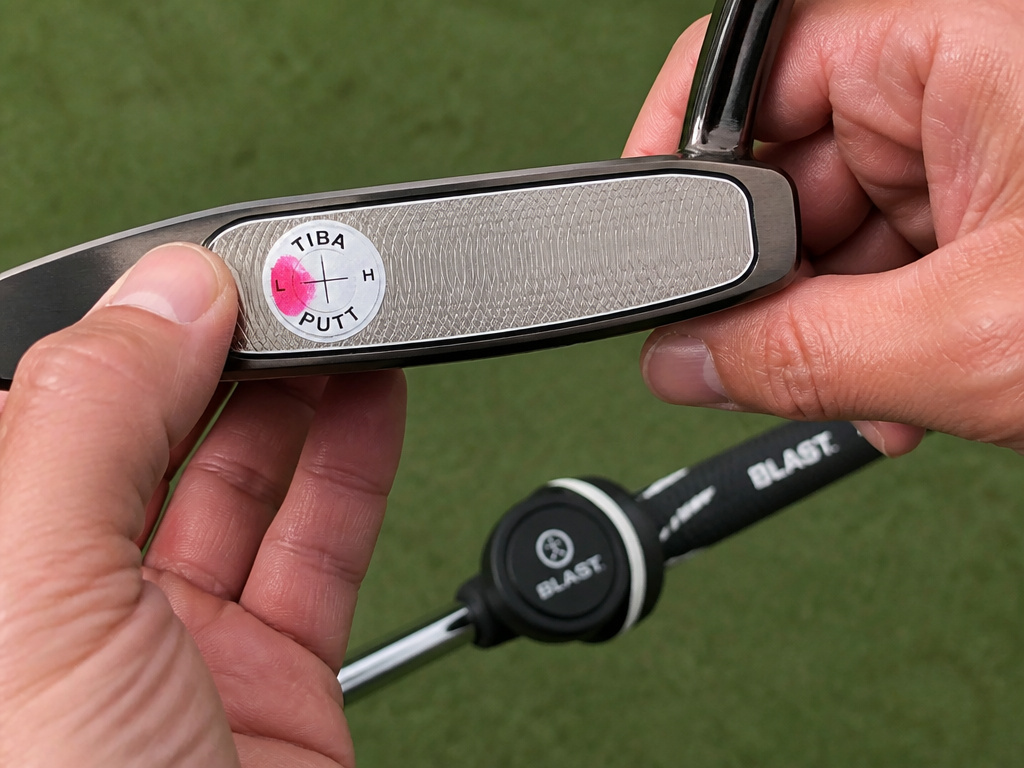 Feel is feedback. Good tools give you accurate feedback faster. They measure the two components of speed control: impact consistency and stroke timing.
For impact, a simple impact tape like TIBA Putt shows where you’re striking the face. Off-center hits lose energy and twist the putter, producing inconsistent speed. The fix is often in your putting alignment or your putting grip, not your speed instinct.
For tempo and rhythm, a sensor like the Blast Motion attaches to your putter. It reports your backswing time, downswing time, and the ratio between them. Elite putters have a consistent rhythm between 1.7 and 2.5 (backswing time to downswing time). If your ratio jumps from 2.0 to 1.3, you’re jerking the putter through, a sure sign of poor distance control.
The Visioputting Tempostik is a dedicated trainer. It uses a line of LEDs to guide you through an ideal acceleration profile for any chosen distance and green speed. It forces you to match the light, building muscle memory for a smooth stroke. Research into golf putting mechanism PID study underpins these electronic training aids, validating that controlled acceleration is a learnable motor skill.
| Tool Type | What It Measures | Best For Fixing |
|---|---|---|
| Impact Tape (TIBA Putt) | Strike location on putter face | Inconsistent speed from heel/toe strikes |
| Motion Sensor (Blast) | Tempo, rhythm, stroke length | Jerky acceleration, timing faults |
| Guided Trainer (Tempostik) | Ideal acceleration profile | Building a repeatable, model stroke from scratch |
These tools are translators, not crutches. They turn the abstract concept of “soft hands” into a concrete number you can practice.
The Non-Negotiable Drills for Building Feel
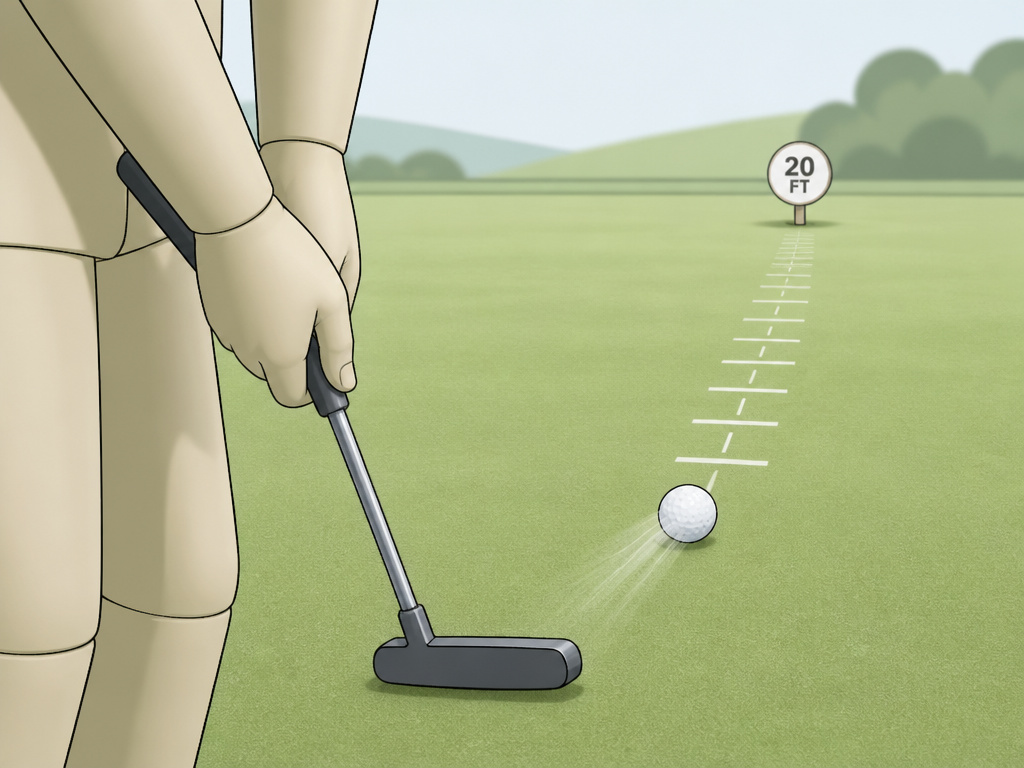 Tools give you data. Drills ingrain the skill. These two exercises target the core of speed control: calibrating your stroke to a target distance without a line.
The Ladder Drill
Set four tees in a straight line at 10, 20, 30, and 40 feet. Start at the closest tee. Putt three balls, trying to stop each one between the tee and the hole. If all three finish in the zone, move to the next distance. If any one misses, start over. This drill pressures your lag putting under a simple pass/fail rule. It reveals whether you can consistently match stroke to distance.
Eyes-Closed Putting
Place five balls 30 feet from a hole. Read the break and pick your line. Then, address each ball and close your eyes before you make the stroke. Focus entirely on the sensation of the swing length and the sound of impact. This severes visual dependency and heightens your sense of kinetic energy. It’s the fastest way to connect your stroke to a distance outcome.
Both drills should be part of your regular putting drills routine. They build the feel that makes the 8-4-4 system work under pressure.
Diagnosing Your Speed Faults: Stroke Length vs. Tempo
When your speed is off, the fix is in one of two places: the length of your stroke or the timing of your acceleration. Here’s how to tell which is broken.
If your putts are consistently short or long by a wide margin, you’re misjudging stroke length. This is common when switching between green speeds. The fix is to rehearse the 8-4-4 system before your round to recalibrate.
If your distance control is erratic, one putt flies 10 feet past, the next comes up 10 feet short, your tempo is the culprit. A jerky, quick transition from backswing to downswing delivers unpredictable clubhead speed. This often stems from poor fundamental putting mechanics, where the hands or wrists take over.
Where this goes sideways: Using your wrists to generate power on long putts. The putter head wobbles, strike location varies, and speed becomes a lottery. For any putt over 20 feet, feel the swing in your shoulders, not your hands.
Check your rhythm. A good checkpoint is the “tick-tock” cadence. The backswing (“tick”) and the follow-through (“tock”) should feel even in duration. If your stroke is “tick—tock”, with a rushed downswing, you’ve found the problem. Drills with a metronome or the Blast sensor can smooth this out.
Frequently Asked Questions
What is the most important factor in putting speed control?
Center-face contact. A putt struck on the heel or toe loses energy and twists offline, making speed unpredictable regardless of your stroke length or tempo. Consistent strike is the foundation. Everything else, green reading, slope adjustment, stroke system, builds on that.
How does grain affect putting speed?
Grain is the direction the grass blades lean. Putting into the grain (against the lay of the grass) significantly slows the ball, like putting on carpet. Putting down-grain makes the ball skid and then roll faster. When reading greens, you must adjust speed for grain, especially on Bermuda grass. A 20-foot down-grain putt might need the stroke of a 15-footer.
Should I try to die the ball at the hole or hit it with pace?
For amateur golfers, dying the ball at the hole increases three-putts. A ball rolling at 0.5 mph when it reaches the hole has a larger effective hole size than one trickling at 0.1 mph. The old “never up, never in” adage has physics behind it. Your goal is for the ball to finish 12 to 18 inches past the hole if it misses. This requires enough pace to hold the line you read.
Can I use the same putting stroke for all green speeds?
Yes, and you should. The 8-4-4 system is designed for this. Your stroke length and tempo remain constant. What changes is the distance the ball rolls for each unit of stroke. On a fast green, your 8-inch stroke might roll 12 feet. On a slow green, it might roll 8 feet. You learn the multiplier for the day and apply it.
How do professionals adjust to tournament green speeds?
Pros arrive early and use a combination of technology and feel. They’ll use a Stimpmeter reading to get the official number, but then they hit dozens of lag putts on the practice green at different slopes. They’re calibrating their stroke to the specific friction and roll of that day’s surfaces, often tracking it as part of their Strokes Gained Putting analysis.
Before You Go
Speed control is the separator between a good putter and a great one. It’s not magic. It’s the product of a repeatable stroke, an understanding of green mechanics, and honest practice.
Start with the 8-4-4 system on a flat practice green. Measure your stroke lengths with an alignment rod. Once the distances are reliable, move to a slope. See how that three-foot miss from the Quintic study feels in your hands. Then hit the ladder drill until your speed is automatic.
The green is the most variable surface on the course. Your stroke doesn’t have to be.
