
Master Your Game by Knowing Your Yardages for Each Club
This post contains affiliate links. As an Amazon Associate, we earn from qualifying purchases.
This post contains affiliate links. As an Amazon Associate, we earn from qualifying purchases.
Knowing your yardages for each club means tracking your median carry distance, not your best shot, for every club in the bag. The process requires a launch monitor or rangefinder, hitting 8-10 shots per club, and discarding outliers to find a true average. This data, adjusted for temperature, altitude, and wind, forms a yardage card that replaces guesswork with a one-club decision.
That median is the number that matters on the 15th hole, not the perfect 7-iron you flushed once on the range. Most amateurs play to their maximum potential distance, which they hit maybe one time in ten. The rest of those shots land short, in bunkers, or over greens. Building your game around the median is how you stop coming up short.
What follows is the method to find your real numbers, the science behind why they change, and how to turn a simple index card into your most valuable piece of equipment. This isn’t about hitting it farther. It’s about knowing exactly where it’s going.
Key Takeaways
- Your playing distance is the median of 8-10 shots, not the longest. Building a bag around career-best strikes guarantees you’ll be short 80% of the time.
- A 30-yard gap between your longest iron and shortest fairway wood is the most common distance hole; it requires a dedicated hybrid or wood to fill, not a harder swing.
- Environmental adjustments are arithmetic: add roughly 2% carry per 1,000 feet of altitude, subtract one club’s worth of distance below 50°F, and add 1 yard of carry reduction for every 1 mph of headwind.
- Update your yardage card each spring and any time you change your golf ball. Swing speed, fitness, and equipment drift more than most golfers track.
- The goal is a 10-15 yard gap between consecutive clubs. Gaps over 20 yards are scoring leaks that a single club fitting can permanently fix.
Why “How Far” Is the Wrong Question
Asking how far you should hit a 7-iron is a trap. The charts showing a 145-yard average for male amateurs are meaningless if your swing speed is 82 mph or you consistently strike it off the toe. Your real distance is a product of three measurable things: clubhead speed, strike quality (smash factor), and launch conditions.
A tour pro’s 7-iron goes farther not just because they swing faster, but because their smash factor is near perfect. An off-center strike can cost an amateur 15 yards of carry even with a good swing speed.
The real question is “how far do I carry this club, with my swing, my strike pattern, right now?” That answer only comes from measurement. GPS gives you the distance to the target. A launch monitor gives you the distance you actually hit.
The Real Reason You’re Short
Most players are short because they select clubs based on memory of their best-ever strike. You remember the pure 7-iron that flew 150 yards over water that one time. You forget the six other shots that same day that carried 138, 135, 142, 145, 132, and 140. Your median distance is 141 yards. Playing the 150-yard shot means you’re short 86% of the time.
This is why fitting a complete set of golf club sets matters. A mismatched bag with old hybrids and modern strong-lofted irons creates unpredictable gaps that no mental calculation can fix.
How to Build Your Yardage Card (The 4-Step Method)
This isn’t a one-day exercise. It’s a deliberate session that yields the single most important tool in your bag.
Step 1: Gather the right tools.
You need a way to measure carry distance accurately. A personal launch monitor like the Garmin R10 or SkyTrak+ is ideal. If you’re on a budget, a laser rangefinder at an open range with clear markers works. Do not attempt this on a windy day. Wind corrupts everything.
Step 2: Hit and record with discipline.
Start with your highest lofted wedge and work up to the driver. For each club, hit 8-10 shots at normal, on-course effort. Record every carry distance. This is critical: you must ignore the urge to “step on one” to get a bigger number. You’re collecting data, not impressing anyone.
Step 3: Find the median, not the average.
List the distances for each club in order. Throw out the single longest and shortest shot—these are outliers. The median is the number in the middle of the remaining set. This median carry distance is your number for that club. It represents the shot you hit six times out of ten.
Step 4: Create the physical card.
Write each club and its median carry on an index card. Use a single number (e.g., “7i: 141”). No ranges. Laminate it or tape it inside your golf bag. This card, not your memory, is your reference on the course.
Common mistake: Using the average instead of the median. One “flyer” shot from a perfect lie can skew an average upward by 3-4 yards, which is enough to leave your approach in the front bunker.
This process also reveals if your current golf club shafts are a match for your swing speed. Consistently short numbers with a stiff shaft when you have a moderate swing speed is a major equipment red flag.
The Gapping Table: Where Your Bag Earns or Loses Strokes
Once you have your numbers, lay them out side-by-side. The goal is consistent progression. This table shows an example of a gapped bag versus one with a critical hole.
| Club | Well-Gapped Bag Carry | Bag with a Gap Carry | The Problem |
|---|---|---|---|
| 5-Wood | 195 yds | 200 yds | |
| 3-Hybrid | 180 yds | 185 yds | |
| 4-Iron | 168 yds | 155 yds | 30-yard gap |
| 5-Iron | 156 yds | 145 yds | |
| 6-Iron | 144 yds | 135 yds |
The bag on the right has a 30-yard canyon between the 3-hybrid and the 4-iron. From 185 yards, the player has no reliable club. They must either over-swing a 4-iron or ease up on a hybrid, both low-percentage shots. This is where understanding club sets for intermediate players becomes critical—a proper set is built to avoid this exact scenario.
A gap this large needs a dedicated club, usually a 4-hybrid or a high-lofted fairway wood. The rule from the 2014 Fitting Manual is clear: a 30-yard gap in the long game requires two clubs to fill. You can’t will a single club to cover it.
Adjusting for Real-World Conditions
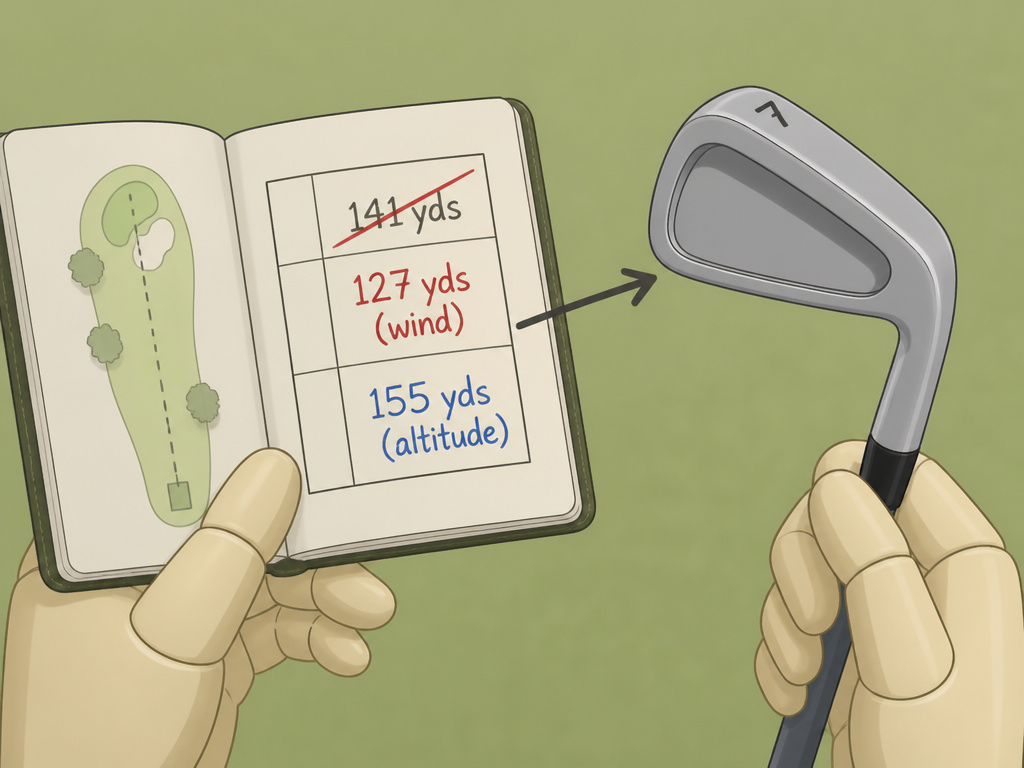 Your yardage card is your baseline for a 70°F, calm, sea-level day. The course is rarely that. You must adjust, and the adjustments are mathematical, not mystical.
Temperature: Cold air is denser. Below 50°F, plan for one less club’s worth of distance. A 141-yard 7-iron in summer behaves like a 130-yard club in winter.
Altitude: Thin air reduces drag. Add approximately 2% to your carry distance for every 1,000 feet above sea level. At 5,000 feet (like Denver), your 141-yard 7-iron now carries about 155 yards.
Wind: This is the big one. A headwind reduces carry by about 1% per mph. A 10 mph headwind turns that 141-yard shot into a 127-yard shot. A tailwind adds about 0.5% per mph. Crosswinds affect direction more than distance.
| Condition | Adjustment Rule | Effect on a 141-yd 7-Iron |
|---|---|---|
| Cold (<50°F) | Club down (10-12 yds) | Plays like a 130-yd club |
| Altitude (5,000 ft) | +2% per 1,000 ft | ~155 yards carry |
| Headwind (10 mph) | -1% per mph | ~127 yards carry |
| Tailwind (10 mph) | +0.5% per mph | ~148 yards carry |
These factors compound. A 50°F day at altitude with a headwind requires a complex calculation your brain can’t do mid-round. This is why the best players write down their “adjusted” number for the shot before they pull a club.
The Tools That Give You Truth: Launch Monitors vs. Rangefinders
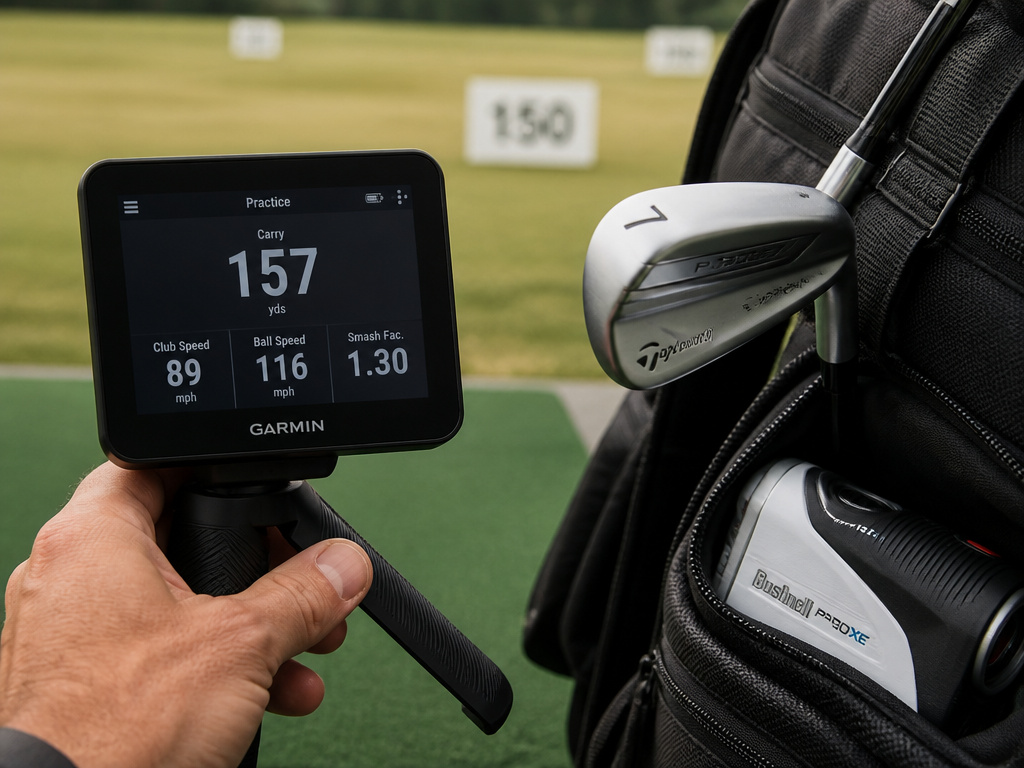 You need objective feedback. The two main tools serve different purposes.
A launch monitor (Garmin R10, SkyTrak+, FlightScope Mevo) gives you instant data: carry distance, ball speed, launch angle, and smash factor. It’s the fastest way to build your yardage card and diagnose why you’re short. It tells you if the problem is swing speed or strike quality.
A laser rangefinder is for on-course verification. You can use it on the range to measure where shots land, but it’s slower and less precise for building a full card. Its real job is to give you the exact yardage to your target so you can execute the number on your card.
For most dedicated amateurs, a budget launch monitor is the better investment. The Garmin R10 provides radar-based data accurate enough for reliable gapping. It also exposes whether your best drivers are actually a good fit, or if you’re losing distance from poor launch conditions.
Where this goes sideways: Using a rangefinder to measure “total” distance including roll on a range. Firm range turf gives unrealistic rollout. You must measure carry only, or your card will be wrong for approach shots into soft greens.
How Often to Update and Why It Matters
Your distances are not permanent. They change with your swing speed, fitness level, and equipment. The most common trigger for an update is a new golf ball. A switch from a low-spin distance ball to a high-spin tour ball can cost you 5-7 yards per club.
Update your yardage card each spring. Your winter swing is different from your in-season rhythm. Re-run the 4-step gapping session with your current gamer ball.
Update after any significant equipment change. New irons, a new driver, even new golf grips can subtly alter delivery and distance. Don’t assume the new clubs go “a club farther.” Measure it.
Update if your strike consistency improves dramatically. If you’ve been working on centered contact, your smash factor will rise, and your median distances will creep up. That’s a good reason to change the card.
This discipline is what separates a player who manages their game from one who is perpetually surprised. It turns “I have no idea what club this is” into a single, confident selection.
Frequently Asked Questions
How many balls should I hit with each club to get an accurate distance?
Hit 8-10 shots with each club. Fewer than that and your median can be skewed by a single outlier. More than 10 leads to fatigue, which slows your swing speed and corrupts the data. Focus on consistent, 80% effort swings—the kind you trust under pressure.
What’s the difference between carry distance and total distance?
Carry distance is how far the ball flies in the air before its first bounce. Total distance includes the roll after landing. You must use carry distance for your yardage card. It’s the only number that reliably clears hazards and holds greens. Total distance is variable and course-dependent.
My gap between my pitching wedge and sand wedge is 25 yards. What should I do?
This is a very common scoring gap. You need a dedicated gap wedge (typically 50-52 degrees of loft). This club is designed specifically to fill that yardage hole. Trying to hit a soft pitching wedge or a hard sand wedge is a low-percentage play that adds strokes. Filling this gap is a priority when selecting complete golf sets for beginners or any new set.
Do I really need a launch monitor, or can I use a driving range?
You can use a marked driving range with a rangefinder, but it’s harder. You must laser the landing spot for each shot, which is time-consuming. Range balls also often fly shorter than premium balls, so you’ll need to estimate a conversion. A launch monitor removes both these variables and provides much richer data on why you hit it a certain distance.
Are the USGA rules on club length important for distance?
Yes. The USGA club length measurement procedure (TPX3002) sets the maximum club length at 48 inches, excluding putters. While longer drivers can increase swing speed, they often reduce control and strike quality. For most amateurs, maximizing distance comes from better impact, not a longer shaft. The rules ensure equipment remains within traditional bounds.
The Bottom Line
Knowing your yardages turns golf from a game of hope into a game of execution. The player with a weathered yardage card taped inside their bag doesn’t wonder. They take the number, adjust for the wind, and pull the club that covers it.
Start with a single gapping session. Find your median for your seven through nine irons. You’ll immediately see where you’ve been cheating yourself. Then build out the rest of the bag, fill the gaps with the right clubs—be it senior golf sets designed for easier launch or men’s golf sets built for control.
The scorecard doesn’t ask how far you can hit it. It asks how many. Give it a better answer.
