
Choosing Between Long Irons and Hybrids? 3 Deciding Factors
This post contains affiliate links. As an Amazon Associate, we earn from qualifying purchases.
This post contains affiliate links. As an Amazon Associate, we earn from qualifying purchases.
Long irons and hybrids are not interchangeable. The choice comes down to three measurable specs: static loft, center of gravity location, and moment of inertia. Get one wrong and your 200-yard shot becomes a low, hooking nightmare that never finds the green.
That low hook happens because a long iron’s center of gravity sits higher and further back than a hybrid’s. The hybrid’s weight is low and forward, which gets the ball up even with a slower swing. The rest of this guide walks through the numbers, the lofts, the test results, the player profiles, so you can match the club to your swing, not the other way around.
What follows: a side-by-side spec breakdown, the forgiveness truth from robot testing, and the specific iron and hybrid models that actually work for different player types.
Key Takeaways
- Loft for loft, a hybrid launches the ball 3–5 degrees higher than a comparable long iron due to its lower, deeper center of gravity.
- Forgiveness is a measurement, not a feeling. A hybrid’s larger head and perimeter weighting provide a higher Moment of Inertia (MOI), which reduces distance loss on off-center strikes by up to 15% compared to a player’s long iron.
- The best long irons for distance, like the Callaway Apex Ai 150, are hollow-bodied and packed with tech, but they still demand a consistent, downward strike.
- If you fight a slice, a hybrid can make it worse. The draw bias built into many models turns a fade into a hook if your path is already in-to-out.
- Your decision starts with your 4-iron. If you can’t launch it high and stop it on a green, the 3- and 4-hybrid swap is your first move.
The Loft & Launch Angle Reality
You can’t compare a 4-iron to a 4-hybrid. The numbers are never the same.
Modern long irons are stronger-lofted than ever. A current player’s distance 4-iron might be 21 degrees, which is what a 3-iron was fifteen years ago. A standard 4-hybrid typically sits around 22 or 23 degrees. So you’re often comparing a 21-degree iron to a 23-degree hybrid, the hybrid has more loft, yet it’s designed to go the same distance because of its hotter face and higher launch.
The center of gravity in a hybrid is positioned low and deep within the clubhead, often 30-40% lower than in a comparable iron. This low CG promotes a higher launch angle and greater spin, which helps the ball land softly on greens even from long range.
The real difference is in the launch window. A well-struck 4-iron produces a piercing, mid-trajectory ball flight. A well-struck 4-hybrid of the same loft produces a higher, steeper arc. That higher flight is why hybrids are easier to stop on the green; the descent angle is steeper, so the ball doesn’t run out as much.
| Club Type | Typical 4-Loft | Key Tech for Launch | Ideal Ball Flight |
|---|---|---|---|
| Player’s Long Iron | 21° – 23° | Hollow body, thin face, low CG | Penetrating, mid-trajectory |
| Hybrid | 22° – 24° | Low, deep CG, larger face profile | High, steep, soft-landing |
| Game-Improvement Iron | 23° – 25° | Wide sole, perimeter weighting | High, forgiving |
If you struggle with hitting long irons high enough, the issue is rarely strength. It’s strike. A hybrid’s design forgives a slightly thin or low-face strike and still gets the ball airborne. An iron punishes that same miss with a line-drive that runs through the green.
Which is More Forgiving: Long Irons or Hybrids?
Forgiveness has a number. It’s called Moment of Inertia (MOI), and it measures a club’s resistance to twisting on off-center hits. A higher MOI means less distance loss when you don’t find the sweet spot.
Hybrids win this contest outright. Their larger head size allows designers to distribute weight around the perimeter more effectively. Independent robot testing shows a modern hybrid can retain over 85% of its ball speed on a strike half an inch towards the toe. A comparable player’s long iron might drop to 70-75% on the same mishit. That’s the difference between reaching the front edge and coming up 20 yards short.
The forgiveness isn’t just lateral. It’s vertical. The hybrid’s low CG helps launch shots even when you catch it a groove low. A long iron’s smaller face and higher CG turn that low strike into a knuckleball that never climbs.
Where this goes sideways: Choosing a hybrid for forgiveness when you already hook the ball. Many hybrids have built-in draw bias. If your miss is a big hook, that bias can turn it into an unplayable snap-hook. In that case, a straighter-flying driving iron or a game improvement iron might be the better fix.
This is why hybrids for beginners and hybrids for seniors are such common recommendations. They maximize results from slower swing speeds and less consistent contact. For a better player, forgiveness might mean a different thing, it’s about controlling trajectory and shape. For them, a forgiving long iron like the Srixon ZX4, which blends a larger profile with a players-ish look, can be the perfect bridge.
The Distance Verdict: What the Robot Tests Show
Distance is easy to measure. But the longest club isn’t always the right one.
In MyGolfSpy’s 2026 iron test, the Callaway Apex Ai 150 was the distance leader in the player’s iron category. It’s a hollow-body design with a forged face cup, engineered purely for ball speed. It’s long. But the test notes also show it traded off some greens-in-regulation accuracy for that distance. It ranked 10th in that category. That’s the trade: raw distance versus scoring control.
Hybrids, when matched correctly for loft, often match or exceed the total distance of a long iron because they optimize launch conditions. They spin more, which costs a little carry distance, but they also land steeper, which can result in more total distance if the iron would have run through the fairway.
| Performance Factor | Modern Long Iron Advantage | Hybrid Advantage |
|---|---|---|
| Peak Carry Distance | Higher potential with perfect strike | More consistent across the face |
| Distance Dispersion | Wider (good vs. Bad strikes vary greatly) | Tighter (mishits lose less yardage) |
| Turf Interaction | Better from tight lies, firm conditions | Better from rough, soft turf |
| Workability | Easier to shape shots high/low, draw/fade | More difficult to hit low, penetrating shots |
The best hybrids like the PING G-series are engineered for this consistency. They aren’t always the absolute longest on perfect strikes, but their average distance across ten shots, including a few mishits, will be higher for most golfers. This is the core of the debate: maximum potential versus reliable average.
If your goal is consistent iron shots that find greens, the hybrid’s tighter dispersion is usually the better scoring choice. If you’re confident in your ball-striking and need a specific trajectory, the modern player’s long iron offers more control.
Should You Play a Long Iron, Hybrid, or Both?
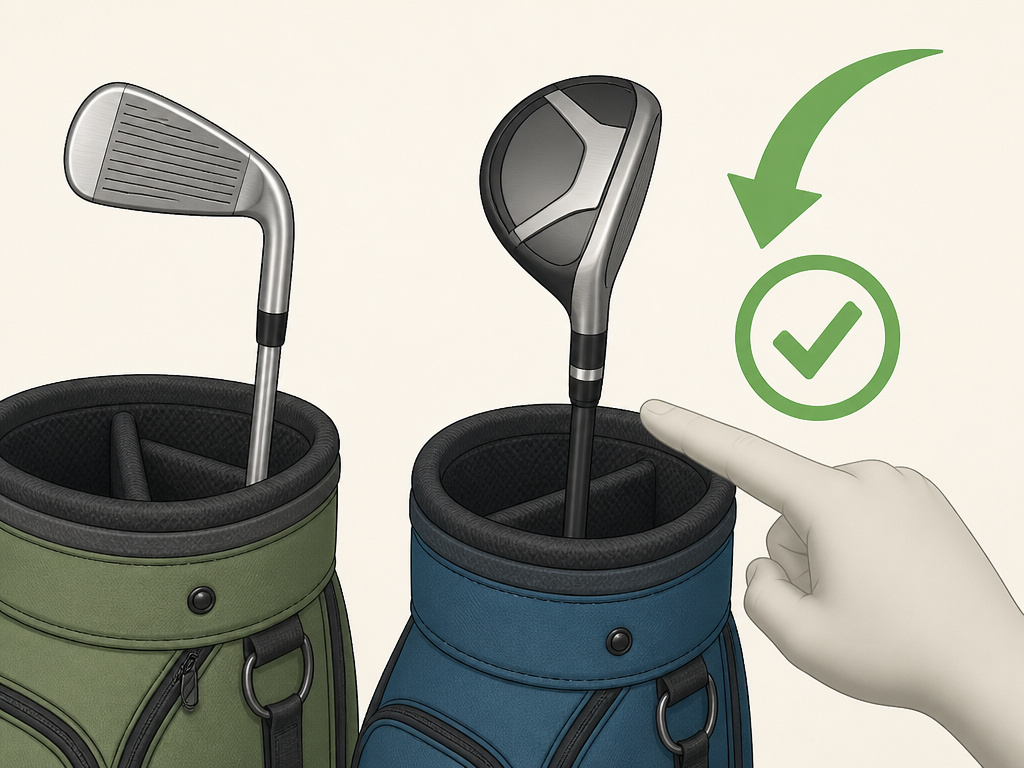 Your bag setup isn’t an all-or-nothing choice. Most players benefit from a mix.
Start by assessing your own 4-iron or 5-iron. Can you hit it high enough to hold a green from 180-200 yards? Does it feel like a weapon, or a liability? If it’s a liability, that’s your crossover point. Replace the 4-iron with a 4-hybrid. If the 5-iron is also shaky, consider a 5-hybrid or a high-lofted hybrid iron from a set like the Cleveland Launcher Halo.
For the low-handicap player: A 4-iron might still be a useful tool for windy days, punch shots, and tight par-4s. You might carry a 3-hybrid for par-5s and long par-3s, and a 4-iron for everything else. The best irons for this player are in the player’s distance category, think Titleist T150 or the Apex Ai 150.
For the mid-to-high handicapper: Your long irons are likely costing you strokes. A hybrid set that runs from 4 or 5 through pitching wedge simplifies the game. Brands like Cobra and Wilson make excellent, affordable full sets. Alternatively, slot in two or three individual best hybrid clubs to replace your 3, 4, and 5 irons.
For seniors and slower swing speeds: This is the hybrid’s home turf. Look for models specifically marketed as forgiving hybrids for seniors, with lightweight shafts and maximum perimeter weighting. The goal is to get the ball airborne with minimal effort. Your set might start with a 5-hybrid.
I keep a 3-hybrid in the bag for any course with long par-3s over water. The high, soft landing is a stress-saver. But on my home links course, where the wind blows and the ball runs, the 4-iron stays. It’s a tool for a specific job.
The modern solution is the combo set. Many best hybrid golf irons sets are designed to blend seamlessly, with hybrids at the long end, cavity-back irons in the middle, and forged scoring clubs at the short end. This is the smartest way to build a bag without a full custom fitting.
How to Test Them For Your Game
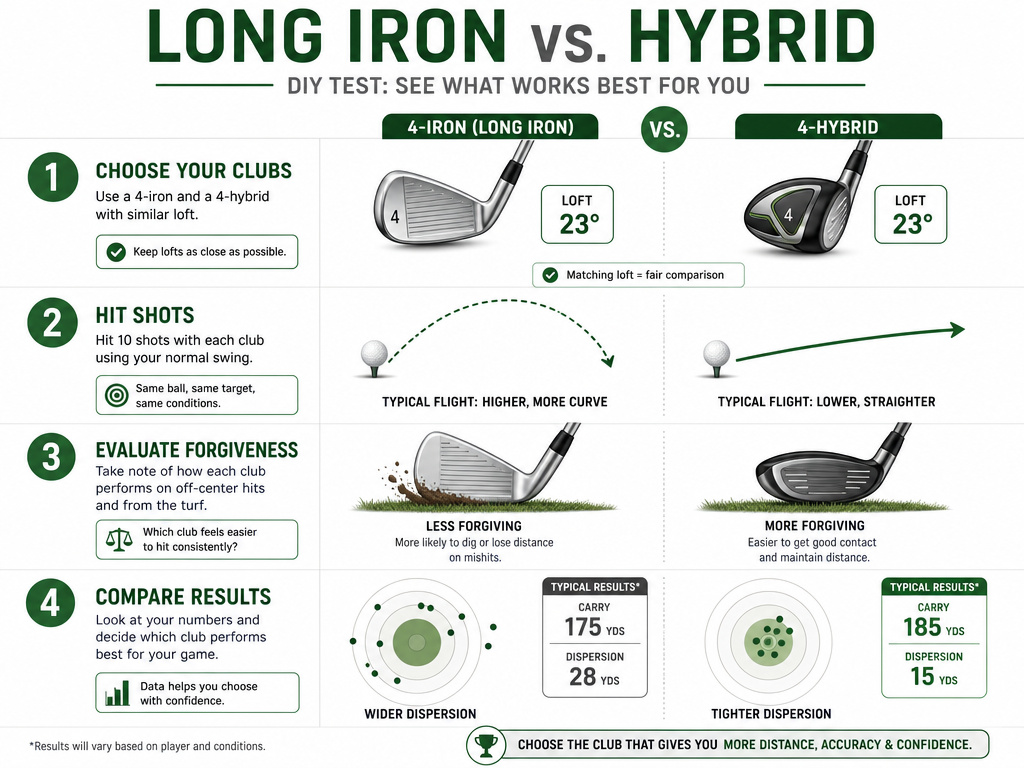 You can’t decide this in a vacuum. You need to hit shots with both.
A proper fitting is ideal, but you can do a useful DIY test at any range with a launch monitor. If that’s not available, use your eyes and your feel. Here’s what to look for:
- Compare the same loft. Find a 4-iron and a 4-hybrid (or clubs with lofts within a degree of each other). Hit ten shots with each.
- Watch the ball flight. Ignore the perfect ones. Watch the worst five shots. Which club produced the more playable miss? The hybrid’s miss will likely be shorter but straighter. The iron’s miss might be a low line drive or a big curve.
- Feel the turf interaction. Hit some off tight lies. Does the hybrid’s wider sole bounce or dig? Does the iron’s thinner sole glide through? Your typical course conditions matter.
- Check your dispersion. Where do the balls finish? Draw a mental circle around your target. Which club put more balls inside that circle? Consistency beats one hero shot.
This process will tell you more than any spec sheet. It answers the only question that matters: which club helps you score better?
Frequently Asked Questions
Can I replace all my long irons with hybrids?
Yes, and many golfers do. Combo sets and full hybrid sets are designed for this. It’s common to see bags with hybrids from 3 through 5 or 6, then transitioning to irons. The key is ensuring the gapping between your longest hybrid and your next iron is consistent, usually about 12-15 yards.
Do any pros use hybrids?
Absolutely. While tour players use traditional long irons more than amateurs, a growing number carry at least one hybrid, especially for specific courses. It’s a utility club for them, often used for long shots out of rough or when they need a high, soft landing shot into a par-5. It’s about having the right tool.
Why do I hit my hybrid further than my driver?
This usually points to a driver swing issue, not a hybrid miracle. The hybrid’s shorter shaft and more loft make it easier to hit solidly and square the face. If you struggle with driver consistency, you’ll often make better contact with a hybrid, leading to surprisingly good distance. A driver fitting is likely your real solution.
Are “driving irons” the same as long irons?
Not exactly. A driving iron is a specialty club, often a 2-iron or 3-iron, designed with a hollow body and thin face like a hybrid, but in a compact, iron-like shape. It’s for better players who want a low, penetrating trajectory off the tee, more forgiving than a blade long iron, but not as high-launching as a hybrid.
How do I stop hooking my hybrid?
Hybrid hooks often come from two places: a closed clubface at impact or a swing path that’s too far in-to-out. First, check if the hybrid has an adjustable hosel; you might be able to set it to a more neutral or even fade bias. Second, focus on swinging along your target line, not from too far inside. A lesson can identify the root cause quickly.
The Bottom Line
Stop thinking about long irons and hybrids as rivals. They’re different tools.
If your priority is launching the ball high from any lie with consistent distance, the hybrid is your answer. Start by replacing your hardest-to-hit long iron and work backwards. If you have the speed and strike to control a penetrating trajectory, the modern, tech-filled player’s long iron is a potent weapon.
The right choice is the one that turns your 200-yard approach from a hope into a plan. For most players holding this article, that’s going to be a hybrid. Go test one against your current long iron. The results don’t lie.
