
Record Low Scores in Pro Golf History: From 55 to Modern 57s
This post contains affiliate links. As an Amazon Associate, we earn from qualifying purchases.
This post contains affiliate links. As an Amazon Associate, we earn from qualifying purchases.
The lowest score in a sanctioned professional golf tournament is a 13-under 57, shot by Cristobal del Solar on the Korn Ferry Tour in 2024 and matched by a few others. However, the absolute lowest score ever recorded on an 18-hole course is a 55 by Homero Blancas in 1962, though it is not recognized by Guinness World Records due to the course measuring only 5,002 yards.
That yardage clause is where most summaries stop. They don’t tell you why it matters or what it says about how we define a “record.” A score posted on a short course with preferred lies tells a different story than one shot under major championship pressure. The context, the equipment, the course setup, the rules in play, is the record’s real signature.
What follows is a breakdown of the numbers that make history, the asterisks that haunt them, and the spectacular failures that sit on the other end of the same scorecard.
Key Takeaways
- The 55 shot by Homero Blancas in 1962 is golf’s lowest known score but was purged from official record books because the course was under 6,561 yards.
- Cristobal del Solar’s 57 in 2024 is the lowest score in a PGA Tour-sanctioned event, achieved with preferred lies on a soggy course.
- Single-hole disasters, like John Daly’s 18 or Kevin Na’s 16, often overshadow full-round lows and reveal the mental game’s fragility.
- Major championship scoring records are a separate category, with 62 being the current low for all four men’s majors.
- Understanding a record requires examining the conditions, yardage, weather, and tournament rules, not just the number.
What Is the Lowest Score Ever in a Professional Tournament?
The number is 57. On February 8, 2024, Cristobal del Solar shot a 13-under 57 in the first round of the Korn Ferry Tour’s Astara Golf Championship in Bogotá, Colombia. That round tied the lowest score ever recorded in a professional tournament. The previous Korn Ferry Tour record was a 58.
A 57 represents a scoring average of 3.17 strokes per hole on a par-70 layout. To achieve it, a player must essentially birdie nearly half the course and avoid a single bogey, a feat of sustained precision and mental control that even elite players might see once in a career.
But this record comes with a footnote. The round was played with preferred lies in effect on a soggy Country Club de Bogotá course. “Lift, clean, and place” rules eliminate bad lies in the fairway, removing one of golf’s core variables. It doesn’t invalidate the score, but it frames it. A 57 with preferred lies is an incredible display of ball-striking and putting; a 57 without them, in a major, would rewrite the sport’s physics.
Other players have touched this mark. Ireland’s David Carey shot an 11-under 57 on the Alps Tour in 2019. His course, however, played to a par of 68. This nuance is everything in the hunt for the lowest scores. When you compare these rounds to the historic low rounds in the major championships, you see a canyon of difficulty. The best sub-60 rounds on the PGA Tour, like Jim Furyk’s 58, are legendary because they happened under standard rules on championship courses.
| Player | Score | Tour | Year | Critical Context |
|---|---|---|---|---|
| Cristobal del Solar | 57 | Korn Ferry Tour | 2024 | Preferred lies in effect on a wet course. |
| David Carey | 57 | Alps Tour | 2019 | Course was a par 68. |
| Jim Furyk | 58 | PGA Tour | 2016 | First 58 on PGA Tour, standard rules. |
| Stephan Jaeger | 58 | Korn Ferry Tour | 2016 | Set the previous KFT record. |
The pursuit of a 56 or lower on the PGA Tour under standard conditions is the sport’s final scoring frontier. It’s less about if and more about when, and what the weather will be that week.
The 55 That Wasn’t Official
Before the 57, there was the 55. On August 19, 1962, Homero Blancas shot a 55 at the Premier Golf Club in Longview, Texas. His round on the par-70 course included 13 birdies and an eagle. He hit 17 greens in regulation and took only 20 putts. By the raw numbers, it is the most dominant competitive round ever played.
And it doesn’t count.
Guinness World Records purged it because the Premier Golf Club measured only 5,002 yards, falling far short of their minimum requirement of 6,561 yards for a “low golf score” record. The yardage rule exists for a reason. A 300-yard drive on a 5,000-yard course is a weapon; on a 7,200-yard championship track, it’s merely adequate. Blancas’s feat is a testament to scoring, but it exists in a separate category from modern tour events.
I learned this distinction the hard way early in my career. I was obsessed with the flashy, new swing-analysis software that showed twenty data points. I’d use it with students, pointing to their perfect club path number while their ball continued to slice into the trees. The data was correct, but it was the wrong data for the problem, like celebrating a 55 on a pitch-and-putt. I stopped using that software. It paralyzed people with information when they needed a single, simple feel. Strip it back. Context is the truth nobody sells. Blancas’s 55 is real, spectacular, and absolutely belongs in the conversation of historic low rounds. It just needs that asterisk explaining the field it was played on.
When a Single Hole Eats a Scorecard
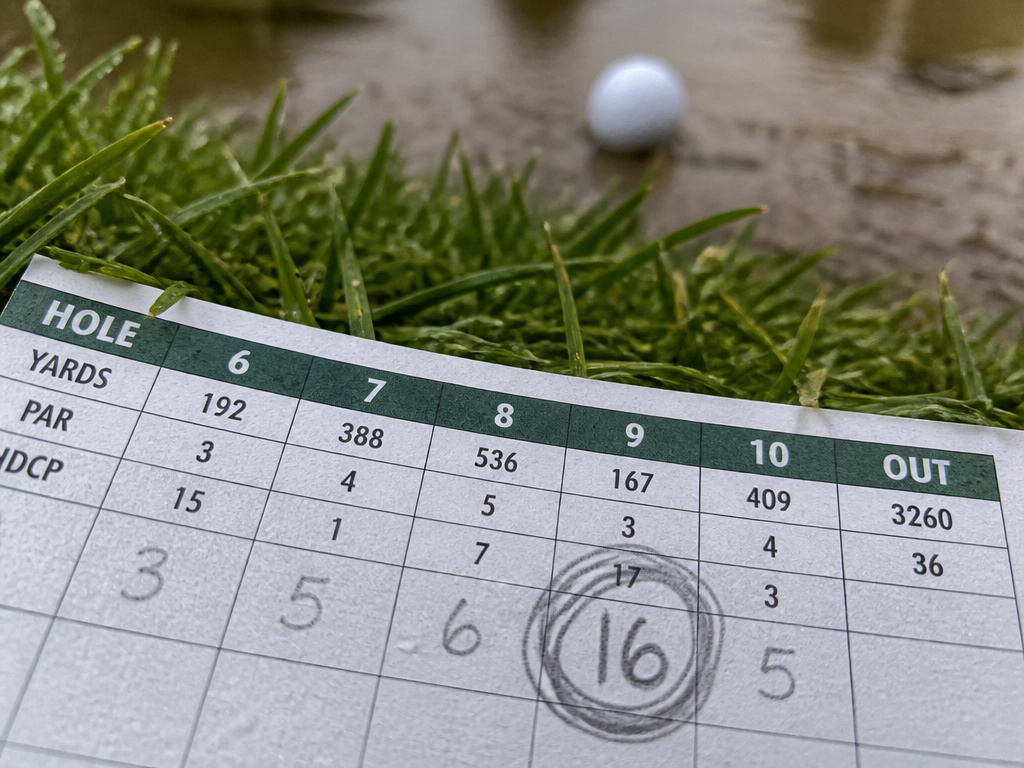
For every story of a 57, there’s a counterpoint of a 16, an 18, or worse. These single-hole catastrophes are a brutal part of golf’s history, often more memorable than the winning score. They happen when a mechanical hiccup meets a stubborn mind, and the hole becomes a black hole.
The most famous modern example is John Daly’s 18 on the par-5 6th at Bay Hill in 1998. He famously tried to drive the green over water, failed, and then continued to hit ball after ball into the drink. The sound of a ball splashing on a shot you know is lost before it lands is uniquely gutting. Daly’s scorecard that day is a museum piece of persistence gone wrong.
He doesn’t hold the official record, though. That dubious honor, since the PGA Tour began keeping hole-by-hole records in 1983, belongs to Kevin Na. At the 2011 Valero Texas Open, Na carded a 16 on the 474-yard par-4 ninth hole. The pressure of tournament play, a tight hole, and a compounding mistake created a duodecuple bogey, a score so high it needed a Latin prefix.
Where this goes sideways: Trying to hero-shot your way out of trouble after the first penalty stroke. The second splash is usually followed by a third, because the player is now playing angry, not smart. The hole is over after the first lost ball; everything after that is damage limitation.
These scores aren’t just freak accidents. They’re lessons in course management and emotional reset. David Duval’s 14 at The Open in 2019 came from hitting a wrong ball, a procedural nightmare. His honesty in signing for the 91 it produced is as much a part of his legacy as his major win. These high numbers are the shadow to the lowest scores; they define the razor-thin margin between a record day and a disaster.
How Major Championships Set a Different Standard
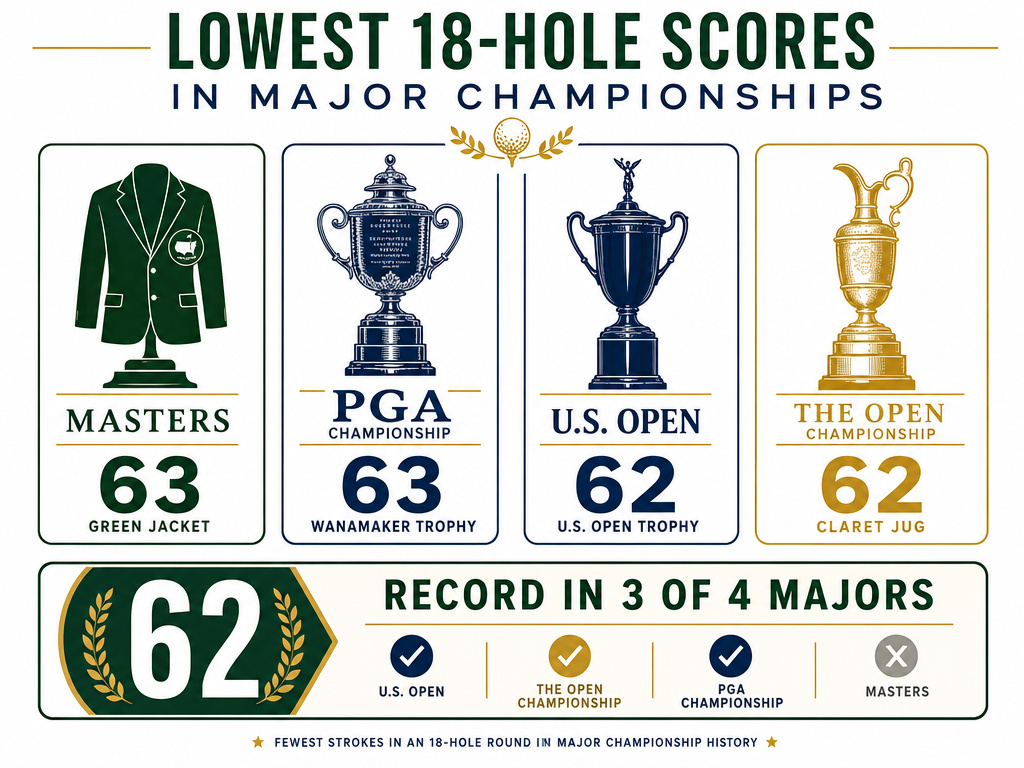
The four major championships are where scoring records carry the most weight. The courses are longer, the rough is thicker, and the pressure is a physical presence. Shooting 59 here is the sport’s moon landing.
The current 18-hole record in all four men’s majors is 62. It’s been done at The Masters, the PGA Championship, the U.S. Open, and The Open Championship. Xander Schauffele alone has posted 62 in two different majors. Breaking 60 in a major is the last great scoring barrier. It requires a player to sustain a round of flawless golf on a course specifically designed to punish any flaw.
Consider the Masters Tournament at Augusta National. The greens are the defense. An approach shot six feet from the pin can be a great shot; if it’s on the wrong tier, it can be a three-putt. This is why the lowest scores in majors are so revered. They represent a player solving an intricate, shifting puzzle under the highest glare. The history of The Open Championship, with its wind and pot bunkers, or the PGA Championship with its brutal rough, tells the same story: a 63 in a major is often a better round than a 57 on a softer setup.
| Major Championship | Lowest 18-Hole Score | Player(s) | Year |
|---|---|---|---|
| Masters Tournament | 63 | Greg Norman, Nick Price | 1996, 1986 |
| PGA Championship | 62 | Xander Schauffele, Shane Lowry | 2024 |
| U.S. Open | 62 | Xander Schauffele, Rickie Fowler | 2023 |
| The Open Championship | 62 | Branden Grace | 2017 |
The 72-hole scoring records in the majors are another layer. They speak to dominance over four days. Rory McIlroy’s 16-under 268 at the 2011 U.S. Open or Henrik Stenson’s 264 at The Open in 2016 are monuments to consistency. These aggregate marks are arguably more impressive than a single hot round, because they demand that a player sleep on a lead and do it again.
The Fine Print on Every Record
A number without context is just a digit. Every record in golf’s books comes with a set of conditions that explain its value. Ignoring them is how myths are born and comparisons become meaningless.
The first condition is course length and setup. Homero Blancas’s 55 is the prime example. The second is the rules in play, like the preferred lies for del Solar’s 57. The third is the era. Equipment changes everything. A modern driver and ball would shred a course from 1962; conversely, the feathery ball and hickory shafts of 1900 make Old Tom Morris’s scores seem superhuman. This is why comparing Jack Nicklaus’s 18 majors directly to Tiger Woods’s 15 is a fool’s errand. The depth of global competition Tiger faced is a different beast.
The part nobody mentions: Official record-keeping for scores on the PGA Tour only goes back to 1983. Stories of Tommy Armour’s 23 in 1927 or Ray Ainsley’s 23 in 1938 are part of golf’s lore, but they live in the realm of reported history, not verified data. They’re still true to the experience of the game, every golfer has had a hole that felt like a 23, but they sit outside the official ledger.
This context is what separates a trivia answer from understanding. When you look at a list of the best golf scores, your first question shouldn’t be “what’s the number?” It should be “under what circumstances?” That’s how you learn what the record actually means.
Frequently Asked Questions
Has anyone ever shot a 54 in professional golf?
No. A 54 (18-under on a par-72) has never been recorded in a sanctioned professional tournament. The 55 by Homero Blancas and the several 57s are the closest. The perfect round of 18 birdies remains one of golf’s great theoretical feats.
What is the worst score on a single hole in PGA Tour history?
Since official hole-by-hole records began in 1983, the worst score is a 16 by Kevin Na on a par-4 in 2011. Before 1983, scores like Tommy Armour’s reported 23 exist in golf lore but lack verified scorecards.
What is the lowest score ever in a major championship?
The lowest score for a single round in any men’s major championship is 62. This score has been achieved in all four majors: The Masters, PGA Championship, U.S. Open, and The Open Championship.
Why doesn’t Homero Blancas’s 55 count as the official record?
Guinness World Records and other official bodies have minimum course length requirements for scoring records (typically over 6,500 yards). Blancas’s 55 was shot on a course measuring only 5,002 yards, so it is considered an incredible feat but not an official “world record.”
Could we ever see a 56 on the PGA Tour?
It’s statistically possible, especially on a short, soft course with low wind. As players continue to optimize distance and approach shot accuracy, the odds increase. However, the pressure of shooting a historically low number and the variance of putting make it an extremely high barrier.
Before You Go
The search for the lowest score is really a search for a perfect round. It’s a quest that exposes golf’s beautiful contradiction: the game is quantifiable, but its greatest achievements are defined by unquantifiable context. A 57 with preferred lies is a marvel. A 62 in a major is a masterpiece. A 55 on a short course is a legend.
Your takeaway shouldn’t just be a list of numbers. It should be the lens to view them through. Next time you hear about a record round, ask about the yardage, the weather, and the rules. That’s where the real story is. And if you’re ever having a bad day on the course, remember that even major champions are just a few stubborn swings away from a number they never thought they’d post. The difference between history and a horror story is often just one good decision.
