
Types of Golf Clubs Explained | The 5 Essential Categories
This post contains affiliate links. As an Amazon Associate, we earn from qualifying purchases.
This post contains affiliate links. As an Amazon Associate, we earn from qualifying purchases.
Golf clubs are divided into five legal categories, woods, irons, hybrids, wedges, and putters, defined by the R&A and USGA equipment rules. A legal club must be at least 18 inches and not exceed 48 inches in length, have a shaft straight to within 5 inches of the sole, and a putter cannot have a loft greater than ten degrees. You are allowed a maximum of 14 clubs in your bag during a round.
That definition is the rulebook’s starting point. It tells you what a club is, but not which ones to carry or why a sand wedge feels nothing like a driver. The real game is played in the gaps between those categories, the hybrids that blend woods and irons, the wedges you buy separately, the putter you use 36 times a round.
What follows is a breakdown of each club type by its rules, its job, and the common mistakes players make when choosing them. By the end, you’ll know how to read a club’s sole, understand why loft is the only number that truly matters, and assemble a bag that covers every shot without wasting a single slot.
Key Takeaways
- The 14-club limit is absolute, but most recreational players are better served by a focused 10-12 club set that eliminates redundancy.
- Loft, not the number on the club, is the primary determinant of trajectory and distance; a 7-iron can be 28 degrees or 34 degrees depending on the set.
- A club damaged during a round is still considered conforming for that round, but a club that was non-conforming when new can never become legal through wear.
- 60% of shots occur inside 100 yards, making your wedge selection and practice more critical to scoring than any driver upgrade.
- For beginners, a mallet putter like an Odyssey 2-Ball or a cavity-back iron set from Callaway or TaylorMade provides the forgiveness needed to build confidence.
The 5 Types of Golf Clubs: A Quick Reference
Every club in your bag serves one of five purposes. The table below maps each type to its primary use, key specifications, and a note on where most players get it wrong.
| Club Type | Primary Use | Key Spec (Loft Range) | Common Pitfall |
|---|---|---|---|
| Woods | Maximum distance off tee or fairway | Driver: 8°–13° | Using a driver on tight par-4s; the 3-wood is often smarter. |
| Hybrids | Replacing long irons; easier launch from rough | 18°–27° | Carrying a 3-hybrid and a 5-wood that go the same distance. |
| Irons | Precision approach shots from 100–200 yards | 4-iron: ~20°; 9-iron: ~45° | Buying blades for looks when cavity-backs offer real forgiveness. |
| Wedges | High, soft shots inside 100 yards; greenside control | Pitching: 48°; Lob: 58°–60° | Having a 20-yard gap between your pitching and sand wedge. |
| Putters | Rolling the ball on the green | Loft ≤ 10° | Using a blade putter with a straight-back-straight-through stroke. |
Where this goes sideways: Choosing clubs based on the number on the sole instead of the actual loft. Two different 7-irons can be 6 degrees apart in loft, creating a 15-yard gap you didn’t plan for. Always check the spec sheet.
Your golf bag essentials start with covering these five distances. A modern standard set makeup typically includes a driver, a fairway wood, hybrids, 5-9 irons, three wedges, and a putter.
What Makes a Golf Club Legal? The Rulebook Stuff
Before you worry about brands, you need to know the boundaries. The R&A equipment regulations and USGA equipment standards are the final word. They exist to preserve the skill of the game.
Length is the first hard rule. A club must be at least 18 inches long and cannot exceed 48 inches. Almost every standard club falls between 35 inches (a putter) and 45.75 inches (a driver). The shaft must be straight from the grip down to a point no more than 5 inches above the sole.
Loft defines the club type. The rules state a putter is any club with a loft not exceeding ten degrees. That’s why a “chipper” with 12 degrees of loft is technically an iron, not a putter. For other clubs, loft is unrestricted, but tradition and physics keep drivers under 13 degrees and lob wedges under 64.
Wear is not damage. This is a critical distinction. A club that is conforming when new remains legal even if its grooves wear down through normal use. However, if you crack the head during a round, that club is still considered conforming for the rest of that round, but not for a subsequent playoff, which counts as a new round. Conversely, a club that was illegal when new can never become legal, even if you wear it down.
The part nobody mentions: The 2010 groove rule. Irons and wedges manufactured before 2010 often have square grooves that generate more spin. For most amateur events, these “grandfathered” clubs are still allowed. But if you’re qualifying for a USGA championship, you’ll need wedges marked with a “CC” (Condition of Competition) stamp. That rule phased in fully by 2014.
Woods: The Distance Engines
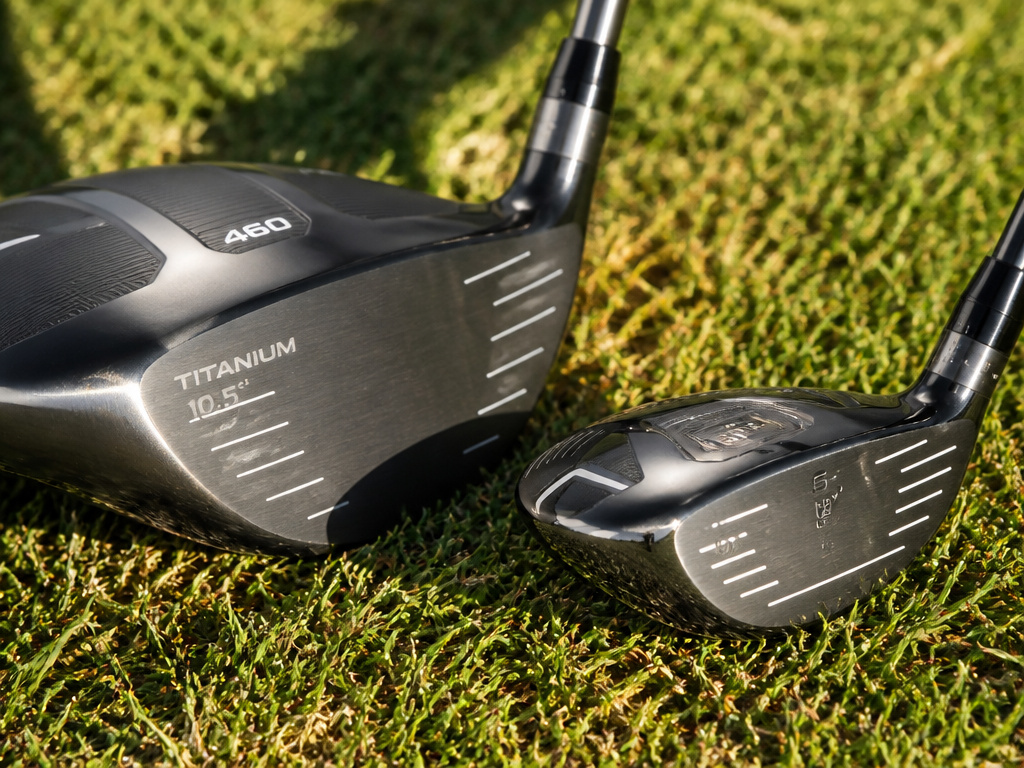 Woods are built for one job: covering vast amounts of real estate with minimal effort. The large, hollow head and long shaft are designed for swing speed.
The driver is the outlier. It has the largest head (typically 460cc), the longest shaft, and the lowest loft. You use it exclusively off a tee. The modern titanium driver is a marvel of forgiveness, but it’s still the hardest club to control. On a tight par-4, a 3-wood off the tee is often the smarter play.
Fairway woods (3-wood, 5-wood, 7-wood) are for the turf. They have slightly more loft and a shallower face than a driver, allowing you to hit them off the fairway or light rough. A 5-wood is a revelation for most players, it launches high, lands soft, and is far easier to hit than a 3-iron.
The mistake here is overlap. If your 3-wood and your driver both tend to slice, you’re carrying two clubs with the same miss. Better to find one reliable fairway wood you can hit off the deck and stick with it. For most players building their first full set of clubs, a driver and a 5-wood is a more practical long-game combo than a driver and a 3-wood.
Irons: The Workhorses
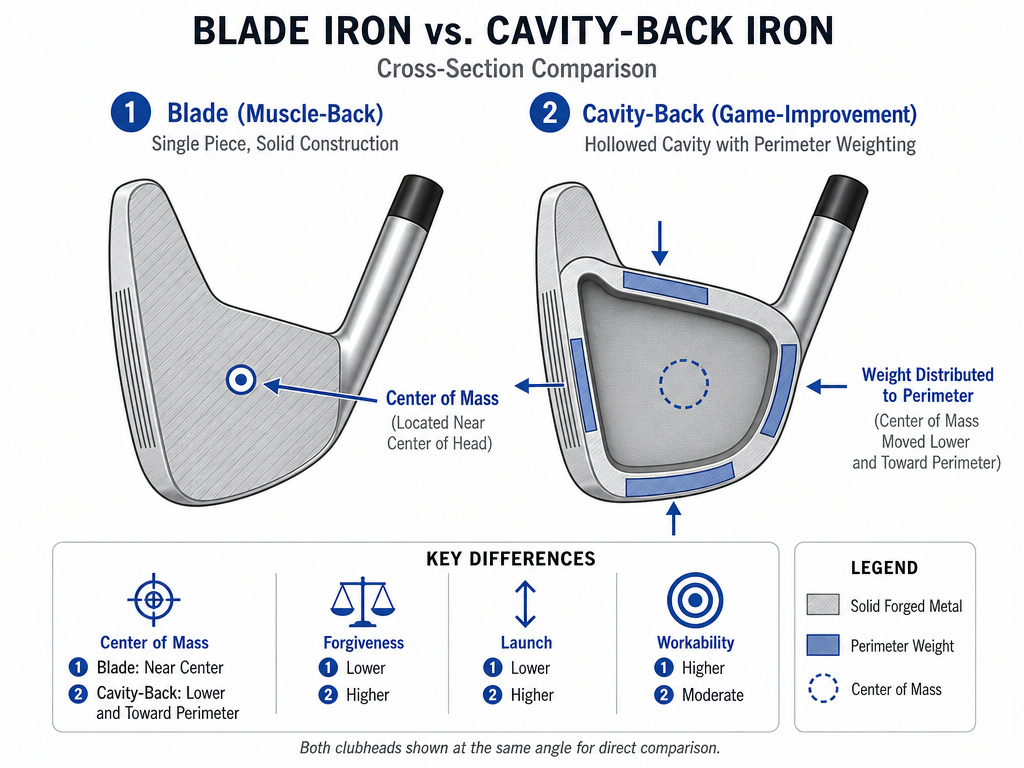 Irons are for precision. Numbered from 3 to 9 (though many sets now start at 5), they are your tools for hitting greens from the fairway. The lower the number, the less loft, the longer the shaft, and the farther the ball goes, in theory.
Blade vs. Cavity-Back. This is the fundamental iron choice. * Blades (Muscle-Backs): A single piece of forged metal. They offer pristine feel and workability for elite players but punish off-center hits severely. * Cavity-Backs (Game-Improvement): The back of the club is hollowed out, distributing weight to the perimeter. This increases forgiveness on toe and heel strikes. This is the category for almost every amateur and the foundation of most game improvement clubs.
Worth knowing before you start: “Strong lofting” is rampant. To market distance, companies have steadily decreased the loft on irons. A modern 7-iron might have the same loft (32 degrees) as a 5-iron from 20 years ago. Don’t brag about hitting your 7-iron 180 yards until you check its loft. You’re just hitting a renumbered 5-iron.
Your iron set should flow seamlessly into your wedges. If your 9-iron is 40 degrees and your next wedge is 48 degrees, you have a massive yardage gap. This is why many players buy their wedges separately to ensure proper gapping.
Hybrids: The Problem Solvers
Hybrids are the best thing to happen to the average golfer in 30 years. They combine the low-profile head of a fairway wood with the length and swing of an iron. The result is a club that launches high, cuts through rough, and is brutally forgiving.
They replace long irons. A 4-iron is notoriously difficult to hit well. A 4-hybrid, with its wider sole and lower center of gravity, makes that shot routine. Most players should carry at least one hybrid, typically in the 19-22 degree loft range, to replace their 3 or 4-iron.
When adding a hybrid, check the loft against your fairway woods. A 5-wood might be 18 degrees, and a 3-hybrid might be 19 degrees. That’s redundant. Your hybrid should fill a specific distance gap, not create a duplicate. For those selecting their first clubs for beginners, a hybrid is non-negotiable.
Wedges: The Scoring Tools
This is where games are won and lost. As the Wikipedia golf club entry notes, wedges are specialized irons with the highest lofts. You use them for everything inside 100 yards.
The four main wedges:
- Pitching Wedge (PW): Usually 44-48 degrees. Comes with your iron set.
- Gap Wedge (GW): 50-54 degrees. Bridges the gap between your PW and SW.
- Sand Wedge (SW): 54-58 degrees. Designed with a wide “bounce” sole to glide through sand.
- Lob Wedge (LW): 58-64 degrees. For high, soft shots over bunkers or when you have no green to work with.
Common mistake: Carrying a 60-degree lob wedge because the pros do. Unless you practice with it weekly, a 60-degree wedge is a liability. It’s easy to blade or chunk. A 56-degree sand wedge is more versatile for most amateurs.
Your wedges need to be spaced 4-6 degrees apart. If your PW is 44 and your next wedge is 56, you have a 12-degree canyon in your short game. You’ll constantly be hitting half-shot PW or swinging too hard with the SW. Fill the gap.
Putters: The Final Weapon
You use the putter more than any other club. Its sole job is to roll the ball smoothly on the green. The rules give putters special allowances, like having a flat grip and a face that isn’t necessarily symmetric.
Blade vs. Mallet.
- Blade: Traditional, compact, minimal forgiveness. Best for players with a pronounced arcing stroke (think Tiger Woods’ old Scotty Cameron Newport).
- Mallet: Larger head, higher moment of inertia (MOI), and often alignment aids. Best for a straight-back-straight-through stroke. The Odyssey 2-Ball is the iconic example.
The putter is the most personal club in the bag. Length, lie angle, head weight, and grip size all dramatically affect your stroke. This is why a custom golf clubs fitting often starts with the putter. What feels right is usually what works right.
Building Your 14-Club Bag: A Decision Guide
You have 14 slots. The goal is to cover every distance from 230 yards to 2 yards without overlap. Here is a proven template for a balanced bag, adaptable for different skill levels.
| Club Type | Beginner / High Handicap | Intermediate / Mid Handicap | Advanced / Low Handicap | Why This Choice? |
|---|---|---|---|---|
| Driver | 10.5° | 9.5°–10.5° | 9° | Higher loft for beginners = more forgiveness and carry. |
| Fairway Wood | 5-wood (18°) | 3-wood (15°), 5-wood (18°) | 3-wood (15°) | Beginners need launch; intermediates need options; advanced players need a tee alternative. |
| Hybrids | 4H (22°), 5H (25°) | 3H (19°), 4H (22°) | 2H (17°) | Replace hard-to-hit long irons completely at first. |
| Irons | 6, 7, 8, 9, PW (cavity-back) | 5, 6, 7, 8, 9, PW (cavity-back) | 4, 5, 6, 7, 8, 9, PW (maybe blades) | Build confidence with fewer, more forgiving irons. |
| Wedges | GW (52°), SW (56°) | GW (50°), SW (54°), LW (58°) | GW (52°), SW (56°), LW (60°) | Start with two scoring wedges; add a lob wedge as skill demands. |
| Putter | Mallet | Mallet or Blade | Blade or Mallet | Forgiveness first, then feel. |
The bottom line: A beginner’s ideal composition of a modern golf set is about 10 clubs: Driver, 5-wood, 4H, 5H, 6-9 irons, PW, 52°, 56°, and a putter. That covers all the shots without complexity. As you improve, you’ll know exactly which gap to fill with your 13th and 14th clubs, usually a 3-wood or a specialty wedge.
For those on a budget, excellent clubs under $500 for a full set are available from brands like Wilson and Callaway, offering all the forgiveness a new player needs.
Frequently Asked Questions
What are the 5 main types of golf clubs?
The five types are woods (for distance off the tee), irons (for approach shots), hybrids (a blend of woods and irons), wedges (for short, high shots), and putters (for the green). These categories are defined by the official rules of equipment based on their design and intended use.
What does the number on a golf club mean?
The number generally indicates loft and shaft length. A lower number (3-iron, 3-wood) means less loft, a longer shaft, and more potential distance. A higher number (9-iron, 9-wood) means more loft, a shorter shaft, and a higher, shorter shot. However, there’s no industry standard, so a 7-iron from one brand may have the same loft as a 6-iron from another.
Can I carry more than 14 clubs?
No. Rule 4.1b of the Rules of Golf states the maximum is 14. If you start a round with more, you must declare the excess clubs out of play before teeing off, with a penalty of two strokes per hole (max four strokes) in stroke play. It’s a strict rule to prevent players from having a specialty club for every possible lie.
What’s the difference between a blade and a cavity-back iron?
Blade is a single piece of forged metal, offering great feel but little forgiveness on off-center hits. A cavity-back has a hollowed-out rear that pushes weight to the perimeter, making it much more forgiving. Over 95% of amateur golfers should play cavity-back or other forgiving golf clubs.
Do I need a 60-degree lob wedge?
Probably not immediately. A 60-degree wedge requires precise technique to use effectively. For most players, a 56-degree sand wedge is sufficient for greenside bunkers and high shots. Add a lob wedge only when you consistently find yourself needing to hit a shot that stops dead on the green from a tight lie, and you’re willing to practice it.
How often should I replace my golf clubs?
Irons can last 5-10 years if the grooves are intact. Drivers and fairway woods see more technological gains, so every 3-5 years is reasonable if you want the latest in forgiveness. Wedges wear fastest because of the soft metal; replace them when the grooves look rounded and you lose spin on the green. Putters can last a lifetime.
Before You Go
Your clubs are just tools. The rules define them, the categories organize them, but your swing brings them to life. Start by understanding the five jobs that need doing, distance, approach, trouble, scoring, and putting. Build a simple bag that covers those jobs without duplication. A driver, a fairway wood, a hybrid, six irons, two wedges, and a putter will get you around any course.
Spend your practice time where it counts: with the wedges and the putter. That’s where the strokes are saved. When you’re ready to upgrade, let your misses guide you. Not sure where to start? Look at our curated list of top-rated clubs for every level. Now go hit something besides your limit.
