
What Clubs Should Be in Your Golf Bag for a Perfect Setup
This post contains affiliate links. As an Amazon Associate, we earn from qualifying purchases.
This post contains affiliate links. As an Amazon Associate, we earn from qualifying purchases.
You can carry up to 14 clubs in your golf bag, but the best setup for you depends on your driver swing speed. If you swing under 90 mph, a bag with 11 or 12 clubs, replacing long irons with hybrids and focusing on wedge gapping, often scores better than a full 14. The rules mandate a minimum club length of 18 inches and a maximum of 48 inches, with specific penalties for exceeding the limit.
That swing speed threshold is the pivot. Most advice assumes you need to fill every slot, but data from real golfers shows that isn’t true. Carrying a club that duplicates a distance you already cover just adds weight and indecision.
What follows is a breakdown of the official R&A Rules of Golf Rule 4, the core clubs every bag needs, and how to match your specific mix to your game. We’ll use data, not dogma, to build your bag.
Key Takeaways
- The 14-club limit has been in force since 1938; a breach costs two penalty strokes per hole, up to four strokes total.
- Driver swing speed under 90 mph often means you need fewer than 14 clubs to avoid overlapping distances and confusion.
- Replace your 3-, 4-, and 5-irons with hybrids (22° to 30°); they launch higher, are more forgiving, and work from any lie.
- Your driver and putter are mandatory; everything else is negotiable based on the courses you play and your typical shot distances.
- Higher handicappers (20+) often carry only 13 clubs, typically dropping the lob wedge because they don’t have consistent shots for it.
The 14-Club Rule and Its Real Penalties
You can’t start a discussion about bag setup without the rule. The R&A and USGA adopted the 14-club limit in 1936, and it took effect in 1938. Before that, players could, and did, carry upwards of 25 clubs. The rule exists to keep the game a test of skill, not a contest of who has the most specialized tools.
Where this goes sideways: Forgetting a test club in your bag after a range session. Ian Woosnam was tied for the lead at the 2001 Open Championship when his caddie discovered a 15th club, an extra driver. The two-stroke penalty effectively ended his championship run.
The penalty is concrete. In stroke play, you get two strokes for each hole where a breach occurred, with a maximum penalty of four strokes. You must immediately declare the extra club out of play. If you start with fewer than 14, you can add clubs during the round to reach the limit, but a lost club cannot be replaced.
The rules also cover damaged clubs. If a club is damaged during normal play, you can continue using it or have it repaired. It still counts as one of your 14. However, you cannot deliberately alter a club’s characteristics mid-round, like adjusting loft or adding lead tape.
| Rule Scenario | What’s Allowed | Penalty for Breach |
|---|---|---|
| Starting with 15+ clubs | Must declare excess club out of play immediately | 2 strokes per hole (max 4) |
| Damaged club during round | Use as-is or repair; it remains a conforming club | No penalty if damaged in normal play |
| Sharing clubs with a partner | Allowed in partner play, but combined total ≤ 14 clubs | Loss of hole in match play / 2 strokes in stroke play |
| Altering club during round (e.g., adjusting loft) | Not allowed | General penalty (2 strokes/loss of hole) |
Understanding this framework is your first step. It is the boundary within which you make every equipment choice. For a deep dive on the specifics, our guide on the 14-club limit breaks down every exception.
What the Data Says: Most Golfers Don’t Need 14 Clubs
Walk into any store and you’ll see full 14-club sets presented as the default. The marketing assumes you need to fill every slot. Real-world data from thousands of golfers tells a different story.
Analysis of golfer data shows a clear trend: while low-handicap players almost always carry 14 clubs, higher handicappers do not. A 20-handicapper often carries 13 or 14 clubs, frequently dropping the lob wedge. A 25-handicapper averages just 13 clubs, with many skipping the lob wedge entirely.
Why? Shot versatility. A lob wedge requires precise technique for high, soft shots around the green. Many recreational players find they only use it a handful of times per round, often with poor results. They instead use a sand wedge for most greenside shots, accepting a slightly lower trajectory for more consistency.
The bigger insight comes from swing speed. If your driver clubhead speed is under 90 mph, the traditional 4° loft gaps between irons don’t create enough ball speed separation. You might find your 7-iron and 6-iron flying within 5 yards of each other.
Common mistake: Carrying two clubs that go the same distance. If your 5-wood and 3-hybrid both travel 180 yards, one is baggage. Use that slot for a club that gives you a different window or handles a specific lie.
In this case, carrying fewer, better-gapped clubs reduces confusion. It forces you to learn partial swings and creative shots with the tools you have, which often leads to more consistent scoring than fumbling between 14 options.
The Driver and Putter: Your Non-Negotiables
Every bag has two absolute requirements. You need a tool to start the hole and a tool to finish it. Everything in between is negotiable.
The Driver
This is your distance engine. Modern drivers are highly adjustable, allowing you to tweak loft and move weights to promote a draw or fade. The goal is finding the fairway. A drive in the rough almost always costs a stroke compared to a drive in the short grass, even if it’s 20 yards shorter.
Don’t just buy the one with the biggest marketing budget. Pay attention to forgiveness on off-center hits. Players with slower swing speeds often benefit from slightly higher loft (10.5° or even 12°) to maximize carry.
The Putter
You’ll use this club on every single green, and probably a few times off it. Putting is about feel, alignment, and confidence. The style, blade, mallet, high-MOI, is less important than how it looks to your eye at address and how it swings in your hands.
A putter that sets up square to your target line every time is worth more than one with the latest groove technology. Go to a store and roll a dozen. The right one will feel obvious after a few strokes.
Spend time here. A great putting day can salvage a round where everything else is off. These two clubs are the bookends of your game; choose them carefully. For a curated list of top performers, see our reviews of the best golf clubs on the market.
The Long Game: Woods, Hybrids, and the Irons You Actually Need
 This is where most bags get cluttered. The old “driver, 3-wood, 5-wood, 3-iron through 9-iron” template is outdated, especially for the average player.
Fairway Woods
A 3-wood (around 15° loft) is the most common fairway wood. It’s useful off the tee on tight holes and for second shots on par-5s. Many players are now adding 7-woods (21°-23°) or even 9-woods. These high-lofted woods are incredibly easy to launch, stop quickly on greens, and are far more forgiving than a long iron. Models like the TaylorMade Qi10 Max or Callaway Paradym Ai-Smoke Max are built for this exact purpose.
Hybrids: The Long-Iron Replacement
This is a recommendation for anyone who is not a plus-handicap. Replace your 3-, 4-, and 5-irons with hybrids.
A hybrid combines the easy launch of a fairway wood with the control of an iron. Its design places the center of gravity low and back, helping get the ball airborne from any lie, fairway, rough, or even light bunkers. For the vast majority of players, a 22° 4-hybrid will be more accurate, go farther, and land softer than a 4-iron.
Your Iron Set
For most, a modern iron set starts at the 6-iron or 7-iron. This is the “scoring iron” range where you’re hitting approach shots into greens. The technology in today’s game-improvement irons provides forgiveness on mishits while still offering feel. You don’t need a 3-iron because you have a hybrid. You don’t need a 4-iron for the same reason.
Build this section of your bag from the green backward. Decide what your highest-lofted iron is (e.g., a 9-iron at 42°), then fill the gap between it and your highest-lofted hybrid with clubs that give you consistent 10-12 yard gaps. This often means a 6-iron, 7-iron, 8-iron, and 9-iron.
The Scoring Zone: Your Wedge Setup
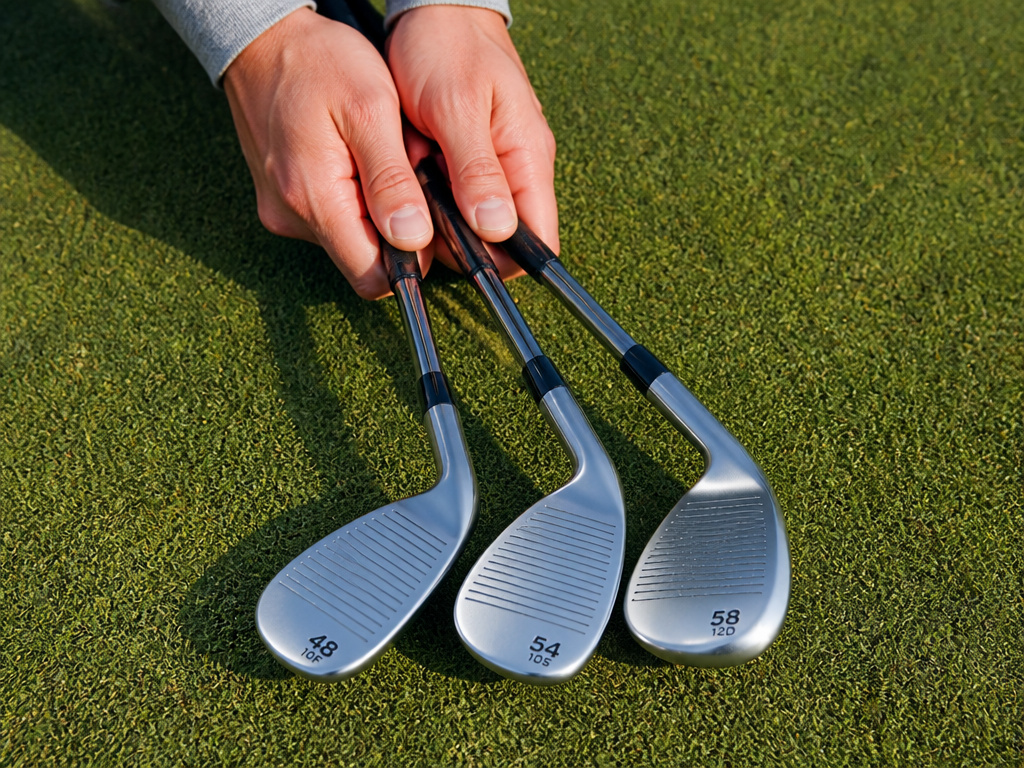 This is where rounds are saved or blown. You need enough wedges to cover short-yardage shots, but not so many that you’re guessing over every 30-yard pitch.
A standard, effective three-wedge setup looks like this: * Pitching Wedge (PW): Usually 45°-48°. Your 100-125 yard full-swing club. Also used for bump-and-run chips. * Gap Wedge (GW): Usually 52°-54°. Bridges the distance between your PW and Sand Wedge. Essential for 75-100 yard shots. * Sand Wedge (SW): Usually 56°-58°. Designed for greenside bunkers. Also your primary club for most pitches and chips around the green.
Many better players add a fourth, a Lob Wedge (LW) at 60° or more, for high, soft shots over hazards when they have no green to work with. However, as the data shows, if you’re a higher handicapper and this club causes more thin or fat shots than miracles, leave it out. Master the sand wedge first.
The part nobody mentions: Wedge gapping is about bounce and grind, not just loft. A wedge with high bounce (10°-14°) is better for soft sand and lush turf. Low bounce (4°-8°) is better for firm conditions and tight lies. Most players need at least one high-bounce wedge in the bag.
Your wedges are precision tools. They should be fitted to your swing and the typical conditions you play in, just like your irons. Don’t just take the stock wedges that come with a complete set; consider them a separate, critical purchase.
Building Your Bag: A Setup for Every Player
Let’s translate this into real bags. Your goal is to cover every distance you encounter on your regular courses without duplication. Here are two proven templates.
For the Player (Driver Swing Speed < 90 mph)
This setup prioritizes launch, forgiveness, and simplicity. It has 12 clubs. 1. Driver 2. 3-wood (15°) 3. 5-hybrid (25°) 4. 6-hybrid (28°) 5. 7-iron 6. 8-iron 7. 9-iron 8. Pitching Wedge (45°) 9. Gap Wedge (52°) 10. Sand Wedge (58°) 11. Putter
For the Player (Driver Swing Speed > 90 mph)
This setup has 14 clubs and includes more long-iron options for shot shaping. 1. Driver 2. 3-wood (15°) 3. 5-wood (19°) 4. 4-iron (22°) or 4-hybrid 5. 5-iron 6. 6-iron 7. 7-iron 8. 8-iron 9. 9-iron 10. Pitching Wedge (45°) 11. Gap Wedge (52°) 12. Sand Wedge (56°) 13. Lob Wedge (60°) 14. Putter
| Club Type | Slow Swing (<90 mph) Priority | Faster Swing (>90 mph) Priority |
|---|---|---|
| Long Clubs | Hybrids for launch & forgiveness | Mix of woods, hybrids, and long irons for versatility |
| Iron Set Start | 7-iron or 6-hybrid | 5-iron or 4-iron |
| Wedge Count | 3 (PW, GW, SW) | 4 (PW, GW, SW, LW) |
| Total Clubs | 11-12 | 14 |
Remember, these are templates. If you never face a 200-yard shot into a green, you might not need a 5-wood. If your home course has huge, soft greens, a lob wedge might be essential. Build the bag for your game, not a magazine photo. For new players, starting with a well-chosen beginner clubs set that follows this logic is the fastest path to improvement.
Frequently Asked Questions
Can I carry two drivers?
Yes, it’s legal as long as you stay within the 14-club limit. Phil Mickelson won the 2006 Masters with two drivers, one to hit a draw and one to hit a fade. For 99.9% of golfers, this is a waste of a slot. That space is better used for a club that covers a unique distance or lie.
What is the minimum number of clubs I can carry?
One. The rules set a maximum (14), not a minimum. You could theoretically play with just a putter, though it wouldn’t be much fun. Most minimal “Sunday bags” for a quick nine holes might contain a driver, a hybrid, a 7-iron, a wedge, and a putter.
Do my clubs have to match?
No. Your bag can be a mix of brands, models, and ages. Many players use a driver from one brand, irons from another, and wedges from a third. The only requirement is that each club conforms to the USGA equipment rules 2019. Play what works.
What if I break a club during a round?
If a club is damaged during the normal course of play, you can continue to use it, repair it, or simply not use it. It still counts as one of your 14 clubs. You cannot replace it with a new club during that round.
How often should I reevaluate my bag setup?
At least once a season. Your swing changes, your preferences change, and new technology can offer real benefits. The best way to evaluate is with on-course or launch monitor data. Know how far you actually hit each club, and look for gaps that are too large (15+ yards) or too small (under 8 yards).
Before You Go
Forget the idea of a “standard” bag. Your ideal setup is a personal toolkit, built around your swing speed, your common course challenges, and the shots you actually need to hit. The rule is 14 clubs maximum, not 14 clubs mandatory.
Start with the essentials: a driver you can find the fairway with and a putter you love. Then, replace the hard-to-hit long irons with hybrids. Finally, build a wedge system you have confidence in from 100 yards and in. If that totals 12 clubs, your back will thank you and your scores might just improve.
The most important club in your bag is the one you trust. Fill your slots with those. For those ready to take the next step in precision, exploring custom clubs through a professional fitting is the ultimate way to build that trust.
