
The Official Rule: How Many Clubs Are Allowed in a Golf Bag?
This post contains affiliate links. As an Amazon Associate, we earn from qualifying purchases.
This post contains affiliate links. As an Amazon Associate, we earn from qualifying purchases.
You can carry a maximum of 14 clubs in your golf bag during a round. This limit is defined by Rule 4 of the official Rules of Golf, jointly governed by the R&A and the USGA. The rule counts any club carried by or for the player, but excludes separated parts of a club or a club broken into pieces. Starting with more than 14 clubs incurs a penalty, but you can start with fewer and add clubs up to the limit.
That 14-club ceiling is non-negotiable for any round played under the official rules. It’s not a suggestion or a best practice—it’s the line that separates a legal bag from one that costs you strokes. The governing bodies didn’t pick that number at random. It’s a deliberate constraint meant to preserve the game’s core challenge: success should depend on the player’s judgment and skill, not on carrying a specialized tool for every conceivable shot.
What follows is a breakdown of where that rule comes from, what the governing bodies actually say counts toward your fourteen, and the specific, often-missed exceptions that can save you from a penalty. We’ll also walk through the penalties for getting it wrong and how to think about building a set that stays within the lines.
Key Takeaways
- The 14-club maximum is enforced by both the R&A and USGA under Rule 4. Starting with more than 14 clubs results in a two-stroke penalty per hole (max four strokes) in stroke play.
- Separated parts of a club (like a loose driver head) and a club broken into pieces do NOT count toward the 14-club limit, per official interpretations.
- You can share clubs with a partner in team formats like foursomes or four-ball, provided the shared side’s total does not exceed 14 clubs.
- If you realize you have an extra club mid-round, you must immediately declare it out of play. Failure to do so leads to disqualification.
- Your caddie or anyone else carrying clubs for you counts those clubs toward your 14. The limit applies to all clubs at your disposal, not just those in your own hands.
The Official 14-Club Limit (And Where It Comes From)
The rule isn’t hidden in fine print. It’s right at the top of Rule 4 – The Player’s Equipment in the official rulebooks. The R&A and USGA state the purpose clearly: golf is a game where success should hinge on the player’s judgment, skills, and abilities. Limiting equipment is a direct extension of that principle.
Rule 4.1b of the Rules of Golf establishes the 14-club maximum. It specifies that a player must not start a round with more than 14 clubs, or have more than 14 clubs during the round. The limit includes any club carried by the player or their caddie. A player who starts with fewer than 14 clubs may add clubs during the round to reach the limit, provided play is not unduly delayed.
You can find this stated verbatim on the R&A Rule 4 equipment rules page and within the USGA’s corresponding regulations. This consistency is critical—whether you’re playing a casual round in Arizona or qualifying for the Open Championship, the ceiling is fourteen.
Why fourteen? Historical precedent. Before the rule was codified in 1938, players would occasionally show up with 20 or more clubs. The limit forced strategic decisions about club selection and rewarded shot-making versatility over simply having the perfect club for every lie. That strategic layer remains the rule’s beating heart.
What Counts as a “Club”? (The Surprising Exceptions)
This is where most golfers’ understanding gets fuzzy. The rule defines a “club” as a club you can use to make a stroke. But the official interpretations carve out specific, non-intuitive exceptions that don’t count toward your fourteen.
| Item in Your Bag | Counts Toward 14? | Official Reasoning (Rule Interpretation) |
|---|---|---|
| A complete, usable club | Yes | This is the standard definition. |
| A separated clubhead (e.g., a driver head loose in a pocket) | No | 4.1b(1)/1: Separated parts are not considered a “club.” |
| A broken shaft (snapped below the grip) | No | 4.1b(1)/2: A club broken into pieces is not a “club.” |
| Another player’s club mistakenly in your bag | No | Rule 4.1b: It is not treated as your club, but you must not use it. |
| A damaged but repairable club (e.g., a bent hosel) | Yes | It is still a complete club unless it’s in pieces. |
The “separated parts” exception is a lifesaver for travelers. If your driver head pops off during transit, you can carry the head and shaft separately without them counting as a club. You cannot, however, reassemble and use it during the round—that would constitute repairing a club damaged outside the round, which is not allowed unless the damage occurred during the round.
Similarly, if you snap a shaft in frustration (not recommended), the broken pieces are no longer a club. You could technically carry the fragments and still have 14 other functional clubs. These interpretations exist to avoid penalizing players for equipment failure, not to encourage creative bag assembly.
Penalties for Breaking the 14-Club Rule
The penalty structure depends entirely on when you breach the limit. Getting this wrong can turn a good score into a disaster quickly.
Common mistake: Thinking you can just not use the extra club. Once you know you have more than 14 clubs, you must take clear action to take the excess out of play before your next stroke. Leaving it in the bag “just in case” is a violation.
Scenario 1: You start the round with more than 14 clubs.
This is the most costly error. The moment you make a stroke on the first tee with an excess club, you incur a penalty. * Stroke Play: Two strokes per hole where a breach occurred, with a maximum penalty of four strokes (applied to your first two holes). * Match Play: The state of the match is adjusted by deducting one hole for each hole where a breach occurred, up to a maximum deduction of two holes.
You must immediately choose which club(s) to take out of play. You cannot simply discard the extra club on the next tee; you must declare it out of play or take a clear action like turning it upside down in your bag.
Scenario 2: You add an extra club during the round.
If you started with 14, you cannot add another. If you started with fewer and add clubs to reach 14, then later add one more, you have breached the rule. * The penalty is the same as above, but it applies only to the hole(s) where you had more than 14 clubs after the addition.
Scenario 3: You have an extra club and fail to declare it out of play.
If you discover the extra club and do not take the required action to remove it from play, you are disqualified. No exceptions. The rule assumes deliberate intent if you know about the breach and continue.
Building a Legal 14-Club Set
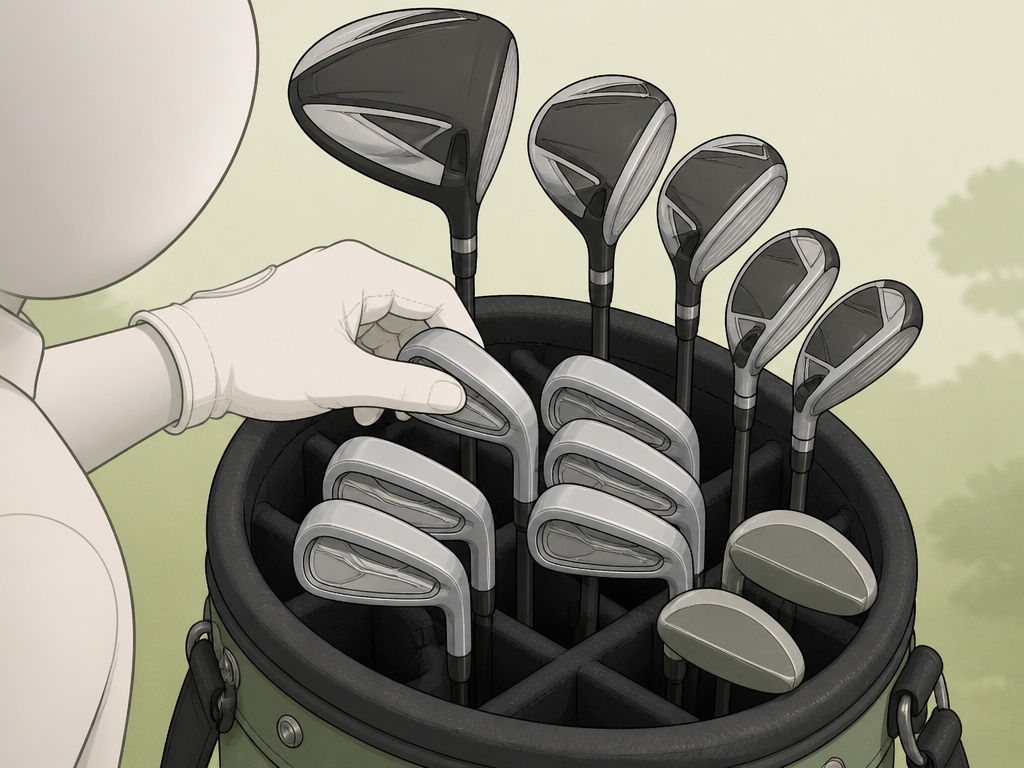
With only fourteen slots, every choice matters. There’s no single perfect formula, but most effective sets follow a balanced framework. Your specific mix will depend on your skill level, the course you’re playing, and your personal preferences.
- The Driver (1 club): Your longest club, for the tee. Some players opt for a strong 3-wood instead, but the driver is the standard choice for maximum distance.
- Fairway Woods (1-2 clubs): A 3-wood is almost universal. A 5-wood or 7-wood provides a high-launch option for long approach shots or par-5s. Skip a fairway wood if you struggle to hit them off the deck; a hybrid is often easier.
- Hybrids (1-3 clubs): These replace long irons for most players. A common progression is a 3-hybrid (19-21°) and a 4-hybrid (22-24°). They are more forgiving and launch higher than equivalent irons.
- Irons (6-8 clubs): This is the core of your set. A standard set runs from 5-iron through pitching wedge (PW). Better players might start at a 4-iron. The key is consistent gapping—each club should be about 10-15 yards apart.
- Wedges (3-4 clubs): Don’t short-change your short game. A typical setup is Pitching Wedge (45-48°), Gap Wedge (50-52°), Sand Wedge (54-56°), and Lob Wedge (58-60°). This covers full swings, pitches, bunker shots, and flops.
- The Putter (1 club): The most used club in the bag. Its selection is deeply personal.
This basic framework already consumes 13-15 clubs, forcing you to make a trade-off. Do you carry an extra wedge for short-game precision, or a fourth hybrid for long par-3s? Your decision defines your strategy. A good golf bag organizer can help you arrange these clubs for quick access, which matters when every shot counts.
Special Situations & Edge Cases
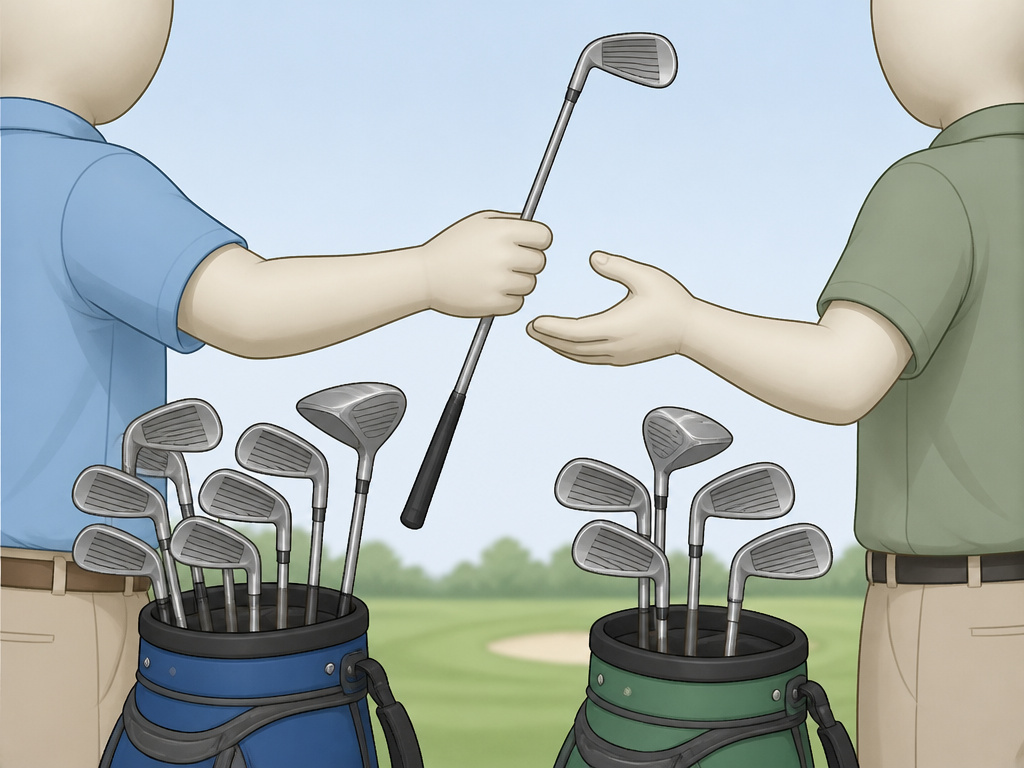
The rules anticipate scenarios that don’t fit the clean “14 clubs in one bag” model. Knowing these can save you in a team event or a strange equipment failure.
Partner Sharing (Foursomes & Four-Ball)
In team formats where partners compete as a side, Rule 22.5 (Foursomes) and Rule 23.7 (Four-Ball) permit partners to share clubs. The critical limit is that the side must not have more than 14 clubs between them. * Example: Partner A carries 8 clubs, Partner B carries 6 clubs. Total = 14. They can share any of those 14 clubs freely. * If the side has 15 total clubs, they are in breach of Rule 4.1b and face the standard penalties.
This rule encourages cooperation but maintains the equipment limit for the competing unit. It’s a common tactic in elite foursomes play, where partners might share a specialty wedge or a particular fairway wood.
The Caddie’s Clubs Count
Your 14-club limit isn’t personal—it’s logistical. Rule 4.1b(1)/3 clarifies that any club carried by your caddie, or by any other person asked to carry clubs for you, counts toward your limit. You can’t start with 10 clubs in your bag and have your friend carry 5 more “just in case.” The moment you intend to use any of those 5, you’ve exceeded 14 from the start of the round.
Lost or Damaged Clubs
- Lost Club: If you lose a club during the round, you cannot replace it if you started with 14 clubs. If you started with fewer, you can add a club to replace the lost one, but only up to your original starting number or 14, whichever is lower.
- Damaged Club: If a club is damaged during the round (not before), you are generally allowed to repair it or replace it with another club, without penalty. The damaged club is still counted among your 14.
Frequently Asked Questions
Can I have 15 clubs if one is broken?
No. A “broken club” only escapes the limit if it is broken into pieces. A club with a bent shaft or a cracked head is still a single, complete item and counts as one of your 14. You must take it out of play if it’s unusable, but it still occupies a slot.
What if I accidentally pick up another player’s club?
If you find another player’s club and put it in your bag, it is not treated as one of your clubs for the 14-club limit, according to the rule. However, you must not use it. The best practice is to leave it where you found it or turn it in to the pro shop.
Do training aids or alignment sticks count as clubs?
No. Training aids like alignment sticks are not designed to make a stroke and are not considered clubs. However, their use during a round is restricted by Rule 4.3, which limits equipment that might give artificial help. You can’t use them to help plan a stroke during play.
Can I change the specs of my clubs during a round?
Generally, no. You cannot adjust a club’s playing characteristics (like loft or lie) during a round, unless you are repairing damage that occurred during that round. Changing settings to fit a specific shot is a breach.
What’s the best way to organize 14 clubs?
Efficient organization reduces fumbling and speeds up play. Most modern golf bag types use a 14-way divider top, which protects clubheads and makes selection intuitive. Woods and long irons go at the back, mid-irons in the middle, and wedges and putter up front for easy access. A dedicated putter holder can also prevent damage to your most valuable club.
Before You Go
The 14-club rule is a foundational constraint, not a bureaucratic hurdle. It forces a deliberate choice in your golf bag contents: will you favor long-game coverage or short-game precision? That choice becomes part of your strategy for the course ahead.
Double-check your bag before you tee off. Count them. Know that a separated driver head won’t cost you a penalty, but a forgotten extra wedge absolutely will. For the vast majority of golfers, a well-chosen complete golf club sets from a major brand like Callaway, TaylorMade, or Titleist will come configured at 14 or fewer clubs, keeping you legal from the start. The rule exists to test your skill with the tools you have, not the tools you wish you had.
