
Understanding the Blind Shot in Golf: A Guide to Key Rules
This post contains affiliate links. As an Amazon Associate, we earn from qualifying purchases.
This post contains affiliate links. As an Amazon Associate, we earn from qualifying purchases.
A blind shot in golf is any shot where you cannot see your intended target, be it the green, a fairway landing area, or the hole itself, from where your ball lies. This happens because of terrain features like hills, mounds, or dense tree lines that block your view.
That definition is the easy part. The real challenge starts the moment you pull a club. You have to pick a line to a spot you can’t see, trust your yardage, and execute a swing without the visual feedback you rely on for every other shot. The 75-foot elevation drop on the 12th at Osprey Links isn’t just a number; it’s the difference between a confident 9-iron and a hesitant wedge that comes up 20 yards short because you misjudged the wind at the crest.
What follows is a breakdown of why blind shots exist, the strict rule that governs how you can get help, and a step-by-step method to turn a nerve-wracking guess into a repeatable, committed stroke.
Key Takeaways
- A blind shot occurs anytime terrain blocks your view of the target, most commonly on tee shots over crests or approaches into sunken greens.
- Rule 10.2b(4) prohibits a caddie or partner from standing on your line of play to help you aim once you begin taking your stance; violation is a two-stroke penalty in stroke play.
- Your process is everything: pick a distant intermediary target on your intended line, align your body to it, commit fully, and accept the outcome.
- Course architects are divided on blind shots; some, like Alister MacKenzie, considered them a tool to be used sparingly, while many golfers outright dislike them. Safety is an essential part of the process, always make sure your landing area is clear before hitting a blind shot.
The Technical Definition and Rule 10.2b(4)
A blind shot isn’t a special category of golf. It’s a situational challenge defined by line of sight. If a hill, mound, or grove of trees sits between your ball and where you want it to finish, you’re hitting blind. The most frequent encounters are tee shots to a fairway on the other side of a hill and approach shots into greens that sit in a bowl or behind a bunker complex.
The governing bodies have a specific rule for this scenario because the temptation to get help is high. This is where Rule 10.2b(4) comes in.
Under Rule 10.2b(4), once a player begins taking their stance for the stroke, their caddie or partner must not deliberately stand on or close to the line of play behind the ball to provide directional information. Doing so results in a two-stroke penalty in stroke play or loss of hole in match play.
This rule was clarified in the 2019 revisions by the USGA and R&A. It means your partner can’t stand behind you on your target line like a human aiming stick once you’re setting up. They can, however, point out the line from the side or describe the location of hazards before you take your stance. The line is drawn at the start of your setup routine. This rule exists to ensure the player, not the caddie, is responsible for aiming the shot.
How to Play a Blind Shot: A 5-Step Process
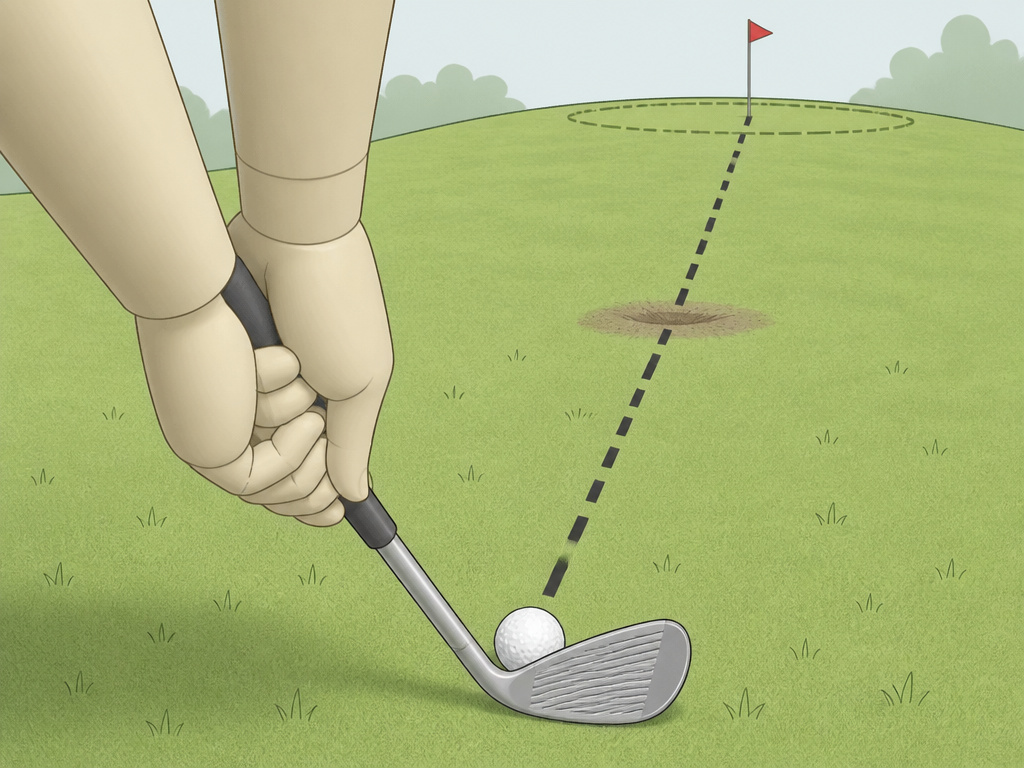
You can’t see the flag. Your gut says to aim at the big oak tree left of the green, but you’re not sure. This is where a system beats instinct every time. Good golf should feel less complicated the more you understand it, and a blind shot is a perfect test of that.
Follow this sequence. It turns a guessing game into a procedure.
- Walk and Scout. Before you even select a club, if it’s safe and practical, walk forward to get a look at your target. See the slope, the wind at the crest, the pin position. If you can’t walk ahead, use every tool available: the hole diagram on the tee sign, your yardage book, or a GPS device that shows the hole layout. This recon gives you the picture you need.
- Pick Two Targets. First, choose your ultimate target (the spot on the green or fairway). Second, and most critically, pick an intermediary target directly on that line that you can see. This could be a discolored patch of grass 10 yards away, a specific tree on the horizon, or the corner of a bunker. This visible target is your compass.
- Align Everything to the Compass. When you return to your ball, don’t look at the hidden flag. Instead, place your clubface directly behind the ball, aiming at your visible intermediary target. Then set your feet, hips, and shoulders parallel to that line. Your body is now aligned to your intended starting path.
- Select the Club and Commit. Factor in the wind, elevation change, and any adrenaline. On the 12th at Osprey Links, for example, the green sits 75 feet below the fairway crest. That’s more than a two-club difference, and wind at the hilltop can add or subtract another. Choose the club, then commit to the swing. Doubt is the real enemy here.
- Execute and Accept. Make your normal swing, focused on striking the ball well. Once it’s airborne, your job is done. Accept the result, good or bad. Trusting the process is what makes it repeatable.
Common mistake: Rushing the alignment step. If your feet are aimed at the oak tree but your clubface is pointed at the pond, the ball has no chance. The intermediary target alignment is non-negotiable.
This process works because it gives your brain a concrete, visible task, hit the ball over that brown patch, instead of an abstract one, hit it toward the invisible flag. I favor straightforward drills players can actually stick with, and this is less a drill and more a mandatory routine for a specific shot.
The Rules and Penalties You Can’t Afford to Miss
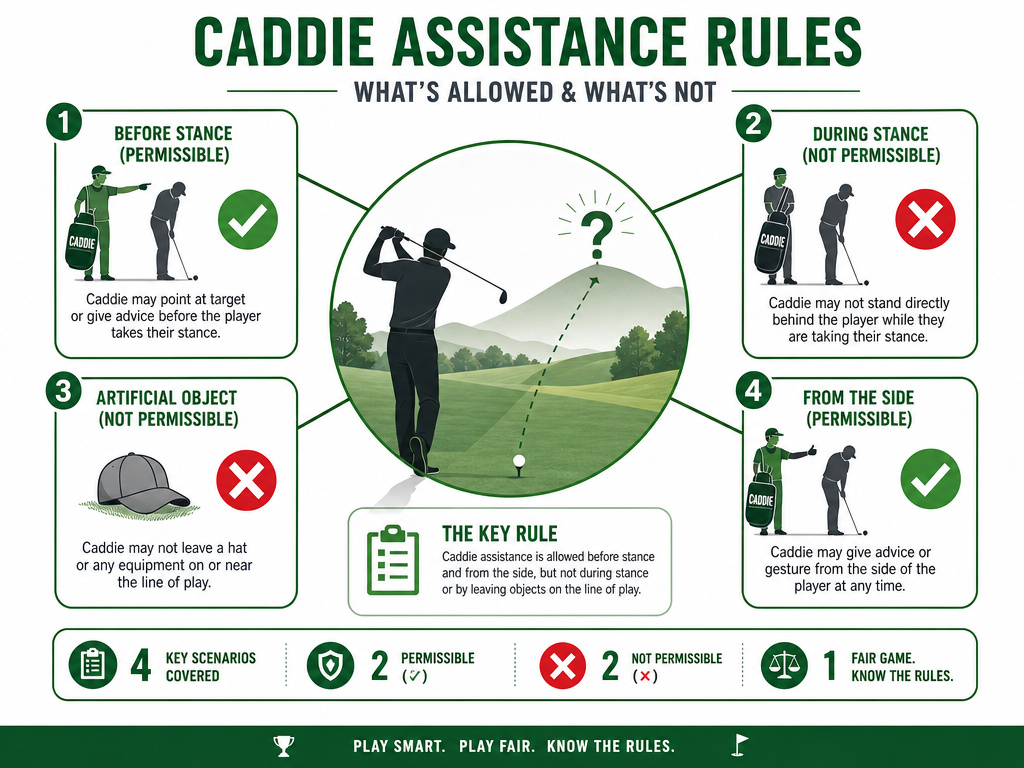
The rules around blind shots are stricter than most recreational players realize. It’s not just about whether you can get help; it’s about when and how that help is given.
The Denny McCarthy incident early in the 2019 PGA Tour season is the textbook example. He was initially assessed a penalty under Rule 10.2b(4) when his caddie appeared to be standing behind him as he lined up a shot. The penalty was rescinded only after video review proved McCarthy had not yet begun taking his stance when his caddie was in position. The tour officials were watching for this specific violation because the revised rule was fresh.
| Scenario | Is It Allowed? | Penalty If Violated |
|---|---|---|
| Partner stands behind you on your line before you take your stance to show you the line. | Yes. | None. |
| Partner remains standing behind you on your line after you begin taking your stance. | No. | Two strokes (stroke play) / Loss of hole (match play). |
| Partner leaves a hat or club on the ground to mark the line for you. | No. | Two strokes (stroke play) / Loss of hole (match play). |
| Partner stands off to the side (not on the line) and describes the location of a hazard. | Yes. | None. |
The rule extends to “other directional information.” This means your caddie can’t leave an object as a marker, and they can’t stand on a hill pointing out where the out-of-bounds line is while you’re swinging. They can show you first, but then they must move.
Why such a harsh penalty? The principle is that the skill of aiming and committing to a line is fundamental to golf. Taking that responsibility away from the player undermines the game’s challenge. This rule keeps that skill squarely in your hands, especially when it’s hardest.
Why Blind Shots Exist: The Architect’s Debate
Are blind shots a clever design feature or a frustrating flaw? The golf world is split, and the divide goes back to the game’s most famous designers.
On one hand, architects like Alister MacKenzie, the mind behind Augusta National, included blind shots among his thirteen principles of golf course design as elements worth considering. Used sparingly, they can create drama, suspense, and force a player to rely on feel and course knowledge over pure visual calculation. They’re a strategic tool.
On the other hand, many modern architects and a huge portion of everyday golfers dislike them. The criticism is that they feel unfair, punishing a well-struck shot simply because the player couldn’t see where to aim. There’s also the undeniable safety concern. Hitting a blind shot without a spotter is a risk to players ahead who might be hidden.
This architectural tension explains why you’ll find specific aids on classic courses with blind shots. It’s common to see a tall fairway flag at the top of a crest or even a bell next to a hidden green for players to ring when they’ve cleared the area. These are concessions to the practical dangers of the design.
| Perspective | Argument For Blind Shots | Argument Against Blind Shots |
|---|---|---|
| Course Architect | Adds strategic variety, tests nerve and local knowledge, creates memorable holes. | Can feel gimmicky, overuse leads to frustration, potential safety issues. |
| Low-Handicap Player | Rewards detailed course management and precise distance control. | Removes the reward for visualizing a shot, can feel like luck is involved. |
| Recreational Golfer | Can be a fun, dramatic change of pace when encountered rarely. | Increases anxiety, slows pace of play, often leads to poor scores. |
Your opinion on them will likely match your tolerance for uncertainty. But understanding why they’re on the course helps you approach them not as a trap, but as a puzzle with a specific solution.
Common Mistakes and How to Avoid Them
Most failures on blind shots aren’t due to a bad swing. They come from mental and procedural errors that happen before the club ever moves.
Mistake 1: Ignoring the Elevation Change. This is the big one. A 75-foot drop, like at Osprey Links, doesn’t just look dramatic. It changes the actual yardage by 2-3 clubs. Your 150-yard club might only fly 125 yards of actual distance before the plunge carries it the rest of the way. If you don’t account for this, you’ll come up short every time. Use your GPS or rangefinder’s elevation function, or use the old caddie rule of thumb: one club for every 30 feet of drop.
Mistake 2: Aiming at Nothing. Without a visible intermediary target, your alignment will drift. You’ll subconsciously aim at the top of the hill or an unrelated object. The result is a shot that starts offline and stays offline, often into trouble you thought you were avoiding. Pick that compass target. It takes ten seconds and it’s the single most important step.
Mistake 3: Decelerating Through Impact. This is the physical symptom of doubt. Because you can’t see the target, your brain hesitates, causing your body to slow down the swing to “guide” the ball. This leads to weak, off-center contact. The fix is in your pre-shot routine: once you’ve done your steps 1-4, your only swing thought should be a confident, full turn and release. A swing thought longer than three words gets forgotten mid-swing. “Smooth and committed” works. “Make sure to rotate your hips while keeping your head still and swinging inside-out” does not.
Mistake 4: Forgetting Safety. This isn’t a scoring mistake; it’s an ethical one. Never hit a blind shot without absolute certainty the area is clear. If there’s any doubt, send a player ahead to act as a spotter, or wait. The two minutes it costs is nothing compared to the consequence of hitting someone.
Frequently Asked Questions
What’s the most famous blind shot in golf?
The “Postage Stamp” 8th hole at Royal Troon features a blind tee shot over dunes to a tiny, elevated green. Many iconic championship moments have happened here, where players must trust their line completely off the tee.
Can I use a rangefinder on a blind shot?
Yes, absolutely. A laser rangefinder or GPS is invaluable for a blind shot. It gives you the precise yardage to a flag you can’t see, and many modern devices account for elevation change. It’s the best tool to remove the biggest variable.
What if I hit a great shot but it’s lost because it was blind?
This is a brutal part of the game. If you hit a seemingly perfect shot into a blind landing area and the ball cannot be found, it is lost. You must proceed under the lost ball rule (stroke and distance). This is why, on unfamiliar courses, extreme caution and using a spotter is advised for blind shots into areas with heavy rough or hazards.
How does blind golf for visually impaired players work?
Blind golf is a competitive adaptive sport where visually impaired athletes play with the assistance of a sighted guide. The guide helps with alignment, club selection, and describing the course, but the player executes the swing. It’s a remarkable example of the game’s accessibility and the power of a good process.
Does hitting a lot of blind shots hurt my game?
Not if you have a good process. In fact, learning to play them well can improve your overall course management and commitment to shots. It teaches you to trust your preparation over your eyes. However, a course with an excessive number of blind shots can be frustrating and slow, and might not be the best place to work on the visual aspects of your game like shaping shots.
Before You Go
A blind shot tests more than your swing. It tests your ability to plan, trust, and commit. The difference between dreading it and handling it is a five-step routine: scout, pick a visible target, align, choose the right club, and swing with conviction.
Remember the rule. Your partner can help you find the line, but they must step away before you start setting up. That two-stroke penalty is waiting for anyone who forgets.
Finally, know that your feelings about these holes are shared by everyone from weekend players to legendary architects. Some see a thrilling challenge; others see an unfair trick. Your job isn’t to settle that debate. It’s to take the information you have, pick your spot, and hit the shot. The rest is just golf.
