
Understanding How Blind Golf Works & The Vital Coach’s Rule
This post contains affiliate links. As an Amazon Associate, we earn from qualifying purchases.
This post contains affiliate links. As an Amazon Associate, we earn from qualifying purchases.
Blind golf works by pairing a blind or visually impaired player with a sighted aide, following modified Rules of Golf (Rule 25) that allow for assistance with alignment, club selection, and aim without physical help during the stroke. The coach can stand on the line of play, and the player can ground their club in a bunker, but the player must execute the swing based solely on verbal instruction, physical feel, and a refined sense of distance.
It changes the entire dynamic of the sport. You move from a solo pursuit to a team effort, where communication and trust are as critical as swing mechanics. The player isn’t guessing, they’re processing a specific verbal picture of a 158-yard shot over a bunker, translating that into a swing they’ve learned by feel, and trusting their feet to tell them they’re balanced enough to make it work.
What follows is a breakdown of the official rules that make this possible, the exact responsibilities that separate a coach from a caddie, and the physical sensations, balance, distance, alignment, that a blind golfer learns to master. By the end, you’ll understand why a blind golf routine is less about seeing the target and more about building a repeatable, trust-based system between two people.
Key Takeaways
- Rule 25 of the R&A/USGA Rules of Golf provides the legal framework, permitting an aide to align the player and club, stand on the line of play, and help with ball handling.
- The coach (aide) and caddie are distinct roles; a player can have both, but the coach cannot carry clubs unless also acting as the caddie, or a penalty applies.
- Blind golfers develop an acute sense of distance and a “balance zone” felt through their feet, which becomes more crucial than visual feedback for consistent ball-striking.
- The sport uses a classification system (B1, B2, B3) based on level of sight, ensuring fair competition across varying degrees of visual impairment.
- Putting and bunker play have specific modifications: no objects can be placed for alignment on the green, but a club can be grounded in the sand before a stroke.
The Role of the Coach vs. Caddie
This is the first thing that trips people up. The coach, also called an aide or guide, isn’t just a talkative caddie. Under the R&A Rules of Golf Rule 25, the aide has the same status as a caddie, but their duties are specialized and legally distinct.
Common mistake: Assuming the coach can just carry the bag. If a blind golfer has both a coach and a separate caddie, the coach may only touch the clubs when physically helping align the player or the clubface. If the coach handles clubs for any other reason, the player is deemed to have two caddies and incurs a two-stroke penalty (or loss of hole in match play) for each hole where the breach happens.
So what does the coach actually do? They walk the player to the ball, describe the lie, the target, and any trouble. They help select a club. Then comes the critical part: they position the player’s feet, shoulders, and hips toward the target, and they place the clubhead directly behind the ball, ensuring the face is square. They are the player’s eyes for setup. The moment that’s done, they step back. The swing, the strike, the outcome, that’s 100% on the player.
I’ve watched teams where the communication is so streamlined it’s like a dance. The coach says, “154 yards, pin back right, bunker short left. Be long.” The player nods, feels their grip, and the coach quietly places a club across their shoulders, pointing the grip end at the target. The player registers the alignment in their back, the coach removes the club, and the player makes their swing. Not a single extra word. That level of shorthand trust is the goal.
The Physical Feel: Balance and Distance
A blind golfer doesn’t just lack sight; they lack the visual cues that automatically regulate balance. Your eyes are a gyroscope. Without them, your feet become your primary balance sensor. This is the “balance zone” you’ll hear coaches talk about, the feeling of weight primarily on the balls of your feet, stable and ready to rotate.
A player who feels their weight shift to their heels during the backswing knows, immediately, that the shot is in trouble. They can’t correct it mid-swing like a sighted player might. That’s why you’ll see a blind golfer back away from a shot on uneven ground. They’re not being fussy; they’re searching for that stable feeling in their feet before they commit any kinetic energy to the swing.
Distance comprehension is the other superpower that gets developed. A sighted player sees 40 yards and thinks “looks like a gap wedge.” A blind golfer feels 40 yards. They’ve associated a specific backswing length and tempo with that exact distance through thousands of repetitions. It’s a more pure, numerical relationship. The coach provides the number, “this putt is 20 feet, slightly downhill”, and the player executes the stroke that feels like 20 feet downhill. This is why golf scoring becomes so tangible for them; they connect a physical sensation directly to a number on the card.
Official Rules and Modifications (Rule 25)
 You can’t understand how blind golf works without knowing what’s actually in the rule book. The entire framework is built on Rule 25: Modifications for Players with Disabilities. Here are the key modifications that apply specifically to blind golfers:
| Standard Rule | Modification Under Rule 25 | Why It Matters |
|---|---|---|
| Rule 10.2b(3): No setting down objects to help with aiming or stance. | An object (like a club) may be placed to help with aiming. It must be removed before the stroke. Not allowed on the putting green. | Allows for critical alignment without penalty. The green restriction prevents undue insight into slope. |
| Rule 10.2b(4): Caddie cannot stand on or close to the line of play behind the ball before the stroke. | The aide may stand on or close to the line of play to help with alignment. No penalty. | The coach needs to be directly behind the ball to ensure the player is aimed correctly. |
| Rule 12.2b(1): No grounding the club in a bunker before the stroke. | A blind player may ground the club in a bunker. Cannot improve the lie or test the sand. | Provides essential tactile feedback for a hazard you can’t see. |
| Rule 10.3: Player may have only one caddie. | A player may have both an aide and a caddie simultaneously. | Accommodates teams where the aide is not able or willing to carry the bag. |
These aren’t just leniencies; they are necessary accommodations that level the playing field. The [Wikipedia entry on blind golf](https://en.wikipedia.The Wikipedia article on blind golf provides an overview of how these rules translate into international competition. The most important takeaway is that the game is still governed by the spirit of the rules, the player executes the stroke, the ball is played as it lies, and the aide cannot influence the swing itself.
The Blind Golf Classification System (B1, B2, B3)
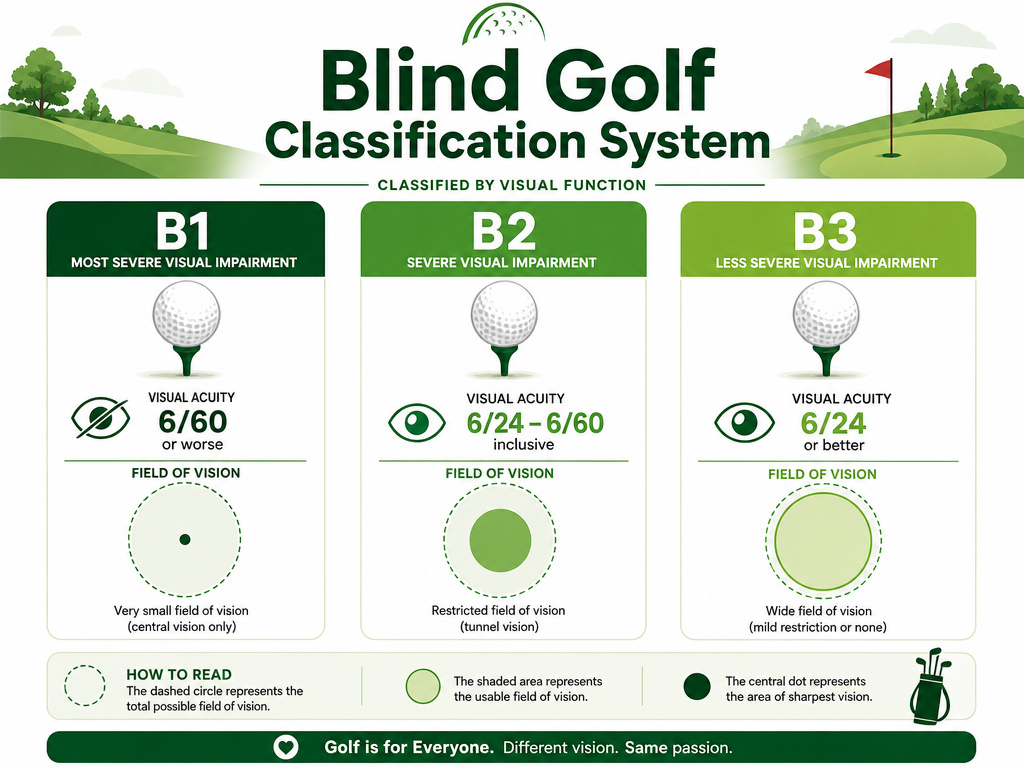 Not all visually impaired golfers have the same level of sight, so competitions are divided into classes to keep things fair. This isn’t a functional classification based on golf skill; it’s a medical classification.
| Classification | Visual Acuity | Field of Vision | Typical Description |
|---|---|---|---|
| B1 | Worse than 6/60 (20/200) or total absence of light perception. | Less than 5 degrees. | Totally blind. |
| B2 | Between 6/60 (20/200) and 6/120 (20/400). | Between 5 and 10 degrees. | Partially sighted, very limited vision. |
| B3 | Between 6/120 (20/400) and 6/240 (20/800). | Between 10 and 20 degrees. | Partially sighted, able to perceive shapes and light. |
This system ensures a B1 player isn’t competing directly against a B3 player who might detect light, shadow, or large shapes. Everyone plays within their classification. This shows that blind golf is not a single type of activity; the experience and required changes differ a lot.
Equipment and the Player’s Swing
Let’s be clear about equipment: a blind golfer uses the same clubs as anyone else. The adaptation is in the swing, not the gear. Because they can’t make last-second visual corrections, the swing must be built on repeatable mechanics and feel.
The grip is taught by feel, with the coach making manual adjustments. The takeaway is often kept more compact, a shorter backswing is easier to control and return to a consistent position. This isn’t a limitation; it’s a smart adaptation. Many sighted amateurs would benefit from the same focus on a controlled, repeatable motion rather than chasing a long, loose backswing.
Club selection is a collaborative decision, but the player’s feel is paramount. A coach might suggest a 7-iron, but if the player feels that club doesn’t produce the right distance for that day’s swing, they’ll speak up. This is where modern tools can help. While I’m generally skeptical of gadgets, a simple golf swing analysis session that provides audio feedback on tempo can be invaluable for reinforcing a blind golfer’s internal sense of timing.
Simple. The goal is a motion they can trust without seeing it. That often leads to swings that are technically efficient, balanced, and less prone to the over-complicated movements sighted players talk themselves into.
On the Course: Strategy and Common Scenarios
Strategy in blind golf is a team effort with a clear division of labor. The coach handles course management, knowing when to lay up short of a hazard, suggesting the right line on a dogleg hole, judging wind. The player focuses on executing the shot that’s been described.
Where this goes sideways: A coach over-describing trouble. Telling a player “there’s water left and a bunker right” before a 150-yard shot can create mental clutter. Better to say, “155 yards, middle of the green is fine.” The player then swings to the distance, not away from hazards.
Bunker play is a prime example of the rules in action. The player can ground their club, which gives them crucial information about the sand’s depth and the ball’s position. But they still have to execute the splash shot by feel. Putting has its own rhythm. Some players like to walk off the distance to the hole, counting paces to internalize the length. The coach will read the break and slope, but on the green, the coach cannot place an object for alignment, the player must use the verbal description and their practiced stroke.
Ball selection also plays a subtle role. A consistent, durable ball helps. Many find that softer-feeling 70 compression balls or forgiving 2-piece balls provide better auditory and tactile feedback on clean strikes, which reinforces that all-important feel.
Frequently Asked Questions
Can a blind golfer have two caddies?
No. A player can have one coach (aide) and one caddie, but the coach cannot perform caddie duties like carrying the bag. If the coach handles the clubs outside of alignment help, the player is penalized for having two caddies.
How does a blind golfer find their ball?
The coach walks with the player and describes the area. They will often use precise yardage and directional cues (“about ten paces ahead of the blue 150-yard marker, in the first cut on the right”). Other players in the group also assist in spotting the ball.
Do blind golfers ever get hole-in-ones?
Yes. There are recorded instances in competitions. It’s a testament to the precision of their distance control and the accuracy of their coach’s alignment. The shot is just as valid and celebrated as any other ace.
What’s the biggest misconception about blind golf?
That it’s a novelty or purely recreational. It’s a highly competitive sport governed by strict rules. The players are athletes who have honed their skills through immense practice. The scores in top-tier blind golf competitions are often in the 70s and 80s for 18 holes.
Can a blind golfer play on any course?
Yes. They play by the same basic rules, just with the modifications of Rule 25. Any course that allows public or member play is open to them. The main requirement is a willing and trained coach.
Before You Go
The real insight of blind golf isn’t about what’s missing. It’s about what becomes hyper-developed: communication, trust, and a profound physical awareness of the swing. It strips the game back to its core elements, a player, a target, and a motion to connect them.
If you’re interested in the sport, either as a potential player or a coach, start with feel. Hit balls with your eyes closed on the range to understand the balance zone. Practice describing shots in clear, numerical terms. And remember, the best equipment is often the simplest, reliable amateur clubs and consistent all-round golf balls build confidence faster than any technical trick. Good golf should feel less complicated the more you understand it, and blind golf is the ultimate proof of that principle.
