
What Is Best Ball in Golf? The Team Format Rules Explained
This post contains affiliate links. As an Amazon Associate, we earn from qualifying purchases.
Best ball in golf is a team format where every player plays their own ball for the entire hole, and only the lowest individual score on that hole counts for the team total. Under USGA Rule 23, the official name for two-player best ball is Four-Ball. This format is distinct from a scramble, and it’s the only common team game where your individual score can still be posted to your handicap index.
That last point about handicaps is where most weekend tournaments quietly get it wrong. The USGA’s recommended handicap allowance for a two-man best ball is 85% of your course handicap, not 100%. Using full handicaps tilts the field. The rest of the format is about managing two scores instead of one, which changes every decision from the tee box to the green.
What follows: the exact scoring mechanics, the official rulebook distinctions most players miss, a breakdown of how handicaps actually work in this format, and the strategic shift that turns a pair of golfers into a team.
Key Takeaways
- The official USGA term for two-player best ball is Four-Ball, governed by Rule 23.
- In a net best ball event, the USGA recommends each player uses 85% of their course handicap (90% for match play) to ensure fair competition.
- Best ball is the only team format (vs. Scramble or alternate shot) where your individual score can be posted to your official handicap index.
- The hyphenated term “Best-Ball” in the rulebook refers to a specific 1-vs-2 or 1-vs-3 match play format, not the common team game.
- Effective strategy relies on the “safe and aggressive” player model on each hole to maximize birdie chances while securing a team score.
How Does Best Ball Scoring Actually Work?
You play your own ball. Your partner plays theirs. At the end of the hole, you compare scores. The lower number is all that goes on the team card.
Each player completes the hole with their own ball, recording their individual gross score. The team’s score for the hole is the lowest gross score recorded by any team member. In net competitions, course handicap strokes are applied to each individual score first, and the lowest resulting net score becomes the team score for the hole.
It is a simple concept that creates a unique psychological safety net. Your double bogey disappears if your partner makes par. This safety net directly enables more aggressive play. If your partner is safely on the green in regulation, your approach shot becomes a free run at the pin. There is no penalty for missing, only upside if you hit it close. This dynamic is the core strategic engine of the format.
The team score will almost always be lower than any single player’s individual round. A typical two-person team might post a net score five to ten strokes under par. A four-person team in a charity event might go even lower. The math is straightforward: with more players, the odds increase that someone in the group has a good hole.
| Team Size | Typical Net Score (vs. Par) | Primary Use Case |
|---|---|---|
| 2-Person | -5 to -10 | Club competitions, member-guests, Ryder Cup Four-Ball |
| 4-Person (1 Best Ball) | -8 to -15 | Charity outings, corporate events, casual tournaments |
| 4-Person (2 Best Balls) | -12 to -20 | Events where two scores count, increasing team depth |
The critical paperwork happens on the scorecard. Every player must keep their own full 18-hole score. The team score is kept on a separate line. This individual record is what allows the round to count toward your official handicap, a key detail that separates best ball from other team games.
The Official Rules: Four-Ball, “Best-Ball,” and What the Rulebook Says
Most golfers use “best ball” and “Four-Ball” interchangeably. For casual play, that’s fine. But the rulebook draws a precise, and often overlooked, distinction.
The United States Golf Association (USGA) and the R&A govern the game worldwide. Rule 23 of the Rules of Golf is titled “Four-Ball,” and it is the complete rule set for two-player best ball competitions, both in stroke play and match play. This is the format you see in the Ryder Cup, Solheim Cup, and Presidents Cup during the team sessions. When a tournament poster says “Four-Ball,” this is the rule they are using.
Then there’s the hyphenated version. Rule 30 covers “Best-Ball.”
The part nobody mentions: The Official Rules of Golf define “Best-Ball” as a match in which one player plays against the better ball of two other players or the best ball of three other players.
This is a 1-vs-2 or 1-vs-3 match play format. It’s not the team-against-team game you see at a charity outing. This specific rule is why purists get twitchy about terminology. For the overwhelming majority of golfers, “best ball” means the team format. Just know that if you ever see “Best-Ball” in a formal competition notice, check the details—it might be that rare 1-vs-many match.
Finally, three- and four-player best ball variations are immensely popular for club events and outings. These are not officially recognized formats under Rule 23, which is strictly for two-player teams. They operate on the same principle but exist in the realm of “local rules” and tradition. Their legitimacy comes from the USGA Handicap Manual, which provides specific handicap allowances for these larger teams to keep competition fair.
Handicaps in Best Ball: The 85% Rule and Net Scoring
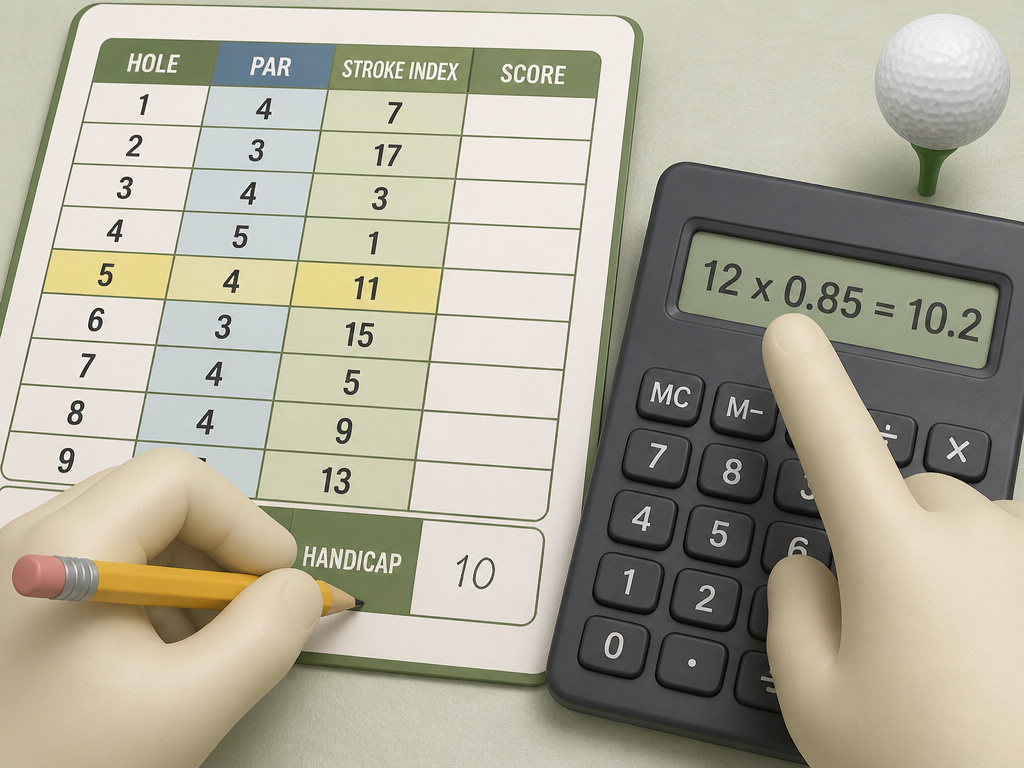 Handicaps are what make best ball accessible and competitive for mixed-ability groups. They are also the most common source of tournament error. Most events default to using 100% of a player’s course handicap. The USGA recommends a different number.
The governing body publishes handicap allowances in its Handicap Manual to adjust for the statistical advantage of a team format. These percentages level the playing field.
| Team Format & Type | USGA-Recommended Handicap Allowance |
|---|---|
| Two-Person Best Ball (Stroke Play) | 85% of course handicap |
| Two-Person Best Ball (Match Play) | 90% of course handicap |
| Four-Person Best Ball (1 Ball Counts) | Men: 80%, Women: 90% of course handicap |
| Four-Person Best Ball (2 Balls Count) | 90% of course handicap |
Here is how it works in practice. You have a course handicap of 12. For a two-person stroke play event, you take 85% of 12, which is 10.2. You then round to the nearest whole number, giving you 10 strokes. You receive those strokes on the 10 hardest holes as indicated by the stroke index on the scorecard.
On a hole where you get a stroke, your gross 5 becomes a net 4. If that net 4 is the lowest score between you and your partner, it counts for the team. This system allows a higher-handicap player to contribute meaningfully on specific holes, which is the entire point of a net competition. A smart team knows which holes are their “stroke holes” and plays them accordingly—often with a more conservative strategy to secure that net par or birdie.
Common mistake: Using 100% of course handicaps in a best ball event. This over-allocates strokes to higher-handicap players, giving their team an unearned statistical advantage that the USGA’s 85% formula is designed to neutralize.
Best Ball vs. Scramble vs. Alternate Shot: Which Format Is Which?
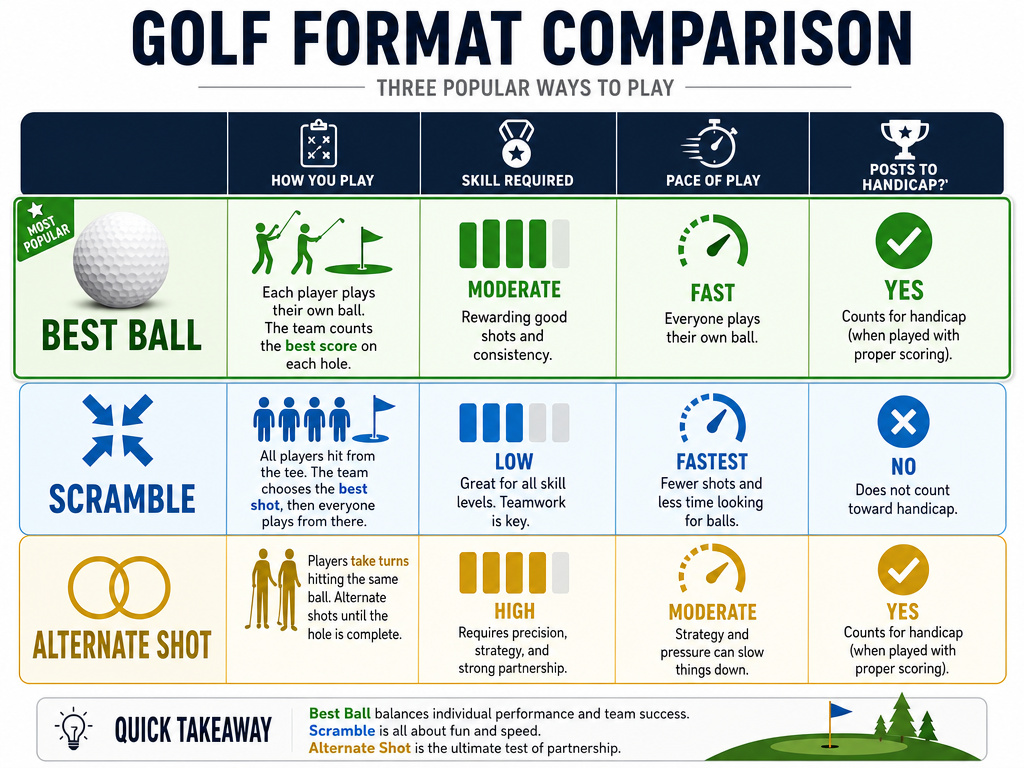 The confusion is real. All three are team formats, but they function so differently that they create entirely separate experiences. Choosing the right one depends on your group’s skill level, competitiveness, and goals.
Best Ball is the format of individual accountability within a team framework. You own your score, but only your best hole matters. It’s the standard for club championships and any event where players want their round to count toward their handicap. The pace of play is a normal round.
A Scramble is the format of ultimate forgiveness. Every player hits a tee shot, the team chooses the best one, and everyone plays their next shot from that spot. This repeats until the hole is finished. Bad shots are erased. It’s faster, more social, and perfect for charity outings or groups with wildly varying skills. Your individual score is meaningless, and the round does not post to your handicap.
Alternate Shot (or Foursomes) is the format of maximum pressure and partnership. Two-player teams share one ball, alternating shots tee-to-green. You hit the drive, your partner hits the approach, you hit the putt. It requires immense trust and consistency, as one player’s mistake immediately becomes their partner’s problem. It’s a staple of elite match play events like the Ryder Cup but is less common in casual play.
| Format | How You Play | Skill Required | Pace of Play | Posts to Handicap? |
|---|---|---|---|---|
| Best Ball | Your own ball, start to finish | High – you must complete every hole | Standard 18-hole round | Yes |
| Scramble | All play from the best shot | Low – mistakes are erased | Faster than standard | No |
| Alternate Shot | Partners share one ball, alternating shots | Very High – synergy is critical | Fastest | No |
The choice comes down to purpose. For a serious game where scores matter, use best ball. For a fun, social outing with beginners, choose a scramble. For a pure test of teamwork under pressure, try alternate shot. Understanding these differences is the first step in selecting the right ball and strategy for the day.
Winning Best Ball Strategy: It’s About Roles, Not Heroes
Good best ball teams aren’t carried by one superstar. They operate on the “ham and egg” principle—different players contribute on different holes. To make this happen, you need a plan for each hole before anyone tees off.
The most effective model is the “Safe and Aggressive” player strategy. On every hole, the team designates one player to be the “safe” player and one to be the “aggressive” player. The safe player’s job is to find the fairway, find the green, and secure a par. The aggressive player is then freed up to take on riskier shots—cutting a corner, firing at a sucker pin, running a long putt—in pursuit of a birdie.
Who takes which role changes hole by hole. It depends on driving accuracy, approach shot distances, wind direction, and confidence. If the hole is a long par 3 over water that suits your partner’s club selection, they become the aggressive player. Your job is to get the ball on dry land. This coordinated approach systematically gives your team two looks at every hole: one for par, one for birdie.
Communication is the glue. This isn’t just cheerleading. It’s actionable intelligence. – On the tee: “I’m going to rip a driver here. If I find the trees, you play an iron to the fairway.” – On the approach: “My ball is in the back bunker. You need to take enough club to get over the front ridge.” – On the green: “My putt was straight and died a foot short. Hit yours with a hair more pace.”
The mental game is equally crucial. When you hit a poor shot, you must immediately reset. Your job is now to support your partner, not sulk. A simple “You’ve got this one, I’m out” relieves their pressure and lets them focus. This ability to compartmentalize bad holes is what separates good best ball pairs from great ones. It also influences your equipment choices; knowing you have a safety net might make you more confident with a low spin vs high spin ball off the tee.
Frequently Asked Questions
Is best ball the same as Four-Ball?
Yes, for all practical purposes. Four-Ball is the official competition name used in the Rules of Golf (Rule 23) for two-player best ball. The term “best ball” is the common, recreational name for the same format. In events like the Ryder Cup, you will always hear it called Four-Ball.
How many players are on a best ball team?
Teams are most commonly two or four players. Two-player teams are standard for competitive play under USGA rules. Four-player teams are the norm for charity scrambles and casual outings, where the single best score (or sometimes the two best scores) counts.
Can you use best ball scores for your handicap?
Yes, and this is a major differentiator. Because every player completes each hole with their own ball, you have a legitimate individual 18-hole score. This score can and should be posted to your handicap index. Scramble and alternate shot rounds cannot be posted.
What’s the difference between best ball and a scramble?
This is the most common confusion. In a best ball, each player plays their own ball for the entire hole. In a scramble, all players hit, then the team selects the best shot and everyone plays their next shot from that spot. A scramble is more forgiving and faster; best ball requires more individual skill. Your golf ball construction choice matters more in best ball, as you play your own ball all day.
What is “Better Ball” in golf?
“Better ball” is simply another name for the two-player best ball/Four-Ball format. Some regions and players use it interchangeably. It does not refer to a different game.
Before You Go
Best ball turns golf into a team sport without robbing you of your individual game. You get the camaraderie of a partner and the satisfaction of your own scorecard. Remember the two rules that matter most: know the official handicap allowance (it’s probably 85%, not 100%), and always designate a safe and aggressive player on every hole.
That strategic pairing is what lowers scores. It turns two golfers into a unit that covers for mistakes and pounces on opportunities. Whether you’re signing up for a member-guest or just trying a new format with friends, that’s the shift that makes it work. Now you know what to look for in versatile golf balls that can handle both the safe and aggressive shots your team will need.
