
Low Spin vs High Spin Golf Ball | The 4,000 RPM Wedge Gap
This post contains affiliate links. As an Amazon Associate, we earn from qualifying purchases.
This post contains affiliate links. As an Amazon Associate, we earn from qualifying purchases.
Choosing between a low spin and high spin golf ball hinges on one trade-off: driver distance versus wedge control. Low-spin models, often with ionomer covers like the Callaway Supersoft, reduce backspin off the tee for straighter, longer drives but offer minimal stopping power on approach shots. High-spin balls, typically urethane-covered tour models like the Callaway Chrome Tour X, generate significantly more greenside spin, up to 4,000 RPM more on wedge shots, for precise control, at the cost of potentially higher driver spin that can exaggerate a slice.
The 4,000 RPM figure is the measured wedge-shot gap between the highest and lowest spinning balls in the 2025 MyGolfSpy robot test. That single number reframes the entire choice from a vague preference to a concrete performance decision.Your short game either needs that stopping power or it doesn’t.
What follows is a breakdown of the 2025 robot data, the real-world consequences of each spin profile, and a clear guide to matching a ball to your swing speed and the part of your game that dictates your score.
Key Takeaways
- The biggest spin difference is on wedge shots: high-spin urethane balls can generate nearly 4,000 RPM more than low-spin ionomer models on a 35-yard pitch.
- Low-spin balls (e.g., Callaway Supersoft) reduce driver spin for less curvature and more rollout but sacrifice iron and wedge stopping power.
- High-spin balls (e.g., Callaway Chrome Tour X) maximize greenside control and approach shot hold but can increase driver spin, potentially amplifying a slice.
- Swing speed dictates priority: slower speeds often need the lift and spin of a tour ball for carry and holding greens; faster speeds may need a low-spin ball to control excess backspin.
- You can’t have both: the design that creates low driver spin (firm core, ionomer cover) is the same design that creates low wedge spin.
The Core Trade-Off: Distance Forgiven vs. Control Earned
This discussion concerns where on the course you need help most. The engineering of a golf ball forces a choice between two conflicting goals.
A low-spin ball is built for the tee box. It typically features a firmer, high-compression core and a harder ionomer cover (like Surlyn). This construction transfers more energy to the ball at high clubhead speeds, reducing the friction-induced backspin that causes the ball to balloon or curve excessively. The result is a flatter, more penetrating flight with more roll. The trade-off is a lack of friction around the greens, the same hard cover that reduces driver spin also slides off wedge faces, offering little check or bite.
A 2025 robot test found the Titleist Velocity spun at just 2,058 RPM on a 35-yard wedge shot, while the TaylorMade TP5 spun at 6,026 RPM. That 4,000 RPM gap is the difference between a shot that releases 15 feet and one that stops within a foot of its pitch mark.
A high-spin ball is built for the scoring zone. It uses a softer, often multi-layer core and a soft urethane cover. Urethane is exceptionally grippy. It “grabs” the grooves of your wedges and irons, creating more friction and more backspin. This allows for steep descent angles and quick stopping power on greens. However, that same grabby cover can increase spin off the driver, which for some players turns a fade into a slice or reduces overall carry distance.
Breaking Down the 2025 Robot Test Data
Forget generalizations. The latest robot testing from MyGolfSpy provides the specific numbers that show where spin differences actually matter in your bag.
| Shot Type | Where Spin Varies Most | Performance Impact | Example Gap (2025 Test) |
|---|---|---|---|
| Driver | Subtle (~200-500 RPM) | Affects curvature & rollout; high spin can balloon, low spin can fall short. | Chrome Tour X (3,490 RPM) vs. Supersoft (2,589 RPM) at low speed. |
| Mid-Iron | Significant (~1,300 RPM) | Dictates green-holding ability; low spin releases, high spin checks. | Titleist Tour Soft (6,749 RPM) vs. Callaway ERC Soft (5,428 RPM) at mid speed. |
| Wedge | Massive (~4,000 RPM) | Determines short-game control; the single biggest differentiator. | TaylorMade TP5 (6,026 RPM) vs. Titleist Velocity (2,058 RPM) on a 35-yard shot. |
The table reveals the critical insight: driver spin differences are often overemphasized, while wedge spin differences are underrated. A 300 RPM difference off the driver might change your total distance by a few yards. A 3,000 RPM difference with a gap wedge changes your entire short-game strategy.
Where this goes sideways: Choosing a ball based only on driver performance. If you can’t stop a 7-iron on the green, the extra 8 yards off the tee are meaningless. Your wedge spin needs dictate the category; your driver swing fine-tunes the model.
The data also shows a clear material divide. The lowest-spinning balls across all tests. Callaway Supersoft, Srixon Soft Feel, TaylorMade SpeedSoft, are all ionomer-covered. The highest-spinning balls. Callaway Chrome Tour X, Srixon Z-Star Diamond, TaylorMade TP5, are all urethane-covered. Your cover material choice locks in your spin profile.
Which Golf Ball Spin Profile Fits Your Swing Speed?
Your swing speed doesn’t just affect distance; it changes how a ball’s spin profile interacts with your game. The “low spin for fast players, high spin for slow players” rule is an oversimplification that the 2025 data contradicts.
For High Swing Speeds (105+ mph Driver)
You generate plenty of spin naturally. Your primary goal is often to reduce excessive backspin off the driver to maximize carry and minimize curvature. * Low-Spin Priority: A low-spin, often high-compression ball like the Srixon Z-Star or Bridgestone Tour B X can help lower your driver spin into an optimal window (1,700-2,200 RPM) for a penetrating flight. The trade-off is that these are still urethane balls, so you retain excellent greenside control. * The Risk: Going to a pure distance ball (ionomer cover) sacrifices all short-game spin. For a skilled player, that’s rarely a good trade. The modern tour ball is a low-driver-spin, high-wedge-spin design.
For Mid Swing Speeds (85-104 mph Driver)
You have the most strategic flexibility. This is where balancing a lower-spin driver ball with higher-spin irons makes the most sense, according to the MyGolfSpy spin range analysis. * Balanced Approach: Consider a mid-spin urethane tour ball like the TaylorMade Tour Response or Callaway Chrome Soft. It provides manageable driver spin and very good wedge spin. This is the category where understanding your own spin rate and launch angle is most valuable. * The Decision: If you fight a slice, a softer, low-spin model like the Callaway Supersoft can help straighten drives. Just know your approaches will release more.
For Low Swing Speeds (Under 85 mph Driver)
You need all the help you can get to generate lift and carry. High spin is your friend, not your enemy. * High-Spin Priority: A high-spin, often softer compression ball like the Titleist Tour Soft or Srixon Q-Star Tour is ideal. The extra spin helps get the ball airborne, increases carry distance, and provides crucial stopping power on greens that your lower ball speed might not otherwise create. * The Mistake: Choosing a rock-hard, low-spin distance ball. It will fall out of the air too quickly, costing you total distance and making it impossible to hold a green. For many high handicapper low spin balls are a misnomer; they often need more spin, not less.
Urethane vs. Ionomer: The Cover Material Decides
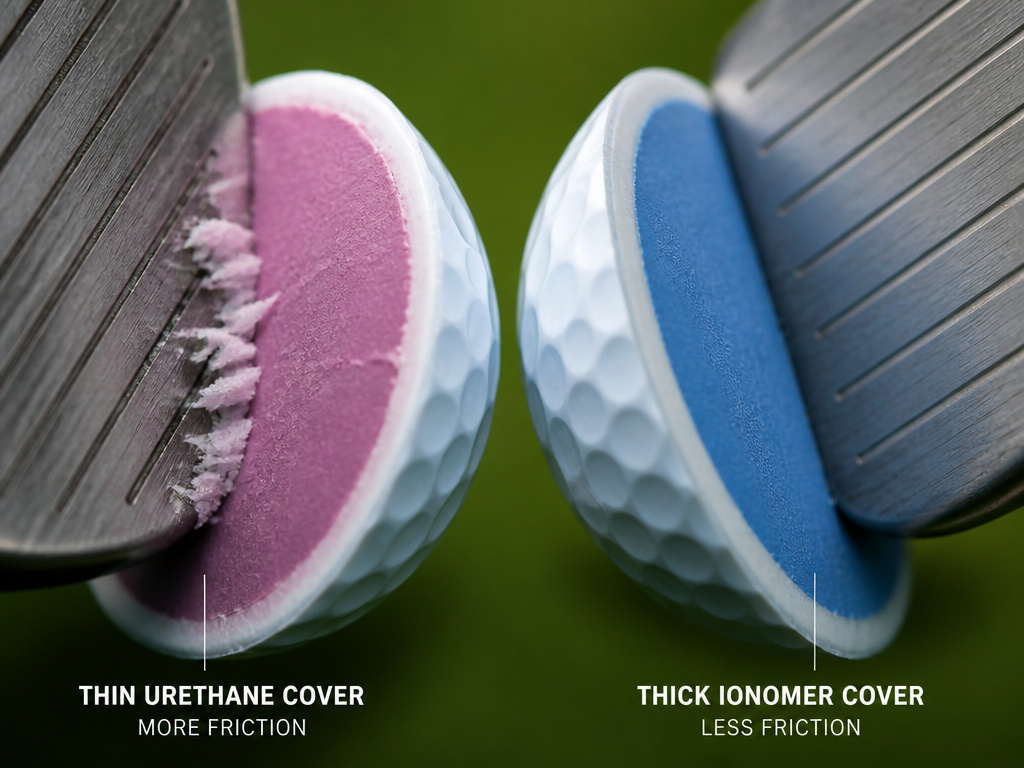
The single most important component for spin is the cover. Everything else, core layers, dimple pattern, works in support of this one material choice.
Urethane Covers are soft, thin, and exceptionally grippy. They feel like a high-quality leather. When a wedge’s grooves bite into a urethane cover, they create massive friction, generating the high spin rates essential for short-game control. Every tour ball and most premium models use urethane. It’s the reason a Callaway Chrome Tour X can stop on a dime. The downside is that this material is expensive and can cut more easily.
Ionomer Covers (like Surlyn) are harder, more durable, and cheaper to produce. They feel clickier off the putter. This hardness reduces friction with the clubface, which is why they produce lower spin rates across the bag. This makes them excellent for golf balls to reduce slice spin and maximize durability for beginners. The trade-off is a complete lack of greenside bite.
The part nobody mentions: You can’t “add” wedge spin to an ionomer ball. If you need the ball to check, you must start with a urethane cover. All other spin talk is secondary.
This fundamental difference is why the urethane vs Surlyn choice is the first and most critical one you make. Your cover material dictates your spin ceiling.
How to Test and Choose Your Golf Ball

Launch monitor data is best, but you can make an informed choice with a simple, on-course test.
- Identify Your Priority. Are you losing strokes off the tee (slices, lack of distance) or around the greens (can’t stop chips, approaches rolling through)?
- Buy Two Sleeves. Get a premium urethane ball (TaylorMade TP5, Titleist Pro V1) and a value ionomer ball (Callaway Supersoft, Srixon Soft Feel).
- Conduct a Short-Game Test. Hit ten identical 30-yard pitch shots with each ball to a green. Observe which one stops faster and more predictably. The urethane ball will win decisively.
- Conduct a Driver Test. Hit five drives with each ball. Note the ball flight and overall feel. Does the ionomer ball fly noticeably straighter or lower?
- Weigh the Results. If the wedge spin advantage of urethane is dramatic and the driver difference is minor, play the urethane ball. If your driver is a disaster with the tour ball and your short game doesn’t benefit much, the ionomer ball might be your fix.
Your ball should complement your game, not fight it. If you’re a player who relies on bump-and-run chips, you don’t need a high-spin monster. If you attack pins from 150 yards, you do.
Frequently Asked Questions
Can a high swing speed player use a high spin golf ball?
Absolutely. Many tour players with swing speeds over 115 mph use high-spin balls like the TaylorMade TP5 or Callaway Chrome Tour X. The key is that their delivery and angle of attack produce an optimal, not excessive, amount of spin. They use the spin for control. Amateurs with high speed who have a steep angle of attack or strike down on the driver may generate too much spin, making a lower-spinning tour model a better fit.
Do low spin golf balls go further?
They can, but only if excess backspin is costing you distance. For a player who balloons their drives (very high launch, very high spin), a low spin golf ball will reduce that spin, leading to a more penetrating flight and more rollout, increasing total distance. For a player with low launch and low spin already, a low-spin ball may actually lose carry distance because it won’t stay in the air long enough.
What is the best low spin golf ball for a slicer?
Look for a ball with an ionomer cover and a softer compression. The Callaway Supersoft is the benchmark. The soft feel can help promote a better release through impact, and the low-spin design minimizes the side spin that exacerbates a slice. It’s a band-aid, not a cure, but it’s an effective one for many players.
How does golf ball compression relate to spin?
Generally, higher compression balls (firmer) are geared toward faster swing speeds and can be designed to produce lower driver spin. Lower compression balls (softer) are easier to compress for slower swings and often generate more spin across the board. However, cover material is a stronger spin determinant. You can have a low-compression, high-spin ball (Titleist Tour Soft) and a high-compression, low-spin ball (Titleist Pro V1x). Our golf ball compression explained guide dives deeper.
Why do all tour players use high spin golf balls?
Because their livelihood depends on controlling the golf ball from 120 yards and in. The massive greenside spin of a urethane-covered ball allows them to attack pins, stop the ball on firm greens, and execute a wide variety of short-game shots. They have the skill to manage the driver spin. For them, the trade-off is overwhelmingly in favor of control.
The Bottom Line
Stop thinking about spin as a single number. Think about it as a signature that changes from club to club. Your driver wants one thing, your wedge wants another, and the ball is a compromise.
If your score is built on keeping the ball in play off the tee and you prefer a simple short game, a low spin golf ball like the Callaway Supersoft will serve you well. If your game is about attacking flags and scoring inside 100 yards, a high spin golf ball like the TaylorMade TP5 is non-negotiable. The 4,000 RPM wedge gap is the defining line between the two categories. Choose based on where you need to save strokes, and let the rest of your game adjust.
