
The Open Championship Rota Explained: Courses & Turnberry
This post contains affiliate links. As an Amazon Associate, we earn from qualifying purchases.
This post contains affiliate links. As an Amazon Associate, we earn from qualifying purchases.
The Open Championship rota is the unofficial rotation of 10 historic links courses in Scotland, England, and Northern Ireland that host golf’s oldest major. The R&A, the tournament’s organizer, states there is no “official” rota, but since 1933 only these 10 courses have been used. The current lineup excludes Turnberry following a 2021 decision linked to its ownership.
That “unofficial” label matters. It means the selection isn’t locked in by a contract but by a century of tradition, course quality, and logistical capability. The list has shifted before, courses have been added and removed, and it might shift again, especially with talks about a course in the Republic of Ireland.
What follows is a breakdown of each of the ten rota courses, the specific record scores that define them, the political shadow over Turnberry, and the real criteria that keep a course in this elite rotation.
Key Takeaways
- The rota includes 10 courses: St. Andrews, Muirfield, Royal St. George’s, Royal Liverpool, Royal Lytham & St Annes, Royal Birkdale, Royal Troon, Carnoustie, Turnberry, and Royal Portrush.
- Turnberry is currently excluded from hosting; The R&A stated in 2021 it would not return there “under current circumstances,” a reference to Donald Trump’s ownership.
- St. Andrews has hosted 30 Opens, more than any other course, and is scheduled to host again in 2027.
- The rota is not an official, locked contract but a tradition-based rotation, allowing The R&A flexibility to add or remove venues.
- A course must be a true links layout with the infrastructure and challenge to test the world’s best golfers under often brutal conditions.
The 10-Course Rota: A Complete Breakdown
Since 1933, the championship has circulated among a consistent group of ten seaside links. This isn’t a random list. Each course delivers a specific type of punishment and theater. You can’t understand a major championship venue without knowing what each one asks of a player.
The table below is your quick reference. The “Record Score” is the lowest 72-hole total ever shot there during an Open, a number that tells you how gettable the course can be in perfect conditions.
| Course | Location | Opens Hosted | Record Score (To Par) | Record Holder |
|---|---|---|---|---|
| St. Andrews (Old Course) | Fife, Scotland | 30 | 268 (−20) | Cameron Smith (2022) |
| Muirfield | East Lothian, Scotland | 16 | 271 (−13) | Tom Watson (1980) |
| Royal St. George’s | Sandwich, England | 15 | 265 (−15) | Collin Morikawa (2021) |
| Royal Liverpool | Hoylake, England | 13 | 270 (−18) | Tiger Woods (2006) |
| Royal Lytham & St Annes | Lytham St. Annes, England | 11 | 271 (−13) | Tom Lehman (1996) |
| Royal Birkdale | Southport, England | 11 | 268 (−12) | Jordan Spieth (2017) |
| Royal Troon | Troon, Scotland | 10 | 264 (−20) | Henrik Stenson (2016) |
| Carnoustie | Carnoustie, Scotland | 8 | 276 (−8) | Francesco Molinari (2018) |
| Turnberry (Ailsa) | Turnberry, Scotland | 4 | 268 (−12) | Tom Watson (1977) & Nick Price (1994) |
| Royal Portrush | Portrush, Northern Ireland | 3 | 267 (−17) | Scottie Scheffler (2025) |
These numbers aren’t just trivia. They’re a direct measure of a course’s defense. Carnoustie’s record is only 8-under because its closing stretch, especially the par-4 18th nicknamed “Hogan’s Alley,” is one of the most demanding finishes in golf. In contrast, St. Andrews and Royal Troon have yielded 20-under winning totals, showing that calm conditions can turn these historic layouts into birdie festivals.
The R&A says there isn’t an “official” Open Championship rota, but since 1933 only 10 courses have hosted the Open Championship. It’s safe to say those 10 courses make up the rota, official or not.
This quote from the organization itself is the key. It grants The R&A the flexibility it needs. If a course’s membership makes a controversial decision (as Muirfield did regarding female members in 2016, briefly getting dropped), or if ownership becomes a political liability, they can pause its use without breaking a formal agreement.
The St. Andrews Anomaly: Hosting Every Five Years
Why does St. Andrews have nearly double the hosting count of its nearest rival? It’s the “Home of Golf.” The Old Course is the spiritual and ceremonial heart of the game, and The Open is its homecoming. The current pattern aims for a visit every five years, though world events like the pandemic have disrupted that rhythm.
The announcement for the 2027 Open was made unusually early, in January 2025, signaling a return to that quinquennial schedule. When you walk the Old Course at St. Andrews, you’re walking the same fairways where the history of The Open was written. That legacy is unmatched.
The Turnberry Question: Politics and the Rota
Turnberry’s stunning Ailsa Course is currently in limbo. It hosted four legendary Opens, including the 1977 “Duel in the Sun” between Tom Watson and Jack Nicklaus. Yet, it hasn’t hosted since 2009.
In 2021, then-R&A chief Martin Slumbers stated The Open would not return to Turnberry “under current circumstances”, a direct reference to Donald Trump’s ownership of the resort. This isn’t about the quality of the golf course, which is universally praised. It’s a logistical and political decision by The R&A to avoid the distraction and security complexities associated with the former president.
Where this goes sideways: Assuming the rota is set in stone. Turnberry’s absence proves it’s a living list, responsive to real-world concerns beyond grass and bunkers.
The door hasn’t been permanently closed. R&A officials have consistently said they “really like the golf course.” But its return hinges on a change in those “current circumstances,” making its future the biggest variable in the rota’s composition.
What Makes a Course “Rota-Worthy”?
It’s not just about being old and by the sea. A course must satisfy a brutal checklist to even be considered. I’ve walked these layouts in tournament conditions, and the wind off the water has a concrete feel, it doesn’t just move the ball, it reshapes your strategy from the ground up.
First, it must be a genuine links course. This means it’s built on sandy soil near the coast, with natural dunes, firm fairways, deep pot bunkers, and fescue grasses. The ball runs out, and the wind is the primary defense. This style is essential for The Open’s identity.
Second, it needs major championship infrastructure. We’re talking about space for grandstands for 50,000 fans, massive corporate hospitality villages, media centers, and parking for thousands. Many classic links are landlocked by towns or coastline, which rules them out. This is the primary reason wonderful clubs like Royal Dornoch or Ballybunion have never hosted.
Third, the course must provide a complete strategic test. It can’t be just long or just tricky. It needs a mix of risk-reward holes, a balance of par-5s that are reachable and ones that are three-shot holes for everyone, and a closing stretch that can crown or crush a champion. It’s what separates a great course from a true championship test.
Courses That Left the Rota (And One That Might Join)
The rota has evolved. Understanding who’s out tells you as much as knowing who’s in.
- Prestwick Golf Club: Hosted the first 12 Opens and 24 total, the last in 1925. It was deemed too short and lacked the space for growing crowds. Its removal was never officially declared, it just faded out.
- Musselburgh Links: A 9-hole course that co-hosted early Opens but was replaced by Muirfield in 1892.
- Royal Cinque Ports & Prince’s Golf Club: Both in Deal, England, they hosted a handful of early 20th-century Opens. Royal Cinque Ports was dropped after weather repeatedly forced cancellations, and Prince’s was damaged during World War II.
Today, the most likely addition is Portmarnock Golf Club in County Dublin, Ireland. The R&A has completed a positive feasibility study, and the Irish government has committed funding. It would be the first Open venue in the Republic of Ireland. Adding a new bucket list course of this caliber would be a historic shift, expanding the championship’s geographic footprint while staying true to its links roots.
The Open Rota vs. Other Major Championships
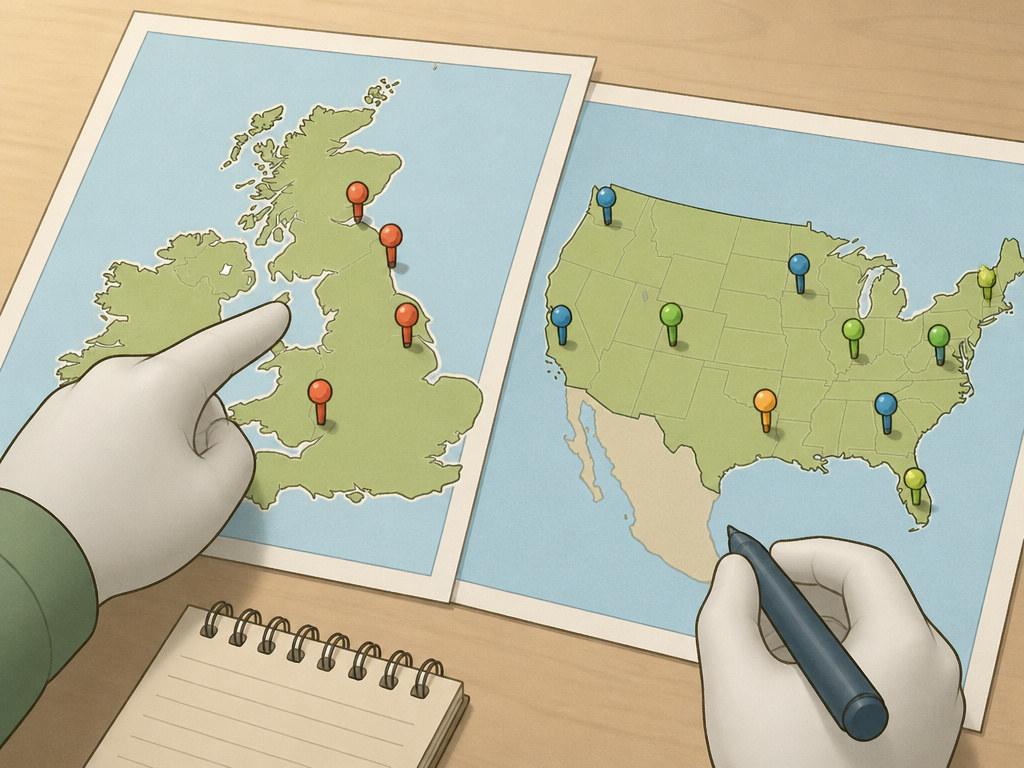 How does this rotation compare to the other men’s major championships? The contrast is stark and intentional.
The Masters is held at Augusta National Golf Club every single year. It’s defined by its permanence. The PGA Championship moves around the United States to various classic parkland and modern stadium courses. The U.S. Open rotates among a mix of classic and modern American courses, both links-style and parkland.
The Open’s rota is unique because it’s the only one exclusively tied to a specific type of course (links) and a specific region (the United Kingdom and Ireland). While the U.S. Open might go from Pinehurst to Pebble Beach to Winged Foot, The Open’s venues all share the same DNA of wind, sand, and rumpled fairways. You won’t find the tree-lined majesty of an Augusta or a famous American course like Oakmont on this list.
This focus creates a specialized skill set. Winning an Open requires mastering the low, running stinger, navigating unpredictable bounces, and possessing patience that can withstand a 40mph sideways rain shower. It’s a different game.
The Future Schedule: Where is The Open Heading?
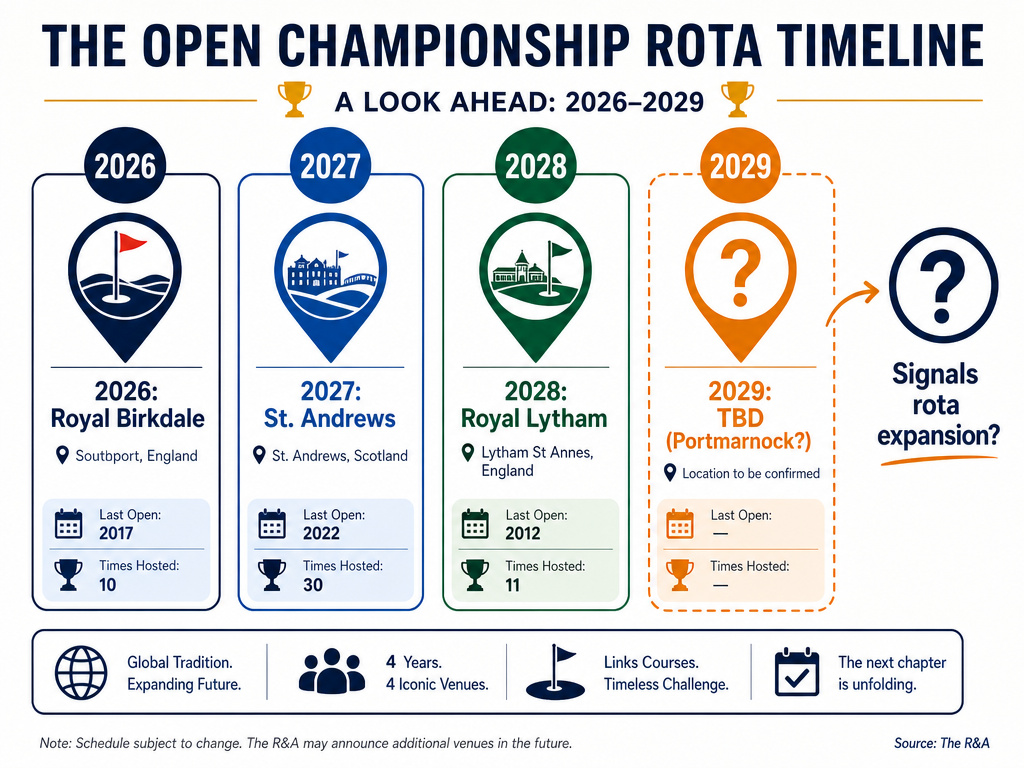 The schedule is set several years in advance, giving fans and players a clear roadmap. Here’s the confirmed upcoming slate, which you can also verify on the Wikipedia list of Open venues:
| Year | Venue | Notable Fact |
|---|---|---|
| 2026 | Royal Birkdale | 11th hosting; Jordan Spieth won here in 2017. |
| 2027 | St. Andrews (Old Course) | 31st hosting; returns to the “every five years” plan. |
| 2028 | Royal Lytham & St Annes | 12th hosting; announced in April 2026. |
| 2029 | TBD | Portmarnock is the leading candidate if a deal is finalized. |
The 2028 announcement for Royal Lytham was typical, made about two years prior. The 2027 announcement for St. Andrews was the exception, made early to reaffirm its special place in the cycle. Watching how the 2029 slot is filled will be telling. If it goes to Portmarnock, it signals the rota is actively expanding. If it returns to, say, Royal Liverpool or Royal Troon, it reinforces the current ten-course cycle.
Frequently Asked Questions
Is The Open rota official?
No, The R&A explicitly states there is no “official” Open Championship rota. However, since 1933, the championship has only been held at ten specific links courses, creating a de facto unofficial rotation that everyone refers to as the rota.
Why is Turnberry not in The Open rota?
Turnberry is not currently being used due to a 2021 statement from The R&A that it would not host The Open there “under current circumstances.” This is widely understood to refer to the course’s ownership by Donald Trump and the desire to avoid the associated political and security distractions. The R&A still praises the golf course itself.
How many courses are in The Open rota?
There are ten courses in the current, unofficial Open rota: St. Andrews, Muirfield, Royal St. George’s, Royal Liverpool, Royal Lytham & St Annes, Royal Birkdale, Royal Troon, Carnoustie, Turnberry, and Royal Portrush.
What is the most used course in The Open rota?
The Old Course at St. Andrews is by far the most used, having hosted The Open 30 times. It is considered the “Home of Golf” and is traditionally scheduled to host approximately every five years.
Can new courses be added to The Open rota?
Yes. The rota has changed before, and The R&A is actively exploring new venues. The strongest candidate is Portmarnock Golf Club in Ireland. A course must be a championship-level links with the necessary infrastructure and provide a stern test for the world’s best players.
The Bottom Line
The Open Championship rota is a tradition upheld by practicality. It’s a list of ten legendary links, each capable of producing a champion who has mastered golf in its rawest form. But remember the two rules that govern it: nothing is official, and nothing is permanent.
The exclusion of Turnberry proves that external forces can sideline even a world-class course. The pursuit of Portmarnock shows the rota can still grow. For a fan, this means the history you’re watching is still being written. The next change to the list won’t be announced with a rulebook citation, it’ll come from a quiet R&A feasibility study or a shift in the political weather. That’s what keeps this 150-year-old championship alive.
