
What Is the Presidents Cup? | Format, History & Venue
This post contains affiliate links. As an Amazon Associate, we earn from qualifying purchases.
This post contains affiliate links. As an Amazon Associate, we earn from qualifying purchases.
The Presidents Cup is a biennial, no-purse team golf competition organized by the PGA Tour, featuring 12 U.S. Players against 12 International players (excluding Europe) in 30 match-play contests over four days. The first team to reach 15.5 points wins; if tied, the Cup is shared. Since 1994, it has raised over $56.4 million for player-nominated charities worldwide.
This 15.5-point threshold is the entire game. It’s not a random number, it’s the exact majority of the 30 total points at stake, designed to force a decisive outcome while honoring the famous 2003 tie. Get that math wrong, and you misunderstand the event’s competitive tension.
What follows is a breakdown of the format most fans miss, the charity model that sets it apart, and the historical quirks, like its scheduling dance with the Ryder Cup, that define this unique event.
Key Takeaways
- The Presidents Cup is a team match-play event with no prize money; all net proceeds go to charities selected by the players and captains.
- A team needs 15.5 points to win from a total of 30 matches (12 Singles, 9 Foursomes, 9 Four-ball).
- The International Team’s only victory came in 1998 at Royal Melbourne Golf Club in Australia.
- The event’s schedule has been shifted twice by world events: after 9/11 in 2001 and due to COVID-19 in 2020.
- The 2026 Presidents Cup will be held at Medinah Country Club in Illinois, with Jim Furyk and Mike Weir returning as captains.
What Is the Presidents Cup? The Core Facts
The Presidents Cup isn’t just another golf tournament. It’s a team war fought over four days, where national pride replaces prize money. The format is pure match play, meaning you win holes, not post a total score.
Each team fields 12 players. The U.S. Side is exactly what it sounds like. The International Team is a coalition of the world’s best golfers from everywhere except Europe, think stars from Australia, South Africa, Japan, Canada, and South America. This global roster creates dynamic pairings you won’t see anywhere else.
The Presidents Cup is a four-day, match play event with 30 total matches, comprised of a 12-person U.S. Team and 12-person International Team. The team that earns the most points after four days of competition wins.
The heart of the competition is the team match formats. You’ll see foursomes, where two teammates alternate shots with one ball, a brutal test of synergy and strategy. Then there’s fourball, where both players play their own ball, and the team’s best score on each hole counts. This format often produces the most birdies and dramatic swings.
The captain’s role is massive here. They’re not just cheerleaders; they’re tacticians who decide which players pair together in the team sessions and in what order they’re sent out. A bad pairing decision on Friday can dig a hole a team never climbs out of.
A Brief History: From 1994 to the Modern Era
The event was born in 1994 at the Robert Trent Jones Golf Club in Virginia. The idea was to create a global team event for the non-European world, a counterpart to the storied Ryder Cup. The U.S. Won that first edition handily, setting a pattern that has largely held.
The International Team’s lone victory is a legendary outlier. In 1998, at the famed Royal Melbourne Golf Club in Australia, they delivered a stunning 20.5 to 11.5 defeat to a U.S. Team captained by Jack Nicklaus. The course’s firm, fast conditions favored the home team, and they executed perfectly. That win is a permanent reminder of the International side’s potential.
Then there’s the tie. The 2003 Presidents Cup in South Africa ended deadlocked at 17-17. Captains Jack Nicklaus and Gary Player sent Tiger Woods and Ernie Els out for a sudden-death playoff that stretched three holes into deepening darkness before they called it. That dramatic stalemate directly inspired the current tie rule: if the score is 15-15 after Sunday Singles, the teams share the Cup.
| Year | Venue | Winner | Score | Notable Moment |
|---|---|---|---|---|
| 1994 | Robert Trent Jones GC, USA | United States | 20-12 | Inaugural event. |
| 1998 | Royal Melbourne GC, Australia | International Team | 20.5-11.5 | International Team’s only win. |
| 2003 | The Links at Fancourt, South Africa | Tie | 17-17 | Woods-Els playoff halted by darkness. |
| 2015 | Jack Nicklaus GC Korea, South Korea | United States | 15.5-14.5 | U.S. Clinched on final hole. |
| 2022 | Quail Hollow Club, USA | United States | 17.5-12.5 | U.S.’s ninth consecutive win. |
The event’s calendar has been ping-ponged by history. It was postponed a year after the 9/11 attacks, moving to odd-numbered years. Then, the COVID-19 pandemic pushed the 2020 Ryder Cup, which bumped the Presidents Cup back to even years, where it currently resides. Keeping track requires a scorecard.
How the Scoring and Format Works
Forget stroke play. This is a points game. Every one of the 30 matches is worth a single point. Win your match, your team gets a point. Halve the match, each side gets half a point. The first team to cross 15.5 points claims the Cup. That number is crucial, it’s one more than half of 30, preventing another outright tie like 2003.
The four-day schedule is a grind designed to test depth and strategy.
- Day 1 (Thursday): 5 matches. The host captain chooses to start with either foursomes or fourball.
- Day 2 (Friday): 5 matches of the opposite format from Day 1.
- Day 3 (Saturday): 8 matches total, 4 fourball in the morning, 4 foursomes in the afternoon.
- Day 4 (Sunday): 12 Singles matches. Every player goes head-to-head.
The “snake draft” lineup selection is a show in itself. Captains alternate picks to set the pairings for each session. If the U.S. Captain puts out a powerhouse duo first, the International captain can choose which of his pairs he wants to match against them. It’s a high-stakes game of chess played with golfers.
Where this goes sideways: Thinking fourball is just a shootout. In team fourball, the player with the worse score on a hole is often out of the hole entirely. Smart teams use that player to take aggressive, high-reward risks they never would in individual play, knowing their partner has a safe ball in play. It’s strategic, not just long-drive exhibition.
Each player must compete in at least one match before Sunday Singles. This rule ensures the captain can’t hide a struggling player and forces them to build a cohesive team unit from the start.
The Teams: How Players Qualify and Are Selected
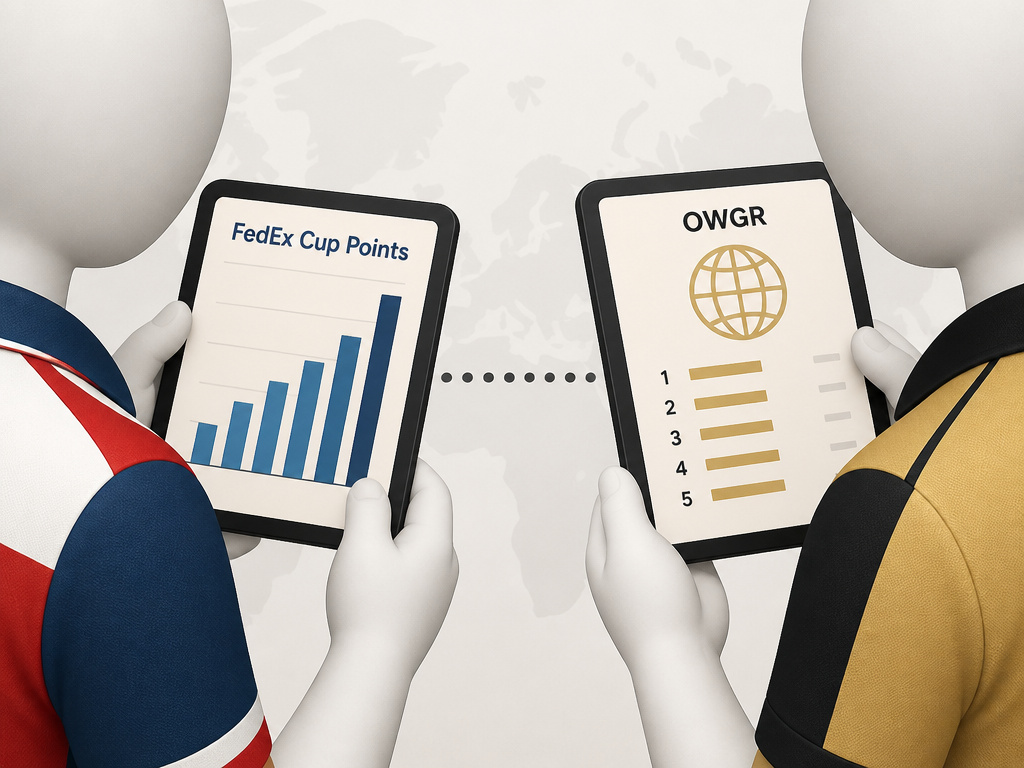 You don’t just play your way onto these teams. The qualification paths are different for each side, reflecting the structures of the PGA Tour.
The U.S. Team uses a FedEx Cup points system. Over a designated qualifying period (e.g., from January 2025 through August 2026 for the 2026 event), PGA Tour members earn weighted points based on their FedEx Cup standings. The top six point-earners get automatic spots. The remaining six slots are captain’s picks, chosen by the U.S. Captain for form, chemistry, or specific course fit.
The International Team uses the Official World Golf Ranking (OWGR). The top six eligible international players (again, excluding those eligible for Europe’s Ryder Cup team) in the OWGR after a cutoff tournament earn automatic berths. Their captain then fills out the roster with six picks.
This is where the captain’s influence becomes tangible. A pick might be a seasoned veteran for leadership, a hot putter for the specific greens, or a player who forms a known successful partnership with an automatic qualifier. A bad pick can fracture team morale; a great one can define a winning campaign.
The Presidents Cup vs. The Ryder Cup
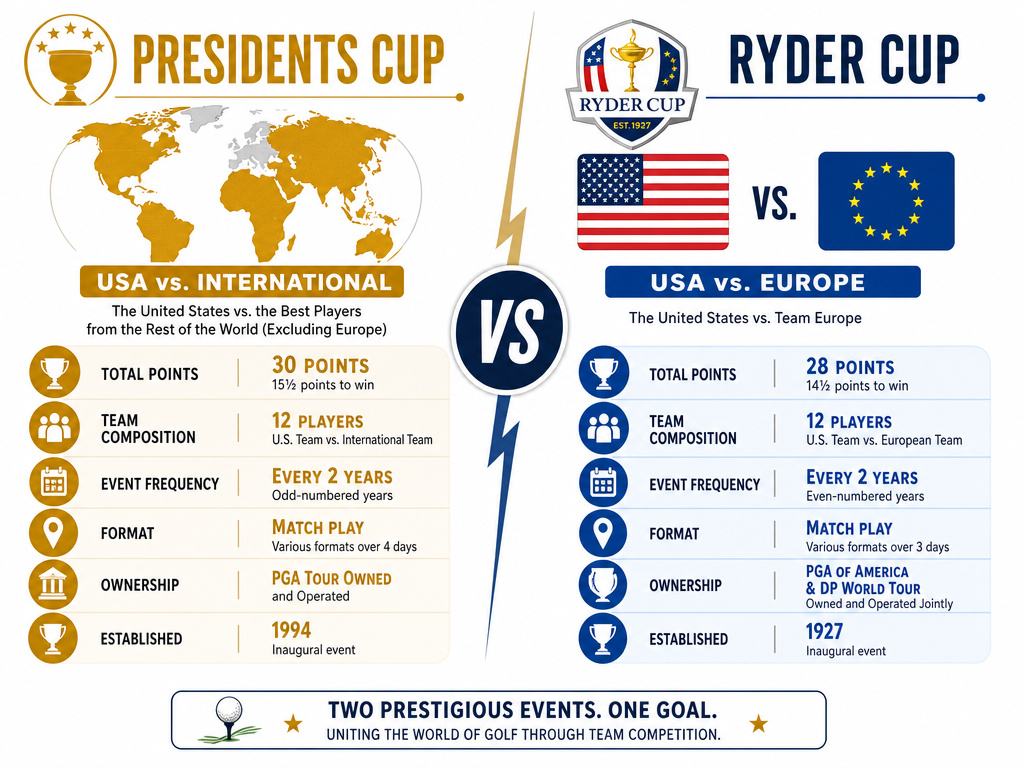 It’s the question every new fan asks. They look similar, team match play, biennial schedule, intense crowds, but the differences are fundamental.
The core difference is the opponent. The Ryder Cup is USA vs. Europe, a rivalry steeped in nearly a century of history. The Presidents Cup is USA vs. The World (minus Europe), a younger event created to give global stars a team stage. This makes the International Team a more diverse, and often less familiar, coalition.
The formats have structural divergences. The Ryder Cup has 28 total points; the Presidents Cup has 30. The Presidents Cup starts on a Thursday and uses the 15.5-point win threshold with a shared-Cup tie rule. The Ryder Cup retains the Cup in a tie. The match play intensity is the same, but the rhythms are distinct.
Finally, ownership. The Ryder Cup is jointly run by the PGA of America and Europe’s Ryder Cup Europe. The Presidents Cup is owned and operated by the PGA Tour. This influences everything from branding to, notably, player eligibility. LIV Golf players, currently suspended from the PGA Tour, are not eligible for the Presidents Cup.
The Charity Model: No Purse, Big Impact
This might be the most distinctive feature. There is no prize money. Players are not paid to compete. Instead, the net proceeds from the event are distributed equally among charities chosen by the players, captains, and assistant captains from both teams.
Since 1994, this model has generated over $56.4 million for more than 475 charities across 18 countries. That’s not a marketing line; it’s a tangible legacy. A player’s motivation shifts from a paycheck to representing his team and directing significant funds to causes he cares about personally.
It changes the atmosphere. The competition is fiercely proud, but there’s a underlying camaraderie and shared purpose you don’t always see in individual, purse-driven tournaments. The opening ceremony and team dinners carry a different weight when you know your performance is directly funding community projects, hospitals, or junior golf programs.
Looking Ahead: The 2026 Presidents Cup at Medinah
The next chapter is already written. The 2026 Presidents Cup will be held at Medinah Country Club (Course No. 3) in Medinah, Illinois. This is a iconic venue with major championship history, having hosted three U.S. Opens and two PGA Championships.
The captains will be familiar faces: Jim Furyk for the U.S. And Mike Weir for the International Team, both leading for the second consecutive time. This continuity is rare and sets up a fascinating strategic rematch.
Qualification for the 2026 teams is already underway. The U.S. Is accumulating FedEx Cup points from January 2025, while the International Team is tracking the Official World Golf Ranking. The race for those six automatic spots will shape the next two seasons on tour.
Frequently Asked Questions
What’s the difference between the Presidents Cup and the Ryder Cup?
The Ryder Cup pits the U.S. Against Europe. The Presidents Cup features the U.S. Against an International Team from the rest of the world (excluding Europe). The Presidents Cup also has a different points total (30 vs. 28), starts on Thursday, and has a shared-Cup tie rule.
Do golfers get paid to play in the Presidents Cup?
No. There is no prize money or appearance fee. Instead, all net proceeds from the event are donated to charities selected by the players, captains, and their assistants from both teams.
How often is the Presidents Cup held?
It is a biennial event, held every two years. Its schedule has occasionally been shifted by external events (like the 9/11 attacks or COVID-19) but it aims to alternate with the Ryder Cup.
Has the International Team ever won the Presidents Cup?
Yes, but only once. The International Team won decisively at Royal Melbourne Golf Club in Australia in 1998, by a score of 20.5 to 11.5. They came close to a second win in 2003, which ended in a historic tie.
Where can I watch the Presidents Cup?
Broadcast rights in the United States are held by NBC and Golf Channel, with streaming available on Peacock. Coverage typically includes all four days of matches, with extensive pre-and post-match analysis.
How are the captains chosen?
Captains are selected by the event’s organizational body, the PGA Tour, often in consultation with past captains and players. They are typically major championship winners or highly respected figures who can command the room and manage the unique pressures of team golf.
Before You Go
The Presidents Cup’s real appeal isn’t found in any one stat. It’s in the contrast: the fierce rivalry on the course against the shared mission off it. It’s a team event where a player’s worst shot can be saved by his partner, and where a victory funds a children’s hospital.
If you only watch one, make it the Saturday afternoon foursomes. That’s where partnerships are forged or broken under the heaviest pressure, and where the match play format reveals its brutal, beautiful simplicity. The Sunday Singles provide the climax, but the team sessions build the story.
Good golf should feel less complicated the more you understand it. The Presidents Cup, stripped of individual prize money and focused on team points, is a perfect example.
