
Stroke Play vs Match Play in Golf: How Scoring Really Works
This post contains affiliate links. As an Amazon Associate, we earn from qualifying purchases.
This post contains affiliate links. As an Amazon Associate, we earn from qualifying purchases.
Stroke play counts every stroke against the entire field for a total score, while match play is a head-to-head duel where you win individual holes. The general penalty in stroke play is two strokes; in match play, it’s loss of the hole. You must post scores for both formats, using your ‘Most Likely Score’ for any conceded holes in match play.
That scoring difference changes everything from your strategy to how you handle a rules breach. In stroke play, a bad hole lingers on your card. In match play, you shake it off and move to the next tee.
What follows is a breakdown of the three systems that flip between these formats: the scoring mechanics, the penalty structures, and the strategic mind games. By the end, you’ll know exactly which format you’re actually built for and how to avoid the common mistakes that cost holes and inflate scores.
Key Takeaways
- The general penalty is two strokes in stroke play but loss of hole in match play, fundamentally changing the cost of a mistake.
- You must post your match play score for handicap, using a ‘Most Likely Score’ for any hole you concede or don’t finish.
- Ready golf is encouraged in stroke play to speed up pace, but in match play, playing out of turn lets your opponent cancel your shot.
- A 2024 study in Computational Statistics found only a marginal advantage in tailoring your strategy to an opponent in match play; playing your own optimal game is usually better.
- For most casual games and tournaments, stroke play is the default. Save match play for team events like a skins game or club matches where head-to-head drama is the point.
The Core Difference: Head-to-Head vs. The Field
Stroke play is golf’s traditional format, where every player’s total strokes over 18 holes are tallied to determine a winner against the entire field. Match play is a direct, hole-by-hole duel between two players or sides, where the winner is the side that wins more holes than are left to play.
Your goal defines the game. In stroke play, you battle the course and every other player on it simultaneously. A triple-bogey on the 3rd hole is a scar on your card for the remaining 15. The player with the lowest total score wins. This is the format of every PGA Tour event (except the WGC-Dell Match Play and the Ryder Cup), major championships, and most club championships.
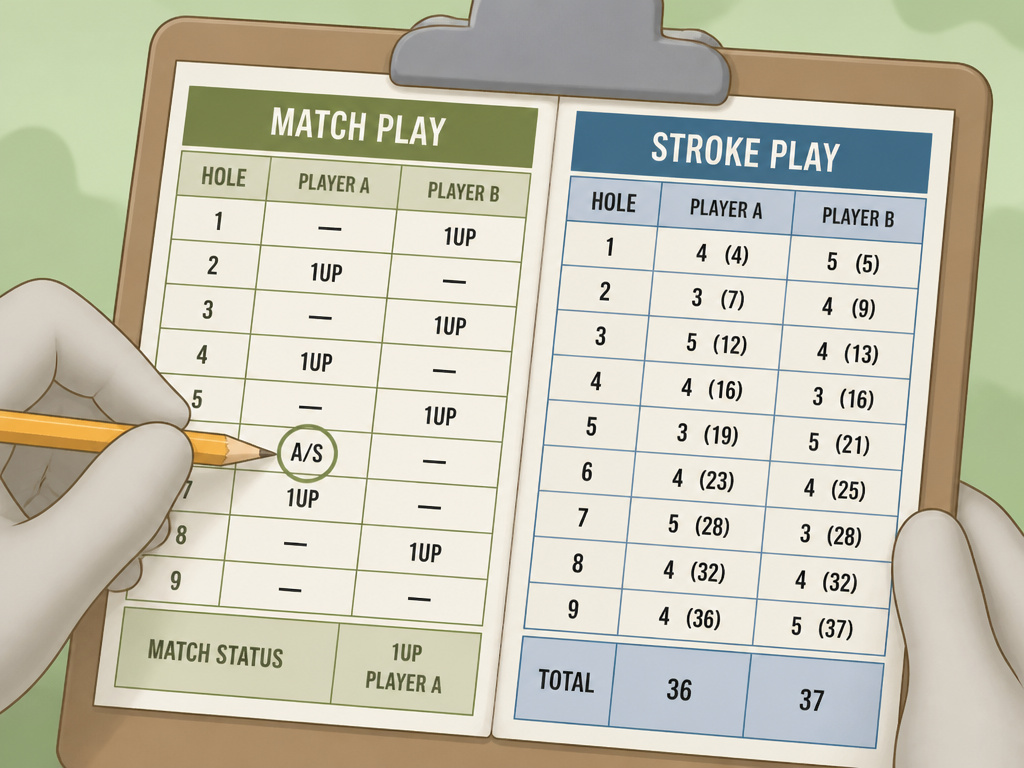
In match play, your world shrinks to one opponent. You compete hole by hole. If you make a 5 and your opponent makes a 6, you win the hole and go “1 up.” If you both make the same score, the hole is halved. The match ends when one player leads by more holes than remain (e.g., being “3 up” with 2 holes left). A blow-up hole only costs you that one point; you start fresh on the next tee. This is the format of the Ryder Cup, Presidents Cup, and countless amateur club match-play brackets.
The mental shift is total. Stroke play is a marathon of consistency. Match play is a series of 18 independent sprints where momentum is everything.
Scoring & Score Posting: What Actually Counts
You keep score differently, but you must post for your golf handicap in both formats. This trips up more golfers than any other rule.
Stroke Play: The Full Ledger
Every single stroke counts. You finish every hole, write down your total (including penalty strokes), and add them up at the end. Your final score is your gross score. For handicap purposes, this gets adjusted to a net score using your handicap strokes. There’s no escaping a number once it’s on the card.
Match Play: The “Most Likely Score” Rule
Here’s the part most weekend players get wrong. You must post your score from a match play round for your handicap, even if the match ends early on the 15th green.
Where this goes sideways: Picking up on a conceded hole and leaving your scorecard blank. The World Handicap System requires you to record a ‘Most Likely Score’ for any hole you don’t complete. This is your strokes already taken plus the number of strokes you’d reasonably need to finish the hole from that position.
For example, if your opponent concedes your 15-foot putt for a par, you record a 4. If you’re 50 yards out in the rough after two shots and pick up because you lost the hole, you estimate: “I’d probably chip on and two-putt for a 5.” That 5 goes on the card. The system then scales your 15-hole score to an 18-hole equivalent. The OGA guide to format differences explains this procedure clearly.
| Scenario | Stroke Play Action | Match Play Action | Score for Handicap |
|---|---|---|---|
| Topped tee shot into water | Take penalty, play from drop zone. Score likely 6 or 7. | Lose the hole. Pick up. Record ‘Most Likely Score’ (e.g., 6). | Both post a score (e.g., 7 or 6). |
| 3-foot putt conceded | Must still putt out. Score is actual strokes. | Putt is conceded. Record the score you would have made (e.g., 4). | Both post a 4. |
| Match ends on 16th hole | Not applicable—round is 18 holes. | Match is over. Record ‘Most Likely Score’ for holes 17 & 18. | System scales 16-hole score to 18 holes. |
Penalties: Two Strokes vs. Loss of Hole
This is the single biggest rules divergence. The same infraction can have a dramatically different consequence.
In stroke play, the general penalty is almost always two strokes. Hit a wrong ball? Two strokes. Cause your ball to move on the green? Two strokes. The penalty adds to your total for that hole, punishing you within the larger marathon.
In match play, the general penalty is loss of hole. Commit a serious breach, and that hole is over. You lose it, regardless of what your opponent does. This makes match play both more forgiving and more brutal. A single clumsy mistake can cost you a point that took four good shots to earn.
Common mistake: Thinking you can ignore an opponent’s rule breach to be nice. You can choose not to enforce a penalty in match play, but you cannot agree with your opponent to waive a rule you both know applies. Do that, and you’re both disqualified.
Some penalties are format-specific: * Too Many Clubs: Stroke play: two-stroke penalty per hole, max four strokes. Match play: adjustment of the match status by up to two holes. * Playing Out of Turn: Stroke play: no penalty (“ready golf” is encouraged). Match play: no penalty, but your opponent can cancel your stroke and make you replay it. * Putting Green Rules: In stroke play, if your ball on the green hits another ball at rest, you get a two-stroke penalty. In match play, there is no penalty.
Understanding these differences is part of basic on-course etiquette. The official match play rules from the USGA are the final word.
Strategy & Mindset: Playing the Opponent vs. Playing the Course
Your brain needs to switch gears. A peer-reviewed match play strategy analysis from 2024 provides the best evidence we have. Researchers used PGA Tour data to model optimal strategies. The headline finding? The advantage gained from specifically tailoring your play to your opponent’s position is marginal—often less than 1% per hole.
The study suggests that, contrary to complex game theory, the old caddie wisdom holds: “Play your own game.” Deviating from your optimal stroke-play strategy usually hurts you more than it hurts your opponent.
But that doesn’t mean strategy is dead. It just shifts from complex calculations to a few clear principles.
When to Get Aggressive:
- When you’re 1-down with 3 to play. Playing safe won’t win holes; you need to create birdie chances.
- When your opponent is in deep trouble. If they’ve punched out to the fairway, you can aim for the center of the green instead of a risky sucker pin.
- On holes where you get a handicap stroke. That’s a free shot—use it to attack.
When to Play Conservative:
- When you’re 2-up with 5 to play. Your opponent needs to win holes; you just need to tie them. Avoiding big numbers (like a lost ball or out of bounds penalty) is the priority.
- When your opponent is already out of the hole. There’s no reward for a heroic shot if they’re lying 5 in a bunker.
The concession is a unique strategic tool. Giving a short putt can be an act of gamesmanship—it denies your opponent the chance to feel the putt drop. It also maintains pace of play. But be careful: once a concession is given, it cannot be taken back.
Which Format Is Right For You?
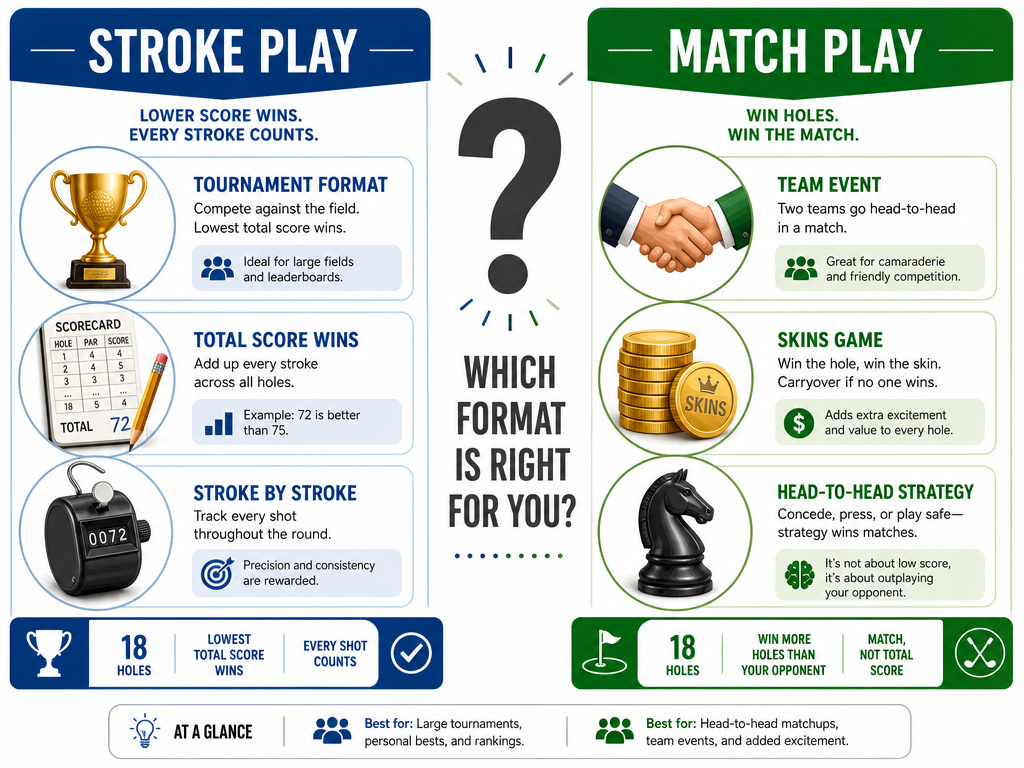
Most golfers default to stroke play because it’s what they see on TV. But your game and your goal should dictate the format.
Choose Stroke Play If:
- You’re playing in a large tournament or club championship.
- You want a pure test of your total score against the course.
- You’re practicing consistency for your handicap.
- You’re using a stroke counter to track every shot meticulously.
Choose Match Play If:
- You’re in a team event like the Ryder Cup or a club match.
- You’re playing a casual skins game with friends.
- You have a volatile game (great holes, blow-up holes). Match play neutralizes the disasters.
- You thrive on head-to-head competition and psychological momentum.
For 90% of casual weekend rounds, you’re playing informal stroke play. But understanding match play makes you a better, more versatile golfer. It teaches you how to close out holes, manage momentum, and play under a different kind of pressure. The NCGA Rules 101: stroke vs match guide calls it learning “a different side of the game.”
Frequently Asked Questions
Can you play match play and stroke play at the same time?
Yes, in a format called “Stableford” or in some team events, but it’s administratively messy. For a casual group, it’s simpler to pick one format. Trying to run both often leads to confusion over order of play and conceded putts.
What happens if a match play tie continues past 18 holes?
The match goes to “sudden death.” Players continue to the next hole (usually the 1st hole again) and play until one player wins a hole. There is no limit.
Do professional match play events affect world ranking points?
Yes, but the points distribution is different. Winning a match play event like the WGC-Dell Match Play awards significant ranking points, though the calculation accounts for the fact that a player may only play 3 matches instead of 4 rounds.
Is “ready golf” allowed in match play?
No. Playing out of turn in match play carries no direct penalty, but your opponent has the right to cancel your stroke and make you replay it in the correct order. This is a key tactical difference from stroke play, where ready golf is encouraged to speed up the round.
The Bottom Line
Stroke play is the game’s enduring ledger, a test of total execution. Match play is its raw, psychological cousin, a battle of moments. Knowing the difference changes how you add up your score, how you take a penalty, and where you aim your shot when the match is on the line.
For your next round, decide what you’re really after. If it’s a pure number, stick with stroke play and track every stroke. If it’s the thrill of the duel, try match play. Just remember to post that “Most Likely Score” when you pick up. Your handicap will thank you, and you’ll walk away understanding two games for the price of one.
