
The Definitive Guide to World Golf Rankings Explained Simply
This post contains affiliate links. As an Amazon Associate, we earn from qualifying purchases.
This post contains affiliate links. As an Amazon Associate, we earn from qualifying purchases.
World golf rankings work on a two-year rolling point system. A player’s Official World Golf Ranking (OWGR) is their total ranking points (adjusted for age) divided by the number of tournaments they’ve played, with a minimum divisor of 40 events. Points are awarded based on a tournament’s Field Rating, which is calculated from the Strokes Gained World Rating of every player in the field, and they begin to decay 13 weeks after being earned.
Strip it back. The OWGR isn’t a measure of who’s the “best” in some abstract sense. It’s a meticulously engineered scoreboard designed to compare players who compete on different tours, under different conditions, at different times. The system’s entire purpose is to provide a credible, transparent, and, above all, actionable ranking that tournament organizers can use for invitations and fans can use to track the sport’s global pecking order.
What follows is a breakdown of the system’s seven core mechanics, the single biggest change that rewired its math in 2022, and why understanding these rules reshapes how you view a player’s schedule, a tournament’s prestige, and even the strategy behind chasing the number one spot.
Key Takeaways
- The ranking uses a two-year (104-week) rolling period, with points awarded at full value for only 13 weeks before decaying weekly.
- A player’s average is calculated using a minimum divisor of 40 tournaments, which penalizes part-time players or those from smaller tours.
- The Field Rating of a tournament is now calculated from every player’s Strokes Gained World Rating, eliminating old biases that favored certain tours.
- Winners of a second event within 52 weeks get a 60% bonus (capped at 4 points); a third win earns a 70% bonus (also capped at 4 points).
- Rankings are updated every Monday morning GMT, but only after the final putt of the last eligible tournament from the previous week drops.
How the New System Shattered Old Biases
I learned this on the weekend rounds where I first got hooked: good systems correct for bias, and bad ones bake it in. Before August 2022, the OWGR had a problem. Its method for rating a tournament field relied heavily on how many top-200 players were teeing it up. This created a hidden subsidy for tours like the old European Tour, where an event without a single top-200 player could still dish out World Ranking points as if it were a strong field, simply because of the tour’s “minimum point level” status.
Where this goes sideways: A tour’s prestige, not its actual strength, dictated point distribution. A T20 finish in a weak-field European event could net a player more points than a T20 in a deeper PGA Tour event, warping the ranking’s accuracy.
The 2022 overhaul, the result of an independent analysis started in 2018, fixed this by pulling the rating lever from the tour level down to the individual player level. Now, every player in the field brings a quantifiable number of Performance Points to the tournament, based on their own Strokes Gained World Rating. This rating is a complex, two-year rolling average of a player’s scores, adjusted for the difficulty of each round they’ve played. The sum of all these Performance Points in the field is the tournament’s Field Rating, the total points pie to be divided up.
The result? The bias is gone. A field is now judged strictly by who is in it and how they’ve been playing, not by the name of the tour on the banner. This change is why the 2023 FedEx St. Jude Championship winner got roughly 10 fewer points than the 2022 winner, the absence of top players who had moved to other tours was directly reflected in a lower Field Rating.
The 7 Pieces That Define a Player’s Rank
The OWGR formula isn’t one calculation; it’s a chain of seven. Miss one link and the output makes no sense.
1. Strokes Gained World Rating: This is the foundation. It’s a statistical measure of a player’s skill, expressed as strokes per round relative to a baseline, calculated from every 18-hole stroke-play round they complete over the two-year ranking period. It has a ceiling (2.8981) and a floor (-14.6466). If a player has fewer than 10 recorded scores, they contribute a default 0.01 Performance Points to a field.
2. Performance Points: A player’s Strokes Gained World Rating is fed through the Performance Curve, a yearly-updated model built from millions of simulated tournaments, to spit out their personal Performance Points value. This is the number they “bring” to an event.
3. Field Rating: Add up the Performance Points of every player in the starting field. That sum is the tournament’s Field Rating, which equals the total number of ranking points available to be awarded.
4. Ranking Points Distribution: The Field Rating is then sliced up using a Ranking Points Distribution Curve. Which curve is used depends on the Field Rating’s “points per player” value and the field size. A standard full-field event awards about 17-18% of its total points to the winner. A small field (80 players or fewer) uses a different curve where the winner gets about 21%. Points are awarded to every player who makes the cut, down to a maximum of 125th place.
5. The Two-Year Rolling Period: All ranked points live on a two-year (104-week) clock from the Monday they are awarded.
6. The Decay Schedule: Points are frozen at their original value for 13 weeks. After that, they lose 1/92nd of their original value each week for the remaining 91 weeks. This is the “recent performance” weighting in action.
7. The Divisor & Average: Finally, a player’s rank is their Total Points (adjusted for decay) divided by the number of eligible tournaments played. Here’s the kicker: there’s a minimum divisor of 40. If you’ve played fewer than 40 events in two years, your total is still divided by 40, crushing your average. Conversely, only your most recent 52 events within the period count toward the divisor.
| Ranking Component | What It Is | Why It Matters |
|---|---|---|
| Strokes Gained World Rating | Player skill metric (strokes/round) | Determines the Performance Points a player contributes to a field. |
| Field Rating | Sum of all player Performance Points in a tournament | Sets the total points pool for that event. |
| Minimum Divisor (40) | Floor for the “events played” denominator | Heavily penalizes part-time players (e.g., some LIV Golf stars). |
| 52-Event Cap | Ceiling for counted events in the divisor | Rewards consistent play but limits the penalty for playing a very heavy schedule. |
| 13-Week Freeze | Period points retain 100% value | Makes winning a major or PLAYERS Championship an immediate ranking rocket. |
| Weekly Decay (1/92) | Points reduction after 13 weeks | Creates a constant churn, forcing players to keep performing to maintain position. |
From Field to Finish: How Points Are Awarded
Let’s trace the path of a single ranking point. It starts with a player’s recent form, gets transformed into a tournament’s prestige, and ends up on a leaderboard.
The system’s transparency here is its greatest strength. Once the starting field is set, OWGR publishes a projected Field Rating. After the final putt, when official results data is submitted, the final Field Rating and Ranking Points Distribution are locked in.
The Official World Golf Ranking system is administered over a two-year rolling period. Ranking Points are awarded to all players in a tournament field who complete the event (or make the primary cut), up to a maximum of 125th place, based on the tournament’s Field Rating and the applicable Ranking Points Distribution Curve.
Not all tournaments are created equal, and the system has explicit tiers: * Major Championships: The Masters, PGA Championship, U.S. Open, and The Open each award 100 First Place Points. They are in a class of their own. * The PLAYERS Championship: Awards 80 First Place Points. * All Other Events: Award points according to their Field Rating, with a maximum of 80 First Place Points.
What about a rain-shortened event? At least 36 holes must be completed for points to be awarded, and they are reduced: 54 holes pays out 75% of the original points pool, 36 holes pays out 50%.
The Hidden Levers: Minimum Divisor & Win Bonuses
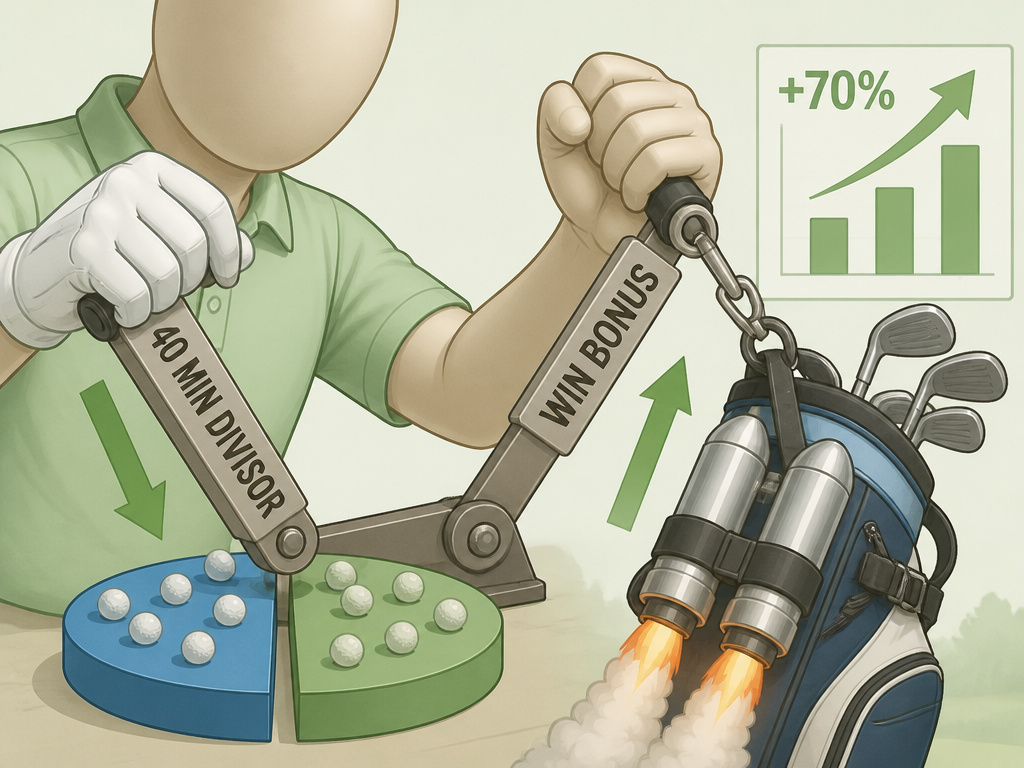 Two rules act as powerful, often misunderstood, ranking engines: the divisor floor and the multi-win bonus.
The minimum divisor of 40 is a sledgehammer. Let’s say a phenomenal talent plays only 20 times in two years and earns 200 total points. Their average isn’t 200/20 = 10.0. It’s 200/40 = 5.0. They are instantly halved. This rule protects the ranking from being skewed by part-time specialists or players from tours with short seasons. It’s why a player who jumps to a league with fewer than 40 OWGR-recognized events per year, like LIV Golf, faces an almost mathematical certainty of falling down the rankings, their points decay, and they can’t play enough counting events to meet the divisor minimum.
The Multi Win Bonus is a jet pack for hot players. Effective from the 2024 season: * Win a second eligible tournament within a 52-week period, and you get bonus points equal to 60% of the first-place points for that win, capped at a maximum of 4 bonus points. * Win a third (or more) event in that same 52-week window, and the bonus jumps to 70%, also capped at 4 points per win.
This isn’t just a nice-to-have. It’s a strategic lever. A player planning a schedule might target a couple of weaker-field events they can win to rack up points and then use that bonus as a booster for their ranking average. It rewards winning above all else.
Tour Eligibility & What “Counts”
 Not every golf tournament in the world feeds the OWGR. There’s a gated community of 24 Eligible Golf Tours, and getting in isn’t easy. The Official World Golf Ranking system has strict Tour Eligibility Standards that assess a tour’s pathways, access policies, tournament formats, and technology.
Common mistake: Assuming all professional events count. Exhibition matches, most team events, and unsanctioned tournaments offer zero ranking points.
The standards are rigorous: a tour must run at least 10 official events, maintain an average field size of 75, have an open qualifying system, and use approved formats (72-hole stroke play is the gold standard). The application process takes 12-18 months, and new tours serve a three-year probationary period. This gatekeeping is why debates around including new leagues are so heated, it’s not just a paperwork exercise; it’s about maintaining the statistical integrity of the entire global comparison.
Frequently Asked Questions
Why do some players in the top 10 play different schedules?
The minimum divisor forces it. A player ranked 8th who plays 25 times a year needs every start to be high-quality to maintain their average against the 40-divisor. A player ranked 12th who plays 35 times can afford a few missed cuts because their divisor is higher, spreading the risk. It’s a pure math game dictating travel.
How often are the rankings updated?
Every Monday morning GMT. But if a tournament finishes late on a Monday (like some in Asia or Australia), that update is delayed until the final putt drops. The published list is then final for the week.
Do all tours award the same amount of points?
No. The PGA Tour and DP World Tour typically have the highest Field Ratings due to strong player depth. Smaller tours like the Sunshine Tour or Japan Golf Tour have lower ratings, so a win is worth fewer points. This is the system’s way of quantifying competitive depth.
Can a player’s rank go down if they don’t play?
Absolutely, and it happens every week because of the decay. If you don’t play, you don’t earn new points to replace the ones aging out of the 13-week full-value window. Inactivity is a one-way ticket down the list, which keeps the top players competing regularly.
Why is there a minimum divisor?
Without it, a player could theoretically win two majors in a year, play only those two events, and have a sky-high average that crowns them world number one without facing consistent competition. The 40-divisor mandates a minimum level of participation to be considered a touring professional.
Before You Go
Let’s be clear about this: the OWGR isn’t a fan poll. It’s a logic engine built to solve a specific problem, comparing golfers who rarely meet on the same course. Its 2022 shift to a Strokes Gained World Rating foundation was the single most important correction in its history, stripping out institutional bias and making the math relentlessly honest.
One practical threshold changes everything: if a golfer’s schedule involves fewer than 40 OWGR-recognized events in a two-year span, they are fighting the ranking with one hand tied behind their back. That’s the line that separates the system’s contenders from its statistical casualties. Everything else, the bonus points, the decay, the Field Rating, is just detail. Good golf should feel less complicated the more you understand it, and now you understand the scoreboard.
