
What Is LIV Golf? Explained: Format, Teams & 72-Hole Rules
This post contains affiliate links. As an Amazon Associate, we earn from qualifying purchases.
This post contains affiliate links. As an Amazon Associate, we earn from qualifying purchases.
LIV Golf is a professional men’s golf league featuring 57 players across 13 teams who compete in 14 annual tournaments, each lasting 72 holes with a shotgun start and no cut. The league, which transitioned from a 54-hole format in 2026, uniquely combines individual stroke play with team competition, where all four team members’ scores count in every round.
That 57-player field is the whole game. It’s not a random number, it’s the structure that forces the shotgun start, dictates the 13 teams of four, and creates the season-long battle for both individual and team titles. Miss that number, and the league’s mechanics feel like quirks instead of a system.
What follows breaks down the three-layer format: the 72-hole tournament structure, the dual individual and team scoring systems, and how this all stacks up against the traditional PGA Tour model. You’ll know exactly what you’re watching by the end.
Key Takeaways
- LIV Golf tournaments are 72-hole, no-cut events with all 57 players starting simultaneously via a shotgun start.
- The league fields 13 permanent teams of four players each; a team’s total score uses all four players’ rounds.
- Individual players earn points toward a season-long championship, with 1,000 points distributed per event starting in 2026.
- The name “LIV” is the Roman numeral for 54, reflecting the league’s original 54-hole tournament length.
- Key differences from the PGA Tour include the team format, guaranteed player contracts, and the lack of a 36-hole cut.
The Core LIV Golf Format: 57 Players, 13 Teams, 72 Holes
Forget field sizes of 144 or 156. The LIV Golf League locks in at 57 players. That specific count is the deliberate engine for everything else.
Fifty-two of those players are permanently assigned to one of 13 teams. The remaining five spots are wild cards, offering a path into events for players outside the team structure. This setup creates a contained, familiar roster week-to-week, a stark contrast to the fluctuating fields of a typical tour event.
The LIV Golf League features 57 players, including 5 Wild Card players, and 13 teams of 4 that compete throughout a 14-event season for the Individual Championship and Team Championship.
Tournament length is now 72 holes. This is a critical change that took effect in 2026. For its first few seasons, LIV Golf events were 54 holes (three rounds), which fed the “LIV” namesake. The move to four-round events brought it in line with the traditional major championship and PGA Tour standard, a shift aimed at bolstering competitive legitimacy.
Every tournament uses a shotgun start. At the appointed tee time, 18 groups of players spread out across the 18 holes and all begin play simultaneously. There’s no morning wave and afternoon wave. The broadcast can jump to any group at any moment, and every player finishes around the same time. The pace feels different, compressed and constant.
And there is no cut. All 57 players play all 72 holes, guaranteed. This eliminates the Friday pressure of “making the weekend” that defines the PGA Tour experience. For fans, it means the star they came to see won’t disappear after two rounds.
How Scoring Works: Individual Points & Team Totals
LIV Golf runs two competitions at once: one for the individual player and one for his team. This dual layer is what can make a leaderboard look confusing at first glance.
Individual scoring is straightforward stroke play. The player with the lowest 72-hole total wins the tournament. But there’s a second, season-long race. Starting in 2026, every finishing position earns points from a pool of 1,000 per event. The winner gets 200 points (20% of the pool), second gets 113, and it scales down from there. These points accumulate to crown the Individual Champion at season’s end.
The team competition is where the format gets its unique flavor. Each of the 13 teams has four players. In every round, all four scores count toward the team’s total. There’s no dropping the highest score. This “all-four-scores” rule, introduced in 2025, places a premium on team depth and consistency over a single superstar carrying the load.
| Competition | What Counts | Season Goal | Key Change (2026) |
|---|---|---|---|
| Individual | Lowest 72-hole stroke total | Accumulate points for Individual Championship | All 57 players earn points (not just top finishers) |
| Team | Sum of all four players’ scores in each round | Win Team Championship at season finale | All 13 teams earn season points (previously only top 8) |
A team’s total for the week is the sum of its 16 scores (4 players x 4 rounds). The lowest team total wins the tournament’s team title. Teams also earn season-long points based on their weekly finish, which determines seeding for the season-ending Team Championship.
LIV Golf vs. The PGA Tour: A Side-by-Side Look
The differences between LIV Golf and the PGA Tour are foundational, representing a complete redesign.
The most visible difference is the team structure. The PGA Tour is purely an individual endeavor. LIV Golf adds a permanent team layer, you’re playing for the Crushers GC or Legion XIII every week, not just for yourself. This creates built-in rivalries and a second narrative thread for fans to follow.
Contract and compensation models diverge sharply. PGA Tour players earn money solely through tournament purses, sponsorships, and bonuses. LIV Golf players typically sign lucrative, guaranteed contracts upfront, regardless of performance, with tournament winnings paid on top. This financial security was a major initial draw for players like Phil Mickelson and Dustin Johnson.
The tournament experience differs in logistics and rhythm. The PGA Tour’s traditional tee times and 36-hole cut create a building narrative. LIV’s shotgun start and no-cut format deliver all the stars for all four days in a condensed window. One isn’t inherently better, but they cater to different viewing habits.
Where this goes sideways: Comparing them solely on prize money. The real divide is format philosophy, individual meritocracy versus team-based spectacle.
The “LIV” Name, Controversy, and Major Obstacles
 Why is it called LIV? It’s not an acronym. “LIV” is the Roman numeral for 54, a direct reference to the league’s original 54-hole tournaments. Even after switching to 72 holes in 2026, the name stuck, a brand is a brand.
The league’s inception was met with immediate controversy, primarily due to its funding from Saudi Arabia’s Public Investment Fund (PIF). Critics labeled it an act of “sportswashing,” using high-profile sports to improve a nation’s reputation. This backdrop fueled intense player criticism, most notably from Tiger Woods and Rory McIlroy, and sparked an antitrust lawsuit against the PGA Tour.
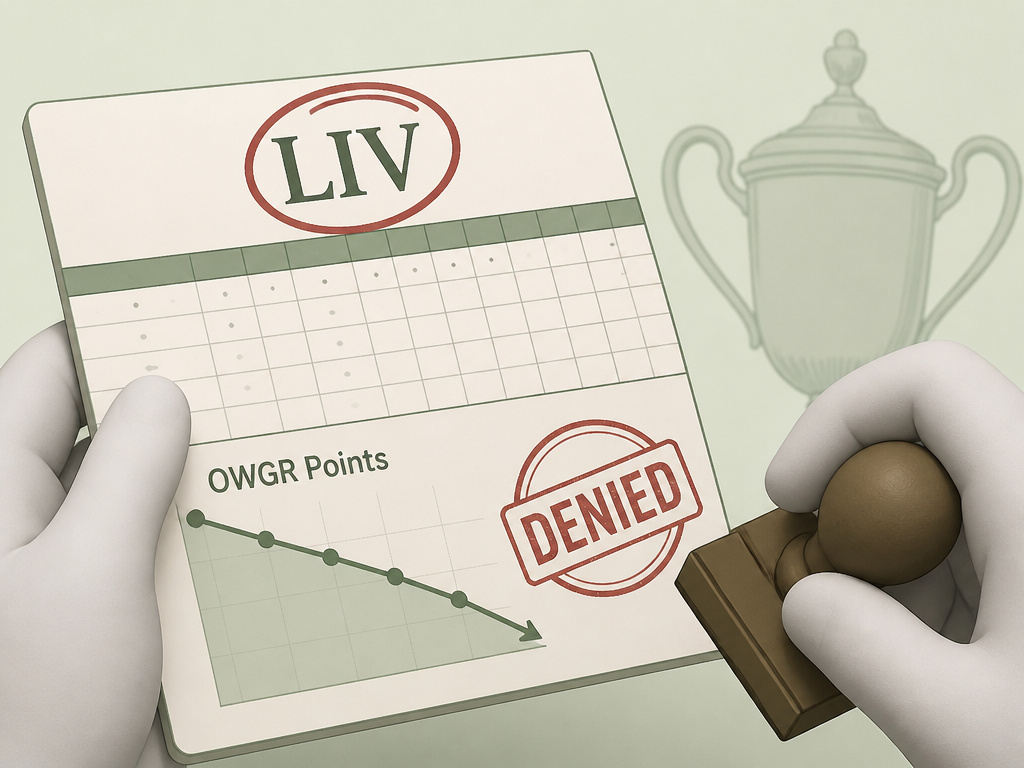
A major competitive hurdle has been Official World Golf Ranking (OWGR) points. The OWGR system, crucial for qualifying for major championships, denied LIV Golf’s application for inclusion in 2023. The governing body cited concerns over the league’s closed format, limited field, and no-cut policy. Without OWGR points, LIV players have seen their world rankings plummet, forcing them to rely on past champion status or special invitations to play in majors.
I’ve had students obsessed with the “right” way to do something, whether it’s a grip or a practice routine, to the point it creates tension and hurts their game. I abandoned teaching the one-piece takeaway as a rigid rule for everyone because of it. The golf world had a similar moment with LIV, a rigid view of what a “real” tour must look like (72 holes, cuts, merit-based entry) clashed with a new model. The tension defined its early years.
The 2026 Season and Future Outlook
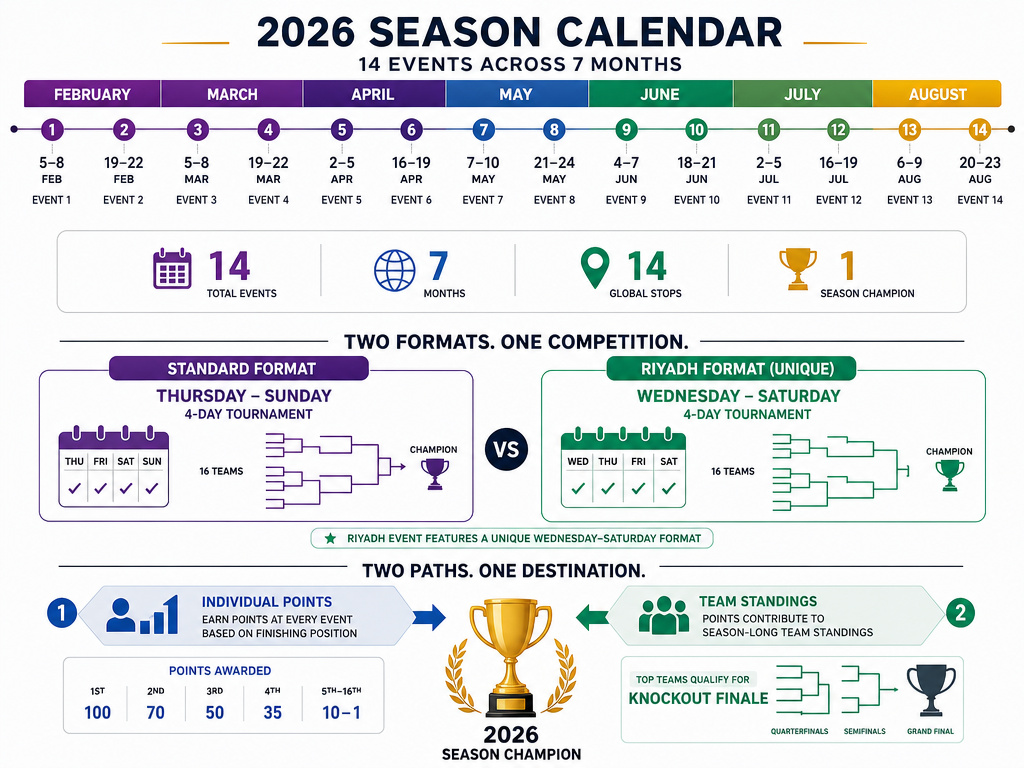 The 2026 season represents a stabilized, if still evolving, version of the league. The schedule runs from February to August, with 14 global events. A notable quirk: the Riyadh event runs Wednesday to Saturday, while every other tournament is Thursday to Sunday.
The season builds toward two climaxes: the crowning of the Individual Champion based on total points, and a seeded Team Championship match-play finale. This finale, where the top teams compete in knockout brackets, is a unique spectacle not found on the traditional golf calendar.
Looking ahead, questions remain. The PIF announced it would not fund the league after 2026, pushing LIV to seek alternative financial backing. Its long-term viability hinges on securing a stable broadcast rights deal, continuing to attract top talent, and perhaps finding a resolution with the OWGR system.
Frequently Asked Questions
What does LIV stand for in golf?
LIV is the Roman numeral for 54. The name originated because the league’s tournaments were originally 54 holes. Despite switching to 72-hole events in 2026, the name was kept for brand recognition.
How do you watch LIV Golf?
For the 2026 season, every round of every LIV Golf event streams live on FOX One. Select rounds also air on the FOX family of networks, including FOX and FS1. Coverage is also available through the FOX Sports App.
Can LIV Golf players play in the majors?
Yes, but it’s not automatic. Since LIV events do not currently offer Official World Golf Ranking points, its players cannot qualify for majors via the world ranking. They must rely on other criteria, such as being a past major champion (within a certain window), winning a qualifying tour event, or receiving a special invitation.
Are LIV Golf players banned from the PGA Tour?
Yes, players who joined LIV Golf were suspended by the PGA Tour for participating in conflicting events without permission. This ban prevents them from playing in standard PGA Tour events, though they remain eligible for the four major championships, which are run by separate governing bodies.
How are LIV Golf teams formed?
Teams are owned and managed by a combination of the league, team captains, and outside investors. Captains, often star players like Jon Rahm or Bryson DeChambeau, help recruit and build their four-player rosters. Some players have equity stakes in their teams.
Before You Go
The debate about LIV Golf’s place in the sport will continue. But as a format, its rules are now set: 57 players, 13 teams, 72 holes, all scores counting. It’s a different product built for a different consumption rhythm.
If you’re tuning in, watch the team standings as closely as the individual leaderboard. That’s where the strategic layer lives, where a player might take an aggressive line on 18 to climb a spot personally and to shave one stroke off his team’s total. It changes the calculus.
Good golf should feel less complicated the more you understand it. The same holds for its tours. Now you know the basic golf rules of this particular game.
