
World Handicap System Explained | The Changes That Matter
This post contains affiliate links. As an Amazon Associate, we earn from qualifying purchases.
This post contains affiliate links. As an Amazon Associate, we earn from qualifying purchases.
The World Handicap System (WHS) is a single, global standard for calculating a golf handicap, governed by the USGA and The R&A. It combines the Rules of Handicapping and the Course Rating System to give you a portable Handicap Index—a number that reflects your demonstrated ability and adjusts for course difficulty, allowing fair competition anywhere. The system calculates your Index from the best 8 of your last 20 Score Differentials, updates daily, and uses a maximum hole score of Net Double Bogey.
That portable number is useless until you convert it for the course in front of you. The real work happens in the conversion formula, the daily adjustments, and the built-in safeguards that keep a bad month from inflating your number permanently. Most guides list the rules. This one walks through the mechanics that actually change your next round.
What follows: the exact math behind your Index, the 2024 rule changes that brought in par-3 courses, the difference between a nightly update and a true daily revision, and the one report your club’s Handicap Committee sees that you don’t.
Key Takeaways
- Your Handicap Index is not static; it updates daily (or nightly) based on the most recent best 8 of your last 20 rounds.
- The 2024 revisions slashed minimum course length requirements, bringing thousands of short and par-3 courses into the system for the first time.
- Net Double Bogey (par + 2 + any handicap strokes you get on that hole) is now the universal maximum score for handicap posting.
- Built-in soft and hard caps prevent your Index from rising more than 5 strokes within a 12-month period, protecting the field.
- You need to post 54 holes (any mix of 9- and 18-hole rounds) to establish your first Handicap Index.
What the World Handicap System Actually Replaced
Before January 2020, golf used six different handicap systems. A player with a CONGU handicap from the UK couldn’t easily compete with someone using the USGA system in America. The World Handicap System unified them.
The WHS is jointly governed by the USGA and The R&A. It encompasses both the Rules of Handicapping and the Course Rating System, replacing the six previous regional systems administered by bodies like Golf Australia and the European Golf Association.
This wasn’t just a branding change. It standardized the core formula, the maximum score, and the update frequency worldwide. The goal was simple: a number you could take to any course, in any country, and have it mean the same thing. Your portable Handicap Index is that number.
How Your Handicap Index is Calculated
Forget averaging all your scores. The system looks for your demonstrated ability, which means your good days. It uses a rolling window of your last 20 acceptable scores.
Here’s the step-by-step breakdown for each round:
- Post Your Adjusted Gross Score. After your round, adjust any hole scores down to a Net Double Bogey (par + 2 + any handicap strokes you get on that hole). This is the maximum for posting.
- Calculate the Score Differential. This is the heart of the system. The formula accounts for your adjusted score, the Course Rating, the Slope Rating, and any Playing Conditions Calculation (PCC) adjustment for the day.
Score Differential = (113 / Slope Rating) x (Adjusted Gross Score - [Course Rating](https://golfworldtrips.com/course-rating-and-slope-rating-explained/) - PCC) - Update Your Record. The new Score Differential enters your record of the most recent 20.
- Calculate the New Index. The system takes the best 8 Score Differentials from those 20, averages them, and multiplies by 0.96 to get your Handicap Index.
The 0.96 multiplier is a slight bias toward better performance. It assumes you might play slightly worse than your best days in competition. The system updates this calculation every night after new scores are posted.
| Term | What It Is | Why It Matters |
|---|---|---|
| Adjusted Gross Score | Your total score with any hole capped at Net Double Bogey. | Ensures one disastrous hole doesn’t unfairly skew your handicap. |
| Course Rating | The expected score for a scratch golfer from a specific set of tees. | Represents the inherent difficulty of the course for a perfect player. |
| Slope Rating | A measure of relative difficulty for a bogey golfer compared to a scratch golfer (range 55-155). | Adjusts your handicap to reflect how much harder the course is for an average player. |
| Score Differential | A normalized score that allows rounds from different courses to be compared. | The raw data point used to find your best 8 performances. |
Where this goes sideways: Posting without the PCC adjustment. The Playing Conditions Calculation is an automatic, daily look at how all scores at a course compared to expectations. If it was very windy and scores were high, a negative PCC adjustment might lower everyone’s Score Differentials for that day. Ignoring it means your score isn’t calibrated to the day’s actual conditions.
From Handicap Index to Course Handicap: The Number You Actually Play With
Your Handicap Index is your traveling number. Your Course Handicap is the number of strokes you get for that specific round, on that specific set of tees. You must convert it every time.
The formula is straightforward:
Course Handicap = Handicap Index x (Slope Rating / 113) + (Course Rating - Par)
Most golfers use a look-up chart at the first tee or a mobile app. The (Course Rating - Par) part of the equation is critical. If the Course Rating is 72.1 and the par is 72, you add 0.1 strokes. This fine-tuning ensures “playing to your handicap” means shooting the par of the course, not necessarily the Course Rating.
This is the step that makes your Handicap Index vs. Course Handicap portable. A 15.0 Index might give you 17 strokes on a tough course (Slope 135) and only 13 strokes on an easy one (Slope 110). The system automatically adjusts for the challenge ahead.
The 2024 Revisions: What Changed and Why
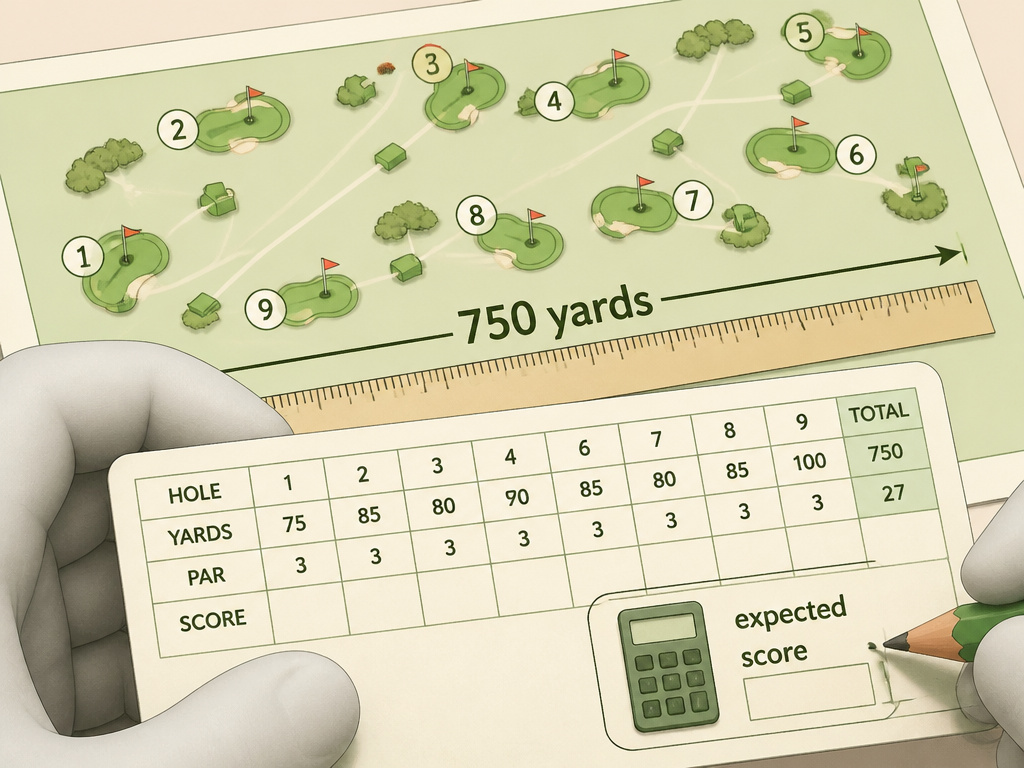 The WHS had its first major update effective January 2024 (implemented January 17 in Canada). The changes leaned heavily on data from over 100 million annual posted scores and focused on inclusivity and accuracy.
The two biggest changes were for shorter courses and incomplete rounds.
-
Minimum Course Length Drastically Reduced. Previously, a set of tees needed to be much longer to receive a Course Rating and Slope Rating. The 2024 update states an 18-hole course can now be as short as 1,500 yards (1,370 metres), and a 9-hole course as short as 750 yards (685 metres).
- Impact: Thousands of par-3 and short executive courses are now part of the system. Golfers who primarily play these courses can finally get an official Handicap Index. This opens the game to more players and venues.
-
Handling Holes Not Played. The old method used a score of net par for any hole you didn’t play. The new method uses an expected score based on your demonstrated ability.
- Impact: It’s more accurate. It also allows a single 9-hole score to be converted into an 18-hole Score Differential immediately in some countries, rather than waiting to pair it with another 9-hole round. This reflects how modern golfers actually play.
The part nobody mentions: These revisions were published in the official 2024 handicapping rules. Most handicap software automatically applies them, so you don’t need to do any new math. But knowing why the rules changed helps you understand the system’s direction—it’s trying to bring more golfers in.
Rules, Safeguards, and the Role of the Handicap Committee
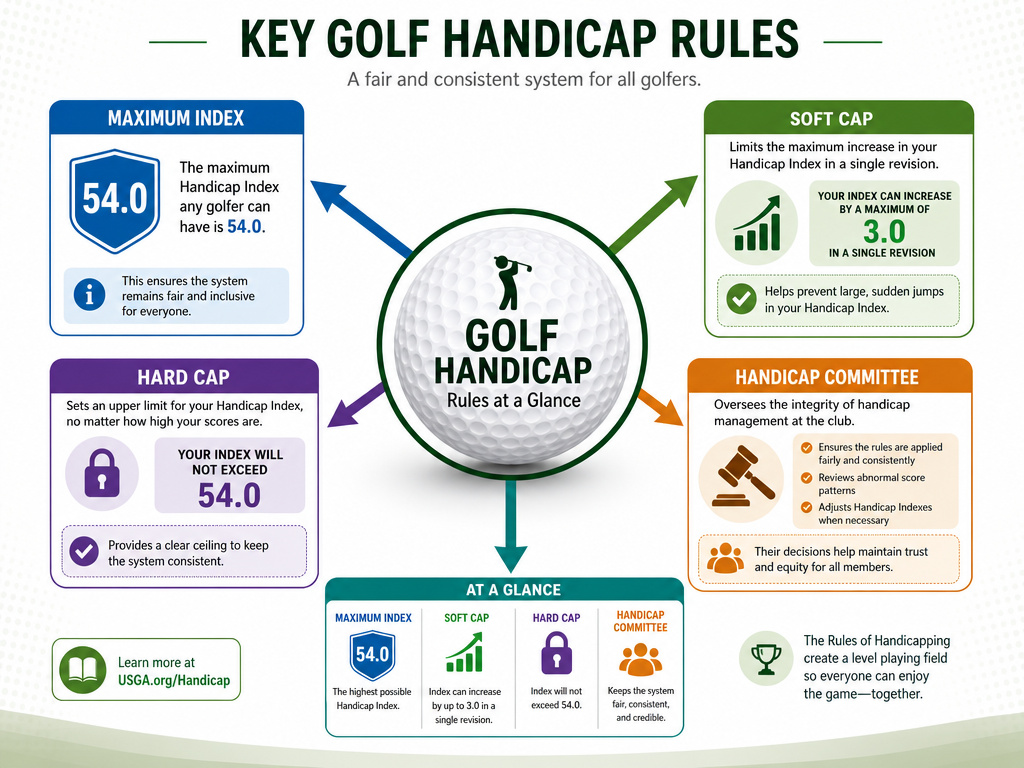 The system isn’t blind automation. It has checks, and real people are involved.
- Maximum Handicap Index: The ceiling is 54.0 for all players, regardless of gender. This encourages everyone to track progress.
- Soft and Hard Caps: These prevent a sudden loss of form from ballooning your handicap.
- Soft Cap: When your Index rises more than 3.0 strokes above your Low Handicap Index (the best Index you’ve held in the last 12 months), the rate of increase is halved.
- Hard Cap: Your Index cannot rise more than 5.0 strokes above your Low Handicap Index within a 12-month period.
- The Handicap Committee: Every club has one. Their vital role is outlined in the R&A Rules of Handicapping Rule 1. They are responsible for annual Handicap Reviews, investigating anomalies, and can manually adjust an Index up or down by a maximum of 2.0 strokes based on knowledge of a player’s game.
Common mistake: Thinking the Hard Cap is a permanent ceiling. It’s a 12-month rolling limit. If your Low Handicap Index improves, the cap resets relative to that new, lower number.
This committee is why sandbagging is harder than people think. The software flags players whose scoring patterns consistently exceed expected ranges. A weekend warrior suddenly posting high 90s after years of mid-80s will get a review.
Frequently Asked Questions
What’s the difference between a Handicap Index and a Course Handicap?
Your Handicap Index is your portable, universal number (e.g., 14.7). Your Course Handicap is the whole number of strokes you get for a specific round, calculated using that Index, the course’s Slope Rating, and the difference between its Course Rating and par. You use the Course Handicap to adjust your score during play.
How often does my Handicap Index update?
It is designed to update daily, as soon as practicable after you post a score. In practice, for most Allied Golf Associations in the US using the GHIN system, updates occur nightly. You post today’s round, and your new Index is ready tomorrow morning. The system recalculates after every new score.
What is the maximum score I can post on a hole?
For handicap purposes, the maximum is Net Double Bogey. Calculate it as: Par + 2 + any handicap strokes you receive on that hole. If you get a stroke on a par 4, your max score is 4+2+1 = 7. This replaces the old Equitable Stroke Control (ESC) tables.
Can I get a handicap if I only play 9-hole rounds?
Yes. You need a total of 54 holes to establish your first Handicap Index. This can be any combination of 9- and 18-hole rounds (e.g., six 9-hole rounds, or three 9-hole and one 18-hole round). Post them as you play.
Do I have to post scores from every round?
You must post all acceptable scores from rounds played under the Rules of Golf, in an authorized format, and with at least one other person as a witness. This includes casual rounds. The system’s integrity relies on a complete picture of your ability. Selective posting is against the rules and can lead to a handicap adjustment by your committee.
Before You Go
The World Handicap System turns the chaos of different courses and conditions into a single, fair number. It rewards consistency, protects the field from manipulation, and finally lets the golfer on a local par-3 course have the same metric as the player at Pebble Beach.
Use your Index to track real progress. Look beyond the number to the Score Differentials that build it. A shrinking differential average means you’re improving, even if your Index is temporarily held down by a great round from eight months ago. That’s the data point that matters.
For the gear that helps you lower those differentials, our guides on forgiving golf clubs and golf balls for high handicappers match equipment to your current game. And when you’re ready to dissect your performance further, strokes gained data shows you exactly where to focus your practice.
