
Understand Handicap Index vs Course Handicap for Fair Golf
This post contains affiliate links. As an Amazon Associate, we earn from qualifying purchases.
This post contains affiliate links. As an Amazon Associate, we earn from qualifying purchases.
Your Handicap Index is a portable measure of your potential ability, calculated from your best 8 Score Differentials out of your last 20 rounds. Your Course Handicap is the number of strokes you actually get on a specific course and set of tees, found by plugging your Handicap Index into a formula that includes the Slope Rating and the difference between the Course Rating and par.
That portability clause is the whole point. The Handicap Index travels with you. The Course Handicap translates it for the battlefield you’re standing on.
What follows: the exact math for both numbers, the three safeguards that keep your index honest, and the one mistake every new golfer makes when trying to figure out their strokes. By the end, you’ll read a scorecard’s rating numbers and know exactly what they’re telling the handicap computer.
Key Takeaways
- Your Handicap Index (e.g., 14.2) is your universal potential, based on your 8 best recent scores. It updates daily and is capped from rising too fast.
- Your Course Handicap is a whole number (e.g., 16) specific to the tees you play. The formula is:
Handicap Index × (Slope Rating ÷ 113) + (Course Rating – Par). - The (Course Rating – Par) term was added in 2020 so players competing from different tees get the correct strokes without a separate adjustment.
- Your index uses a rolling window of your last 20 scores. A single bad round often doesn’t change it because it likely isn’t one of your best 8.
- For competition, a Playing Handicap is your Course Handicap adjusted by a handicap allowance (e.g., 85% for four-ball).
The Core Formula Difference
One number lives on your GHIN app. The other is printed on the scorecard you pick up in the pro shop. Confusing them is how you give away strokes before you even tee off.
Handicap Index: The measure of a player’s demonstrated ability calculated against the Slope Rating of a golf course of standard playing difficulty (that is, a course with a Slope Rating of 113).
Your Handicap Index is a decimal, like 12.4 or 18.7. It represents what you’d likely shoot on a course with a standard Slope Rating of 113. The calculation is governed by the World Handicap System rules, specifically Rule 5. The system takes your last 20 Score Differentials—your adjusted scores, factoring in course difficulty and daily conditions—and averages the lowest 8. That average, rounded to the nearest tenth, is your index.
The Course Handicap is an integer. It answers the practical question: “How many strokes do I get today?” The official USGA Course Handicap formula from Rule 6.1 is:
Course Handicap = Handicap Index × (Slope Rating ÷ 113) + (Course Rating – Par)
The first part (Handicap Index × (Slope Rating ÷ 113)) adjusts your potential for the course’s relative difficulty. A Slope Rating above 113 gives you more strokes; below 113 gives you fewer. The second part, (Course Rating – Par), is the modern fix. It aligns everything to par, so if you’re playing a tee box where the Course Rating is 71.4 and par is 72, you subtract 0.6 strokes (effectively giving a stroke back to the course). This makes competition from different tees seamless.
| Aspect | Handicap Index | Course Handicap |
|---|---|---|
| What it is | Portable potential ability | Strokes received for a specific course/tee set |
| Format | Decimal (e.g., 14.2) | Whole number (e.g., 16) |
| Primary Use | Your traveling benchmark; used to calculate your strokes | The strokes you actually use during a round for net scoring |
| Key Inputs | Your 20 most recent Score Differentials | Handicap Index, Course Rating, Slope Rating, Par |
| Governed by WHS Rule | Rule 5 | Rule 6 |
How Your Handicap Index is Built and Guarded
The system doesn’t just average scores. It’s built to find your demonstrated ability, not your average day. That means it looks for your best golf and then installs guardrails to keep that number honest.
The engine is the 8-of-20 calculation. After each round, your gross score is converted into a Score Differential. This factors in the Course Rating, Slope Rating, and any daily Playing Conditions Calculation (PCC). The system stores your last 20 of these differentials. When it updates, it finds the lowest 8, averages them, and rounds to the tenth.
Where this goes sideways: Thinking every new score changes your index. If you post a 95 on a tough course, that Score Differential might be 25.0. If your current best 8 average is 18.0, that 25.0 isn’t low enough to crack the top eight. Your index won’t move. It only changes when a new score is good enough to displace one of your current best eight.
This is where the Low Handicap Index and the cap procedure come in. Your Low Handicap Index is the lowest your index has been in the last 365 days. It’s the system’s memory of your peak recent form.
- Soft Cap: If your calculated average (before applying caps) rises to be more than 3.0 strokes above your Low Handicap Index, the rate of increase is reduced by 50%.
- Hard Cap: This is the ceiling. Your Handicap Index cannot ever rise more than 5.0 strokes above your Low Handicap Index.
These caps prevent a temporary slump or a string of blow-up rounds from inflating your index beyond a reasonable reflection of your ability. They are a critical part of the handicap calculation process.
Finally, there’s the Exceptional Score Reduction. If you post a Score Differential that is 7.0 strokes or better than your Handicap Index at the time, the system applies an automatic downward adjustment. It’s the algorithm’s way of saying, “You’ve just shown a new level of ability.”
Translating to the Course: The Course Handicap in Action
You’ve checked in. You have your Handicap Index. Now you need to know how many strokes to write on your scorecard. This is where theory meets the first tee.
You don’t need to do the math yourself. Every course should have a Course Handicap table in the pro shop or on the scorecard. You find your Handicap Index range and read across to your tee color. The GHIN app and the USGA website also have calculators. But understanding the calculation reveals why your strokes change from course to course, and even from tee to tee.
Let’s walk through a real example. Say your Handicap Index is 11.6. You’re playing the Blue tees at a course where the Course Rating is 71.0, the Slope Rating is 130, and par is 70.
Handicap Index × (Slope Rating ÷ 113): 11.6 × (130 ÷ 113) = 11.6 × 1.1504 = 13.34+ (Course Rating – Par): 13.34 + (71.0 – 70) = 13.34 + 1.0 = 14.34- Round to nearest whole number: 14
Your Course Handicap is 14. If par were 72 on those same tees, the calculation would be 13.34 + (71.0 – 72) = 13.34 – 1.0 = 12.34, which rounds to 12. That two-stroke swing is the (Course Rating – Par) term at work, perfectly adjusting for the expectation of the tee box.
This number is used for two critical on-course applications: – Net Double Bogey: This is your maximum score on any hole for handicap posting. It’s par + 2 + any handicap strokes you get on that hole. Your Course Handicap of 14 tells you which holes you get strokes on (holes ranked 1-14 in difficulty on the scorecard). – Net Score: Your gross score minus your Course Handicap gives your net score for competition.
When Your Handicap Index Doesn’t Budge (And When It Plummets)

Golfers watch their GHIN app like a stock ticker. Understanding the mechanics stops you from chasing ghosts.
The 20-Round Rolling Window. A score stays in your calculation for as long as it’s among your most recent 20, even if it’s two years old. When you post a new score, your oldest score drops out. That means a great score from 21 rounds ago falling off can sometimes increase your index if it was one of your best 8. The opposite is also true.
The Plateau Effect. If you’re consistently shooting within your current ability range, your new Score Differentials will sit in the middle of your 20-score spread. They won’t be bad enough to be among your worst 12, nor good enough to be among your best 8. Your index will be stable for weeks. This isn’t a glitch. It’s the system working as designed, reflecting a steady state of play.
Common mistake: Grinding over every putt to lower your score for handicap. One score outside your best eight has zero impact. The system rewards consistency of good play, not one heroic day.
Then there’s the Exceptional Score. This is the system’s turbo button. Shoot a round that’s 7.0 strokes better than your current index, and an automatic reduction is applied—often 1-2 strokes—for your next revision. It’s a built-in correction for a breakthrough round. If you want to see how elite players track these breakthroughs, look at strokes gained benchmarks data.
Handicap Index vs Course Handicap vs Playing Handicap
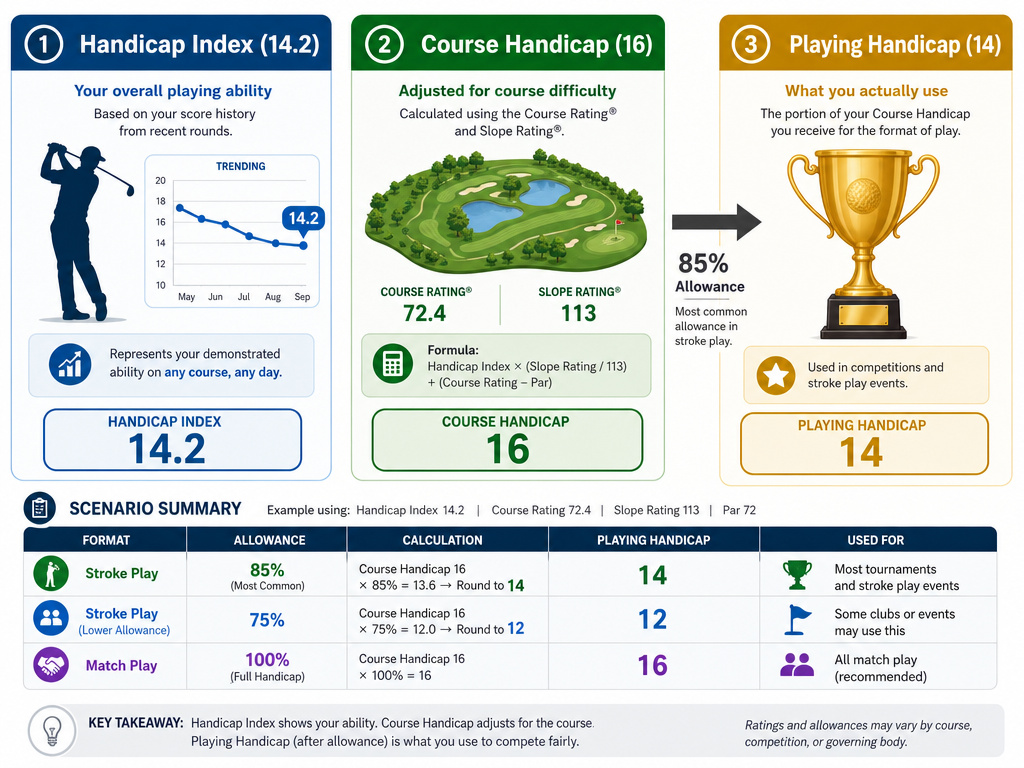
We’ve covered the big two. But walk into a tournament and you might hear a third term: Playing Handicap. This is the final step.
- Handicap Index: Your potential (14.2).
- Course Handicap: Your strokes on this course (16).
- Playing Handicap: Your strokes for this specific format of play.
The Playing Handicap is your Course Handicap adjusted by a handicap allowance. Allowances level the field for different game formats. For example: – Four-Ball Stroke Play: 85% allowance. If your Course Handicap is 16, your Playing Handicap is 16 × 0.85 = 13.6, rounded to 14. – Individual Stroke Play: Usually 95% or 100%. – Four-Ball Match Play: 90% allowance.
The USGA’s official handicap comparison article details these allowances in Appendix C of the rules. The committee running your event will announce the allowance, and your GHIN app will calculate it automatically. You use your Playing Handicap to determine net scores and who wins the match or tournament.
| Scenario | Which Number to Use | Why |
|---|---|---|
| Checking your progress in the GHIN app | Handicap Index | It’s your core, portable metric of ability. |
| Writing strokes on your scorecard | Course Handicap | It’s the strokes you get on this specific set of tees for net par/double bogey. |
| Entering a club tournament | Playing Handicap | The tournament’s format (e.g., four-ball) uses an allowance to adjust your Course Handicap. |
| Playing a casual match with a friend | Course Handicap (typically) | Most casual games use 100% allowance, so Playing Handicap = Course Handicap. |
The Evolution: Why the Formula Changed
If you learned golf before 2020, the old Course Handicap formula was simply Handicap Index × (Slope Rating ÷ 113). The new (Course Rating – Par) addition caused confusion. It was a deliberate fix for a real problem.
Under the old system, if two players competed from different tees, you had to manually adjust their Course Handicaps based on the difference in Course Ratings. It was clunky and often forgotten. The new formula bakes that adjustment in. By referencing all handicaps to par, a player’s Course Handicap automatically accounts for whether their tees are harder or easier than par. When players from different tees compare their Course Handicaps, they are already on a level playing field.
This change is a core part of the modern World Handicap System designed for global consistency. It’s why understanding the underlying Course and Slope Rating system is more important than ever.
Frequently Asked Questions
Why is my Course Handicap different on the same course from different tees?
Because the Slope Rating, Course Rating, and par change. The Back tees have a higher Slope and Course Rating, usually giving you more strokes. The (Course Rating – Par) term also shifts. A bigger rating-par difference means a bigger adjustment to your final number.
I shot my handicap exactly. Why did my Handicap Index go up?
You likely shot your Course Handicap. Your Handicap Index is based on Score Differentials, not raw scores. If the course was easier than standard (low Slope Rating), shooting your Course Handicap might produce a Score Differential that’s actually worse than your current best-8 average, causing a slight increase.
What’s the highest Handicap Index possible?
The maximum Handicap Index for any player is 54.0. This is a rule defined in the R&A’s official handicap procedure (Rule 5.3).
Do I use my Handicap Index or Course Handicap for “Net Double Bogey”?
You use your Course Handicap. Net Double Bogey is par + 2 + any handicap strokes you get on that hole. Your Course Handicap tells you which holes (1 through your handicap number on the Stroke Index) you get those strokes on.
How often does my Handicap Index update?
It should update daily, overnight, after you post an acceptable score. The system revises based on your new scoring record. If you don’t post, it doesn’t change.
Before You Go
Your Handicap Index is your golfing passport. It’s the number that lets you walk onto any course in the world and get a fair game. The Course Handicap is the translation of that passport for the local dialect.
Stop trying to calculate it in your head. Use the GHIN app or the club’s lookup table. Focus on what the numbers do: the 8-of-20 rule means consistency beats a single miracle round, the caps protect the field from sandbaggers, and the Course Handicap formula finally makes mixed-tee competition simple. The system isn’t there to judge your average day. It’s there to measure your best golf and then let you take that potential anywhere.
