
How to Play Golf in the Wind | Master the Wind and Lower Scores
This post contains affiliate links. As an Amazon Associate, we earn from qualifying purchases.
Playing golf in the wind requires three adjustments: move the ball back in your stance to reduce dynamic loft, take at least one more club to allow for a smoother three-quarter swing, and commit to a target that accounts for a wider miss. A 15 mph headwind is a “two-club wind,” cutting your normal 10-yard iron gap down to about 5 yards. Fighting the instinct to swing harder is the real skill; more speed adds spin, and spin is what the wind grabs and throws skyward.
That gap compression changes everything about your approach. When your 7-iron usually flies 150 yards and your 8-iron 140, a 15 mph breeze doesn’t just add 10 yards to the shot—it tightens the space between clubs. You’re not just choosing a club for distance; you’re managing a shrunken toolbox where a slight mishit lands 20 yards short instead of 10.
What follows is the breakdown of why the old “ball back, swing hard” advice fails, the precise math for club selection, and the on-course decisions that separate a surviving round from a blown-up scorecard. This is about letting the wind dictate a simpler, more controlled game.
Key Takeaways
- A 15 mph headwind cuts the gap between your irons by roughly half—a 10-yard gap becomes 5 yards. Club up twice, then swing at 75% effort.
- Moving the ball back works only if your hands stay ahead through impact. If the ball creeps forward, you add spin loft and the shot “balloons.”
- In crosswinds, pick a starting line and let the wind carry the ball. Trying to shape against it amplifies side spin and widens the miss.
- Putting in winds over 25 mph is survival. The ball can move on the green after you’ve struck it. Lag everything and forget about holing anything outside six feet.
- Downwind, the benefit is about half the penalty of a headwind. Expect more roll, not more carry, and club down one.
Why “Ball Back, Swing Hard” Is a Trap
Traditional wisdom says to play the ball back and hit down on it into the wind. That advice is incomplete, and following it blindly creates the exact problem you’re trying to avoid: a high, spinning shot that gets caught and falls short.
The culprit is spin loft—the difference between the club’s dynamic loft at impact and its angle of attack. When you move the ball back but then lunge at it, your angle of attack steepens. This increases spin loft, which increases spin. A headwind magnifies that spin, causing the ball to rise rapidly and lose distance—the dreaded “balloon” shot.
Tom Watson’s counter-advice cuts through the noise: don’t change the ball position dramatically. Just take more club and make your normal, smooth swing. The goal is to reduce dynamic loft through a controlled motion, not a violent hit.
The feel you’re after is a knockdown shot. The ball flight is visibly flatter, the sound at impact is more of a thud than a click, and the divot is shallow and ahead of the ball’s original position. If your divot is deep and behind the ball, the ball crept forward in your stance as you swung. That adds loft. That adds spin. The wind wins.
The 15 MPH “Two-Club Wind” Rule (And Why It’s Wrong)
You’ll hear that a 15 mph wind is a “two-club wind.” That’s a starting point, but it’s dangerously vague. The real adjustment isn’t just about adding clubs; it’s about how the wind changes the spacing between them.
Research from the Keiser University College of Golf provides the numbers. An average golfer might have a 10-yard gap between irons. In a 15 mph headwind, that gap tightens to about 5 yards. Your 7-iron and 8-iron now fly to nearly the same spot. This is why you must club up twice for anything into the breeze.
| Wind Speed | Common Term | Club Adjustment | Effect on 10-Yd Iron Gap |
|---|---|---|---|
| 10 mph | One-club wind | +1 club | Gap shrinks to ~7-8 yards |
| 15 mph | Two-club wind | +2 clubs | Gap shrinks to ~5 yards |
| 20+ mph | Three-club wind | +3 clubs | Gap shrinks to ~3-4 yards |
The “two-club” label also ignores clubhead speed. A player with slower speed has smaller gaps to begin with (7-8 yards). For them, a 15 mph wind might demand three clubs, not two. The rule of thumb is a guess. Your ball flight is the answer.
Where this goes sideways: Adding only one club and then swinging harder. You gain maybe 5 mph of clubhead speed, which can add over 500 RPM of spin. The ball launches higher, the wind catches it, and it lands 15 yards short of a smooth swing with two extra clubs.
Your best wind strategy accepts the compressed yardages. Don’t try to hit your 7-iron 150 yards into the wind. Hit your 5-iron 150 yards with a 7-iron swing. Let the extra loft of the longer club do the work while your slower swing keeps spin down.
The Three Swing Adjustments That Actually Work
Mechanics matter, but overthinking them mid-round is a recipe for disaster. Lock in these three physical cues during your next practice session so they’re automatic when the flags are snapping.
- Ball Position: A Half-Ball Back. Move the ball back no more than one ball width in your stance. This slight change encourages a slightly steeper angle of attack and reduces dynamic loft. The key is keeping your hands ahead of the clubhead through impact. If your hands slip behind, you’ve added loft and spin.
- Swing Tempo: The 75% Rule. Take your extra club and make a three-quarter backswing. Focus on a smooth transition and accelerating through the ball, not at it. A shorter swing is a slower swing. Slower means less spin. This is the core of any practical wind play strategies.
- Finish: Hold It Low. Let your finish be abbreviated and low. A full, high finish often means you’ve released the club fully, adding loft. A low finish encourages the delofted, penetrating flight you need.
Skipping the tempo adjustment is the most common mistake. You nail the ball position, take an extra club, and then give it a full-throttle swing. The result is a high spinny shot that goes the same distance as your normal swing—just with more curve and less control.
Headwind, Tailwind, Crosswind: The Decision Tree
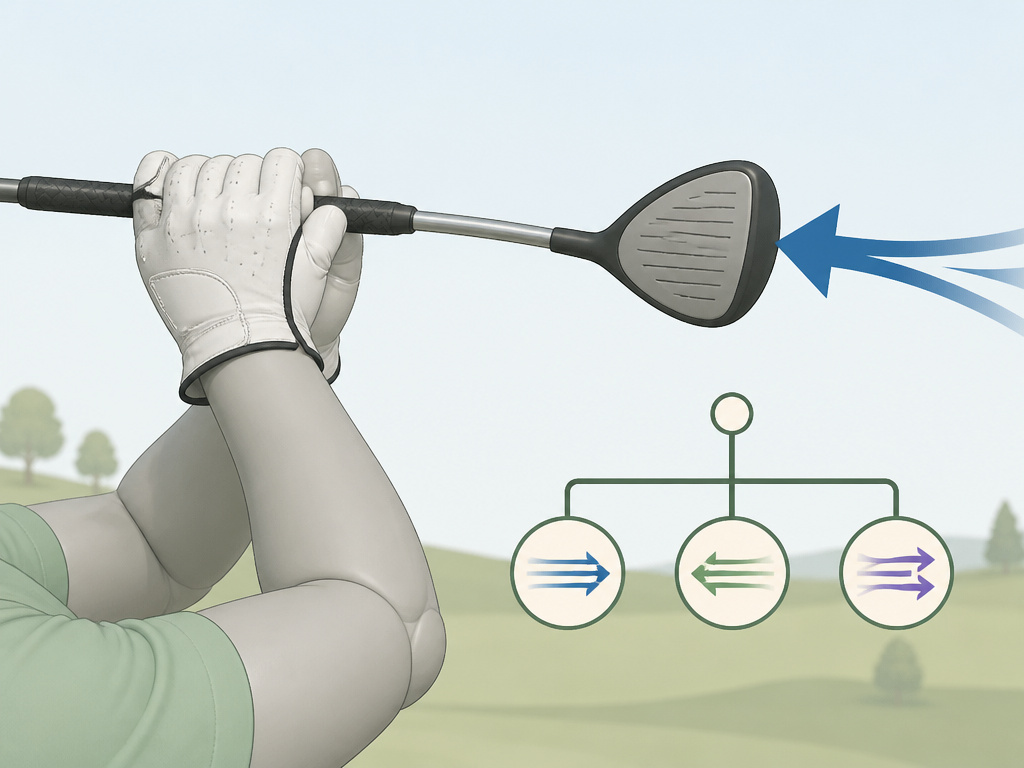
Wind direction changes the equation. A headwind hurts almost twice as much as a tailwind helps at higher speeds. Your strategy must shift with each.
Into the Wind (Headwind)
This is the knockdown shot’s domain. Your entire goal is to minimize time in the air. * Club: Add two clubs (minimum). * Swing: 75% effort, three-quarter finish. * Ball: Half-ball back. * Mindset: Accept a wider dispersion. Aim for the center of the green, not the flag.
Downwind (Tailwind)
The wind flattens your ball’s descent angle, so it runs out more. Don’t get greedy. * Club: Take one less club. A tailwind adds carry for high shots, but for most amateurs, it adds more roll. * Swing: Make your normal swing. There’s no need to force it lower. * Ball: Normal position. * Mindset: Play for the release. If the pin is up front, landing the ball on the middle of the green will let it run to the flag.
Crosswind
This is a test of ego. You have two choices: shape the ball against the wind, or use it. * If you can shape it: Hit a draw into a right-to-left wind, or a fade into a left-to-right wind. This minimizes the wind’s effect. * For everyone else: This is the smarter play. Pick a starting line upwind of your target and let the wind drift the ball back. Trying to hit it straight will exaggerate the curve.
Common mistake: Fighting a crosswind with a straight shot. A 10 mph crosswind can push a ball 20-30 yards off line. If you aim at the flag and swing, you’re bringing bunkers, water, and rough into play that the wind intended for you to avoid.
Having the right golf balls matters here. A lower-spin ball like a Titleist Pro V1 Left Dash or a TaylorMade TP5x will curve less in a crosswind than a high-spin model. Your ball selection is part of your pre-round wind strategy.
Putting When the Wind Howls

Everything changes on the green once the wind hits about 25 mph. The ball can oscillate on the putter face before you strike it, and it can be blown off line after it’s rolling. This is damage control.
- Widen Your Stance. Get as stable as possible. A narrow stance lets your body sway.
- Shorten Your Backswing. Make a shorter, more controlled stroke. A long backswing is harder to keep on line in a gust.
- Lag Everything. Your only goal on putts outside six feet is to get the ball near the hole. Forget about making them. A two-putt is a victory.
- Play Less Break. The wind will push the ball as it rolls. A putt that normally breaks six inches right might break two inches right if the wind is blowing left-to-right across the slope.
This is where good gear saves shots. A sturdy windproof umbrella is crucial for stability when reading putts, and a wind-resistant jacket that doesn’t restrict your shoulders is worth the investment for late-season rounds.
The Gear That Doesn’t Quit in a Breeze
Your equipment choices can either help you or fight you. The right tools simplify the task.
- Ball: Choose a low-spin model for windy days. The Titleist Pro V1x, TaylorMade TP5x, and Callaway Chrome Soft X are designed for lower flight and less spin off the driver and irons. This is non-negotiable if you play in consistently windy locales.
- Umbrella: A large, double-canopy golf umbrella is essential. It’s not just for rain; it’s a windbreak for your scorecard and your sanity while waiting on the tee.
- Apparel: Wear tight layers. A billowing jacket or sweater acts like a sail, disrupting your swing tempo. A thermal base layer under a slim-fit wind-resistant jacket provides warmth without bulk.
- Sunglasses: Polarized golf sunglasses are critical for tracking the ball in a bright, windy sky and judging distances against a moving backdrop.
Your iron sets matter, too. More forgiving game-improvement irons often launch the ball higher. If you live where it’s always breezy, consider a player’s distance iron with a lower, more penetrating default flight.
Frequently Asked Questions
How much club should I take in the wind?
Start with the “one club per 10 mph” rule, but understand it’s a baseline. For a direct 15 mph headwind, plan on adding two clubs. Then, make a smooth three-quarter swing with that extra club. The goal is to swing easier, not harder.
Does the wind affect putting?
Absolutely, and it’s often underestimated. In winds over 25 mph, the ball can move on the green after you’ve hit it. Widen your stance for stability, shorten your stroke, and focus on lag putting. Accept that holing long putts is largely luck.
What’s the best golf ball for windy conditions?
Low-spin, high-compression ball. Models like the Titleist Pro V1x, TaylorMade TP5x, and Callaway Chrome Soft X are engineered for a more penetrating flight. They will curve less in crosswinds and resist ballooning into a headwind better than a soft, high-spin ball.
How do you hit a driver downwind?
Tee the ball slightly higher and make your normal swing. The tailwind will decrease spin and flatten the descent angle, maximizing roll. Don’t try to launch it extra high; a solid, medium-trajectory drive will get the most benefit from the wind at your back.
Can you play golf in 30 mph winds?
You can, but it stops being a test of skill and becomes a test of patience and survival. Putting is a guessing game. Long irons and hybrids become almost unmanageable. If you must play, use a comprehensive wind strategy guide: club up three times, aim for the fattest part of every green, and keep the ball on the ground as much as possible.
The Bottom Line
Playing golf in the wind is about subtraction. You subtract loft, subtract swing speed, subtract spin, and sometimes subtract the flag from your target.The players who score are the ones who let the conditions simplify their game, not complicate it.
Take more club. Swing easier. Aim for the middle. The wind will punish a heroic shot every time, but it has no answer for a boring, low runner that finds the front edge. Your scorecard doesn’t care how you got there.
