
Firm vs Soft Course Conditions Strategy: The Key Adjustments
This post contains affiliate links. As an Amazon Associate, we earn from qualifying purchases.
This post contains affiliate links. As an Amazon Associate, we earn from qualifying purchases.
Firm vs soft course conditions strategy comes down to matching three things: your golf ball’s compression, your wedge’s bounce angle, and your target’s landing zone. On firm ground, a low-spin, high-compression ball with low-bounce wedges keeps the shot down and running. On soft ground, a high-spin, soft-compression ball with high-bounce wedges lets you land steeply and stop. Get one spec wrong and the ball either skids through the green or plugs in the fringe.
The difference between those two outcomes isn’t a mystery. It’s a set of physical reactions you can predict. A ball landing on firm turf at a shallow angle will release—sometimes 30 yards or more. The same ball landing on soft turf at a steep angle will dig its own hole and stop dead. Your job is to control the angle and the interaction.
What follows: the three equipment specs you must adjust, the two swing changes that matter, and the one mistake that turns a good strategy into a wasted stroke. This is how you read the ground before you even pull a club.
Key Takeaways
- Swap your golf ball first. Use a low-compression, high-spin ball (like a Titleist Pro V1) for soft conditions to increase stopping power; use a firmer, lower-spin ball for firm conditions to promote roll.
- Adjust your wedge bounce. Low bounce (4-6 degrees) for firm turf and tight lies to prevent skulling; high bounce (10+ degrees) for soft turf to prevent digging.
- Change your target. On firm ground, land the ball short of the pin and let it release. On soft ground, fly the ball all the way to the hole.
- Never force a high-lofted shot from a tight lie on firm ground. The leading edge will catch and blade the ball over the green.
- In soft conditions, your divots will be deeper. Play the ball slightly back in your stance and commit to a full swing—decelling is how you leave it in the muck.
The 3-Spec Adjustment That Decides Your Score
Your strategy starts before you tee off. Look at the practice green. Is your pitch mark a shallow skid or a deep plug? Feel the fairway with your feet. Does it have give, or is it like pavement? That initial read tells you which of three equipment specs to change first.
Where this goes sideways: Using the same ball for both conditions. A soft-cover, high-spin ball on firm ground will check and then release unpredictably, often leaving you a 40-foot putt from what looked like a perfect shot. A firm, low-spin ball on soft ground will not generate enough backspin to hold the green.
The core adjustment is a triangle: ball, wedge, and landing target. Change one, and you must often change the other two.
| Adjustment | Firm Conditions | Soft Conditions |
|---|---|---|
| Golf Ball | Lower spin, higher compression. Promotes penetrating flight and predictable roll. | Higher spin, lower compression. Increases stopping power on receptive greens. |
| Wedge Bounce | Lower bounce (4–8°). Prevents the sole from bouncing into the ball on tight lies. | Higher bounce (10–14°). Prevents the leading edge from digging into soft turf. |
| Target Landing | Short of the hole. Plan for 10–40 yards of release depending on slope and speed. | At the hole. Plan for minimal roll, often 2–10 yards of release. |
Your club selection in the fairway follows from this table. On firm ground, you are often hitting one less club and playing a knockdown. On soft ground, you take the full club and swing normally.
Why Your Golf Ball Choice Isn’t Marketing
The difference between a Titleist Pro V1 and a Titleist AVX isn’t just feel. It’s a measurable change in spin rate and compression that directly answers the question of firm or soft. A high-spin, soft-compression ball like the Callaway Chrome Soft or TaylorMade TP5 creates more friction with the clubface. That friction translates to more backspin. On a soft green, that spin is your anchor—it kills the ball’s forward momentum. On a firm green, that same spin is a liability. The ball will check up quickly, then hit a hard surface and skid off the back. The firmer, lower-spin ball cuts through the air with less drag and lands with less rotational energy. It hits, takes one small hop, and then runs. That’s predictable. Predictable is what you want when the margin for error is zero.
The Wedge Bounce Tells the Turf What to Do
Bounce angle is the part of the wedge sole that contacts the ground before the leading edge. Think of it as a built-in shock absorber. In soft conditions, you need a lot of shock absorption. A high-bounce wedge (like a 12-degree sand wedge) glides through the turf, preventing the leading edge from burying. It is the only thing stopping a full swing from producing a divot deeper than the ball. In firm conditions, that same high bounce is a disaster. On a tight lie, the rounded sole hits the hard ground and “bounces” the leading edge up into the equator of the ball. The result is a thin, screaming line drive over the green. A low-bounce wedge (6 degrees or less) lets the leading edge get down to the ball cleanly. This is why many good players carry two different wedges with the same loft but different bounce. One for soft, one for firm. If you only carry one, know its bounce number and respect its limits.
Firm Conditions: The Bounce & Bite Problem
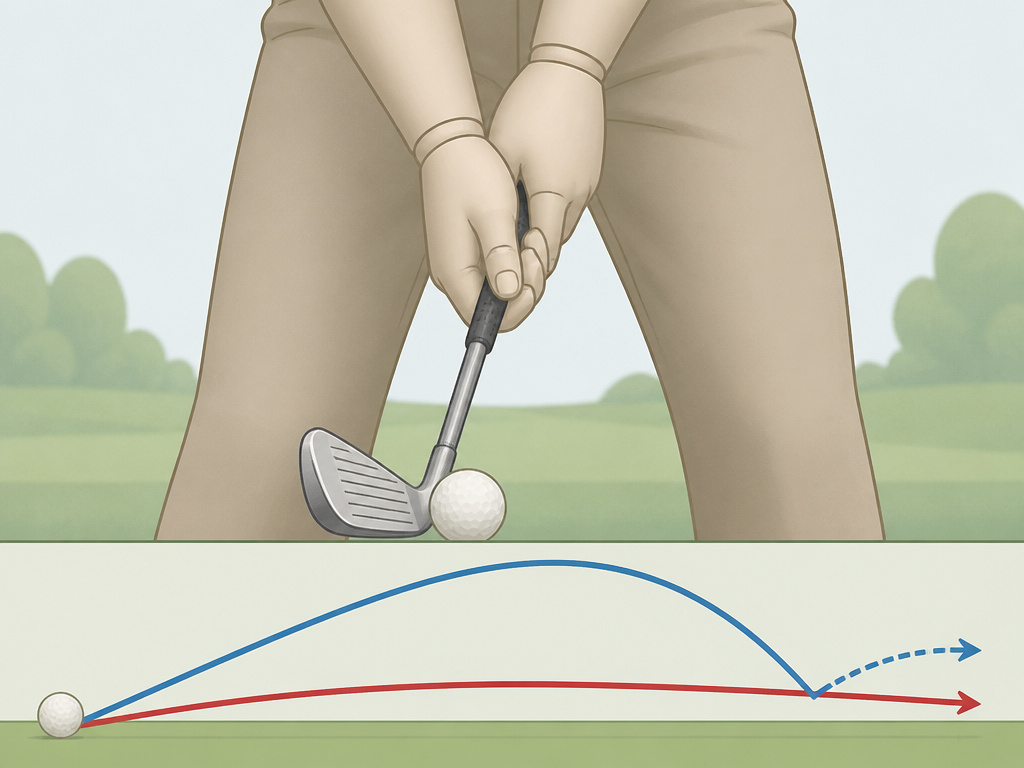 Firm conditions reward the ground game and punish the aerial artist. The ball runs. The challenge is controlling where it stops.
The primary mistake here is attacking pins from the air. A shot that lands on the front of a firm green with a steep descent angle has almost no chance of holding. It will hit, bounce high, and release to the back. Your strategy must shift to a running approach.
Club Down and Play the Knockdown
Your 7-iron from 160 yards will fly 160 yards and stop. In firm conditions, your 8-iron from 160 yards will fly 150 yards and run 10. The knockdown shot is your best friend. It produces a lower, more penetrating ball flight with less spin. The technique is simple: grip down an inch, play the ball back in your stance a hair, and make a three-quarter swing with a firm lead wrist. Don’t try to help it up. The lower trajectory reduces the effect of the wind and increases the roll-out. This is a foundational wind strategy that works double-duty on hard ground.
The part nobody mentions: On a severely firm fairway, your driver may run out 50+ yards. This can bring fairway bunkers or rough into play that are normally out of reach. Check your yardage book for the total run-out zone, not just the carry distance.
The Danger of the High-Lofted Wedge
This is the most common stroke-waster on firm ground. You have 30 yards to a tight pin, with hardpan between you and the green. The instinct is to lob it high with your most-lofted wedge. Resist that instinct. A 60-degree wedge has a sharp leading edge and needs to slide under the ball. On hardpan, there’s no room to slide. The leading edge contacts the ground first, and the ball is bladed over the green. The correct shot is a low, running bump-and-run with an 8-iron or pitching wedge. Use the firm ground as a friend, not an enemy to overcome. Your course strategy for high handicappers here is brutally simple: never leave yourself a short-sided lob shot on firm ground. Always miss on the long side where you can putt or chip from the green surface.
Soft Conditions: The Dig & Stop Reality
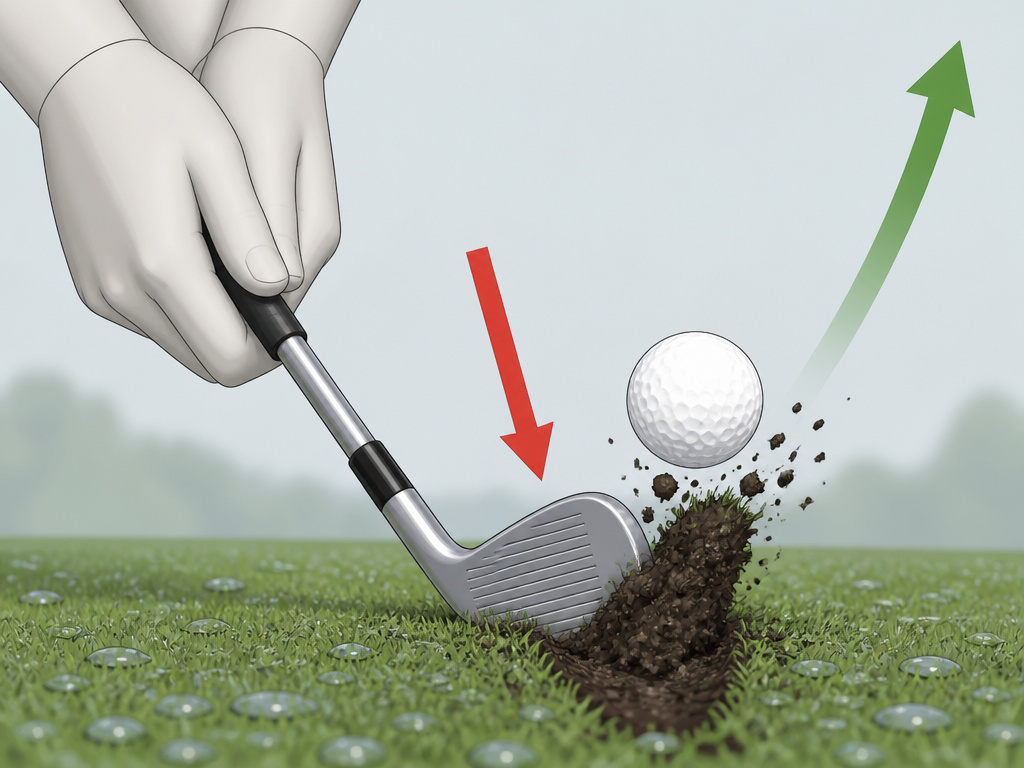 Soft conditions change the physics. The ground absorbs energy instead of reflecting it. Your ball will not run. It will plug.
The strategy inverts. Now, you want height and spin. You want the ball to land steeply and stop quickly. The mistake is not committing to a full swing through soft turf.
Taking Your Divot is Mandatory
In soft conditions, a fat shot is often still a good shot. The cushion of turf between the club and the ball dampens the mis-hit. The real error is hitting it thin because you’re afraid of the dirt. Play the ball in the middle of your stance. Make sure your weight is forward at impact. Then, swing through the ball and accept that you will take a divot. A deep, healthy divot is a sign you used the bounce angle correctly and transferred energy into the ball, not the ground. If you decelerate or try to pick it clean, the clubhead will slow down before impact. The ball will come out dead, with no spin, and will likely plug in the front bunker or the soggy fringe.
Fly It to the Hole
With no predictable release, your target moves. You must fly the ball all the way to the hole, or at least to the spot where you want it to stop. This is pure target golf. This requires precise distance control, which is why soft feel balls are so valuable here. They provide better feedback on mishits and generally help with consistent yardages. A Titleist Pro V1 or a Callaway Chrome Soft will give you the spin to stick a 5-iron on a soft green, where a harder ball might still release 10 feet. Be aggressive with your lines. In soft conditions, the ball is not going to bounce or kick towards the hole. What you see is what you get. This simplifies reading a golf hole—the only thing you’re judging is the carry.
Reading the Greens: Speed is the Tell
The green speed is your final, and most important, data point. It tells you how the ball will behave after it lands. A fast green that is also firm is the ultimate test. The ball will release dramatically. You must land it in the safe quadrant of the green, sometimes 30 feet short of the pin, and let it putt. A fast green that is soft is more forgiving for approach shots but terrifying for putting—the ball will hold its line but roll forever. A slow, soft green is an invitation to attack. You can fire at pins because the ball will stop. A slow, firm green is a trick. The ball will still release because of the hard surface, but your brain will be fooled by the slow stimp meter reading.
| Green Condition | Approach Shot Strategy | Putt Strategy |
|---|---|---|
| Fast & Firm | Land ball in front third of green. Expect massive release. | Die the ball at the hole. Avoid aggressive lines. |
| Fast & Soft | Fly ball to hole. Expect minimal release but hold line. | Firm, confident strokes. Beware of long lag putts. |
| Slow & Soft | Attack pins directly. Ball will stop quickly. | Putts require a firm stroke to reach the hole. |
| Slow & Firm | Land ball short. Release is longer than speed suggests. | Difficult to judge. Err on the side of more pace. |
The One Mistake That Unravels Everything
There is a single decision that renders all this planning useless: changing your strategy mid-round because of one bad outcome. You planned for firm conditions. You hit a perfect knockdown 8-iron that lands short and releases to 15 feet. Then, you hit the same shot, but it catches a dry patch and releases over the green. The mistake is to then abandon the knockdown and start trying to fly everything to the hole. That one over-the-green shot was not a strategy failure. It was a slight misjudgment of the ground’s firmness in one spot. The strategy is still sound. Stick with it. The same is true in soft conditions. One plugged lie doesn’t mean you should start picking the ball clean. Adaptation is about fine-tuning, not overhauling. Trust your pre-round assessment more than your emotional reaction to a single bounce.
Frequently Asked Questions
What is the best golf ball for soft conditions?
Low-compression, high-spin ball like the Titleist Pro V1, Callaway Chrome Soft, or TaylorMade TP5. The soft cover generates more friction for spin, and the low compression helps the ball deform on the clubface for more control. This increases stopping power on receptive greens.
How does wedge bounce affect my shot from soft ground?
High bounce (10-14 degrees) prevents the leading edge of your wedge from digging too deeply into soft turf. The angled sole glides through the grass, allowing you to make a full, aggressive swing without fear of burying the club. Using a low-bounce wedge in soft conditions often results in fat, heavy shots.
Should I use a different putting stroke on firm greens?
Yes, but subtly. On firm, fast greens, the ball will skid less and start rolling truly almost immediately. You can make a smoother, more gradual accelerating stroke. The key is to die the ball at the hole, as firm greens amplify any break. Avoid jabbing or hitting putts with excessive force.
How can I tell if a course is playing firm or soft before my round?
Walk on the first fairway and first green during your warm-up. Drop a ball on the fairway from shoulder height. Does it bounce high (firm) or barely bounce (soft)? On the putting green, hit a basic pitch shot. Does the ball check and stop (soft) or release and roll out (firm)? Your practice routine should include this diagnostic.
Do spikeless shoes work in soft conditions?
They can, but it depends on the model. Modern spikeless shoes like the FootJoy Pro/SLX or G/FORE Gallivant2 use advanced rubber traction patterns that work well in damp grass. However, for extremely wet, muddy conditions, a traditional soft spike shoe with replaceable cleats will almost always provide superior grip and stability to prevent slipping during your swing.
The Bottom Line
Firm and soft conditions ask two different questions of your game. Firm ground asks, “How well can you control the ground?” Soft ground asks, “How well can you control the air?” Your answers are in your bag and in your plan. Match the ball to the turf. Match the wedge bounce to the lie. Match the landing spot to the green speed. This isn’t about hitting better shots—it’s about making the shots you already hit work for the day you’re actually playing. The course gives you the test. Your strategy is the answer sheet. Fill it out before you tee off.
