
Build Your Winning Club Selection Strategy on the Golf Course
This post contains affiliate links. As an Amazon Associate, we earn from qualifying purchases.
This post contains affiliate links. As an Amazon Associate, we earn from qualifying purchases.
A club selection strategy on the course works when you match yardage to a club group first, then adjust for wind and lie. The USGA defines good tee selection as reaching the fairway comfortably on par 4s and par 5s and hitting a variety of clubs into greens. Your real goal is to make the decision before you get to the ball.
That last sentence is the whole game. Hesitation reads as inexperience more than a bad shot does. A strategy is a filter that cuts thirteen options down to two or three before you even take your glove off, rather than a list of perfect clubs for every yardage.
What follows is the system: a four-group yardage filter, the three environmental overrides that matter, and the mechanical reason most weekend golfers pick the wrong club inside the right group.
Key Takeaways
- Sort your bag into four groups: Woods/Hybrids (150+ yds), Mid-Irons (120-150 yds), Short Irons (80-120 yds), Wedges (<80 yds). Match the yardage to the group, then pick the exact club.
- Know three real numbers: your reliable 7-iron distance, your full sand wedge distance, and your average driver carry. Every other club fills the gaps between them.
- Wind is the primary adjustment. A one-club change per 10 mph of headwind or tailwind is the standard rule. Crosswinds affect aim, not club.
- Underclubbing is the most common mistake. Players consistently grab the shorter option in the correct group, leaving the ball short of the target.
- Your strategy breaks if your clubs aren’t a matched set, you’re playing from a severe lie, or your strike is inconsistent. Those conditions require a different plan.
The 4-Group Yardage System: Your Pre-Shot Filter
Forget memorizing thirteen exact distances. Under pressure, you won’t recall them. You’ll hesitate. The four-group system turns a complex decision into a fast, two-step process.
First, match the yardage to a group. Woods and hybrids handle anything past 150 yards. Mid-irons cover 120 to 150. Short irons work from 80 to 120. Wedges are for everything inside 80. This process is about getting into the right neighborhood instantly, not about precision.
Second, pick the club within that group. This is where your three known numbers do the work. If you know your 7-iron goes 145 yards, and you have 135 to the pin, you’re in the mid-iron group. The 8-iron is the obvious next choice. No math. No second-guessing.
The dead-simple system is this: match the yardage to a club group, not a single perfect club, and commit in the time it takes to walk to your ball.
This mental model is your primary course strategy tool. It eliminates the “unzip-rezip” routine that slows play and broadcasts uncertainty. A bad shot with a fast decision looks like an execution error. A bad shot preceded by thirty seconds of dithering looks like you don’t know what you’re doing.
Where this goes sideways: Guessing your group distances based on what a pro hits. Your 150-yard club might be a 6-iron, not a 9-iron. Anchoring to the wrong number means you’re always in the wrong group before you even start.
The Mechanics of a Good Decision: From Patents to Practice
Club selection is applied physics. Patents and studies break it down into a repeatable formula: base distance, plus or minus adjustments.
The foundational step is knowing your actual distance for each club. This is the core of US Patent 7273427, assigned to Bridgestone Sports Co., Ltd. It describes a system that uses a player’s head speed or measured ball data, launch angle, spin, carry distance, to select a suitable club. You don’t need a launch monitor. You need one range session with a focus on your 7-iron, sand wedge, and driver.
| Club Group | Yardage Range | Your Key Club | If You Don’t Know This… |
|---|---|---|---|
| Woods/Hybrids | 150+ yards | Driver Carry | You’ll miss fairways long or short, putting pressure on every tee shot. |
| Mid-Irons | 120–150 yards | 7-Iron Distance | You’ll flip between 6, 7, and 8-irons on every approach and leave most shots short. |
| Short Irons | 80–120 yards | Pitching Wedge | You’ll struggle with partial swings and miss greens from scoring range. |
| Wedges | <80 yards | Sand Wedge | You’ll constantly leave chips and pitches short or blast them over the green. |
Once you have a baseline distance, you apply offsets. US Patent 6569040 outlines this exact method: make an initial selection based on distance, then offset it for factors like wind, slope, and ground firmness.
The wind rule is straightforward. A 10 mph headwind adds one club. A 10 mph tailwind subtracts one club. A crosswind doesn’t change your club, but it changes your aim, play the wind to move the ball toward your target, not fight it.
Common mistake: Adjusting for a crosswind by changing clubs. The wind blows sideways, not forward or backward. Club change doesn’t fix it; aim does.
Elevation is the second major offset. For every 15 feet of elevation change between you and the target, adjust one club. Uphill shots play longer, so take more club. Downhill shots play shorter. Ignoring elevation is why so many approach shots land on the front edge or sail over the back.
The Three Environmental Overrides: Wind, Lie, and Course
Your four-group system works on flat ground in calm air. Real golf adds variables. Your strategy needs explicit overrides for when the textbook answer is wrong.
Wind is the most frequent override. A 20 mph headwind into a green turns a 7-iron into a 5-iron. The mistake is taking the 7-iron and swinging harder. That increases spin, balloons the ball, and makes the wind’s effect worse. Take the 5-iron and make your normal swing. This is the essence of effective wind strategy.
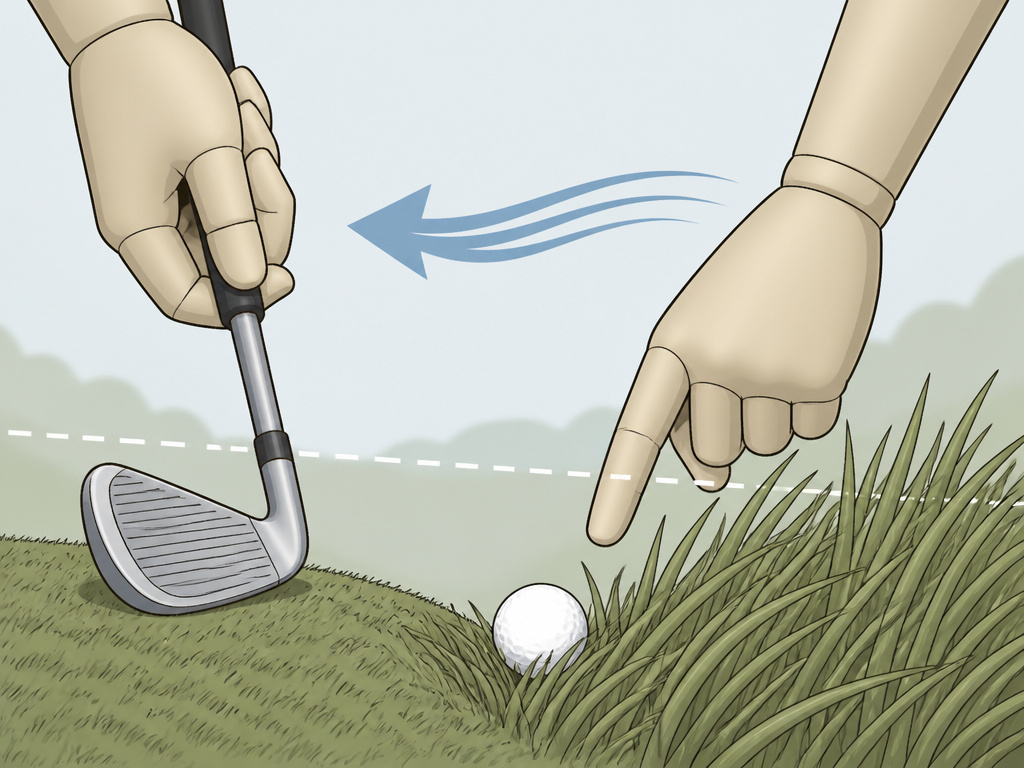
The lie is the silent override. A ball below your feet reduces effective loft. You’ll need more club. A ball above your feet adds loft. You’ll need less. US Patent 8696495 notes that the reliability of any selection method drops when the ball isn’t played from the fairway or is on an uneven lie. From rough, the grass grabs the hosel and closes the face. Add one club and expect the ball to fly lower and run more.
Course conditions are the final override. On a firm vs soft course, your calculations shift. Firm turf means more roll. You can take less club and let the ball release. Soft conditions mean less roll and sometimes mud on the ball, which kills distance. Take at least one more club and expect the ball to stop quickly.
Why You Keep Picking the Wrong Club (It’s Not the Yardage)
You matched the group. You accounted for the wind. You still came up short. The problem is your instinct, not your strategy.
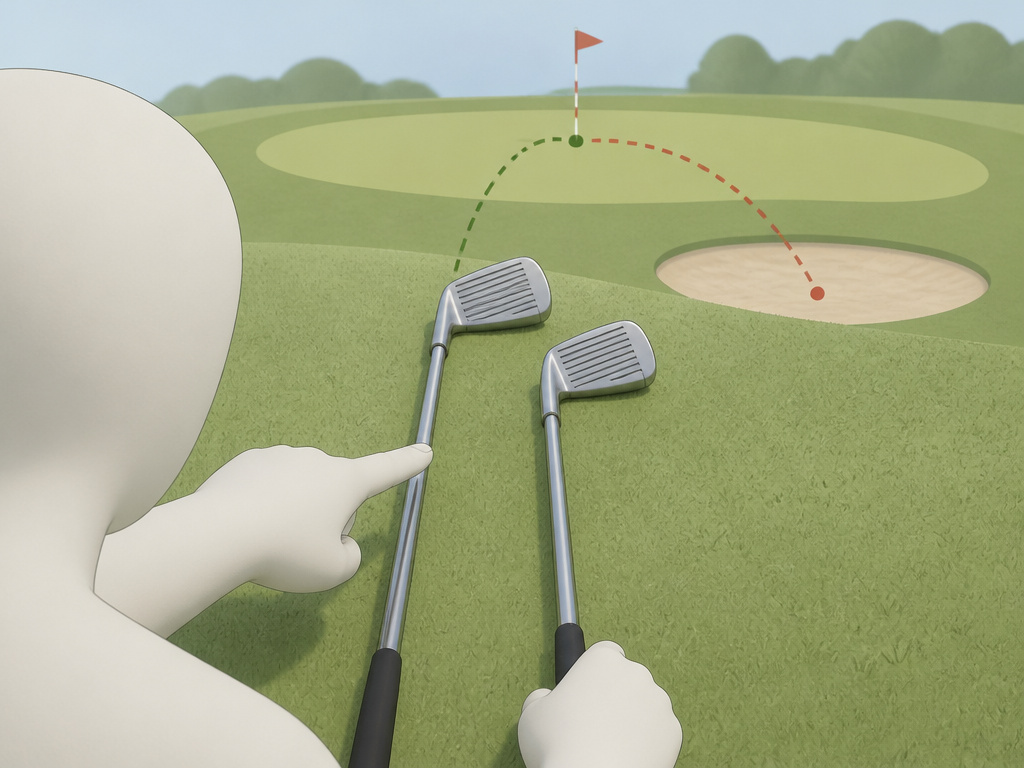
Golfers consistently underclub. Inside the correct group, the brain gravitates toward the shorter, more-lofted option. It feels safer. The result is a parade of shots that land on the front of the green or, worse, in the bunker short. The fix is a deliberate rule: when in doubt between two clubs in the right group, take the longer one. Every single time.
This bias is strongest on approach shots. You see the flag and subconsciously aim at it, ignoring the depth of the green. If the pin is back, your “correct” club might leave you 30 feet short. That’s a three-putt waiting to happen. Play to the center of the green and take enough club to get there. This conservative target golf strategy saves more strokes than hero shots ever will.
Your equipment can also betray you. The same patent (8696495) states that the method’s reliability fails if your irons or woods are not a matched set. Mixing old irons with new ones, or different brands, creates inconsistent distance gaps. One club goes 10 yards farther than it should, the next goes 10 yards shorter. No strategy can account for that. This is why a proper fitting for your club sets matters.
Building Your Personal Decision Tree
A strategy is useless if you can’t execute it under pressure. You need a personal decision tree, a flowchart you can run in the ten seconds between arriving at your ball and pulling a club.
Start with the yardage. Group it. Then run down the checklist: 1. Wind: Headwind or tailwind? Adjust clubs. 2. Elevation: Uphill or downhill? Adjust clubs. 3. Lie: Good, bad, or uneven? Adjust expectation and club. 4. Hazard: Trouble short or long? Favor the safe side.
If any factor is extreme, it overrides the others. A 25 mph wind is more important than a slight uphill slope. A buried lie in wet rough means just get it out; forget the yardage.
This process requires honest knowing your yardages. Not internet yardages. Your yardages, measured with your ball, on a normal day. Write them on a note in your golf bag. Refer to them until the three key numbers are automatic.
TL;DR: Yardage to group, group to club, then adjust for wind and lie. When two clubs seem right, hit the longer one.
Frequently Asked Questions
What is the most important factor in club selection?
Actual distance is the non-negotiable first factor. Every adjustment, for wind, slope, or lie, starts from a true number for your swing. Guessing your distance guarantees inconsistency. Knowing it turns selection into a simple math problem.
How much does wind affect club choice?
Steady 10 mph wind equals about one club. A 10 mph headwind means take one more club (e.g., 7-iron instead of 8-iron). A 10 mph tailwind means take one less. Gusty winds are harder to judge; take the club for the strongest gust you feel and make a smooth swing.
Should I always aim for the flag?
No. Flag-hunting is a low-percentage strategy for most golfers. Your default target should be the center of the green. This gives you the largest margin for error. Only aim at the flag when you have a short wedge in your hand, a perfect lie, and no trouble around the green.
Why do I always come up short?
You are likely underclubbing. Within the correct yardage group, golfers consistently choose the shorter, more-lofted club because it feels less risky. The fix is a conscious rule: if the yardage is between two clubs, always select the longer one. You’ll hit more greens.
Does equipment affect my strategy?
Absolutely. If your clubs are not a matched set, your distance gaps will be inconsistent. The flex and weight of your club shafts also influence launch and distance. Senior players using stiff shafts, for example, will lose distance and height, requiring more club. Your strategy assumes consistent performance from your gear.
Before You Go
A club selection strategy is about eliminating the obviously wrong ones quickly, not about finding the perfect club. The four-group system does that.It gets you from confusion to a shortlist in two seconds.
The rest is calibration. Wind, lie, and course conditions are just edits to your baseline script. Learn your three real distances. Apply the one-club-per-10-mph wind rule. Default to the longer club in the group.
That’s the entire process. It works because it’s simple enough to use when your heart is pounding on the 18th tee. It turns a complex decision into a routine. And on the course, a good routine beats a perfect theory every time.
