
How Target Golf Strategy Works: Master Your Course Management
This post contains affiliate links. As an Amazon Associate, we earn from qualifying purchases.
This post contains affiliate links. As an Amazon Associate, we earn from qualifying purchases.
Target golf is a strategy where every shot is planned to land in a specific, often small, landing zone with minimal roll, prioritizing aerial carry and precision over ground play to navigate hazards. It requires shifting your aim based on your personal shot dispersion, the day’s conditions, and the hole’s architecture, not just aiming at the flag.
The definition from the California Golf Course Superintendents’ Institute in 1977 still nails it: playing from one target to another, stopping the ball quickly after avoiding disaster in the air. That’s the core mechanic. The strategy isn’t about hitting perfect shots every time. It’s about making your misses cost less.
What follows is the breakdown of that 1977 idea into a modern game plan. We’ll cover the two competing philosophies on how to pick a target, the non-negotiable pre-shot routine that makes it work, and how to use your own shot pattern, not a pro’s, to decide when to attack a tucked pin.
Key Takeaways
- Target golf originated as a contrast to links golf and was formally defined in a 1977 paper; it describes a style of play dictated by course design where the ball stops near its landing point.
- Two expert schools clash on target selection: one advocates for the “biggest safe area” to manage pressure, the other for the “smallest possible target” to sharpen focus.
- Your effective target must shift left or right of your intended landing zone based on your consistent shot dispersion, a 5-yard right miss means aiming 5 yards left.
- A smart target is dynamic, changing with wind, hole location, lie, and your own confidence level on that shot.
- For pins tucked near hazards, your decision should account for the frequency of your worst miss, not just your average miss pattern.
What Is Target Golf? (The 1977 Answer)
Forget vague ideas about precision. The term has a concrete origin and a specific mechanical meaning.
Target golf is “the playing of the ball from one target to another, stopping it quickly on the green after avoiding all kinds of disaster to get it there in the air.” That’s the definition put forth by the California Golf Course Superintendents’ Institute in a 1977 paper. It frames the entire game as a series of aerial missions.
This style was named in contrast to links golf, where firm, fast conditions encourage ground shots and rolling approaches. Target golf is its antithesis: soft conditions, penal hazards, and greens that accept only lofted, stopping shots. You’re not playing the contours on the ground. You’re throwing darts from the sky.
The phrase entered the mainstream when The New York Times used it in 1982 to describe the new TPC Sawgrass Stadium Course during The Players Championship. The writer called it a “target” course that demanded “planning and accuracy on every shot.” Sawgrass, with its iconic island green 17th, is the archetype. There is no ground game. There is only the target.
Where this goes sideways: Assuming every parkland course is a target course. Many classic designs offer risk-reward options and ground game choices. A true target course, like Troon North Golf Club in Scottsdale, removes those options. Your strategy is dictated by the architecture.
The Target Selection War: Safe Zone vs. Laser Focus
Once you accept the target golf premise, the next question is how to pick one. Here, instruction authorities split into two opposing camps.
MyGolfSpy represents the safety-first school. Their advice for pressure shots is to pick the “biggest safe area available”, the fat part of the fairway or the safe side of the green. The logic is that pressure tenses your muscles and shrinks your effective skill. Aiming at a large, forgiving area reduces fear and lets you make an aggressive swing. It’s a course management strategy built on damage control.
CaddieHQ advocates for the opposite extreme. They instruct you to pick the “smallest possible target you can see,” like a single, discolored leaf on your intended line. The theory is that a tiny, specific bullseye focuses your mind completely, eliminating indecision and mechanical thoughts. It’s the tightrope-walker principle: a narrow focus improves balance.
So who’s right? It depends on your mindset and the shot.
| Approach | Best For | Risk If Skipped |
|---|---|---|
| “Biggest Safe Area” (MyGolfSpy) | High-pressure situations, trouble-heavy holes, when confidence is low. | Leads to steering, tense swings, and misses that still find the hazard you were fixated on. |
| “Smallest Possible Target” (CaddieHQ) | Routine shots, the driving range, building commitment and visual focus. | Allows vagueness to creep in; the body lacks a clear directive, so dispersion widens. |
The practical synthesis is this: first, use the “biggest safe area” to make your strategic decision from behind the ball. Then, as you step into the shot, use the “smallest possible target” within that area to lock your focus and commit. The safe zone is your strategy. The tiny leaf is your execution trigger.
The Smart Target Formula: It’s a Moving Solution
A smart target isn’t a static spot you pick once. Tangent.Golf calls it a “moving solution.” Your chosen landing zone should adjust based on four live variables.
Think of it as a formula: Intended Landing Zone + Adjustments = Your Target.
- Conditions: Wind is the biggest factor. A strong crosswind off the right means shifting your target left of the ideal landing area. Your wind strategy isn’t just about club selection; it’s about target relocation.
- Course Features: Trouble short? Club up and aim for the back of the green. A dogleg hole with a fairway bunker at the corner? Your target is the curve’s apex, not the centerline.
- Pin Position: A pin tucked tight behind a bunker type like a deep, steep-faced pot bunker is a red flag. Your target becomes the center of the green, giving your miss a chance.
- Personal Confidence: Don’t ignore this. If you haven’t hit a green with a 4-iron all day, your target with that club shouldn’t be a tucked pin. It should be the widest part of the green, or even short of the green in a safe spot.
Common mistake: Picking one target during your practice swing and sticking with it regardless of a gust of wind or a sudden doubt. That’s not strategy; it’s stubbornness.
This dynamic adjustment is where tools pay off. A golf GPS or rangefinders with slope give you the hard data on carry distances to trouble. Shot tracking systems provide the personal data on your dispersion pattern. You merge the course’s demands with your own reality.
How to Use Your Shot Dispersion (The 5-Yard Rule)
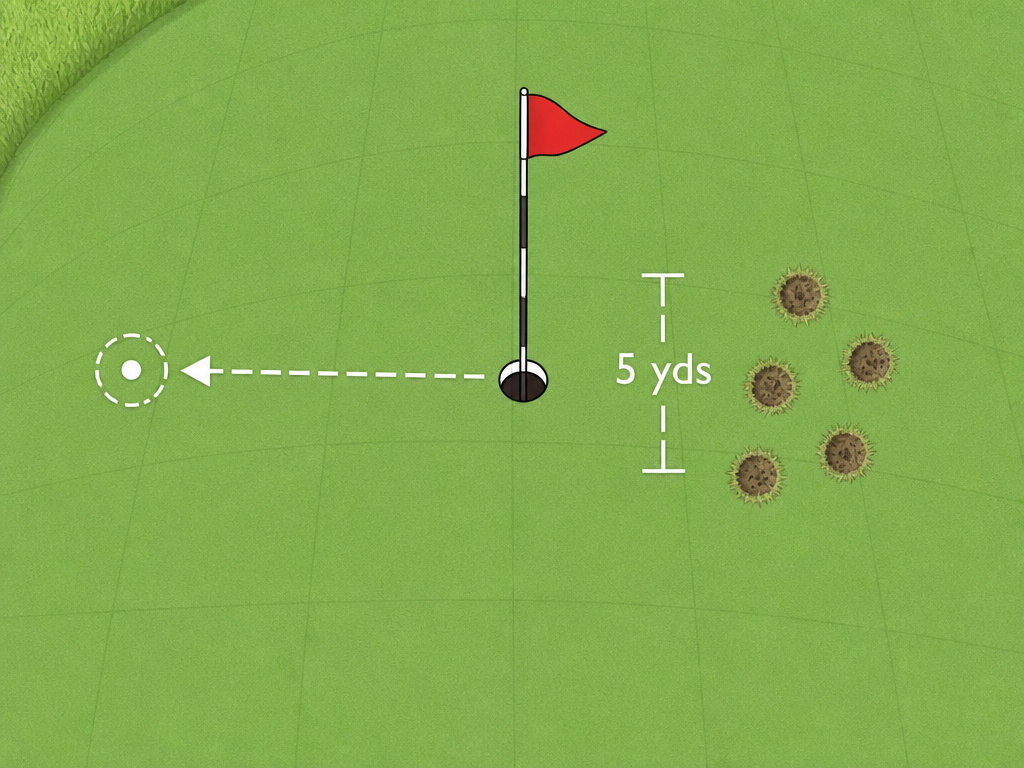
This is the most actionable math in target golf. Your shots don’t land in a single spot. They land in a pattern, or dispersion. Ignoring this pattern guarantees you’ll aim at the wrong place.
Data from T5 Golf illustrates the rule. If your 160-yard shots consistently cluster 5 yards to the right of where you aim, then your effective target must be 5 yards to the left of your desired landing zone. You are deliberately aiming away from the flag so that your typical miss finishes near it.
| Your Typical Miss | Where to Aim | Outcome of a Typical Shot |
|---|---|---|
| 5 yards right | 5 yards left of desired spot | Ball finishes at desired spot |
| 10 yards short | Aim for back edge of green | Ball finishes center green |
| Left-to-right curve (fade) | Start ball at left edge of hazard | Ball curves back to center |
This requires brutal honesty. What is your real pattern with a 7-iron today, not your best-ever shot? This is where understanding the ball flight laws is critical. Knowing that a slice is caused by an out-to-in path with an open face isn’t just a swing fix; it’s a strategic input. That shot will always finish right. So aim left.
For tucked pins, this analysis gets sharper. You must consider your worst-case miss frequency, not just your average. If 1 in 10 shots with your wedge misses 25 yards left, and the pin is tucked 20 feet from a water hazard on the left, that pin is not for attacking. The single disaster wipes out nine good scores. The smart golf course management play is to aim to the fat, right side of the green and putt across.
The 4-Step Target Golf Pre-Shot Routine
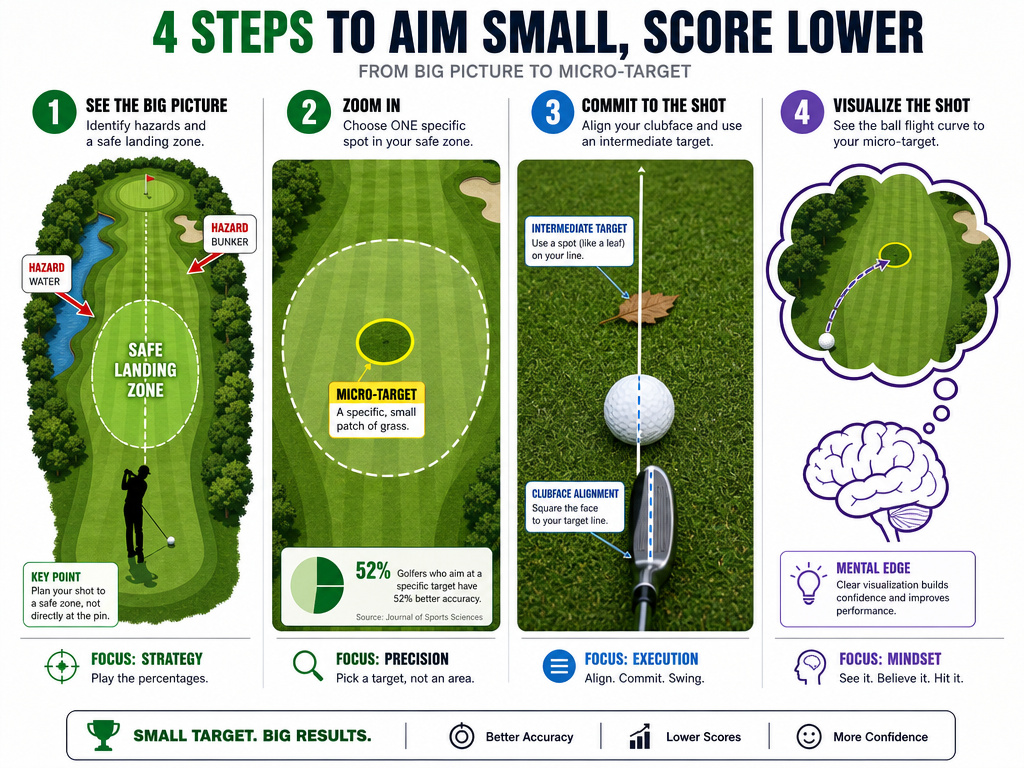
Theory is useless without a repeatable process. This routine codifies the strategy.
- Decide From Behind (The Macro View). Stand behind your ball on the target line. Assess hazards, wind, and the optimal landing zone for your next shot. Your question isn’t “Can I hit the flag?” It’s “Where is the safest, most advantageous place this ball can land?” This is strategic course management in real time.
- Find Your Micro-Target. Within that safe zone, pick the smallest, most specific object you can see, a dark patch of grass, a single branch. This is your commit point. Your brain now has a clear, singular destination.
- Use an Intermediate Target. Find a spot on the ground 1-3 feet in front of your ball on the line to your micro-target. Align your clubface to this spot, then set your body parallel. This makes accurate alignment possible.
- Swing to the Target, Not at the Ball. Your final thought is the image of the ball flying to your micro-target. The ball is just an obstacle in the way of your clubhead traveling toward that destination. This promotes a full, rotational swing.
Skipping the intermediate target is the most common technical failure. Aligning your body to a target 170 yards away is guesswork. Aligning to a blade of grass two feet away is a guarantee.
When to Break the Rules (Attacking vs. Accepting)
Target golf strategy is often framed as conservative. But it’s not about passive play. It’s about choosing your moments.
The rule is simple: You attack when the potential reward outweighs the risk of your worst realistic miss. This is a calculation.
- Attack: You’re 1 down with 2 holes to play. The pin is tight, but a birdie likely wins the hole. Your worst miss is deep rough, not a hazard. The reward (tying the match) outweighs the risk (a difficult up-and-down).
- Accept: You’re 3 up with 5 to play. The same pin offers a birdie chance but brings a penalty stroke into play. The reward (going 4 up) is small compared to the risk (bringing your opponent back into the match). Your target is the middle of the green.
Your golf course management principles must include score and situation. Playing doglegs aggressively to cut the corner is a target golf decision, but only if the shortened approach yields a significant advantage and the bail-out area is acceptable. Otherwise, the target is the wide part of the fairway at the corner’s apex.
Frequently Asked Questions
Is target golf the same as “bomb and gouge”?
No. They are opposites. “Bomb and gouge” prioritizes maximum distance off the tee, accepting wild misses and relying on recovery skill. Target golf prioritizes precision and position from the tee, intentionally avoiding situations where a recovery is needed. Target golf is about avoiding the gouge altogether.
Do I need to change my swing for target golf?
Not fundamentally. You need to change your decision-making and your point of focus. The swing that works is one you can repeat. Target golf asks you to direct that repeatable swing at a smarter destination. However, a higher, softer-landing shot is an asset, which may encourage a ball-forward stance and a focus on clean contact for better distance control.
What’s a good example of a target golf course?
The TPC Sawgrass Stadium Course (Ponte Vedra Beach, Florida) is the textbook example, especially its 17th hole. Other modern “Stadium” designs by Pete Dye and many desert courses like Troon North in Arizona fit the bill. They feature defined landing areas, severe penalties for misses, and greens that reject running shots.
How do I practice target golf on the range?
Stop mindlessly hitting at the 150-yard sign. Pick a specific yardage marker, then aim at a particular letter or number on it. Create imaginary fairways between two targets. Most importantly, use your full 4-step pre-shot routine for every practice shot. This trains the decision system, not just the swing.
Should I always aim for the middle of the green?
For most amateur golfers, aiming at the center of the green is the single fastest way to lower scores. It is rarely a bad target. It maximizes the chance of hitting the green and minimizes the chance of a short-sided miss or penalty. Use the flag as an attraction, not a destination, until your dispersion pattern is tight enough to justify the risk.
The Bottom Line
Target golf isn’t a fad or an overly complicated mindset. It’s the logical application of the 1977 definition to your game today. It means playing the course as it was designed, a series of aerial missions, and using your personal shot data to navigate it.
The strategy boils down to three moves. First, let the hole’s hazards and your own dispersion pattern choose your target, not the flag. Second, have a non-negotiable routine that takes you from a broad decision to a specific commit point. Third, be willing to move that target when the wind blows or your confidence dips.
Master that, and you’re not just hitting golf shots. You’re solving the course.
