
Mastering Golf Shot Shape: Open Stance Versus Closed Stance
This post contains affiliate links. As an Amazon Associate, we earn from qualifying purchases.
This post contains affiliate links. As an Amazon Associate, we earn from qualifying purchases.
An open stance aligns your feet, hips, and shoulders left of the target (for a right-handed golfer), promoting an outside-in swing path and a fade. A closed stance aligns your body right of the target, encouraging an inside-out path and a draw. The clubface aim is separate and must be squared to the target for a controlled shot, not pulled along by your body lines.
That separation between body alignment and clubface aim is the whole game. Most players who struggle with a slice have an accidentally open stance, pulling the club across the ball. Players who fight a hook often set up with a closed body, shoving the path too far from the inside. Your stance isn’t just where you stand; it’s the primary lever that tilts your swing plane.
What follows: the biomechanics of how each stance changes your path, the knee-stress data most guides miss, the two distinct swing styles (“open-to-closed” vs “closed-to-open”) that top pros use, and how to apply each alignment as a tool, not a crutch.
Key Takeaways
- A closed stance (body right of target) encourages an inside-out swing path to promote a draw, but it also delofts the club and increases compressive force on the lead knee joint.
- An open stance (body left of target) promotes an outside-in path for a fade and, according to a 2022 study, reduces lead knee rotation torque by 9% compared to a square stance.
- Your clubface must be aimed at the target independently of your body alignment; a closed stance with a closed face equals a snap hook.
- Use a square stance as your neutral baseline for predictable ball flight, and shift to open or closed alignments only to intentionally shape shots or manage course obstacles.
- The “open-to-closed” swing (face open at the top, then slams shut) and “closed-to-open” swing (face closed at the top, then holds off) are advanced methods; most amateurs should focus on matching a simple stance adjustment to their desired ball flight.
The Core Difference: Alignment Dictates Path
The simplest way to spot the difference is on the ground. Imagine a railroad track. One rail is your target line, running from the ball to the flag. The other rail is your body line, running parallel to it across your toes, knees, and shoulders.
A square stance has both rails parallel. An open stance angles the body rail left of the target rail. A closed stance angles the body rail right of the target rail. The clubface sits on the target line rail, regardless of where your body is pointed.
This geometry physically restricts or encourages certain swing paths. Your body naturally wants to swing along its own alignment. An open stance makes it easier to take the club back outside and cut across the ball. A closed stance creates room to swing the club more from the inside.
The mistake is letting the clubface get dragged along with your body. If you close your stance and also close the clubface, the ball starts right and curves further right, a block or a hook. The face must be worked independently.
| Stance Type | Body Alignment (Right-Handed Golfer) | Encouraged Swing Path | Typical Ball Flight | Common Pitfall |
|---|---|---|---|---|
| Open | Feet, hips, shoulders aimed LEFT of target | Outside-to-In | Fade / Slice | Over-the-top move, weak cut |
| Square | Body lines parallel to target line | Inside-Square-Inside | Straight | Inconsistent path delivery |
| Closed | Feet, hips, shoulders aimed RIGHT of target | Inside-to-Out | Draw / Hook | “Stuck” path, blocked shots |
Where this goes sideways: Using a closed stance as a permanent fix for a slice. It band-aids the symptom but reinforces an inside path that, without proper face control, will eventually produce hooks. You trade one miss for another.
Why Your Stance Changes Ball Flight (The Physics)
It’s not magic. It’s levers and geometry. A closed stance does two concrete things to the club.
First, it promotes an inside-out swing path. Your hips and shoulders are pre-rotated toward the right, so the natural turn back and through travels more around you. This path imparts a clockwise spin on the ball (for a right-hander), which curves it left, a draw.
Second, it delofts the club. Because your body is turned right, your hands and the clubshaft can get slightly more behind the ball at impact. This decreases the effective loft. The result is a lower, more penetrating ball flight. That’s useful into the wind but a problem when you need to stop a ball on a green.
An open stance does the opposite. It encourages an outside-in path, imparting counter-clockwise spin for a fade. It also can add effective loft, creating a higher ball flight that lands softer.
Common mistake: Chasing a draw by closing your stance but leaving the clubface open. The inside path meets an open face, and the ball starts right and stays right, a push. The face must close relative to the path to curve the ball.
The real skill is knowing which lever to pull. To hit a draw, you need an inside-out path and a clubface that is closed relative to that path, but still generally aimed at the target. That’s the coordination challenge. A closed stance gives you the path. Your hands deliver the face.
The Lead Knee Loading Factor (A Non-Commodity Insight)
Here’s a specific, sourced fact most golf instruction misses. A 2022 study in the Journal of Applied Biomechanics measured the effects of stance on lead knee joint loading. Researchers had amateur golfers hit shots with a straight (square) stance and an open stance using different clubs.
The open stance reduced lead knee rotation torque by 9% and compressive force by 5% compared to the square stance. For players with existing knee pain or those logging hundreds of balls on the range, that’s a measurable difference in joint stress.
The mechanism is straightforward. An open stance allows the hips to clear more easily during the downswing, reducing the torsional strain on the front knee. A closed stance, by contrast, can demand more rotational force from that knee to square the body through impact.
This doesn’t mean you should play from an open stance to save your knees. It means if you have lead knee issues, be aware that a heavily closed stance might aggravate them during a long practice session. It’s a data point for managing your body, not a swing prescription.
Open or Closed Stance for Driver?
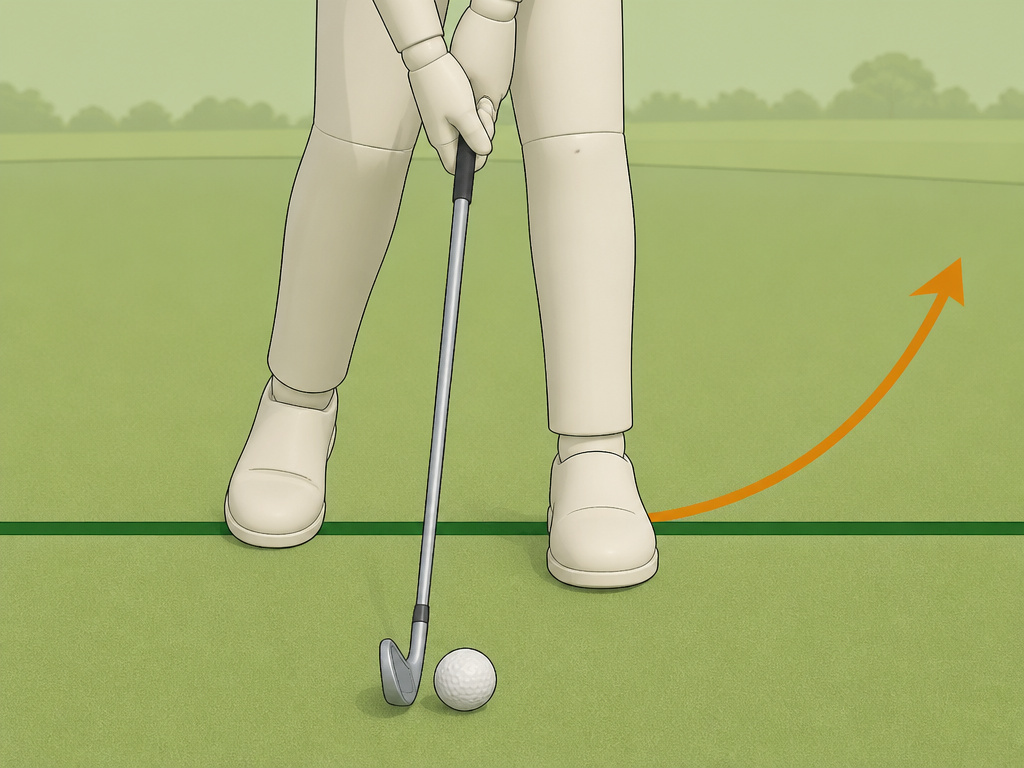 The driver is the one club where a slightly closed stance is almost standard advice for amateurs. The goal is to promote a sweeping, inside-path strike to maximize roll and reduce the spin that causes a slice.
For a driver, play the ball off your front heel. A driver stance that is fractionally closed, right foot pulled back an inch from parallel, helps create that ideal path. It gives you the feeling of swinging out to right field. The key, again, is not to let the clubface close with your body. Feel like you’re holding the face square through impact to start the ball right-center and let it draw back.
An open stance with a driver is a specialist shot. It’s for when you absolutely must hit a cut around a corner or need a higher, softer landing shot into a par-5. For most everyday tee shots, square to slightly closed is the percentage play.
The part nobody mentions: That “slightly closed” driver stance can mask early extension. If you can’t turn your hips properly in the backswing, closing your stance is a compensation that lets you shove the hips forward instead of rotating. It works until your lower back starts complaining.
Short Game Stances: When to Change Your Alignment
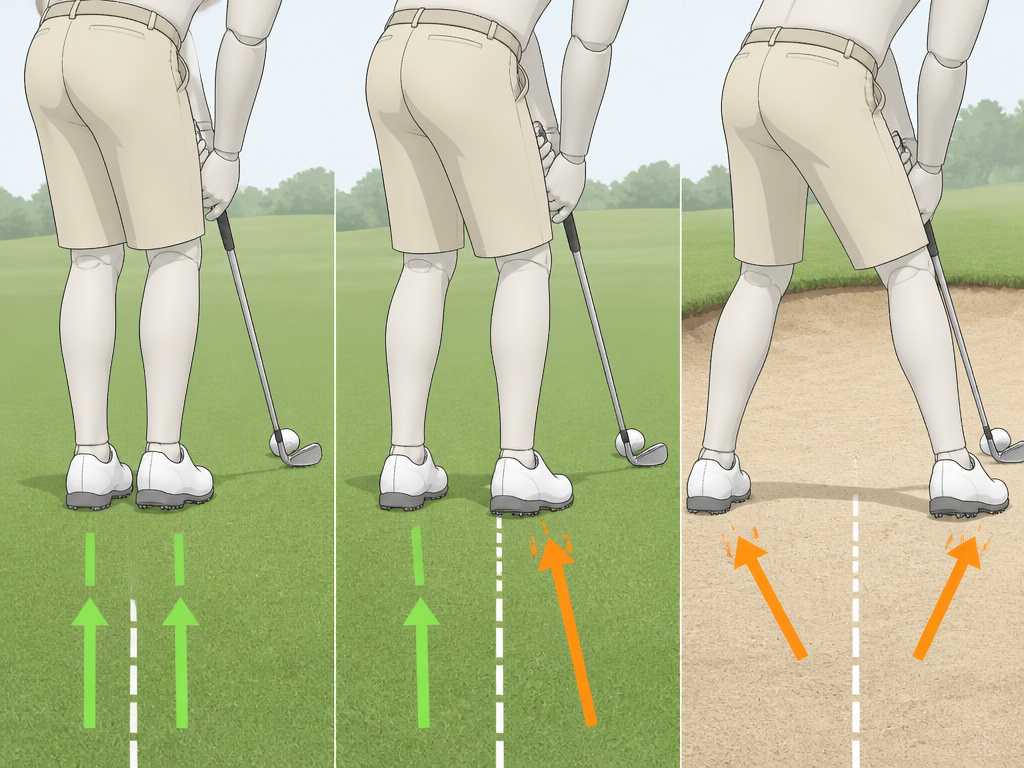 Around the greens, stance becomes a precise tool for trajectory control. The general rules shift.
Chipping: Use a narrow, open stance. Play the ball back in your stance, weight forward. The open alignment helps you keep the clubface looking at the target while your body rotates out of the way, promoting a descending blow and clean contact. This chipping stance is about stability and a consistent low strike.
Pitching: For a standard pitch shot, use a square to slightly open stance. The added loft of a wedge means you don’t need an open stance to get height, but the open alignment aids in clearing the hips and preventing a “scooping” motion.
Bunker Shots: Always use an open stance. This is non-negotiable. You need the club to cut across the sand under the ball, and an open body alignment pre-sets that outside-in path. It also helps you align your body left of the target while the clubface aims at the flag, creating the necessary slice spin to pop the ball up.
The short game is where these alignments feel most intentional. You’re not fixing a flaw; you’re engineering a specific outcome.
“Open-to-Closed” vs “Closed-to-Open” Swing Styles
This is the advanced layer. Beyond simple setup, some instructors teach entire swing patterns based on the clubface’s relationship to the path throughout the motion.
An “open-to-closed” swing features a clubface that is open (toe down) at the top of the backswing. The player then “slams” it shut through impact. Think of Ben Hogan or Webb Simpson. This style can produce powerful draws and reduces a two-way miss for some players.
A “closed-to-open” swing features a clubface that is closed (toe up) at the top. The player then “holds” it off from closing further through impact. Dustin Johnson and Brooks Koepka are modern examples. This style can promote a powerful, straight-to-fade ball flight.
I won’t recommend beginners chase either of these styles. They require exceptional wrist control and timing. For most amateurs, focusing on a consistent, neutral proper stance and a square clubface is the faster path to improvement. These patterns are what emerge when world-class talent refines their mechanics, not a starting point.
Which style works for you? It’s personal. The “open-to-closed” player relies on rapid forearm rotation. The “closed-to-open” player relies on body rotation to delay the face closure. One feels like hitting a forehand topspin in tennis; the other feels like holding a ski edge.
How to Practice and Find Your Best Alignment
Start from square. Always. Use two alignment sticks. Place one on the ground directly at your target. Place the second parallel to it, across your toes. Hit ten shots with a 7-iron. This is your baseline.
Then, experiment. 1. To feel a draw: Pull your right foot back 2-3 inches, creating a closed stance. Keep the clubface aimed at the target. Make your normal swing. The ball should start right and curve left. 2. To feel a fade: Pull your left foot back 2-3 inches, creating an open stance. Keep the clubface aimed at the target. Make your normal swing. The ball should start left and curve right.
What most people get wrong: They change their swing when they change their stance. Don’t. Make the same turn, the same tempo. Let the altered alignment do the work. Your body will find the new path instinctively if you don’t force it.
If you chronically slice, your practice should mix drills. Work on the root causes of a slice, a weak grip, an over-the-top transition, with a square stance. Then, as a temporary on-course fix, employ a slightly closed stance to get the ball turning over. Label it as a band-aid, not a cure.
Your golf shoes matter here. A stable, spikeless sole or traditional cleats allow for the subtle weight shifts and pivots these stance changes require. Slick soles or worn-out insoles can cause your feet to slip during the pivot, muddying the effect of your careful alignment.
Frequently Asked Questions
Should I use an open or closed stance to fix a slice?
Use a slightly closed stance as an on-course temporary fix to promote an inside path. But to truly fix a slice, you must address the core issues: an open clubface at impact and an outside-in swing path. Practice with a square stance, focusing on releasing the club with a stronger grip. The closed stance is a crutch; learn to walk without it.
Do any PGA Tour players use a closed stance?
Yes, many use a slightly closed stance, especially with the driver, to promote a draw. Players like Jon Rahm and Scottie Scheffler often set up with their right foot pulled back. It’s a conscious choice to control their shape. They have the hand speed to square the face from that alignment.
What is the best stance for beginners?
Square stance. Every time. It establishes neutral biomechanics and provides the most consistent feedback. Before you learn to shape shots, you must learn to hit them straight. A square proper golf setup is the only foundation that makes sense. Tinkering with open or closed alignments early introduces unnecessary variables.
How does ball position change with an open or closed stance?
It shouldn’t. Ball position relative to your feet is a separate fundamental. For a mid-iron, the ball stays centered in your stance whether you’re open, square, or closed. What changes is your body’s orientation to the target line, not the ball’s position between your feet. Don’t let a closed stance trick you into playing the ball too far back.
Can your stance cause knee pain?
The biomechanics study suggests it can contribute. A closed stance may increase rotational torque on the lead knee. If you have knee issues and play from a closed stance, try moving to a more square alignment and see if the discomfort eases. Also, ensure your golf footwear provides adequate support and cushioning.
Before You Go
Stop thinking of open and closed stances as permanent fixes. They are dials on a machine. Your square stance is the default setting for reliable, repeatable contact. Turn the dial to “closed” when you need a draw to navigate a dogleg or combat a stiff left-to-right wind. Turn it to “open” for a fade around an obstacle, a high soft shot, or to give a sore lead knee a break.
The real power isn’t in knowing what each stance does. It’s in knowing when you need it. Start from square, learn your own tendencies, and then use these alignments as intentional tools. That’s how you move from reacting to your ball flight to commanding it.
