
Build Your Proper Golf Stance and Setup On These Unchanging Keys
This post contains affiliate links. As an Amazon Associate, we earn from qualifying purchases.
This post contains affiliate links. As an Amazon Associate, we earn from qualifying purchases.
A proper golf stance and setup requires matching three constants across every club in your bag: a head position with your eyes over a fixed swing axis, a pelvis tilted 12-18 degrees forward for spinal alignment, and a weight distribution that centers your pressure between your feet. The variables, stance width, ball position, and trunk angle, change in tiny, measured increments: stance widens by only 5cm from a 7-iron to a driver, and trunk lean decreases by just 5 degrees.
That 5cm and 5-degree window is where most amateurs overshoot. A study of professional swings found the total adjustment in setup from the shortest iron to the longest driver is surprisingly small. The failure usually comes from exaggerating these changes, not from getting them slightly wrong. You make a bigger move than the club actually demands, and your body spends the entire swing recovering from an address position it was never designed to hold.
What follows is a breakdown of the real numbers, pulled from motion-capture studies of professionals. You’ll get the specific measurements for each club, the two most common stance mistakes that guarantee fat or thin contact, and the one adjustment that reframes every other variable in your setup.
Key Takeaways
- Your head’s position is your swing’s North Star. Keep the midpoint of your eyes over a point 37% of your stance width from your right foot for every club, from wedge to driver.
- Widen your stance by only 5cm total from a 7-iron to a driver. Going wider creates a swing arc too long to control, leading directly to inconsistent contact.
- Forward trunk lean decreases a mere 5 degrees from a 7-iron (30°) to a driver (25°). Standing too upright with irons or too bent over with a driver is a primary source of power loss.
- Ball position moves forward in your stance as clubs get longer, but the shift is a percentage of your stance width, not an arbitrary guess. For a 7-iron, play it 40% from your left foot; for a driver, 10%.
- The most damaging setup error is making large, compensatory changes. The research is clear: swing failure more often results from excessive adjustment than from incorrect adjustment.
The 3 Constants in Every Proper Setup
Before you touch a single variable, lock in three elements that do not change from your wedge to your driver. These create a stable, repeatable axis for your swing.
First, your head position. A three-dimensional motion analysis of low handicappers found that the midpoint of their eyes was consistently at 37% of their stance width from the right foot, regardless of club. This isn’t a feel, it’s a measurable anchor point. Your head stays behind the ball, but its lateral placement relative to your feet is fixed. This consistency maintains a steady swing axis. If your head drifts forward of this point, you’ll hit behind the ball. If it moves back, you’ll top it.
Second, your pelvis needs a 12 to 18 degree forward bend. This isn’t about rounding your back. It’s about hinging from your hips to create a neutral spine aligned with your thoracic spine and neck. This position protects your lower back and allows for proper pelvis rotation during the swing, which can exceed 100 degrees in a full drive. Slumping into more bend or standing too upright restricts this rotation and saps power.
Third, your initial weight distribution and center of pressure. At address, your weight should feel balanced between your feet, with your center of pressure (COP) positioned midway. A study on elite golfers found that moving the ball laterally shifted their vertical ground reaction force (VGRF). If your weight is already biased toward your toes or heels at address, you’re forcing a compensation before the swing even begins.
A 3D motion analysis using Kwon3D software on professional golfers found the midpoint of the eyes consistently aligned 37% into the stance from the right foot across all clubs, from a 7-iron to a driver. This fixed head position maintains a consistent rotational axis for the swing.
How Stance Width Actually Changes With Club Length
The old advice is “wider for longer clubs.” The real advice is “slightly wider for longer clubs.” The difference is 5 centimeters.
Here are the measured stance widths, the distance between your ankle joints, from a biomechanics study:
| Club | Stance Width (Between Ankles) | Visual Reference |
|---|---|---|
| 7-Iron | ~5 cm wider than narrowest setting | Insides of feet roughly under shoulders |
| Driver | ~10 cm wider than narrowest setting | Insides of feet just outside shoulders |
The professional player in the study showed even smaller changes. The takeaway is that the adjustment is subtle. If the insides of your feet move outside your shoulders with a mid-iron, your stance is too wide. This creates a longer, wider swing arc that is difficult to control, resulting in fat and thin shots. If your feet are inside your shoulders with a driver, your stance is too narrow, making your swing unstable and robbing you of a power base.
Your golf posture starts from the ground up. A stable, appropriately wide stance is the foundation for the spine angle and arm hang that follow. A proper driver setup isn’t about a dramatically wider stance; it’s about a slightly wider base that accommodates a more sweeping swing path.
Where this goes sideways: Automatically jumping into a “power stance” with the driver. If your stance width increases more than 10cm from your 7-iron width, you’ve overdone it. The resulting swing will be all arms and no rotation, and your consistency will vanish within three holes.
Trunk Angle and Spine Tilt: The 5-Degree Rule
Your trunk forward lean, the angle your spine makes from vertical, is another variable that changes less than you think. From a 7-iron to a driver, it decreases by only about 5 degrees.
- For a 7-iron: Aim for approximately 30 degrees of forward lean.
- For a Driver: Aim for approximately 25 degrees of forward lean.
You stand more upright with longer clubs because the club is longer; you’re naturally farther from the ball. Bending over too much with a driver forces you to reach, collapsing your posture and causing a steep, downward strike. Standing too upright with an iron lifts your center of gravity and promotes a scooping motion.
This angle is tied directly to your spine angle and is a core component of a functional iron setup. To check it, get into your address position and have someone hold the grip end of a club along your spine. The angle it makes against the ground is your forward lean.
The Ball Position Paradox
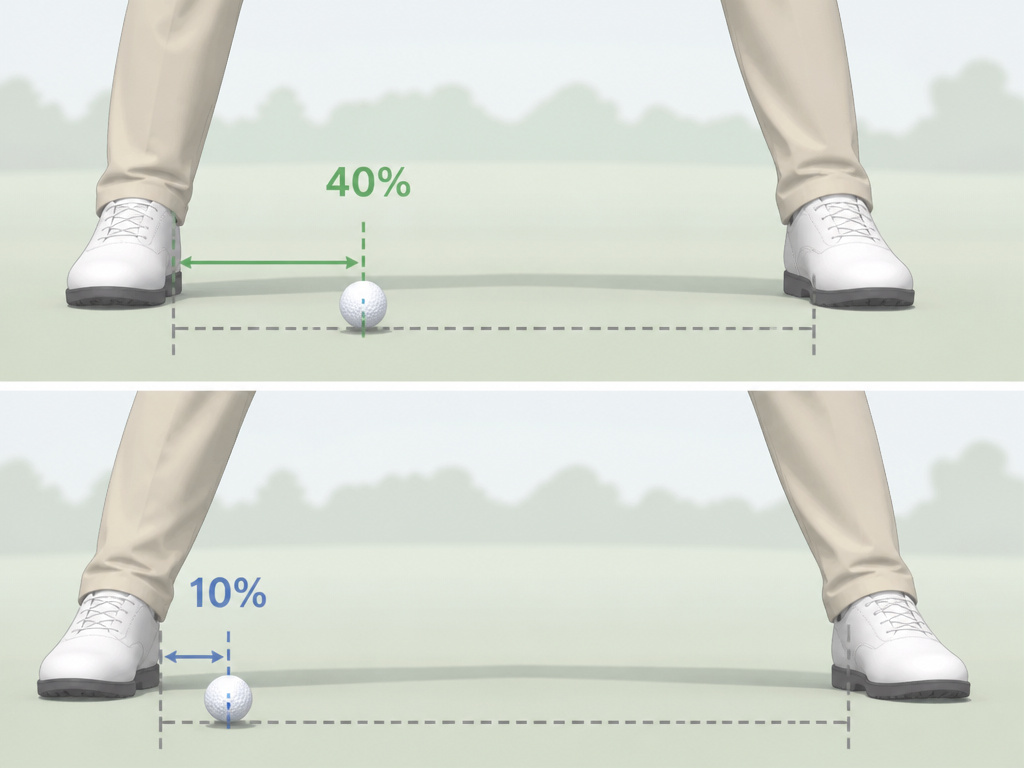 Ball position is the most manipulated variable, and consequently, the most botched. The key is to understand it as a percentage of your stance, not a static “off the left heel” rule.
Research shows that lateral ball position (how far forward it is in your stance) shifts significantly: * For a 7-iron: The ball is positioned 40% of your stance width from your left foot (about 15cm back). * For a Driver: The ball is positioned 10% of your stance width from your left foot (about 5cm back).
Notice the driver ball is still forward in the stance, but the percentage is smaller because your stance is wider. This promotes the slight upward attack angle you need. A peer-reviewed study in the Journal of Sports Science and Medicine found that moving a standard 4.27cm diameter ball just 2.14cm (its own radius) laterally significantly altered shoulder aim, clubface orientation, and ground reaction forces at address. Small changes matter.
Common mistake: Playing every iron off the center of your stance. With a mid-iron, a center ball position places the ball too far back, forcing an excessively steep angle of attack and deep divots. Play your 7-iron forward of center, and adjust from there.
The paradox, noted in the Korean Journal of Applied Biomechanics, is that “the failure of swing result from the excessive changes of setup not from the incorrect changes.” You are more likely to ruin your swing by making a huge ball-position jump from wedge to driver than by being a centimeter or two off with each club. Incremental adjustment is the goal. For a simple method, follow the fundamental rules for ball position using your lead foot as a consistent reference point.
Grip, Arms, and the “Quiet” Adjustments
 While your feet, torso, and the ball get most of the attention, your grip and arm position undergo subtle, crucial shifts.
Your grip’s lateral position changes. For a 7-iron, your hands are typically about 5cm left of the clubface. For a driver, they move to the right side, or slightly behind the clubface. This helps manage the lie angle and path of the longer club.
Your arm hang should feel neutral and relaxed, allowing your arms to hang straight down from your shoulders. If you have to reach or pull your arms in, your posture is off. This relaxed hang is essential for generating speed without tension. A poor grip forces bad arm position, which is a primary cause of the golf slice. If you’re struggling with consistency, your grip selection might be working against your natural setup.
Diagnosing Your Setup: A Faults Table
Use this table to connect a persistent ball-flight problem to its most likely setup origin. Fix the setup flaw before you overhaul your swing.
| Ball Flight Problem | Likely Setup Cause | Quick Fix |
|---|---|---|
| Consistent Fat Shots | Weight too much on back foot at address; ball too far back in stance. | Feel 55% weight on lead foot; use the 40% stance rule to check ball position. |
| Consistent Thin Shots | Standing too upright; head moving forward of the 37% axis during swing. | Re-check trunk forward lean (30° for iron); place a headcover just outside ball to discourage head movement. |
| Pulls / Snap Hooks | Shoulders aligned closed (right of target); ball too far forward. | Square clubface first, then align shoulders parallel to it; move ball back 1 ball width. |
| Slice / Push | Shoulders aligned open (left of target); weak grip; stance too narrow. | Strengthen grip so you see 2 knuckles; widen stance to shoulder-width; check shoulder alignment. |
| Lack of Power | Stance too wide restricting rotation; no pelvis forward bend (flat back). | Narrow stance until insides of feet under shoulders; hinge from hips to create 15° forward bend. |
Many of these issues, especially slices and pulls, stem from misaligned shoulders and feet. Understanding open vs closed stance effects is critical for diagnosis. Sometimes, the fix is as simple as improving your stability with better golf cleats or more supportive shoe insoles.
A Step-by-Step Routine for a Repeatable Setup
Follow this sequence every time to build consistency. It prioritizes the constants first.
- Grip and Clubface: Take your grip and set the clubface squarely behind the ball, aimed at your target. Everything else aligns to this.
- Stance Width: Step into your stance with the appropriate width for the club (refer to the table above). For a 7-iron, insides of feet under shoulders.
- Pelvis and Spine: Hinge from your hips to create a 12-18 degree forward pelvis bend. Let your arms hang naturally. This sets your proper posture.
- Head Position: Settle into your posture and check that your head is centered, with your eyes over the 37% axis point from your right foot.
- Ball Position: Place the ball according to the percentage rule (40% from left foot for 7-iron). Use an alignment rod on the ground for feedback.
- Final Balance Check: Rock gently onto your toes and heels, then settle back to center. Your weight should feel balanced between the balls and heels of both feet.
Skipping the balance check is where high handicappers lose it. They settle into their weight biased toward their toes, then fall forward during the swing. Do the rock-back routine every single time.
Frequently Asked Questions
Should my weight be 50/50 at address?
For most full swings with irons and woods, yes, aim for a 50/50 distribution at address. Your weight will shift naturally during the swing. For a chipping setup, you want a distinct bias, often 60-70% on your lead foot, to promote a downward strike.
How far should I stand from the ball?
Let your posture dictate it. Once you’ve hinged from your hips with your arms hanging freely, the distance is correct. If you have to reach your arms out straight, you’re too far. If your elbows are cramped into your sides, you’re too close. The length of the club handles the rest.
Does foot flare matter?
Yes. Your lead foot should be flared open toward the target by up to 25 degrees to facilitate hip rotation through impact. Your back foot can be square or slightly flared. This is consistent across all full-swing clubs.
How do I know if my shoulders are square?
After aligning your clubface, place a second club across the front of your shoulders. It should point parallel left of your target line (for right-handers). A common mistake is aligning the shoulders with the feet, which are often inadvertently open.
Can a bad setup cause a slice?
Absolutely. An open stance (feet aligned left of target) with closed shoulders is a classic slice factory. So is a weak grip combined with a ball position too far forward. Before working on an in-swing fix, audit your setup. The PGA pre-swing principles PDF from the University of Birmingham details how body alignment dictates initial club path.
Before You Go
Stop searching for a secret. The proper golf stance and setup is a system of small, measurable adjustments built on a foundation of three constants. Lock in your head position, your pelvis hinge, and your centered balance. Then, and only then, tweak your stance width by centimeters and your ball position by percentages.
The research shows professionals change these variables less than amateurs think. Your next range session should be about precision, not overhaul. Pick one constant to monitor, maybe your head position, and hit every club in your bag focusing solely on that. The consistency will follow. For a deeper dive into the athletic principles behind a powerful address, the Keiser University posture guide is an excellent resource, and the broader current golf research summary on PMC confirms that the fundamentals, not fads, drive lasting improvement.
