
How to Hit a Driver in Golf With a Setup That Cuts Your Misses
This post contains affiliate links. As an Amazon Associate, we earn from qualifying purchases.
This post contains affiliate links. As an Amazon Associate, we earn from qualifying purchases.
To hit a driver in golf, match three things: a forward ball position (inside your lead heel), a 5-7 degree spine tilt away from the target, and a swing focused on tempo, not torque. This setup promotes a slight upward strike, squares the clubface, and lets the club’s length work for you instead of against you. Trying to swing harder than 85% effort loses center-face contact and costs you more distance than it gains.
That 5-7 degree spine tilt is the mechanical requirement for getting your shoulders working on the correct plane. Without it, your body fights to get behind the ball during the swing, forcing the club across it from the outside.The result is a slice that starts left and curves wildly right, or a weak pull that never finds the fairway.
What follows breaks down the setup into three measurable checkpoints, explains why the driver swing is a different animal than your iron swing, and gives you the one swing thought that actually works when you’re standing on the tee.
Key Takeaways
- Play the ball just inside your lead heel. This single adjustment forces the correct low-point in your swing arc for an upward strike.
- Set your spine at a 5-7 degree tilt away from the target. This preset rotation keeps your shoulders turning on plane and prevents an over-the-top downswing.
- Swing at 80-85% of your maximum effort. A centered hit at this tempo produces more ball speed and straighter flight than an off-center smash at 100%.
- Tee the ball so half of it sits above the crown of your driver when soled. This height is non-negotiable for clean contact with a positive angle of attack.
- Your grip pressure dictates your wrist hinge. Hold the club firmly enough to control it, but loosely enough that your wrists can hinge and unhinge freely through impact.
Why the Driver Feels Like a Different Sport
Your 7-iron is forgiving. A 2-degree open face at impact might push the ball 5 yards right. Execute that same 2-degree error with a driver, and the miss balloons to 25 yards offline. The reason is simple physics: less loft means sidespin has a dramatically larger influence on ball flight.
A driver’s 9-12 degrees of loft provides minimal backspin to stabilize the ball. Your pitching wedge’s 44-46 degrees of loft creates so much backspin it overpowers minor face-angle mistakes. With the driver, every degree of face error is amplified.
You’re also holding the longest club in the bag. A standard driver length is 45-46 inches, while a 7-iron is about 37 inches. That extra leverage magnifies any flaw in your driver setup. What feels like a small path issue with a mid-iron becomes a wild, uncorrectable curve with the big stick. This is why the foundational setup fundamentals matter more here than with any other club.
The 3-Step Setup That Controls Face and Path
Forget complicated swing thoughts. A repeatable, athletic address position does most of the work for you. Get these three things right before you ever take the club back.
1. Ball Position and Stance Width
The ball must be positioned just inside your lead heel. For a right-handed golfer, that’s the left heel. This isn’t a minor tweak; it’s the entire game. Playing the ball here ensures you make contact slightly after the bottom of your swing arc, creating the essential upward strike.
Your stance should be wider than with an iron—about shoulder-width apart. This creates a stable base for the longer lever and the rotational force you’ll generate. A narrow stance leads to loss of balance and early extension, where you stand up through impact and top the ball.
Where this goes sideways: Playing the ball even an inch too far back in your stance. This forces a downward strike, adding excessive backspin and turning your driver into a low-line rocket that never carries. You’ll lose 30 yards minimum.
2. Spine Tilt and Posture
You need to preset your body into the hitting position. At address, tilt your spine approximately 5-7 degrees away from the target. Feel like your lead shoulder is higher than your trail shoulder. This “hip-led” tilt keeps your upper center behind the ball, promoting an inside-out swing path.
Common mistake: Leaning your upper body back without tilting from the hips. This pulls your lead shoulder back, opens your chest, and guarantees an out-to-in swing path. You’ll hit weak slices all day.
Your golf posture should be athletic: knees slightly flexed, back straight, and hips hinged. From this position, your arms should hang freely, creating a straight line from your lead shoulder down the shaft to the clubhead. This is your proper golf setup.
3. Grip, Alignment, and Tee Height
A neutral golf grip is your only connection to the clubface. For a right-hander, make sure you can see two knuckles on your left hand. Your right-hand lifeline should cover your left thumb. Grip pressure is a 6 out of 10.
Your alignment is everything. Use an intermediate target a foot in front of your ball to square the clubface, then align your feet, hips, and shoulders parallel to that target line. Most amateurs aim right and cut across it.
Finally, tee the ball high. When you sole your driver behind the ball, half of the ball should be visible above the crown of the club. This correct tee height gives you the margin for error to hit up on it without skying the ball or hitting the top of the face.
| Setup Checkpoint | Target | Consequence If Wrong |
|---|---|---|
| Ball Position | Inside lead heel | Downward strike, low spin, 30+ yard distance loss |
| Spine Tilt | 5–7° away from target | Over-the-top path, slice or pull |
| Tee Height | Half-ball above club crown | Thin contact or skyball, inconsistent launch |
| Grip Pressure | 6/10 (firm but not tight) | Restricted wrist hinge, loss of clubhead speed |
| Stance Width | Shoulder-width | Loss of balance, early extension, topped shots |
The Swing: Tempo Over Torque
The driver swing is a sequencing drill. The goal is to transfer energy efficiently from the ground up, not to muscle the club with your arms.
The Takeaway and Backswing
Push the club back low and wide for the first 18-24 inches. Let your shoulders and torso start the turn. This wide arc creates the space you need to drop the club into the slot on the downswing. A narrow, handsy takeaway forces you to reroute the club over the top.
Your backswing should feel full and rotational, not a lift. Your weight will load into your trail side, but your head should stay relatively centered. The feeling is of coiling around your tilted spine, not swaying off the ball.
The Downswing and Impact
Start the downswing with your lower body. A slight bump of your lead hip toward the target begins the unwinding sequence. This moves your weight forward and creates room for your arms to drop down into the slot, approaching the ball from the inside.
At impact, your hands should be slightly ahead of the ball, delivering about 1-2 degrees of forward shaft lean. Compare that to the 4-6 degrees you’d want with an iron. This minimal lean with the driver is why you hit up on it. The club is still ascending.
Swing at 80-85% of your max effort. The data is clear: a centered hit at this tempo produces higher ball speed than an off-center hit at full throttle. You maintain balance, sequence, and most importantly, a square clubface.
The Follow-Through
A balanced finish is the report card for your swing. You should be able to hold your finish on your front foot, with your chest facing the target and your weight fully transferred. If you’re falling back or stumbling, you swung too hard or didn’t shift your weight.
Equipment: The Forgotten Multiplier
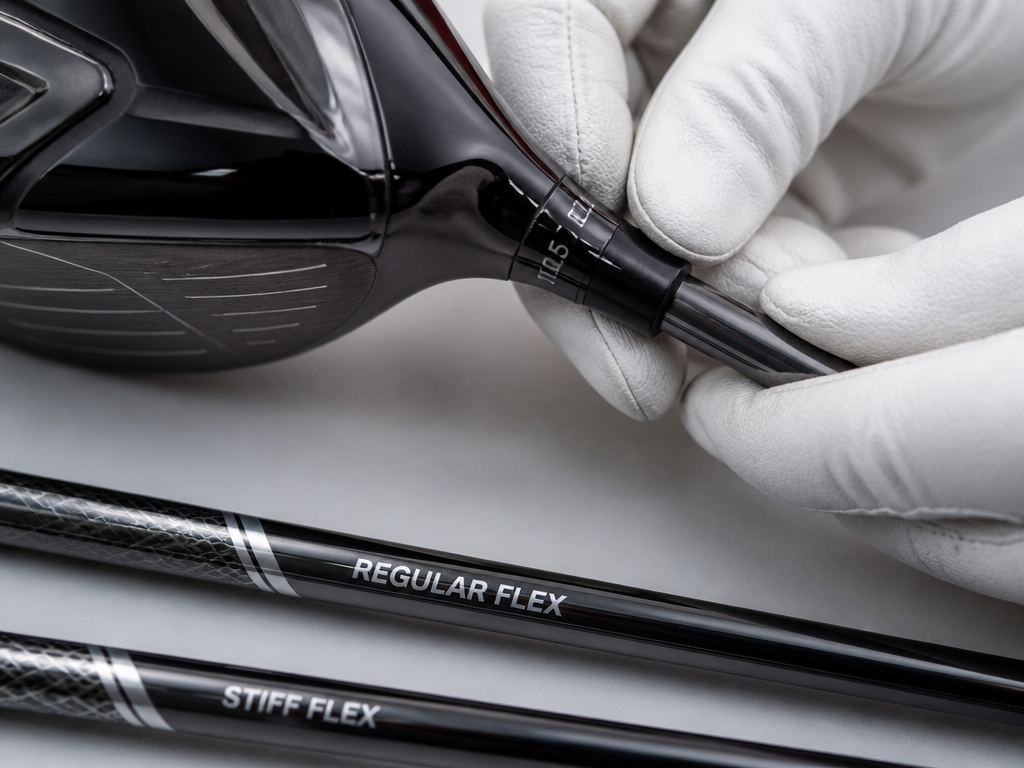 Your technique can be perfect, but the wrong gear will fight you. Two specs matter more than any marketing claim: loft and shaft flex.
Driver Loft and Shaft Flex
Most amateurs use too little driver loft. If your swing speed is under 95 mph, you likely need 10.5 to 12 degrees. More loft increases launch and can actually reduce spin, maximizing carry distance. Don’t let ego pick a 9-degree head.
Choosing shaft flex is about matching your swing speed. A shaft that’s too stiff won’t load properly, costing you distance and forcing a compensative swing. One that’s too whippy makes timing the clubface nearly impossible. Get fit, or use this rule of thumb: under 85 mph swing speed suggests a regular flex; over 100 mph likely needs stiff.
The Gear That Actually Helps
While a fitting is best, a few tools let you self-diagnose. Impact tape or foot spray shows you where you’re hitting the face. A consistent heel or toe pattern points to a ball position or posture issue, not a swing flaw.
For the data-driven, a launch monitor is the ultimate truth-teller. It will show you your angle of attack, spin rates, and club path in real numbers. Without one, you’re guessing.
Faults and Quick Fixes
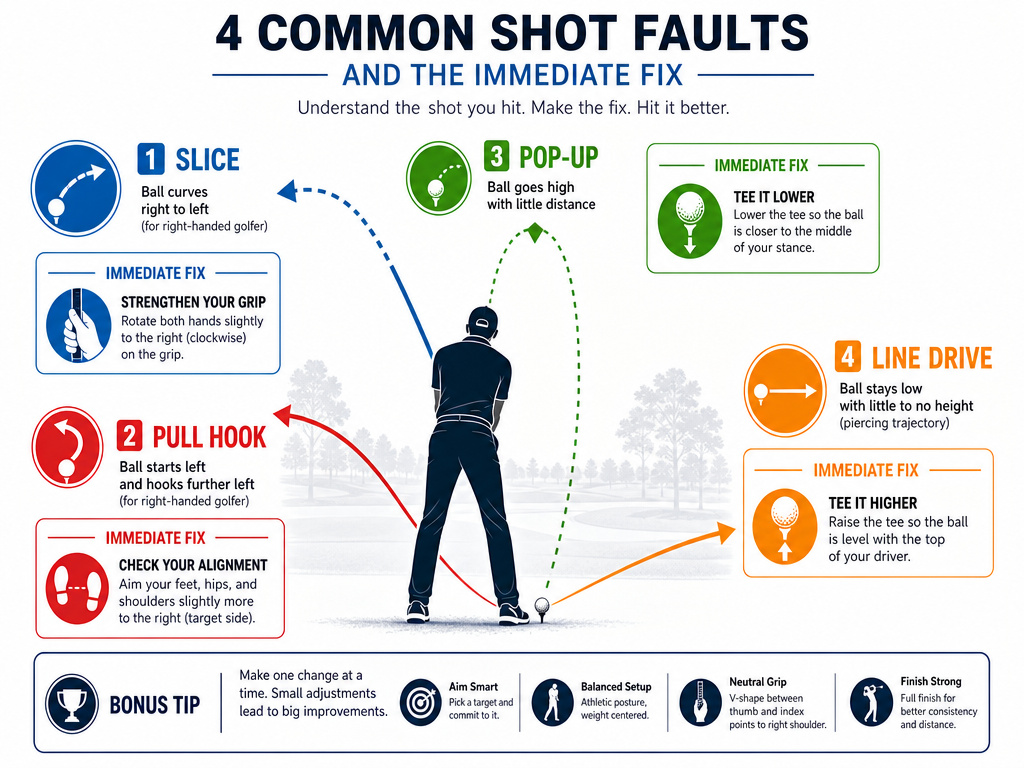 When your drive goes wrong, the cause is usually one of three things. Here’s how to diagnose and fix it mid-round.
| Ball Flight | Likely Cause | Immediate Fix |
|---|---|---|
| Big Slice (starts left, curves right) | Out-to-in swing path with open face. | Feel like you’re hitting the inside-back of the ball. Strengthen grip slightly. |
| Pull Hook (starts right, curves left) | Out-to-in path with closed face. | Check alignment—you’re likely aimed right. Focus on starting the ball at your target. |
| High, Short Pop-up (skyball) | Hitting up too much, striking the crown. | Lower tee height slightly. Feel like you’re sweeping the ball off the tee, not lifting it. |
| Low Line Drive | Ball too far back, downward strike. | Move ball forward to inside lead heel. Focus on finishing high and in balance. |
The part nobody mentions: A sudden case of the tops often comes from ball position creeping back. Before you overhaul your swing, check that the ball is still off your lead heel. It fixes more problems than any swing tip.
Frequently Asked Questions
Should I try to hit up on the ball with my driver?
Yes. A slightly positive angle of attack (hitting up 3-5 degrees) is ideal for maximizing driver distance. It reduces backspin and increases launch angle. This is achieved through the forward ball position and spine tilt, not by scooping with your hands.
How far should I be hitting my driver?
Carry distance is roughly 2.5 times your clubhead speed in mph. An average male amateur swinging 93 mph carries the ball about 210 yards. Don’t compare your total distance (including roll) to someone else’s carry—conditions vary too much.
What’s the one swing thought that actually works?
“Tempo, not torque.” Say it to yourself during your practice swing. It reminds you to swing within yourself, maintain sequence, and find the center of the face. Power is a product of efficiency, not effort.
How important is equipment fitting?
It’s the fastest way to add distance and accuracy if your swing is reasonably consistent. A fitter can pinpoint the optimal loft, shaft, and head setting for your delivery. Playing standard specs off the rack leaves yards and fairways on the table.
Why do I hit my irons well but struggle with the driver?
The different swing techniques are real. Irons require a downward strike for compression; the driver demands an upward strike for launch. The setups are opposites. Trying to hit your driver like a 7-iron is the most common technical error in golf.
Before You Go
Hitting a driver straight is about reducing variables. Nail the setup—ball forward, spine tilted, tee high. Swing with rhythm, not rage. Let the club’s design do the work.
Your driver is a lever to be swung. When your setup is athletic and your intent is smooth contact, the fairways get wider.The game gets simpler. Now go find the short grass.
