
Core Strength Exercises for Golfers: What Science Says Works
This post contains affiliate links. As an Amazon Associate, we earn from qualifying purchases.
This post contains affiliate links. As an Amazon Associate, we earn from qualifying purchases.
Core strength exercises for golfers target three specific capacities: stability, anti-rotation, and rotational power. A 10-week core rehabilitation program for elite male golfers with back pain significantly improved trunk strength, clubhead speed, and carry distance, while a study of 43 golfers found a single weekly session for seven weeks improved movement but not swing performance. The difference is in the program’s focus and frequency.
That gap between movement quality and actual yardage is where most generic advice falls apart. Your swing doesn’t just need a strong midsection, it needs a midsection trained for the specific job of transferring force from your legs to your hands while keeping your spine safe.
What follows is a breakdown of the three non-negotiable capacities, the nine exercises that build them, and the exact program structures pulled from the research that delivered measurable results. You’ll see why a plank alone isn’t enough and where to spend your time instead.
Key Takeaways
- A 10-week core rehab program for elite golfers with back pain boosted clubhead speed and carry distance while reducing pain. A generic once-a-week program for seven weeks improved movement tests but showed no swing gains.
- Your core workout must train three separate capacities: spinal stability (to protect your back), anti-rotation strength (to maintain the “X-factor” coil), and rotational power (to accelerate the club).
- The “side bridge” exercise elicits over 60% maximum contraction in the external obliques, making it a research-backed staple for building the lateral stability your downswing demands.
- If you only have 15 minutes, prioritize anti-rotation exercises like the Pallof press. They have the most direct carryover to preventing early casting and preserving lag.
- Measure progress with a launch monitor like a Garmin R10 for clubhead speed, not just how long you can hold a plank. Strength endurance and swing speed are different goals.
What “Core for Golf” Actually Means (It’s Not Just Abs)
Forget the six-pack. The golf core is the entire cylinder of muscle from your ribs to your pelvis, front, back, and sides. It’s an engine housing, not a decoration. When this housing is weak, power leaks. Your hips fire, but your upper body spins with them too early. That’s casting. Your legs drive, but your spine arches or flexes under load. That’s a recipe for chronic lower back pain.
The research is specific about which muscles matter and what they do. A study breaking down muscle activation found the side bridge hits the external oblique at over 60% of its maximum voluntary contraction. The same study noted the gluteus medius and gluteus maximus fire at high levels during quadruped exercises, and the vastus medialis activates during lunges.
The side bridge exercise elicits greater than 60% MVIC in the external oblique, and greater than 45% MVIC in the gluteus medius. The quadruped exercise elicits high levels of activity (>45% MVIC) in the gluteus maximus.
These aren’t arbitrary choices. The external oblique resists rotation and lateral flexion, exactly what happens when you try to maintain your backswing coil as your lower body starts down. The glutes are your primary power generators; if they’re not online, your core has to work overtime just to keep you stable, stealing energy from the swing.
The 3 Core Capacities Your Golf Swing Actually Needs
Your workout must be built like your swing: with a purpose for each phase. Cramming random ab exercises together wastes time. You need to develop three distinct, golf-specific capacities.
1. Spinal Stability
This is the foundation. It’s the ability to maintain a neutral spine position under load, preventing excessive extension (arching) or flexion (rounding). The rectus abdominis (your “abs”) is a key player here, resisting that arch during a powerful downswing.
Why it matters: A stable spine is a safe spine. It’s also an efficient one. When your core can’t maintain position, power dissipates into unwanted movement instead of flowing into rotation. This is the primary defense against golf back pain.
2. Anti-Rotation Strength
This is arguably the most golf-specific capacity. During the transition from backswing to downswing, your lower body rotates toward the target while your upper body is still coiled away. Your core must resist that pull to maintain the “X-factor” stretch, the coil that stores elastic energy.
Why it matters: Weak anti-rotation strength means you “cast” the club. The upper body uncoils prematurely with the lower body, destroying lag and clubhead speed. Training this capacity teaches your core to be a brake, not just a motor.
3. Rotational Power
This is where the stored energy gets released. Once the anti-rotation brake holds the coil, you need to explosively rotate through impact. This is high-velocity, rotational force production.
Why it matters: You can be stable and strong, but if you can’t express that strength quickly, your swing speed caps out. This is the difference between a strong golfer and a long hitter.
| Capacity | Primary Job in the Swing | Key Muscle Focus | Sample Exercise |
|---|---|---|---|
| Spinal Stability | Prevent arching/rounding of the spine under load. | Rectus Abdominis, Transverse Abdominis | Dead Bug |
| Anti-Rotation Strength | Resist upper body rotation during downswing transition to maintain coil. | External/Internal Obliques | Pallof Press |
| Rotational Power | Generate high-velocity rotation through the impact zone. | Obliques, Hip Rotators | Cable Wood Chop |
The 9-Exercise Framework: From Foundation to Power
This isn’t a random list. It’s a progressive framework that moves from stability to power. You wouldn’t build a house by starting with the roof.
Stability Phase (Exercises 1-3):
- Dead Bug: Trains the rectus abdominis to keep the spine neutral while the limbs move. The risk if you arch your back? You reinforce the faulty pattern that causes back pain.
- Bird-Dog: Integrates the back (erector spinae) with the glutes. It teaches contralateral stability, right arm with left leg, which is the gait pattern of walking and the foundation of the swing.
- Side Bridge: The research-backed heavyweight for the obliques. Start on your knees, progress to feet stacked. If your hips sag, you’re overloading the shoulder, not the core.
Anti-Rotation Phase (Exercises 4-6):
- Pallof Press: The gold standard. Standing perpendicular to a cable or band, press the handle straight out from your chest and hold. Your entire core fires to stop you from rotating toward the machine.
- Tall-Kneeling Band Hold: A simpler version. Kneel upright, hold a band anchored to the side, and resist the pull. This removes the legs, isolating the core’s anti-rotation job.
- Plank with Arm Reach: In a forearm plank, slowly reach one arm forward. This challenges anti-rotation and stability simultaneously as your weight shifts.
Rotational Power Phase (Exercises 7-9):
- Cable Wood Chop: Mimics the swing path. Pull a cable from high across your body to low on the opposite side with controlled speed. Don’t just use your arms, push with the back leg and rotate the torso.
- Medicine Ball Rotational Throw: Explosive, full-body rotation. Heave a med ball into a wall from a coiled position. This trains the fast-twitch muscles for speed.
- Band-Resisted Rotation: Attach a band at waist height, grip it with both hands, and rotate into your follow-through against resistance. This overloads the finish position, building power through the entire range.
Why Some Programs Work and Others Don’t: A Look at the Timelines
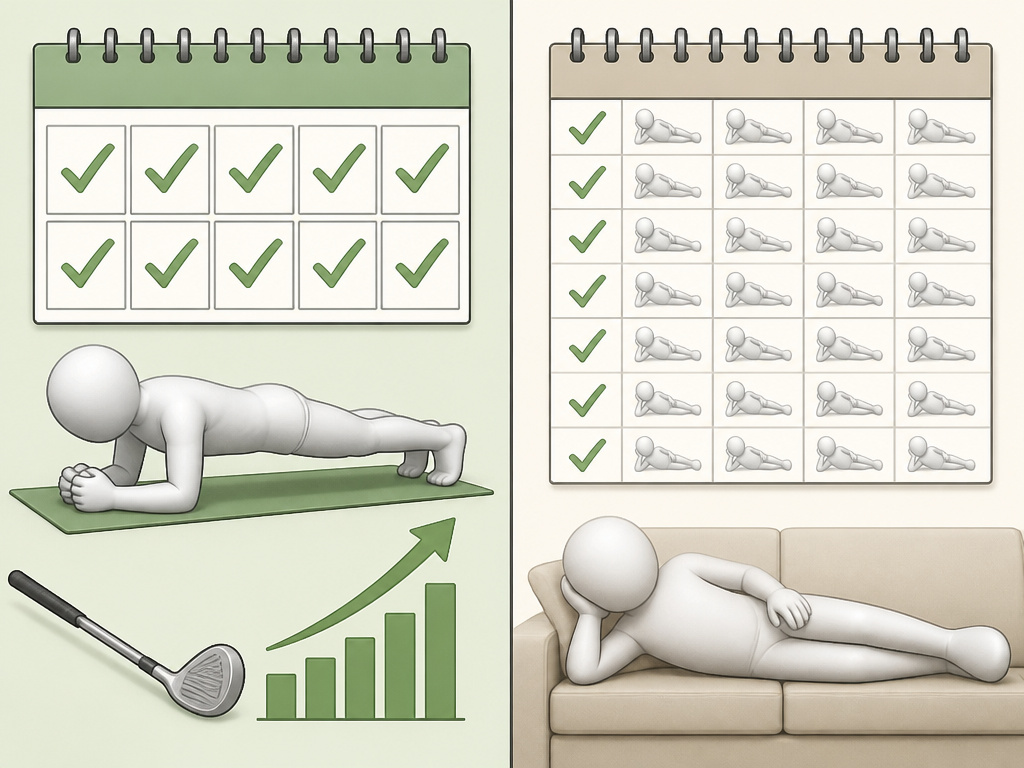
The research gives us a clear before-and-after picture, and the timeline is everything. You can’t cheat biology.
A 10-week core rehabilitation program for elite male golfers with existing lower back pain produced significant results. The study, published in the Journal of Exercise Rehabilitation, measured improvements in trunk strength, shoulder rotation, clubhead speed, carry distance, and pain levels. The key was a focused, frequent program addressing specific deficits.
Conversely, a Bond University study had 43 golfers perform a single supervised exercise session per week for seven weeks. The result? Improvements in movement tests like the left leg bridge and thoracic rotation, but zero significant improvement in any golf swing variable measured by TrackMan.
Where this goes sideways: Training once a week. The Bond University study found a single weekly session for seven weeks improved musculoskeletal movement but translated to no gains in clubhead speed, ball speed, or distance. The body adapts to the stimulus you give it; once a week is a maintenance dose, not a training dose.
The lesson is blunt. Consistency and focus win. A scattered, infrequent approach gets you moving better but won’t add yards. A structured, multi-week attack on a specific weakness will.
Building Your Weekly Schedule: The 3-Template System
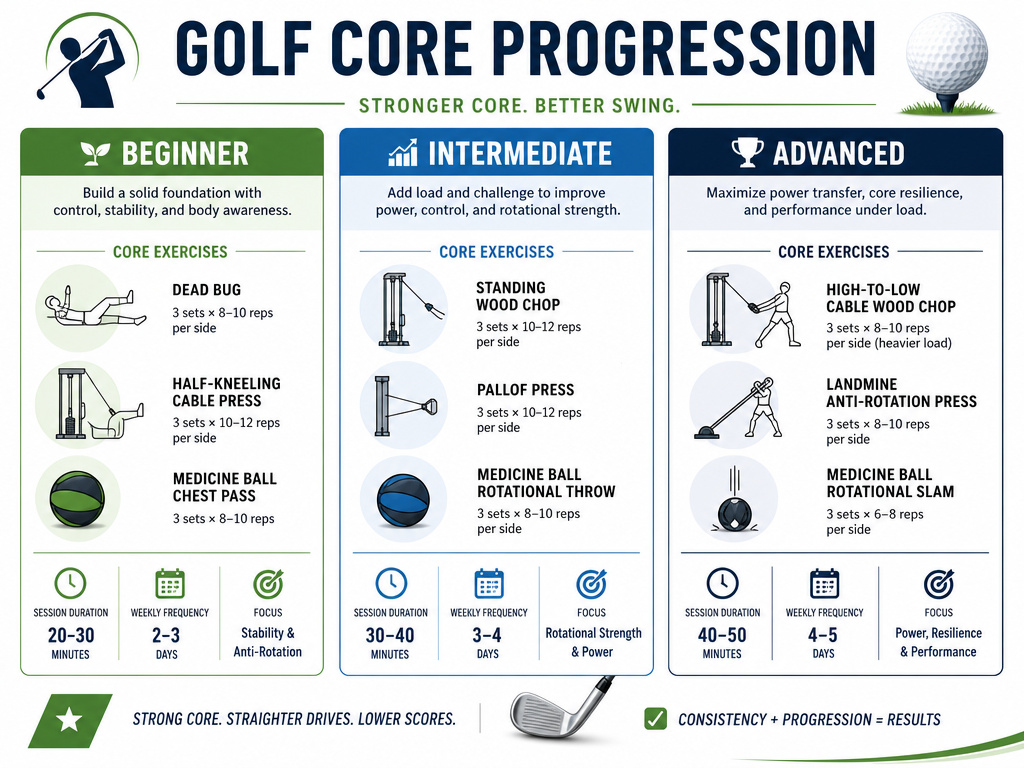
You don’t need to do all nine exercises every time. Here’s how to structure your week based on your experience level. Perform these sessions on non-consecutive days to allow for recovery.
Beginner Template (15-20 minutes):
- Focus: Master stability and introduce anti-rotation.
- Exercises: Dead Bug (2×10/side), Bird-Dog (2×10/side), Tall-Kneeling Band Hold (2×30 sec/side).
- Frequency: 2 times per week.
Intermediate Template (25-30 minutes):
- Focus: Develop anti-rotation strength and introduce rotational power.
- Exercises: Side Bridge (2×30 sec/side), Pallof Press (2×10/side), Cable Wood Chop (light weight, 2×8/side).
- Frequency: 3 times per week.
Advanced Template (30-35 minutes):
- Focus: Maximize rotational power and integrate all capacities.
- Exercises: Pallof Press (heavy, 3×8/side), Medicine Ball Rotational Throw (3×5/side), Band-Resisted Rotation (3×8/side).
- Add one stability exercise as a warm-up.
- Frequency: 3 times per week, cycling with a comprehensive strength training for golf program.
Stick with a template for 6-8 weeks before advancing. For senior golfers or those managing joint issues, the beginner or intermediate template is a long-term home, focus on quality of movement over added load.
How to Measure Real Progress (It’s Not the Mirror)
Core strength is invisible until it isn’t. The right metrics tell you if your program is working.
- Clubhead Speed: This is the ultimate output metric. Use a launch monitor like a Garmin R10 or visit a simulator bay every 4-6 weeks. A reliable gain is 1-3 mph over a dedicated 10-week block.
- Exercise Progression: Are you using more resistance on the Pallof press? Can you hold a side bridge for 45 seconds with perfect form? These are direct strength markers.
- Pain and Resilience: Note how your back feels during and after a full round or a range session. Reduced fatigue and ache are significant wins, especially if you’re using this to rehab existing lower back pain.
- Swing Feel: Do you feel more “connected” in your transition? Does your swing feel more powerful with less effort? This subjective feedback often precedes the measurable gains in speed.
Avoid the trap of measuring core work by how many sit-ups you can do or how long you can plank. Those test endurance in one plane. Your swing needs brief, intense stability and explosive power. Train for that, measure that.
Frequently Asked Questions
Do core exercises directly increase driving distance?
They can, but not alone. A stronger, more stable core improves the efficiency of force transfer from your lower body. This can lead to increased clubhead speed, which is the primary driver of distance. However, technique is still the master switch. A perfect core with a flawed swing won’t magically add 30 yards. Think of core work as upgrading your engine’s transmission, it lets you use more of the horsepower you create.
How long until I see results from a core program?
Expect to feel a difference in stability and swing connection within 3-4 weeks of consistent training (2-3x per week). Measurable gains in clubhead speed typically require a dedicated block of 8-12 weeks, as shown in the successful research studies. The 7-week, once-a-week program failed to produce swing changes, highlighting the need for adequate dose and duration.
Can core work fix my lower back pain from golf?
It is often the most effective solution, but diagnosis matters. For non-specific, mechanics-related back pain, a core program focusing on stability and anti-rotation is frontline treatment. Research on amateur golfer rehabilitation shows it reduces pain and improves function. If pain is sharp or persistent, see a medical professional first to rule out disc or joint issues.
What’s the one core exercise I should never skip?
The Pallof press. It directly trains the anti-rotation capacity that is most specific to the golf swing and most neglected in generic routines. If you only have five minutes, do three sets on each side. It will do more for your swing integrity than a hundred crunches.
Should seniors do the same core exercises?
The principles are the same, but the progression starts earlier and moves slower. Senior golfers should prioritize the stability and anti-rotation exercises from the beginner template, often using shorter holds and lighter resistance. The goal is injury prevention and maintaining rotational capacity, not max power. Mobility work should be paired with it.
Before You Go
The goal isn’t a chiseled midsection. It’s a faster, safer, more repeatable golf swing. The research is clear: generic ab workouts fall short. You need a program that builds the cylinder, front, back, and sides, for the three jobs it has during your swing: staying stable, resisting rotation, and exploding through.
Start with the beginner template. Master the feeling of bracing without holding your breath. Progress to the Pallof press. After eight weeks, test your speed. The gains might be modest on paper, a few miles per hour, but on the course, that’s the difference between a middle iron and a short iron into the green. That’s a real result.
