
Boost Swing Speed: How Fitness & Strength Training Work
This post contains affiliate links. As an Amazon Associate, we earn from qualifying purchases.
This post contains affiliate links. As an Amazon Associate, we earn from qualifying purchases.
Fitness increases swing speed by improving the physical qualities that power the golf swing: rotational strength, explosive power, flexibility, and balance. Peer-reviewed studies show an 8-week combined training program can boost clubhead speed by 4.1% and hitting distance by 5.2%. The gains come from increased torso rotational velocity and better force transfer from the ground up.
That 4.The 1% number is the average effect size from a systematic review of resistance training studies. It means a 100 mph swinger adds over 4 mph, about 12 extra yards off the tee, without changing their technique.The mechanism is physical, not magical.
What follows breaks down the four proven fitness levers: combined strength and power training, targeted flexibility, measurable balance, and explosive plyometrics. We’ll name the studies, cite the timelines, and show where one session a week fails completely. By the end, you’ll know which type of gym time actually moves the TrackMan numbers.
Key Takeaways
- Combined training works. Blending general strength with golf-specific, high-velocity movements for 8 weeks yields a 4.1% average increase in clubhead speed.
- Balance predicts distance. A 2016 study found a significant negative correlation between BESS test scores and driving distance, better balance meant longer drives.
- Infrequent training fails. A 7-week program of one supervised session weekly showed zero improvement in clubhead speed for pre-elite golfers.
- Flexibility isn’t just for warm-ups. Greater sit-and-reach length correlates directly with higher clubhead speed and more driving distance.
- Core training has a direct effect. An intervention using the 360° TitaniUM Core Strength Exercise® raised swing speed from 60.2 mph to 78.65 mph in novice golfers.
The 4.1% Clubhead Speed Rule
Forget vague promises. The benchmark for effective training is a 4.1% gain in clubhead speed. That figure comes from a 2021 systematic review in the Journal of Strength and Conditioning Research that analyzed multiple resistance training methods.
Combined nonspecific and golf-specific training increased clubhead speed by an average of 4.1% and hitting distance by 5.2%. Programs typically lasted 8 weeks and involved golf-specific movements at high velocities for 3-4 sets of 5-15 repetitions.
The “combined” part is non-negotiable. General strength builds the engine; golf-specific movements teach your body to fire it in sequence. A program of just bench presses and leg curls won’t transfer. You need exercises that mimic the swing’s rotational velocity and planes of motion.
| Training Type | Best For | Typical Gain | Key Limitation |
|---|---|---|---|
| Combined (General + Golf-Specific) | Recreational to elite golfers | 4.1% CHS, 5.2% distance | Requires knowledge of swing mechanics |
| Isolated Strength | Building raw power base | Variable, often low transfer | May not improve kinematics |
| Plyometrics | Improving rate of force development | Increased segmental speeds | Riskier; requires established technique |
| Infrequent (1x/week) | Maintenance only | 0% CHS (per 2017 study) | Insufficient stimulus for adaptation |
The study noted a moderate effect size (d = 0.51) for clubhead speed. In plain English, that means the result is reliable and bigger than statistical noise. It’s a real physical change, not a placebo.
Where this goes sideways: Training once a week. A 2017 study in the Bond University Research Repository had 43 golfers (average 8.6 handicap) do one supervised session weekly for seven weeks. Musculoskeletal tests improved, but clubhead speed stayed at 162.1 km/h, exactly the same. Driving distance actually dropped. Frequency matters more than perfection.
Strength & Power: The Rotational Engine
Power is the product of force and velocity. Golf demands you express maximal force in about 0.3 seconds during the downswing. Training must match that demand.
Isokinetic training, where you push against a constant, controlled speed, shows particular promise for pre-elite golfer kinematics. A 9-week program was likely (>80%) more beneficial than traditional isotonic training for improving rotational force and lead arm acceleration. It also had a likely (78%) more beneficial effect on carry distance.
The practical takeaway is that intent matters. Swinging a medicine ball with maximum intent against resistance, focusing on speed through the entire range of motion, mimics the isokinetic benefit.The goal is to increase the speed at which you can produce force.
The X-Factor is a result, not a drill. This term refers to the separation between pelvis and torso rotation at the top of the backswing. A 2017 study on ScienceDirect noted that a greater number of kinematic variables associated with the X-Factor correlated with faster clubhead speeds for a five-iron. You don’t “create” X-Factor by twisting harder; you create the mobility and rotational strength that allows your body to wind up efficiently under speed.
A smart strength plan for golfers includes: 1. Rotational Power: Cable woodchops, medicine ball slams. 2. Lower Body Drive: Squats, deadlifts, lateral lunges. 3. Posterior Chain: Hip thrusts, Romanian deadlifts. 4. Scapular Stability: Face pulls, band pull-aparts.
Force starts from the ground. A weak lower body is a power leak you can’t afford.
Flexibility: The Range Behind the Speed
Flexibility sets the ceiling for your backswing arc. A bigger, controlled arc means a longer distance to accelerate the club. It’s simple physics.
A 2016 study archived by the NIH found that golfers with greater sit-and-reach lengths were more likely to hit the ball farther and generate more clubhead speed. This wasn’t about being a contortionist. It was about having enough hamstring and lower-back mobility to maintain posture and rotate fully.
Common mistake: Stretching only before a round. Flexibility for speed requires dedicated, consistent training separate from your warm-up. Passive stretching post-workout holds more long-term value than five dynamic swings.
The 2007 University of Pittsburgh study gave us the gold standard. An 8-week golf-specific program significantly improved all flexibility measurements for the torso, shoulder, and hip. Those physical gains translated directly to swing changes: the magnitude of upper-torso rotation decreased at acceleration and impact, while upper-torso rotational velocity increased significantly. The body became more efficient, using less excess motion to create more speed.
If you’re looking for game improvement irons to complement your new mobility, focus on models that forgive off-center strikes while you adapt to your new range of motion.
Balance: The Forgotten Speed Lever
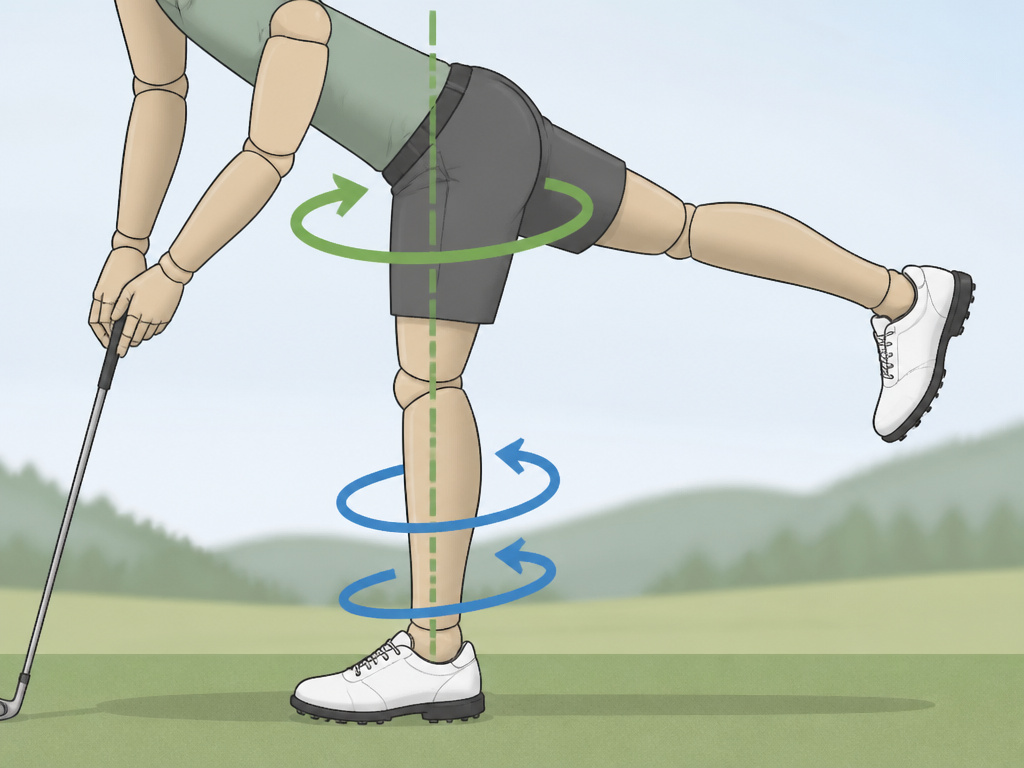 You can’t push against the ground with maximum force if you’re falling over. Balance is the platform for power, and research quantifies its value.
The same 2016 NIH study used the Balance Error Scoring System (BESS) test. They found a significant negative correlation between BESS score and average driving distance for male collegiate golfers. A lower BESS score means better balance. The correlation was strong (r = -0.850). Better balance meant longer drives, full stop.
Balance training for golf focuses on training the body to manage the rapid weight shift and rotational forces of the swing without losing ground connection. This is where proper footwear matters.Playing in arch support golf shoes or stable 4E wide golf shoes provides a solid foundation, but it doesn’t replace training the stabilizer muscles.
Incorporate these into a warm-up or finisher: – Single-leg Romanian deadlifts (no weight). – Rotational medicine ball throws from a single-leg stance. – BOSU ball squats (start shallow).
Poor balance often manifests as early extension or “casting” the club, two major speed killers. Fix the platform first.
Plyometrics & Core: The Speed Transfer
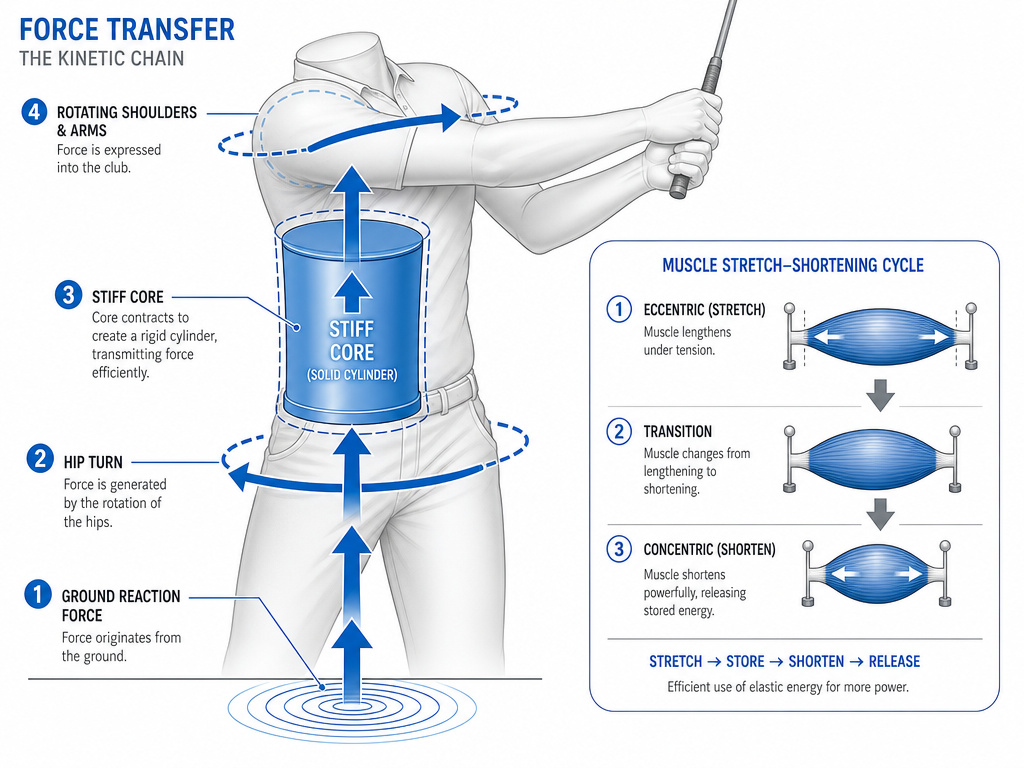 Plyometrics train the stretch-shortening cycle, the elastic recoil that adds snap to your downswing. A core that can stiffen and transfer force is the linchpin.
An eight-week swing kinematics research paper found that a plyometric program increased distal segmental speeds (like hand speed) in skilled male golfers. The exercises were chosen to increase trunk rotational power and ground reaction force. The body’s kinematic sequence didn’t change, but the parts moved faster. That’s pure power training at work.
Meanwhile, a stark result came from a study on the 360° TitaniUM Core Strength Exercise®. The intervention group’s swing speed jumped from 60.20 mph to 78.65 mph. The control group showed no significant change. Isolated core work, when designed for rotational stiffness, works.
Don’t jump into plyometrics unprepared. The Golf Science Journal authors caution that this training is only suitable for golfers with established swing techniques and the physical competency to do the exercises safely. If you’re managing joint issues, investing in ankle braces for golf or arthritic golf grips is a wiser first step toward building a durable foundation.
Putting It All Together: A Sample Week
This is about focused, intentional sessions that complement your practice. Here’s a blueprint for a golfer training 2-3 times per week.
Day 1: Strength & Power
- Goblet Squats: 3 sets of 8
- Single-Arm Cable Rows: 3 sets of 10 (each arm)
- Medicine Ball Rotational Throws: 4 sets of 5 (each side)
- Pallof Press (Anti-rotation): 3 sets of 12 (each side)
Day 2: Mobility & Balance
- Dynamic Warm-up (leg swings, torso twists)
- Adductor Rockbacks: 2 sets of 10
- Thread-the-Needle (thoracic rotation): 2 sets of 8 (each side)
- Single-Leg Balance with Torso Rotation: 3 sets of 30-second holds (each leg)
Day 3: Speed & Transfer
- Box Jumps: 4 sets of 3
- Cable Woodchops (light weight, max speed): 3 sets of 8
- Banded Lateral Walks: 3 sets of 10 steps (each direction)
- Dead Bugs: 3 sets of 12
Consistency with a program like this for 8 weeks will beat random, intense workouts every time. Track your progress with a PRGR device or similar launch monitor. The data doesn’t lie.
Frequently Asked Questions
Does weightlifting make you too tight for golf?
Not if you do it correctly. Strength training through a full range of motion, paired with dedicated mobility work, improves both force production and flexibility. The key is balancing pushing exercises with pulling and never neglecting rotational mobility.
How long does it take to see swing speed gains from fitness?
Measurable gains can appear in as little as 6-8 weeks with a consistent, well-designed program. The 4.1% average gain cited in research comes from 8-week interventions. The body needs time to build new muscle and neurological pathways.
Can fitness help if I have a slow swing speed?
Absolutely. It’s the most reliable way to increase it. While equipment like 70 compression golf balls or anti-slice drivers can optimize your current speed, fitness raises the ceiling. Start with a focus on foundational strength and mobility.
Is running or cardio good for golf swing speed?
General cardio improves overall health and endurance, which can help maintain speed over 18 holes. However, it does not directly increase peak swing speed. Power is specific. Rotational power exercises will have a much more direct effect than steady-state running.
Do I need a personal trainer to get these results?
It helps. A trainer knowledgeable in golf can ensure your form is safe and your program is balanced.At minimum, educate yourself using reputable sources like the NIH golf performance archive to understand the principles. Poor form in the gym can set you back.
Before You Go
Swing speed is a physical skill. The research is clear: combined training adds 4.1%, better balance adds yards, and training once a week adds nothing. Your action item is to audit your own physical profile.
Pick one lever, maybe it’s adding two rotational power sessions a week, or committing to 10 minutes of balance work daily. Get fitted for equipment that supports your body, like game improvement clubs or comfortable golf shorts that don’t restrict your turn. Measure your starting point with a launch monitor. Then build the body that builds the speed. The distance follows.
