
Common Golf Injuries and How to Prevent Them: A Full Guide
This post contains affiliate links. As an Amazon Associate, we earn from qualifying purchases.
This post contains affiliate links. As an Amazon Associate, we earn from qualifying purchases.
To prevent common golf injuries, focus on three proven areas: manage volume to avoid overuse, commit to a dynamic warm-up of at least 10 minutes, and address swing faults that load joints asymmetrically. The data shows over half of all golfers get injured, with pros hitting the lower back and wrist hardest, while amateurs battle the elbow and shoulder.
That 56.6% lifetime injury rate for amateurs is the pooled finding from a systematic review of over 9,000 golfers. The swing is a high-speed, asymmetric movement that repeats hundreds of times a week if you’re serious. Prevention isn’t about avoiding golf; it’s about preparing your body for its specific demands and recognizing your personal risk profile.
What follows breaks down the injury map by skill level, explains the biomechanical failures behind each ache, and lays out the essential routines that cut your risk. We’ll ground everything in the numbers so you know what’s proven, not just preached.
Key Takeaways
- Profiles differ: Professional golfers face a 73.5% lifetime injury risk, with hand/wrist and lower back injuries 3 times more likely than for amateurs, who most often hurt their elbow.
- The 10-minute rule: Golfers who warm up for less than 10 minutes report 2.5 times more injuries per player than those who warm up longer. The first swings of the day shouldn’t be on the first tee.
- Overuse is the enemy: 82.6% of golf injuries are from repetitive strain, not a single accident. Playing more than three rounds a week significantly raises an amateur’s risk.
- Equipment matters: A grip worn past 40-50 rounds loses traction, forcing your hands to over-grip and straining the forearm tendons. A club that’s too long, too stiff, or too heavy torques the spine.
- Prevention is proactive: Effective strategies are consistent. A focused mobility and strength program, like the Golfer’s Fore series, directly trains the body to handle swing forces.
The 3 Most Common Golf Injuries (And Why They Happen)
The lower back, elbow, and wrist form the injury trifecta. But who gets which injury depends heavily on skill level and volume. A 2023 meta-analysis in the British Journal of Sports Medicine made this stark: professionals have a 50% higher lifetime risk of any injury compared to amateurs.
The patterns are direct outcomes of swing mechanics multiplied by repetition.
Lower back injuries have a lifetime prevalence of 44% in professional golfers. The amateur rate is lower but still significant. The golf swing creates massive rotational shear forces on the lumbar spine, especially during the downswing when the hips fire before the shoulders. This “X-factor” stretch is a power source, but with limited hip mobility or poor core stability, the spine takes the overload.
For amateurs, the elbow is the biggest trouble spot. One study of over 700 golfers found it accounted for nearly 25% of amateur injuries, often diagnosed as medial or lateral epicondylitis (golfer’s or tennis elbow). The cause is usually a technical flaw, like a “chicken wing” follow-through or hitting the ground first, that jars the lead arm. Every fat shot sends a shockwave up the arm.
Wrist injuries climb with practice volume. Professionals suffer them at a rate 3.33 times higher than amateurs. The issue is overuse from hitting hundreds of balls, often off artificial turf, which doesn’t give like grass. A bent lead elbow at impact can also force rotation through the forearm instead of the shoulder, straining the wrist’s small tendons and ligaments.
| Injury Site | Most Affected Group | Primary Cause | Typical Diagnosis |
|---|---|---|---|
| Lower Back | Professional Golfers | Repetitive rotational shear, limited hip mobility | Lumbar strain, facet joint irritation, disc injury |
| Elbow | Amateur Golfers | Poor swing mechanics (hitting ground), over-gripping | Medial/Lateral Epicondylitis (“Golfer’s/Tennis Elbow”) |
| Wrist | Professional Golfers | High-volume practice off mats, bent-elbow impact | Tendinopathy, ligament sprain, TFCC tear |
What the Numbers Say About Your Risk
You can’t manage what you don’t measure. The epidemiology gives us clear thresholds.
A 2024 retrospective study of UK golfers calculated an overall injury incidence of 41.26 per 1,000 hours of play. The lower back alone accounted for 9.94 of those injuries. More telling is the severity: the mean time lost for a back injury was 54 days. That’s nearly two months of no golf.
The split between acute and overuse injury is lopsided. The same body of research shows repetitive movement injuries occur at more than double the rate of acute ones. The pattern is clear: golf breaks you down slowly. You might not feel the single swing that hurts your wrist, but you’ll feel the cumulative effect of the 300th swing this week.
Two specific risk amplifiers appear in the data: 1. Playing more than three rounds per week significantly raises an amateur’s injury risk. 2. Carrying your bag is a noted hazard for the lower back, shoulder, and ankle. The load is asymmetric and constant.
The good news is the data also points to a powerful mitigator. One study found golfers who warmed up for more than 10 minutes reported an average of 0.41 injuries per player. Those who warmed up for less than 10 minutes reported 1.02 injuries per player. That’s a 2.5x difference. The warm-up isn’t a suggestion; it’s a statistical shield.
A Proper Warm-Up Isn’t Optional
Most people roll out of the car, take three practice swings, and tee off. That’s a great way to become a statistic. Your body needs to be notified that it’s about to perform a complex, explosive movement.
The goal is increasing blood flow, elevating core temperature, and rehearsing the movement patterns you’re about to use. A dynamic routine takes the joints through their full range of motion under control.
Here is a simple, five-minute sequence to do before every round or range session: 1. Torso Rotations (1 minute): Stand with a club across your shoulders, rotate back and forth smoothly. Feel the stretch in your mid-back. 2. Leg Swings (1 minute per side): Hold onto your cart or a bag for balance. Swing one leg forward and back, then side to side. This wakes up the hips. 3. Arm Circles (30 seconds forward/back): Loosen up the shoulder girdle. 4. Wrist Flexor/Extensor Stretch (30 seconds per side): Extend your arm, pull your fingers back gently, then point them down. 5. Gradual Swinging (2 minutes): Start with half-swings with a wedge, focusing on smooth rhythm. Gradually build to full, easy swings. Your first max-effort swing should not be on the first tee.
Where this goes sideways: Skipping the warm-up because you “feel loose.” The tissues aren’t ready for the rapid acceleration of a driver swing. The first time you ask them for full force, they’ll resist, often with a strain or tear. This is why most injuries happen early in the round or session.
This routine directly supports the mobility pillar of injury prevention. For a deeper library of movements, our guide on golf stretches for flexibility offers a progressive plan.
The Equipment Check You’re Probably Skipping
Your clubs can hurt you. It’s not superstition; it’s physics.
A grip wears out long before it’s visibly torn. After about 40 to 50 rounds, the rubber loses its tack. Your subconscious response is to squeeze harder to maintain control. That constant over-gripping loads the forearm muscles and tendons, a direct path to elbow pain. Check your grips annually. If they’re shiny or hard, replace them.
Shaft flex and length are more subtle culprits. A shaft that’s too stiff for your swing speed won’t load properly. You’ll over-swing to feel the bend, throwing your sequencing off and straining your back. A club that’s too long forces you to stand too upright, altering your spine angle and creating unnecessary torque. The fix is a basic club fitting. It’s not just for pros.
Even your shoes matter. Worn-out spikes or insufficient arch support can destabilize your base. Every swing starts from the ground up; if your feet are sliding or your arches are collapsing, your knees, hips, and back have to compensate. A pair of Superfeet insoles can make a major difference for stability.
Building a Body That Can Withstand the Swing
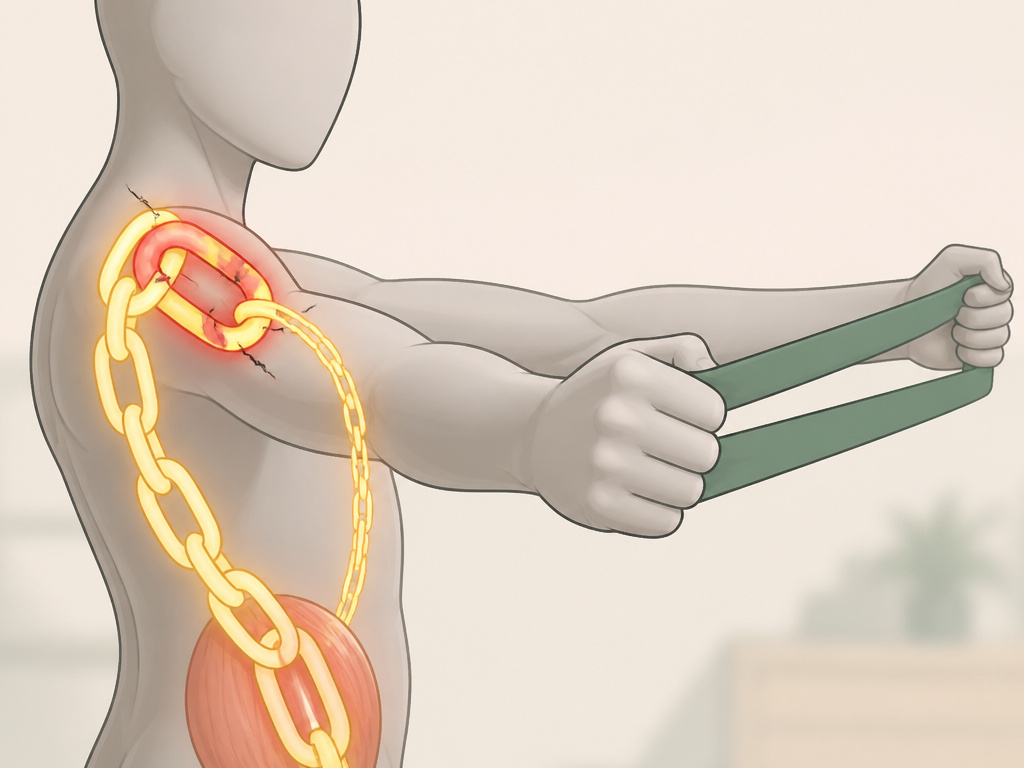
Strength training for golf is about building resilient tissues and the kinetic chain to transfer force efficiently from the ground to the clubhead. When the chain has a weak link, the link above or below it fails.
The core is your powerhouse. It involves all the muscles that stabilize your spine and pelvis. A weak core dumps all the rotational force of the swing onto the passive structures of your lower back. Exercises like planks, dead bugs, and Pallof presses build anti-rotational strength, teaching your spine to stay solid while your hips and shoulders rotate around it.
For the upper body, focus on shoulder and scapular stability. The rotator cuff muscles control the humeral head in the socket during the high-speed backswing and follow-through. Band pull-aparts, prone Y-T-W raises, and external rotations are gold. Strong, stable shoulders protect your elbows and wrists by ensuring the larger joints handle the force.
The part nobody mentions: You don’t need a gym. A single resistance band and your body weight are enough to build a foundation. Consistency beats intensity. Ten minutes of targeted work three times a week does more than one heroic hour a month.
This is the philosophy behind programs like the Golfer’s Fore+ injury prevention program, which is designed to be done at home. The goal is to train the specific demands of the sport, not just get generally fit.
When to Seek Help (And What to Ask For)
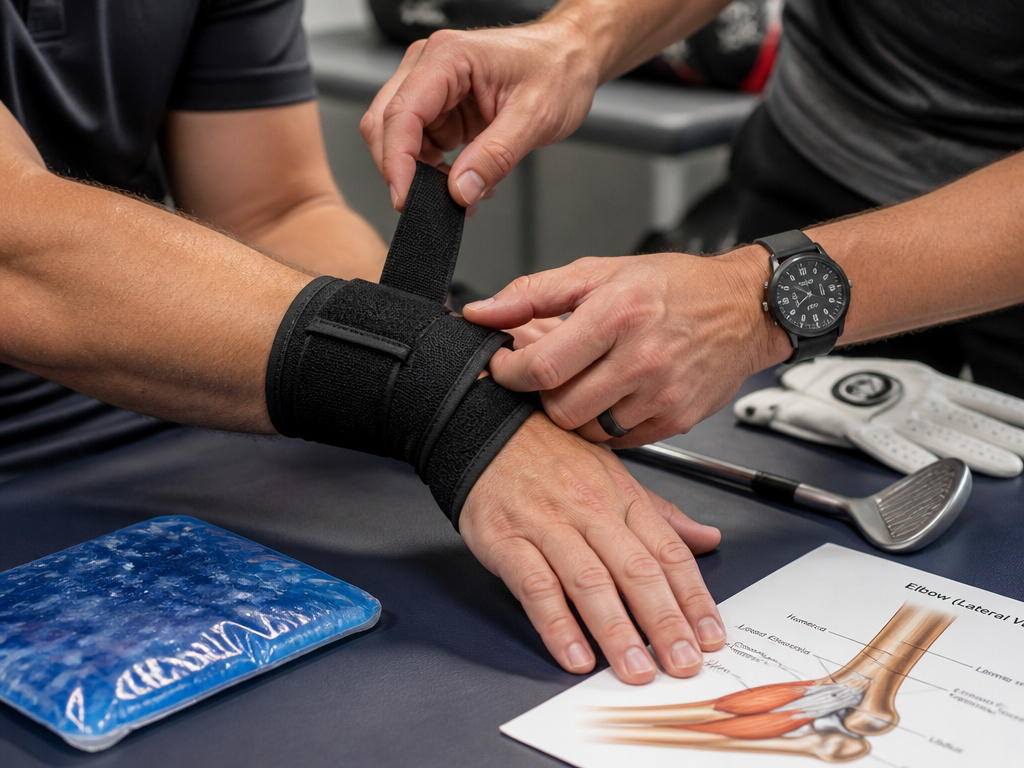
Pain is a signal, not a lifestyle. Ignoring a nagging ache is how a two-week problem becomes a two-month season-ender.
If you have pain that doesn’t resolve with two or three days of rest, or pain that sharpens during a specific part of your swing, see a professional. Start with a physical therapist or a sports medicine doctor who understands golf. They can perform a movement screen, like the Titleist Performance Institute (TPI) assessment, to pinpoint physical limitations that are causing your swing faults.
For common issues like elbow tendinopathy, the early treatment path is straightforward: relative rest (avoiding the painful activity), ice, and gradual loading. As outlined in an NCBI golfers injury analysis, rehab should focus upstream and downstream, improving shoulder and wrist control to take stress off the elbow.
Don’t be afraid to ask about gear. A wrist support or brace can provide proprioceptive feedback and limit painful motion during a round while you heal, though it’s not a long-term fix. The same goes for a knee support if you have existing arthritis or instability.
Frequently Asked Questions
What is the most common injury in golf?
The lower back is the most frequently injured area across all golfers, but the cause differs. For professionals, it’s overuse from extreme rotational forces. For amateurs, it’s often poor mechanics combined with a lack of core strength and hip mobility. The lifetime prevalence is over 40% for pros.
How can I prevent golf elbow?
Preventing golfer’s elbow (medial epicondylitis) centers on technique and equipment. First, ensure you’re not “scooping” or hitting the ground first, which jars the lead arm. Second, check your grips, worn grips force an over-tight hold. Third, strengthen your forearm muscles and ensure your shoulders are stable so your elbow isn’t doing excessive work.
Does carrying your golf bag cause injury?
Yes, carrying your bag is a documented risk factor for injuries to the lower back, shoulder, and ankle. The asymmetric, constant load for 5-6 miles places uneven stress on the body. Using a push cart distributes the weight evenly and is the healthier choice for walkers, as noted in energy-expenditure studies.
How often should I replace my golf grips?
Replace your grips every 40 to 50 rounds as a general rule. If they feel hard, shiny, or slick before that, replace them sooner. Fresh grips allow you to hold the club with 30-40% less pressure, which dramatically reduces strain on the forearm tendons and muscles.
Are wrist injuries common in golf?
Wrist injuries are very common in professional golfers, who are 3.33 times more likely to suffer one than amateurs. The cause is typically high-volume practice, especially off hard mats. For amateurs, a sudden wrist injury often comes from hitting a root or rock, or from a flawed impact position with a bent lead elbow.
Before You Go
The single biggest shift is moving from reactive to proactive. Your body isn’t failing you; the sport is asking a lot of it. The etiology of golf injuries paper confirms most damage comes from correctable factors: volume, mechanics, and preparation.
Start with the warm-up. Commit ten minutes. It’s the highest-return, lowest-effort change you can make today. Then, listen to the whispers, the faint ache in your elbow after a range session, the lower back tightness on the back nine. That’s data. Address it with a grip change, a lesson, or some targeted strength work, not just by ignoring it.
Good golf should feel less complicated the more you understand it. And understanding that your body needs training for the specific task of swinging a club is the first step to playing pain-free for decades. The game is hard enough without fighting your own physiology.
