
Golfer’s Elbow: Primary Causes and Modern Treatment Plans
This post contains affiliate links. As an Amazon Associate, we earn from qualifying purchases.
Golfer’s elbow (medial epicondylitis) is a degenerative tendinopathy of the common flexor tendon, causing pain on the inner elbow. Effective treatment requires a phased approach: initial activity modification and pain control, followed by targeted eccentric strengthening, with more than 90% of cases improving without surgery. The critical insight is that over 90% of cases are not sport-related, but stem from occupational or daily activities involving forceful gripping, wrist flexion, or handling objects over 5 kg for extended periods.
The name is a misnomer that hides the real risk. This isn’t just an overuse injury from a bad golf swing. It’s a mechanical failure of tendon tissue under specific, measurable loads.
What follows breaks down the actual causes, with the weight and repetition numbers that trigger it, and walks you through a treatment ladder from immediate pain relief to long-term tendon resilience. You’ll see why some standard advice fails and which modern options have real data behind them.
Key Takeaways
- Over 90% of golfer’s elbow cases are not sport-related; occupational factors like handling objects heavier than 5 kg for 2+ hours daily are primary drivers.
- Corticosteroid injections offer short-term relief (under 8 weeks) but lack durable benefit and may correlate with higher recurrence rates.
- The cornerstone of effective rehab is eccentric loading of the wrist flexors, not just rest or stretching.
- Surgery is a last resort, typically considered only after 6-12 months of failed conservative management, and even then, over 90% improve without it.
- Prevention hinges on modifying forceful grip, improving swing mechanics to reduce late wrist action, and integrating forearm strengthening into your routine.
What Actually Causes Golfer’s Elbow?
Forget the image of a weekend golfer. The clinical data paints a different picture. Medial epicondylitis is an occupational disease for most.
The disorder involves degeneration and micro-tears in the tendons of the common flexor origin, where muscles like the flexor carpi radialis and pronator teres attach to the inner elbow bone. Repetition alone isn’t the villain. Force is. A systematic review cited in a clinical overview notes medial epicondylitis is strongly associated with handling objects heavier than 5 kg for more than two hours a day, or objects over 10 kg more than ten times daily. Using vibrating tools for over two hours a day is another quantified risk.
Common mistake: Assuming rest alone will fix it. Tendinopathy is a failure of tissue capacity. Without rebuilding that capacity through specific loading, the pain returns the moment you resume activity.
This explains why carpenters, painters, and even intensive typists show up with it. The motion that loads these tendons is forceful wrist flexion and forearm pronation, think of swinging a hammer, turning a stubborn screwdriver, or the late, flipping release in a golf swing that puts excessive strain on the lead arm’s inner elbow.
The NIH StatPearls clinical reference states heavy manual handling of loads over 20 kg is a clear risk factor. In golf, the cause is often an over-reliance on the hands and wrists through impact instead of using the larger core and shoulder muscles to deliver power.
| Activity | Mechanism of Injury | Typical Onset |
|---|---|---|
| Occupational (e.g., carpentry) | Forceful, repetitive gripping & wrist flexion | Gradual, over weeks/months |
| Poor Golf Mechanics | Casting/clubbing, leading to late wrist snap | May be gradual or acute after a range session |
| Weight Training | Improper curling technique, excessive weight | Acute (post-workout) or gradual |
| Racquet Sports | Heavy racquet, tight grip, poor topspin technique | Gradual |
The pain is a symptom of a capacity problem. Your tendon’s ability to handle load has been exceeded by the demands you place on it. The fix isn’t just to reduce demand, but to systematically increase capacity.
Diagnosing It Yourself (And When to See a Doctor)
You can perform a simple provocative test to check if your pain aligns with golfer’s elbow. Sit with your forearm resting on a table, palm up. Have someone gently hold your wrist down while you try to curl your hand upward against their resistance. Pain that localizes to the inner elbow bump during this resisted wrist flexion is a strong indicator.
Other signs include tenderness to the touch about a centimeter below the medial epicondyle, pain when shaking hands, or weakness when trying to grip. The pain often radiates down the forearm.
Where this goes sideways: Self-diagnosing when numbness or tingling into the ring and little finger is present. That suggests ulnar nerve involvement (cubital tunnel syndrome), which requires a different approach and a professional evaluation.
You should see a doctor or physical therapist if: * The pain is severe or follows a specific injury. * You experience any numbness or tingling in your hand. * Your elbow is visibly swollen or misshapen. * Self-care measures provide no improvement after two weeks.
A healthcare professional will rule out other conditions like cervical radiculopathy, arthritis, or ligament injuries. They might use ultrasound or MRI not to diagnose the tendinopathy, which is clinical, but to assess the extent of tendon degeneration or rule out a tear.
The Three-Phase Rehabilitation Roadmap
Recovery isn’t linear. Jumping straight to strengthening on an angry tendon makes it worse. Follow this sequence.
Phase 1: Pain Control & Activity Modification (Days 1-14)
The goal here is to calm the tissue down, not to fix it. This means honest activity modification. * Identify & Reduce: Cut out or dramatically reduce the aggravating activity. For a golfer, that may mean a complete break or switching to putting-only for a week. For a worker, it might mean using a power tool instead of a manual one, or alternating tasks. * Ice & Manage Pain: Apply ice to the inner elbow for 15 minutes several times a day, especially after any activity. Over-the-counter NSAIDs like ibuprofen can help manage pain and inflammation short-term, but they don’t heal the tendon. * Use a Brace: A counterforce forearm strap, worn about two finger-widths below the elbow crease, can reduce strain on the tendon origin during necessary activities. It’s a temporary aid, not a cure.
Phase 2: Load Tolerance & Eccentric Strengthening (Weeks 2-8)
Once pain at rest subsides, you begin rebuilding the tendon. Eccentric loading, strengthening the muscle as it lengthens, is the gold standard for tendinopathy. 1. Wrist Flexor Stretch: Extend your sore arm straight out, palm up. Use your other hand to gently pull the fingers back toward you until you feel a stretch in the forearm. Hold for 30 seconds. Repeat 3 times. 2. Eccentric Wrist Curls: Sit with your forearm on a table, palm up, hand hanging over the edge holding a light weight (a 1-2 lb dumbbell or a can of soup). Use your good hand to help curl the weight up. Then, slowly lower the weight back down using only the sore arm, taking a full 3-5 seconds on the lowering phase. That slow lowering is the eccentric work. Do 3 sets of 15, every other day. 3. Pronation/Supination: Hold a hammer by the end of the handle. With your elbow at your side and bent to 90 degrees, slowly rotate your forearm to turn the hammer head from facing left to facing right. This works the pronator teres, a key muscle in the common flexor group.
Phase 3: Integration & Return to Activity (Weeks 8+)
This phase bridges the gap between clinical strength and real-world function. * Progress Load: Gradually increase the weight used in your eccentric exercises as pain allows. * Integrate Movement: Start with slow, controlled practice swings. Focus on a smooth transition where the body leads and the hands follow passively. A training aid like an elbow support can provide feedback during this reintroduction. * Full Return: Gradually increase the volume and intensity of your golf play or work tasks. Listen to your elbow, a dull ache after activity is normal, but sharp pain is a signal to pull back.
I learned the value of this phased approach the hard way. A player came to me with a classic case, and we dove straight into strengthening. His pain spiked, and we lost three weeks. Now, I always enforce the pain-control phase first. No loading until you can press on the tendon without flinching.
Modern Treatment Options Beyond Rest and Ice
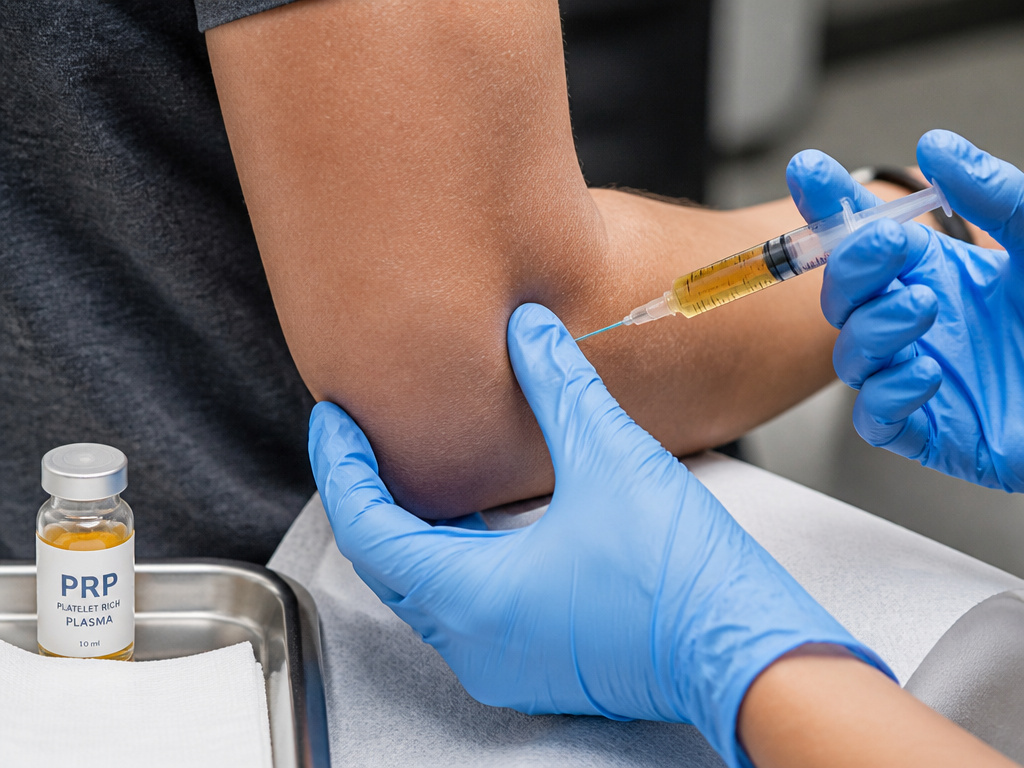
When basic rehab stalls, several advanced interventions have evidence behind them. Understand what you’re getting into.
| Treatment | How It Works | Best For | Evidence & Caveats |
|---|---|---|---|
| Physical Therapy | Guided eccentric loading, manual therapy, kinetic chain correction. | Everyone, especially early stages. | The foundation; most cost-effective long-term solution. |
| Platelet-Rich Plasma (PRP) | Injects concentrated growth factors from your own blood to stimulate healing. | Chronic cases (3-6+ months) that haven’t responded to PT. | Studies show short-to-mid-term outcomes can rival surgery; requires a period of rest after injection. |
| Dry Needling / Percutaneous Tenotomy | Uses a needle to fenestrate (poke holes in) the degenerative tendon to provoke a healing response. | Focal, nodular areas of tendon degeneration. | May outperform corticosteroid injections for chronic pain; can cause temporary soreness. |
| Extracorporeal Shockwave Therapy (ESWT) | Applies acoustic waves to increase blood flow and break down scar tissue. | Tendinopathy lasting >6 months with calcification. | Can promote regeneration; often requires multiple sessions; not always covered by insurance. |
| Corticosteroid Injection | Powerful anti-inflammatory reduces pain and swelling around the tendon. | Severe, acute pain that prevents starting rehab. | Provides short-term relief (<8 weeks) but no long-term benefit. The Mayo Clinic diagnosis and treatment guide and others note it may be detrimental to tendon health long-term. |
The part nobody mentions: The success of any injection hinges on what you do afterward. An injection is not a cure; it’s a window of reduced pain that you must use to aggressively pursue a proper rehabilitation protocol. Without the rehab, the pain comes back.
Surgery is the final option, reserved for the rare case that fails a full 9-12 months of dedicated non-surgical care. Procedures typically involve debriding the degenerative tendon tissue. Recovery is measured in months, not weeks.
How Your Golf Swing Causes (or Prevents) It
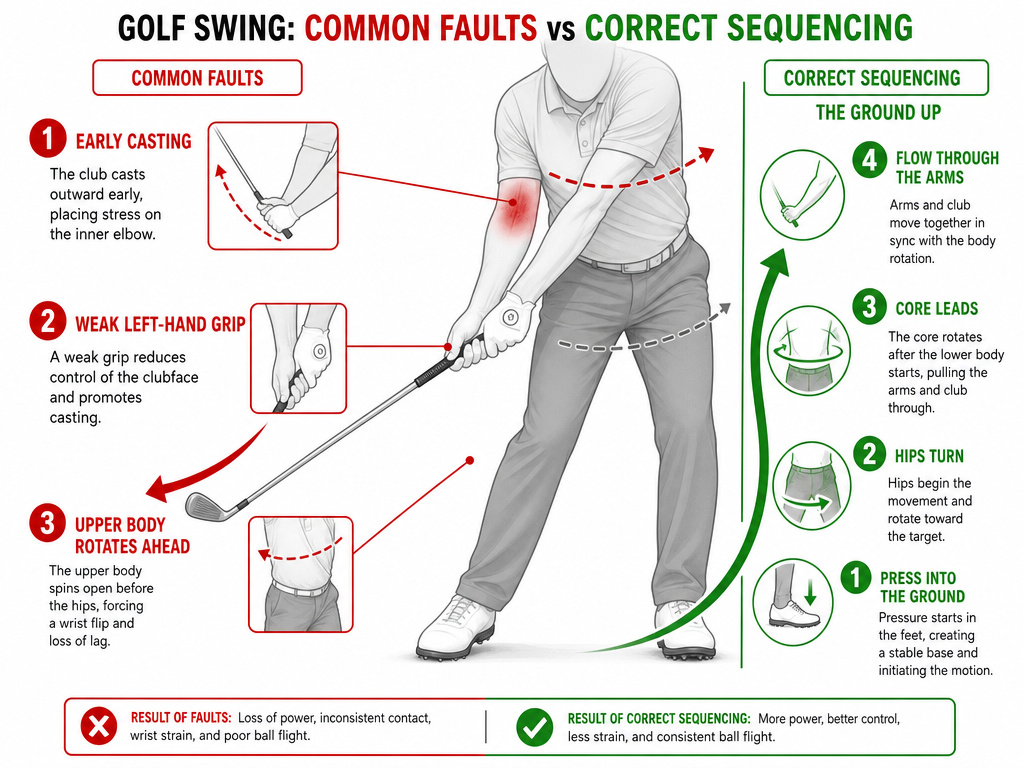
The golf swing is a prime example of the forceful wrist flexion and pronation that strains the common flexor tendon. For a right-handed golfer, it’s the left inner elbow that takes the brunt.
The main mechanical faults are: 1. Casting or “Over-the-Top”: This move throws the clubhead outward with the hands and wrists early in the downswing. It forces the lead arm’s wrist into violent flexion at impact, overloading the tendon. 2. A Weak Grip: An excessively weak (too turned to the left) lead-hand grip places the wrist in a more extended position at the top, demanding even more flexion to square the face, increasing tensile load. 3. Lack of Body Rotation: When the upper body spins out ahead of the lower body, the hands must flip aggressively to catch up. This “flip” is a tendon killer.
The fix is in the sequence. Power should come from the ground up, with the core and shoulders rotating to deliver the club. The hands and wrists are followers, not leaders. Feel like you’re retaining the angle between your lead forearm and the clubshaft for as long as possible in the downswing. This isn’t about slowing your swing; it’s about sequencing it correctly.
In fact, I once worked with a player who was so deliberate and slow at the top that his sequencing fell apart. Telling him to speed up his backswing actually smoothed his transition and took the violent jerk out of his release. His elbow pain faded in a month. Sometimes the standard advice is wrong for the individual.
This is also where overall strength training and core exercises pay a direct injury-prevention dividend. A stronger, more stable body doesn’t need to compensate with overactive hands.
Long-Term Prevention and Management
Golfer’s elbow has a high recurrence rate if you simply return to the old demands. Prevention is a proactive game.
- Equipment Check: Ensure your golf grips are the correct size and not worn slick. Larger grips can reduce finger tension. For work, use tools with ergonomic handles and vibration-dampening features.
- Pre-Hab Routine: Integrate the eccentric wrist curl and pronation exercises from Phase 2 into your regular fitness routine, 1-2 times per week, even when pain-free. This maintains tendon capacity.
- Swing Maintenance: Work with a professional periodically to prevent the creep of compensations like a flying elbow or overswing that alter load patterns. Often, the fault that causes a slice also stresses the lead elbow.
- Listen to Early Signals: A faint ache after activity is a warning. Respond with a day of rest, ice, and maybe using a compression sleeve for golfer’s elbow during your next session, rather than pushing through.
For older golfers or those with previous issues, incorporating regular flexibility exercises and considering supportive braces or wrist supports during high-load periods is smart management.
Frequently Asked Questions
How long does it take for golfer’s elbow to heal?
With appropriate treatment, most people see significant improvement within 6 to 8 weeks. Full recovery and return to unrestricted activity can take 3 to 6 months. Chronic cases may take longer. The key is consistency with the correct rehab exercises, not just passive rest.
What is the difference between tennis and golfer’s elbow?
Tennis elbow (lateral epicondylitis) affects the outer elbow, involving the extensor tendons that straighten the wrist. Golfer’s elbow affects the inner elbow, involving the flexor tendons that bend the wrist. The pain location and aggravating movements are opposite.
Can I still play golf with golfer’s elbow?
In the acute, painful phase, you should take a break. Once pain is controlled, you can often return to modified play (e.g., using a brace, hitting fewer balls, avoiding rough lies) while continuing rehab. Hitting through severe pain will delay healing and likely worsen the condition.
Are corticosteroid injections a good idea?
They can be useful as a bridge to reduce severe pain so you can begin physical therapy. However, as noted in the ScienceDirect review article, their benefit is short-lived (often less than two months) and they do not improve long-term outcomes. They should not be a first or repeated line of treatment.
When is surgery necessary?
Surgery is considered only after a minimum of 6 to 12 months of supervised non-surgical treatment has failed to provide adequate relief. Since over 90% of patients improve with conservative care, surgery is relatively rare.
Before You Go
Golfer’s elbow is a capacity issue, not a life sentence. The path out is clear: accurately identify and modify the aggravating activity, then commit to a progressive rehab program built on eccentric strengthening. Skip the quick fixes like repeated cortisone shots, they don’t build the resilient tendon tissue you need.
The one threshold that changes everything: if your pain hasn’t budged after two weeks of honest activity modification and ice, see a physical therapist. Starting the right exercises early is the single biggest factor in a fast, durable recovery. Everything else is just managing symptoms.
