
Understanding Public vs Private Golf Course Differences
This post contains affiliate links. As an Amazon Associate, we earn from qualifying purchases.
The difference between a public and private golf course comes down to three things you can measure: daily traffic, financial structure, and member control. A private club restricts tee times to members, runs on annual dues, and maintains its turf for about 80-120 rounds a day. A public course sells daily green fees to anyone, operates on volume, and its turf handles 200+ rounds on a summer weekend. That traffic gap alone creates a 15-25% property value premium for homes fronting a healthy private club.
The traffic number drives everything else, the condition you play in, the people you share the range with, and the bill you pay at the end of the month. It’s not about status. It’s a simple equation of wear and recovery.
What follows is a breakdown of where your money and time actually go. This section examines turf conditions, the social and financial structures, and the real estate math that makes a private club frontage worth more. By the end, you’ll know which type of course fits your game, your wallet, and your long-term plans.
Key Takeaways
- Private clubs maintain tighter turf because they limit daily rounds, often with 12-15 minute tee time intervals, while public courses pack in players with 8-10 minute gaps.
- The financial commitment is inverted: public golf charges per round (green fees), while private golf charges per year (dues), regardless of how often you play.
- Homes fronting a financially healthy private club command a 15-25% resale premium over non-golf lots, while public-course frontage yields only a 5-12% view premium.
- The social environment is curated at private clubs through sponsorship and vetting, creating a consistent community, whereas public courses offer a new cast of players every round.
- Your choice often hinges on a single question: do you want golf as an occasional activity or as a central part of your lifestyle and social circle?
The Turf Conditions Gap Is a Traffic Number
The first thing you notice stepping onto a private club fairway is the turf. The grass is tighter, the greens roll faster, and the bunkers have uniform, fine sand.This is a function of one controlled variable: rounds per day.
A private club carrying 80 rounds across 12-hour tee sheets gives each green 9 minutes of recovery between groups. A public course pushing 200 rounds on 8-minute intervals gives the same green 4.8 minutes. The difference shows up as ball marks, foot traffic compaction, and thin lies in the fairway by 2 p.m.
Public courses, especially municipal layouts, are designed for volume. Their tee time intervals are often 8 or 10 minutes. This gets more players through, but it also means more cleat marks on the green, more divots in the landing zones, and less time for the maintenance crew to blow debris, change hole locations, or mow between waves. The grass is in a constant state of repair.
Private clubs stretch those intervals to 12, even 15 minutes. This is about agronomy. The longer gap lets moisture return to the green’s surface, allows for midday rolling, and gives the crew a window to work without holding up play.The course superintendent has the budget and the mandate to prioritize conditioning over throughput.
| Conditioning Factor | Typical Private Club | Typical Public Course |
|---|---|---|
| Daily Rounds | 80 – 120 | 180 – 250+ |
| Tee Time Interval | 12 – 15 minutes | 8 – 10 minutes |
| Greens Mowing Frequency | 6-7 days/week | 5-6 days/week |
| Bunker Raking | Daily, often by hand | Daily or as-needed, often machine |
| Primary Agronomy Goal | Tournament-ready consistency | Playable surface under high traffic |
The best daily-fee and resort courses have closed this gap significantly with advanced sustainable maintenance practices. But the week-in, week-out consistency of a well-funded private club remains the benchmark. Good golf course management strategy always starts with managing wear.
The Social & Financial Divide: Dues vs Green Fees
The second layer is how you pay and who you play with. These systems are opposites, and they attract different kinds of golfers.
Public golf is transactional. You see a tee time, you book it, you pay a green fee. Your playing partners are whoever else booked that slot. There’s no vetting, no sponsorship, and no long-term commitment. It’s flexible and accessible, perfect for the casual player or the traveler wanting to sample different layouts. The golf dress code is usually more relaxed, too.
Private club access is a gatekept membership. You need a sponsor, you fill out an application, and you often interview with a membership committee. The National Golf Foundation tracks initiation fees that can range from a few thousand dollars to well over $100,000 at top-tier clubs, plus annual dues that typically sit between $5,000 and $30,000. This process builds a socially and financially curated community.
The financial models are inverted. * Public: You pay when you play. Play three times a week, your cost is high. Play once a month, your cost is low. * Private: You pay year-round, whether you play five times a week or get snowed in for three months. The math only works if you use the facility heavily.
This isn’t just about golf. Private clubs are lifestyle hubs. They offer swimming pools, tennis courts, multiple dining rooms, and member events. You’re buying into a community, a “second home.” Public courses are primarily golf facilities. Any additional amenities are usually minimal and open to the public.
Where this goes sideways: Joining a private club for the golf alone. If you don’t plan to use the dining room, attend social events, or treat it as a community center, you’re paying a steep premium for conditioned turf you could find at a high-end daily-fee course.
The Real Estate Premium: 15-25% Isn’t Just a View
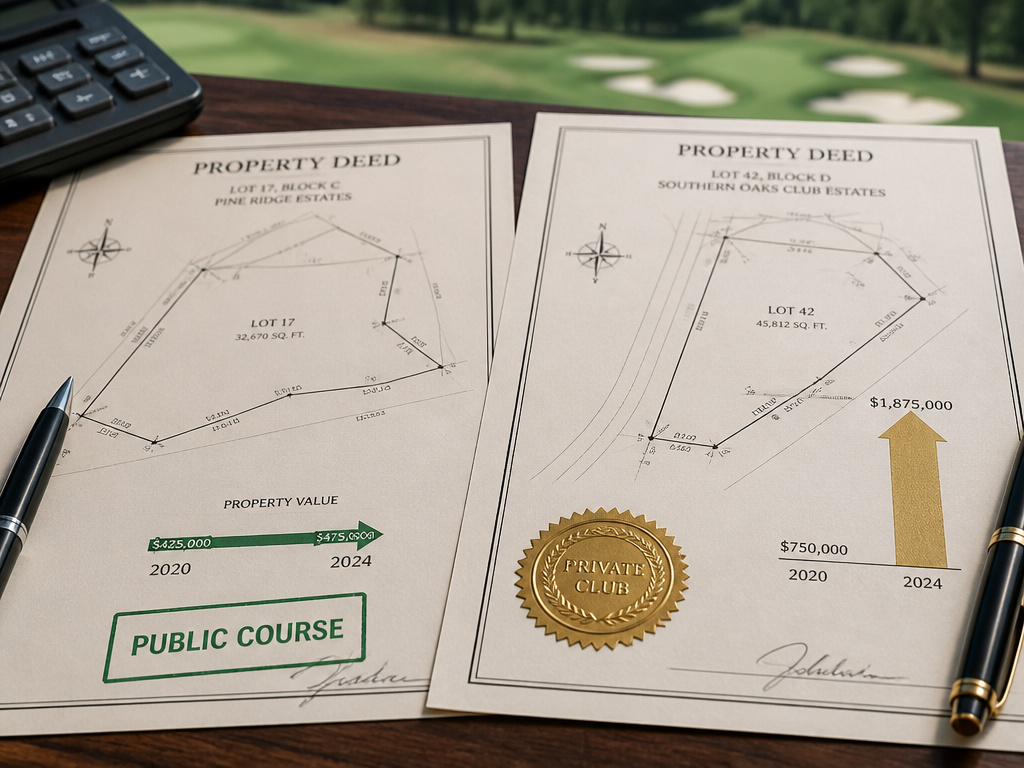 The third and most consequential difference appears on a property deed. A home facing a private golf course is worth more, significantly more, than one facing a public course. This isn’t just about the view.
According to industry analyses from firms like Own Luxury Homes®, the premium breaks down like this: * Private Club Frontage: 15-25% above comparable non-golf lots. * Semi-Private Club Frontage: 8-15% premium. * Public Course Frontage: 5-12% premium, primarily for the open space and view.
The private club premium is higher because it bundles several guarantees: 1. Controlled Access: The course isn’t open to the public. Your backyard isn’t a gallery for random foursomes. 2. Maintenance Standards: The club’s financial model (dues) ensures consistent investment in the course’s condition, protecting your view and your property value. 3. Financial Stability: Member-supported clubs are less vulnerable to closure than public courses that rely on volatile daily fee revenue. 4. Social Capital: You are buying into a verified community, which appeals to a specific, affluent buyer pool when you sell.
The public course premium is largely for the permanent open space and the pleasant vista. There is no guarantee about course conditions, future development, or even that the course will remain open. It’s a view lot, not a club membership.
This leads to the critical question most buyers miss: mandatory vs. Optional membership. In some golf communities, purchasing a home requires you to buy a social or golf membership in the club. In others, it’s optional. * Mandatory Private: Highest carrying cost, highest resale premium. * Optional Semi-Private: Lower barrier to entry, moderate premium. Understanding this distinction is more important than the private vs. Public debate itself when evaluating real estate.
Private, Semi-Private, or Public: Which Fits Your Game?
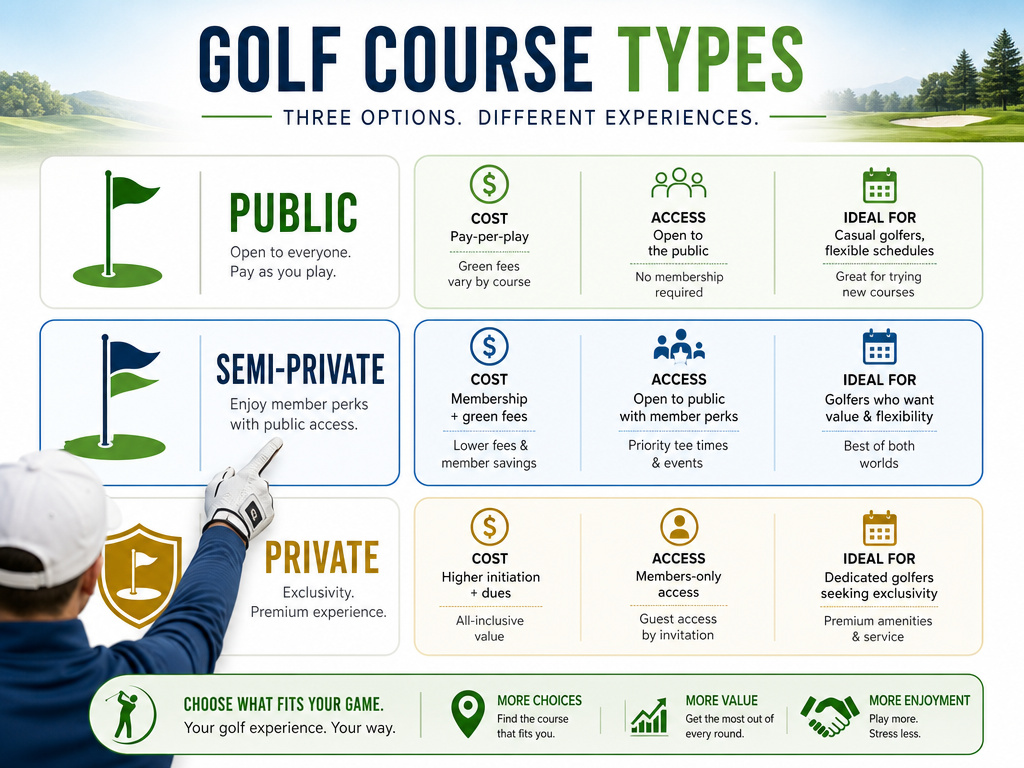 This is a match between your habits and the product. Use this table to see where you land.
| Golfer Profile | Best Fit | Why It Works | Long-Term Consideration |
|---|---|---|---|
| The Casual/New Golfer | Public Course | Low commitment, pay-as-you-play, relaxed atmosphere for learning. | Ideal for figuring out if you love the game without a major financial pledge. |
| The Frequent Player Seeking Value | High-End Daily-Fee / Resort | Excellent conditioning without annual dues, variety of courses. | Costs can rival private dues if you play 100+ rounds/year. No equity or community. |
| The Lifestyle & Community Buyer | Private Club | Golf is a social anchor, consistent playing partners, all-inclusive amenities. | Requires using the club beyond golf to justify cost. Maximizes property value. |
| The Flexible Golfer on a Budget | Semi-Private Club | Some member benefits (e.g., preferred tee times) with lower dues, can still play publicly. | Course conditions may vary daily; you share the facility with non-members. |
I learned this the hard way early in my teaching career. I had a student who was keen to improve but overwhelmed by the sheer volume of swing advice online. In one lesson, I made the mistake of trying to correct his grip, his posture, and his backswing sequence all at once. He left confused, didn’t book again, and it taught me a permanent lesson about simplicity. Good golf should feel less complicated the more you understand it. Choosing a course is the same, the right fit is the one that simplifies your enjoyment of the game, not complicates it with financial stress or social mismatch.
If your primary goal is golf course economics that benefit you, a private club only makes sense with heavy use. Otherwise, you’re subsidizing other members’ lifestyles.
Frequently Asked Questions
What is the biggest difference between public and private golf courses?
The biggest difference is control over traffic. Private clubs restrict play to members, which directly controls wear and tear on the course, enabling superior, consistent turf conditions. Public courses are open to all paying customers, prioritizing accessibility and volume, which leads to more variability in course conditions, especially later in the day.
Is it worth joining a private golf club?
It’s worth joining a private club only if you will use it as a multi-faceted lifestyle hub, playing golf frequently, dining regularly, and participating in the social community. If you only want well-conditioned golf, a high-end daily-fee or resort course often provides a similar experience for less total cost unless you play over 80 rounds a year.
Can anyone play a private golf course?
No. Access to a private golf course is exclusively for members and their invited guests. You cannot simply book a tee time or pay a green fee. Gaining membership requires an application, sponsorship from current members, and often approval from a membership committee, a process designed to curate the community.
Why are private golf courses in better condition?
They are in better condition due to three factors: significantly fewer rounds per day (less wear), larger maintenance budgets funded by member dues, and a primary agronomic mandate focused on quality over quantity. Longer tee time intervals allow for recovery and maintenance work during playing hours.
Do you tip at a private golf club?
Tipping etiquette differs. At private clubs, staff like bag attendants, locker room attendants, and caddies are typically tipped, similar to a resort. However, because members pay substantial annual dues, tipping for basic services like range balls or cart usage is less common than at public courses, where staff rely more on gratuities. Always check the club’s specific guidelines for first time at a course visitors.
The Bottom Line
Your choice between public and private golf is about matching a system to your frequency, your social preferences, and your financial tolerance for predictability versus flexibility.
If you play fewer than 40 rounds a year and value variety, stick with public golf. The golf course business model is built for you. If golf is your primary hobby and social outlet, and you play 80+ rounds, a private club’s math starts to work, provided you actually use the dining room and the pool.
The one rule that applies to everyone: before buying property in any golf community, ask the mandatory membership question. That single answer will tell you more about your future carrying costs than any brochure about the championship golf course layout ever will. The right course is the one that disappears into the background, leaving you with just the game.
