
First Time at a Golf Course | What to Actually Expect & Do
This post contains affiliate links. As an Amazon Associate, we earn from qualifying purchases.
This post contains affiliate links. As an Amazon Associate, we earn from qualifying purchases.
Your first time at a golf course is about managing the situation, not your score. Expect to check in at the pro shop 30 minutes early, choose the forward tees using the PGA’s “Tee It Forward” yardage chart, and focus entirely on one goal: keeping up with the group ahead of you. The etiquette boils down to being ready to hit, fixing your ball marks, and raking bunkers.
Strip it back. You’re not there to shoot par. You’re there to learn how the round flows, from the parking lot to the 18th green, without the panic that makes people quit. Good golf should feel less complicated the more you understand it, and that starts by knowing what’s coming.
What follows is the practical map: how to pick a course you can actually handle, what to do from the moment you park, how to read the basic signals everyone else already knows, and the one adjustment that turns a stressful debut into something you might want to do again.
Key Takeaways
- Play a short course first. A par-3 or executive course cuts the length, time, and pressure in half compared to a championship-length track. This is the single biggest lever for an enjoyable first round.
- Use the “Tee It Forward” chart. Match your average driver distance to the recommended total yardage. If you hit it 200 yards, play a course around 5,200-5,400 yards. If the course is hilly or tough, move one tee box forward from that recommendation. Your only essential job is pace.** Keep your eyes on the group ahead, not behind. If a gap opens, pick up your ball and move to the next hole. The entire course runs on this rhythm.
- Arrive 30 minutes early. This gives you time to check in, pay, ask the pro shop one question about the course, and hit a few putts. Rushing to the first tee guarantees a bad start.
- Pack a half-set of clubs. You need a driver, a 7-iron, a pitching wedge, and a putter. A sand wedge is useful. More clubs than that just cause confusion. Most courses rent sets that are perfect for this.
Choosing Your First Course (The Biggest Mistake)
The most expensive public course in your area is the worst possible choice. You’ll pay a premium for length, difficulty, and expectations you can’t meet. I’ve watched a dozen students have a miserable experience here because they wanted the “real” golf experience. It backfires every time.
Look for a par-3 course or an executive course. These are built for exactly your situation. The holes are shorter (par-3s and short par-4s), the rounds take about two hours, and the atmosphere is relaxed. You’ll hit more clubs you can actually use, wedges and short irons, and you’ll finish feeling like you played golf, not just survived it.
If only a full-length course is available, use the PGA of America and USGA’s “Tee It Forward” guidelines. Don’t guess. This chart translates your driving distance into a total yardage that keeps the game fun.
| If Your Driver Goes… | Play This Total Yardage |
|---|---|
| 275 yards | 6,700–6,900 yards |
| 250 yards | 6,200–6,400 yards |
| 225 yards | 5,800–6,000 yards |
| 200 yards | 5,200–5,400 yards |
| 175 yards | 4,400–4,600 yards |
| 150 yards | 3,500–3,700 yards |
Where this goes sideways: Ignoring elevation and wind. If the course is hilly, exposed, or has quick greens, move one tee box forward from what the chart says. The extra length isn’t a test of skill on day one; it’s a recipe for lost balls and fatigue.
Book your tee time online or by phone. When you do, mention you’re a beginner. A pro shop like PGA TOUR Superstore might slot you into a later, quieter time or pair you with other new players. This is how they keep the course flowing for everyone, not an act of charity.
The 30-Minute Pre-Flight Checklist
A proper warm-up routine is your anchor. I failed to do this before a pro-am event last year and played terribly for the first six holes, a basic mistake I should have avoided. Your first round needs that anchor even more.
Your countdown starts the moment you park. Thirty minutes is the minimum. Here’s what that block actually contains.
Minutes 1-10: Check-in and Intel. Your first stop is the pro shop. Walk in, tell them your name and tee time, and pay. This is also your one chance to ask a useful question. Don’t ask for swing tips. Ask, “What’s the one thing a first-timer should know about this course?” You’ll get a real answer like “the third green slopes hard back-left” or “the cart path is 90-degree rule today.”
Minutes 11-20: Gear and Logistics. If you rented clubs, get them now. Grab a scorecard. If you’re using a cart, get the key. Use the restroom. Change your shoes if you didn’t wear them. This is the admin block. Get it done so it’s not rattling in your head later.
Minutes 21-30: Green Reading and Breathing. Head to the putting green. Don’t try to hit drivers on the range if you’re tight on time. Drop three balls and putt. You’re not practicing. You’re calibrating your hands to the speed of the greens and burning off the static in your nerves. The practice green is usually close to the same speed as the course greens. Hit a few chips if there’s a chipping area. Then walk to the first tee.
What to Actually Do on the First Tee
The starter will call your group. You’ll walk to the tee box. Everyone feels nervous here. Let’s be clear about this: the only people judging you are the ones you brought with you.
There’s a small basket of wooden pegs, tees, on a post or in a box. Take one. Each set of tee markers is a different color (red/forward, white/middle, blue/back). You are playing the red tees. Place your ball on the tee between the two red markers.
Who hits first? If you’re with friends, just agree. In a more formal setting, the honor goes to the lowest score on the previous hole. Since there is no previous hole, you can flip a tee. It doesn’t matter. What matters is being ready when it’s your turn.
Common mistake: Trying to kill the ball off the first tee. Take one practice swing, step up, and make your normal swing. Your goal is to start the ball in play, not to set a distance record. A 150-yard shot in the fairway is a massive success.
If you’re playing as a single and get paired with others, introduce yourself. A simple “Hi, I’m [Name], still figuring this out” is all you need. Every golfer was in your spikes once.
The Unwritten Rules (The Short List)
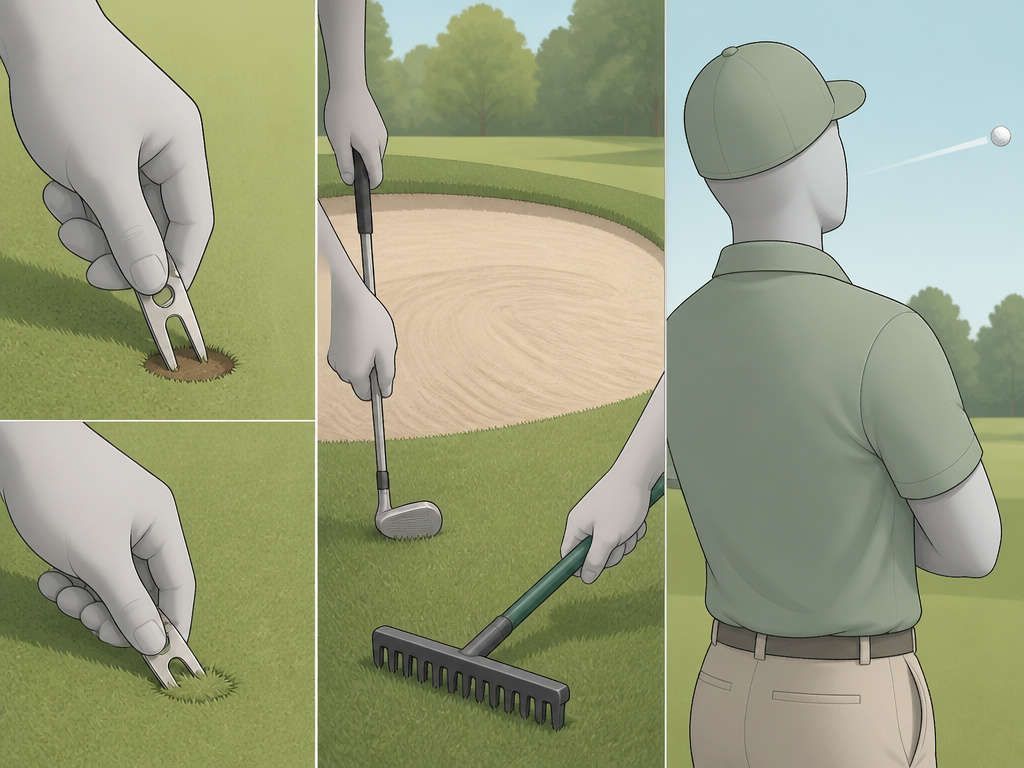
You don’t need the official rulebook. You need the four pieces of etiquette that keep the round moving and show respect for the course and other players. I favor straightforward rules players can actually stick with.
- Fix Your Ball Marks. When your ball lands on the green, it makes a small dent called a pitch mark. Use a tee or a divot tool to repair it. Push the grass inward from the edges, then tap flat with your putter. It takes ten seconds. An unrepaired mark turns into a dead spot for the next player.
- Rake Bunkers. If you hit into a sand trap, enter from the low side. After your shot, use the rake to smooth your footprints and the area where you hit. Leave the rake outside the bunker, parallel to the fairway.
- Stand in the Right Place. When others are hitting, stand still and out of their sightline. Don’t stand directly behind them or directly in front. Stand off to the side and slightly behind. And no talking.
- Yell “Fore!” This is non-negotiable. If you hit a shot that’s heading toward another person, shout “FORE!” as loud as you can. It’s a warning, not an apology. Everyone has done it.
These aren’t just manners; they’re the oil that makes the machine run. Your adherence to basic golf etiquette is how the regulars know you’re trying, even if you’re not scoring well.
How to Keep Score (And When to Stop)
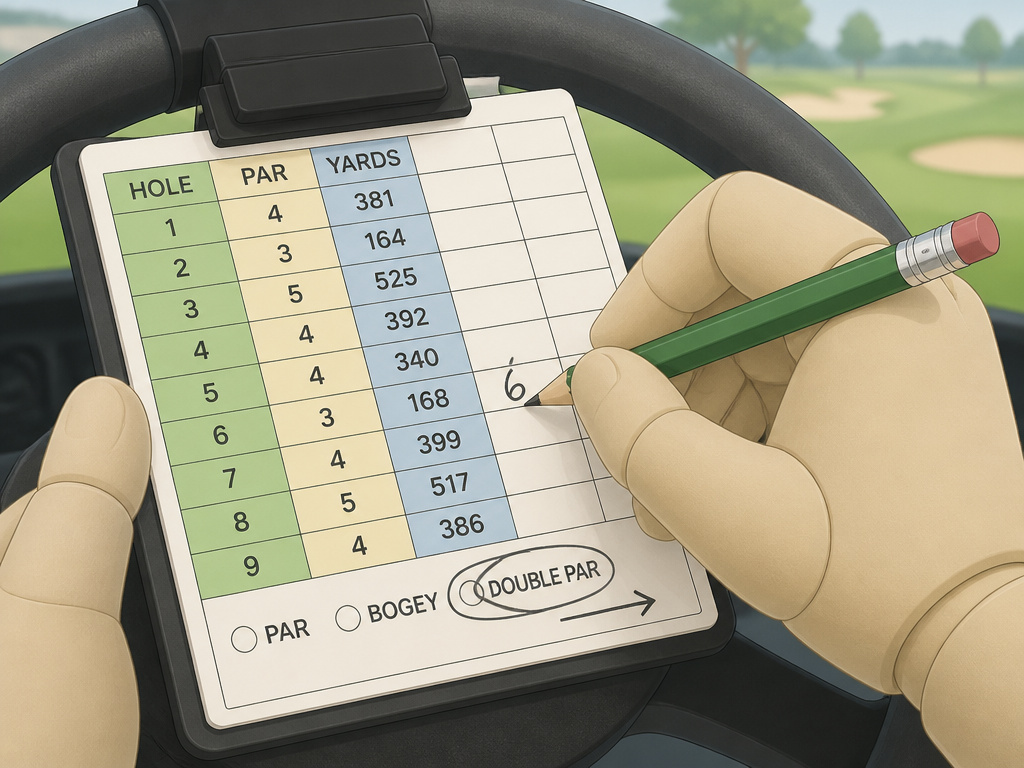
The scorecard has numbers everywhere. You only need three: the hole number, the par, and the yardage from your tees.
| Scorecard Column | What It Means For You |
|---|---|
| Hole | The number, 1 through 18 (or 9). |
| Par | The target. A 4 means a good player needs 4 shots. |
| Yards | The length from your red tee markers to the hole. |
| Handicap | Ignore it. It ranks hole difficulty. |
Write down the number of strokes it takes you to get the ball in the hole. That’s your score for that hole. Add them up at the end.
Here’s the truth nobody sells: you are allowed to stop counting. If you’re on a hole and your score has reached double par (6 on a par-3, 8 on a par-4), pick your ball up. Move to the next tee. This is the single most important tool for maintaining pace of play. The round is for experience, not endurance.
Pace of Play: The Only Metric That Matters
Pace refers to consistency, not speed. The entire course operates on a four-hour schedule for 18 holes.Your group’s job is to stay one shot behind the group in front of you. Not half a hole behind. One shot.
How do you know you’re on pace? Look ahead. If you finish a hole and the group ahead is just leaving the next tee, you’re fine. If you see them walking down the fairway while you’re still on the tee, you’re already behind. You must close that gap on the very next hole.
The practical toolkit for pace:
- Play “Ready Golf.” Hit when you’re ready, regardless of who is “away.” Don’t wait for ceremonies.
- Park the cart smart. Drop your partner at their ball first, then go to yours. Park the cart on the side of the green closest to the next tee.
- Limit practice swings. One is enough. Two is the max.
- Prepare your shot while others hit. Decide your club while you’re walking to your ball.
- Put your headcover and club away after you hit. Don’t stand there admiring your shot.
A slow group doesn’t just annoy the people behind; it backs up the entire course. If you’re struggling, picking up is the professional move. It’s how you ensure your first round is also your second.
What to Bring (The Half-Set Principle)
You don’t need 14 clubs. You need maybe five. Bringing too many is like bringing every spice in the cabinet to make a stew, you’ll just ruin the pot.
The Essential Half-Set:
- Putter: For the greens.
- Sand Wedge (SW) or Pitching Wedge (PW): For shots around the green and in bunkers.
- 7- or 8-Iron: Your most versatile club for shots from 100-150 yards.
- Hybrid or 5-Iron: For longer shots from the fairway.
- Driver: For the tee box.
Add golf balls (lose at least three), tees, a ball marker (a coin works), and a glove if you use one. Wear your proper attire, a collared shirt and shorts or pants without jeans. That’s the whole bag.
Frequently Asked Questions
What if I can’t get the ball airborne?
Then you’re not ready for the course yet, and that’s okay. Go back to the driving range or take a lesson. The course expects you to be able to advance the ball. Spending five minutes whiffing on every shot is unfair to your group and the course.
Can I use my range balls on the course?
No. Range balls are often limited-flight or damaged. They don’t perform the same, and it’s against course policy. Use proper golf balls.
What do I do if I lose a ball?
Look for it for one minute, maximum. If you don’t find it, take a one-stroke penalty. Drop a new ball near where you think it was lost (or where it went out of bounds) and keep playing. Do not hold up the search.
Do I need golf shoes?
For a first time, no. Athletic shoes with decent grip are fine. Proper golf shoes help with stability, especially in wet conditions, but they’re an investment for later.
How do I know which club to hit?
This is where a basic understanding of golf scoring and distances helps. On a par-4, your goal is two shots to reach the green. If the hole is 350 yards, you need two shots that average 175 yards. That might be driver then 7-iron. Don’t overthink it. If you have no idea, hit your 7-iron. It’s almost always the right club to get you moving forward.
Before You Go
Your first time at a golf course is expensive information. Don’t waste it by trying to document all 18 holes. Note the two or three things that genuinely surprised you, maybe how long the walk felt, or how a particular hole looked, and what you’d do differently next time.
The goal is the feeling of walking off the 18th green knowing the process, from the pro shop to the final putt, not a number. That’s how you build a golf warm-up routine that works, and how you manage those first tee nerves the next time out.The game gets simpler from here.
