
What is a Resort Golf Course? USGA Classification & Tiers
This post contains affiliate links. As an Amazon Associate, we earn from qualifying purchases.
This post contains affiliate links. As an Amazon Associate, we earn from qualifying purchases.
A resort golf course is a public-access course that is part of a larger destination property offering lodging and amenities, designed to accommodate a wide range of skill levels with premium conditioning, and typically requiring a resort stay for preferred or exclusive access. This definition, formalized by the USGA in 2021, moves beyond simple ownership to categorize courses by the type of experience they deliver.
That shift from “who owns it” to “what experience does it sell” is the key. It explains why a resort course can feel so different from your local municipal track, and why its business model leads to specific design choices, access rules, and pricing. The experience is the product, and the golf course is its centerpiece.
What follows is a breakdown of that experience: the official USGA classification, how resort courses compare to other types, the economics behind the green fees, and the architectural principles that make them playable for everyone from beginners to pros.
Key Takeaways
- The USGA classifies courses into six experience types, with “Resort” being one; it’s defined by visitor lodging, price premiums, and extensive non-golf amenities.
- “Resort course” refers to the golf facility; “golf resort” is the entire destination property including hotels, spas, and dining.
- While technically public, top-tier resort courses like Pinehurst No. 2 or Shadow Creek restrict prime tee times or require an on-property stay.
- Green fees at premier resorts have climbed 36-37% since 2019, often exceeding $400, driven by bundled stay-and-play packages and premium conditioning.
- Resort course design prioritizes playability with wide fairways, multiple tee boxes (from 5,000 to 7,000+ yards), and softened hazards to serve a transient, varied clientele.
What is a Resort Golf Course? The USGA’s Definition
Forget the old categories based purely on ownership. The modern framework comes from the game’s governing body. In a 2021 report, the USGA proposed a new system to classify golf courses based on the scope of customer experience. This system identifies six distinct types: focused, enhanced, full, lifestyle, resort, and destination.
The “Resort” category is specifically defined by three pillars: the primary customer is a visitor requiring lodging, this customer base allows for price premiums, and the facility includes that lodging. As detailed in their Green Section Record classification study, a resort facility isn’t just a nice course with a hotel nearby. It’s an integrated operation offering a golf course, full practice areas, player-support staff, overnight accommodations, a golf shop, multiple dining outlets, and extensive non-golf recreation like spas. A critical note from the USGA: many customers use the resort without ever playing golf, creating dual revenue streams.
According to the USGA’s 2021 classification, a resort golf course is part of a facility where the primary customer is a visitor requiring lodging, enabling price premiums and necessitating on-site accommodations, extensive practice areas, multiple food outlets, and significant non-golf amenities.
This official definition clarifies the business model. The course isn’t a standalone profit center; it’s a flagship amenity that drives room bookings, spa visits, and restaurant revenue. This explains the investment in immaculate conditioning, the golf course must be a compelling reason to choose this resort over another.
Resort vs. Daily-Fee vs. Private: Where Access Gets Fuzzy

It’s useful to slot resort courses into the traditional access model, but the lines are blurrier than you think. Most golfers are familiar with three main types: municipal courses (public, owned by a city/county), daily-fee courses (public, privately owned), and private courses (members and guests only). A resort course is technically a sub-type of public-access golf, but its rules often mimic private club exclusivity.
| Course Type | Primary Access | Typical Customer | Conditioning Priority |
|---|---|---|---|
| Municipal | Open to all; first-come, first-served | Local residents, value-seeking golfers | Maintain playability at low cost |
| Daily-Fee | Open to all; bookable tee times | Local golfers, weekend players | Good to very good; balances cost and quality |
| Private | Members and their guests only | Members who play frequently | Very high; member satisfaction is key |
| Resort | Public, but often restricted to resort guests | Vacationing visitors, destination golfers | Premium; a marketing tool for the entire property |
The biggest surprise for many is the access restriction. While you can book a time at your local daily-fee course with a credit card, the top resort courses operate differently. At Pinehurst, to play the famed No. 2 course or others like No. 4 or No. 7, you must be a resort guest or a member. Public walk-on play is only offered on specific, less-famous courses during certain months. Shadow Creek in Las Vegas has a similar, stricter rule: access is exclusively tied to a stay at an MGM Resorts property.
This creates a hybrid model. The course is “public” in that anyone can play it, if they buy the full resort experience. This directly impacts golf course economics, as the green fee is often bundled into a package, insulating it from direct comparison with everyday public golf.
The Business Model: Why Resort Golf Costs What It Does
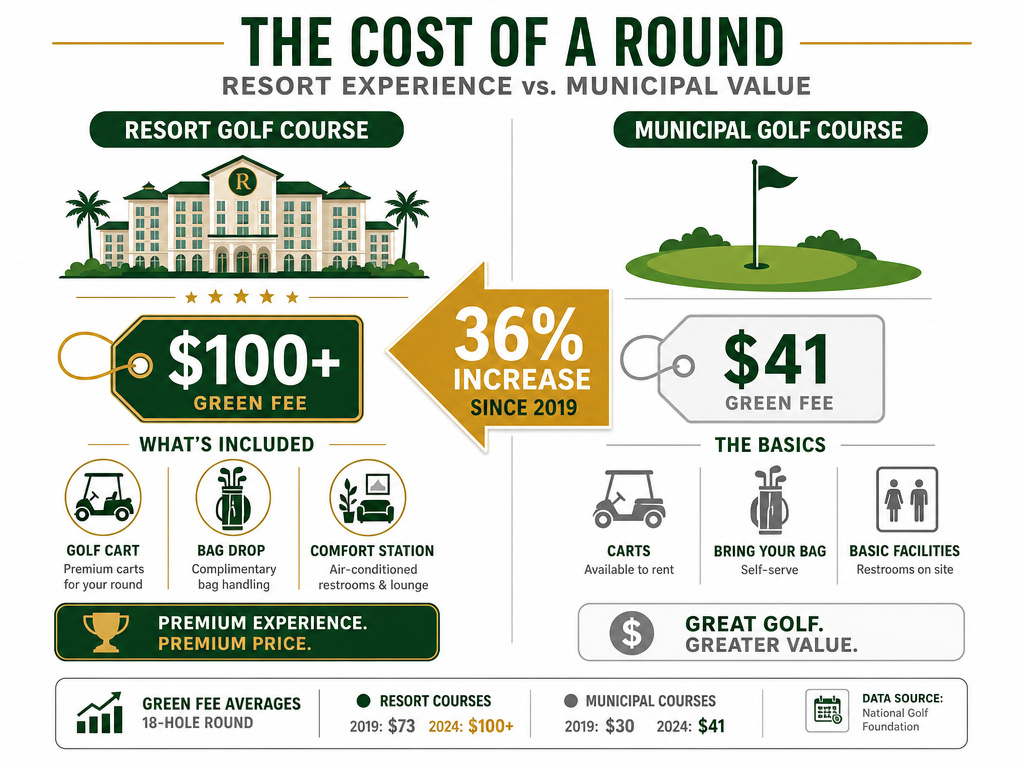
The price tag is the most immediate signal you’re dealing with a resort course. According to the National Golf Foundation, average resort green fees in the U.S. Have increased about 36% to 37% since 2019. The average peak-season rate at these properties now exceeds $100, compared to an average of around $41 at municipal and daily-fee courses.
The gap isn’t an accident; it’s baked into the model. You are paying for more than turf.
- Premium Conditioning: The course is the resort’s front lawn. Budgets for maintenance, landscaping, and agronomy are far higher than at a course that relies solely on green-fee revenue.
- The “Bundle”: The listed green fee is often part of a stay-and-play package that includes your room, range balls, a cart, and sometimes food credits. The golf revenue supports the entire property’s operational management.
- The Experience Layer: This includes bag drop service, player assistants, high-end golf shop merchandise, and superior on-course amenities (e.g., comfort stations, premium food & beverage). Tipping for these services is an expected, additional cost.
Resort course fees illustrate the spectrum. Bandon Dunes charges around $450, Pinehurst No. 2 around $470, Pebble Beach around $675, and destinations like the Wynn Golf Club or Sensei Porcupine Creek can reach $750 to $1,250. A caddie, which is standard at the top tier, adds a significant fee and tip on top.
Where this goes sideways: Comparing a resort green fee directly to your local course’s fee. You’re comparing a round of golf to a vacation destination’s flagship activity. The calculus is different.
The Design Philosophy: Playability Above All Else
The architecture of a resort course serves a specific master: the vacationing golfer. This golfer may play once a year, has a wide range of handicaps within a single group, and is primarily there for enjoyment, not punishment. This mandate shapes every design decision.
I learned through poor results that if you can’t execute a shot calmly on the range, you definitely shouldn’t try it on the course. Resort architects apply that principle at scale. They design out the frustration that would ruin a guest’s expensive vacation.
- Wide Landing Areas: Fairways are generally broader to accommodate less consistent driving. The penalty for a slight miss is a longer approach, not a lost ball in thick native area.
- Multiple Tee Boxes: A hallmark of resort design is four or five sets of tees, allowing the course to play from roughly 5,000 yards up to over 7,000 yards. This lets a high-handicapper, a mid-handicapper, and a low-handicapper all play the same course from appropriate distances.
- Softened Hazers: Bunkers are often placed strategically but may have lower lips for easier escape. Water hazards are used for drama, but not typically to pinch every landing zone.
- Strategic Options: Good strategic golf course design offers risk-reward choices. On a resort course, the “safe” route is almost always very clear and playable, while the heroic carry over water is an optional thrill.
This philosophy doesn’t mean the courses are easy. From the back tees, with the wind up, a championship golf course like Pebble Beach is a brutal test. The design genius is in its scalability. It can be a fun, memorable test for a 25-handicapper and a U.S. Open venue in the same week. This focus on playability and scenery over pure difficulty is a key difference from a minimalist golf course design, which might preserve more natural, penal features.
Iconic Examples and the Spectrum of Resort Golf
The term “resort course” encompasses a stunning variety of landscapes and challenges. Looking at iconic examples shows how the core principles adapt to different environments.
- Bandon Dunes (Oregon): A pure golf resort built on coastal dunes, offering a links-style experience. Its design is minimalist and natural, but its wide fairways and multiple tees make it accessible. The entire destination is golf-focused.
- Pinehurst (North Carolina): A historic Southern resort with multiple courses. Its village atmosphere and famed No. 2 course, a strategic design masterpiece by Donald Ross, define it. Access is tightly managed through the resort-stay model.
- Pebble Beach (California): The ultimate combination of breathtaking oceanfront scenery and championship pedigree. Its green fee is the highest, reflecting its status as a bucket-list destination for golfers worldwide.
- Desert Courses (Arizona/Nevada): Courses like those at Shadow Creek or the Wynn represent the luxury end. They are oases of green in the arid landscape, featuring dramatic waterfalls and immaculate, parkland-style conditions. The desert golf course experience here is about opulent contrast.
Each provides the resort fundamentals, lodging, amenities, premium golf, but the golf course design principles are filtered through sand, pine forest, coastline, or desert.
Frequently Asked Questions
Are resort golf courses public?
Technically, yes, they are considered public-access. However, many high-profile resort courses restrict that access by requiring guests to stay at the resort property to book a tee time, especially on their premier courses. Always check the specific access policy before planning a trip.
What’s the difference between a resort course and a golf resort?
Resort course is the golfing facility itself, the 18 holes, clubhouse, and practice areas. A golf resort** is the entire destination property, which includes the resort course(s) plus the hotel, restaurants, spa, and other recreational amenities. You visit a golf resort; you play a resort course.
Why are resort course green fees so high?
The fees reflect the integrated business model. You are paying for premium course conditioning that acts as a marketing tool for the resort, extensive service layers (bag drop, player assistants), and the fact that the fee is often bundled into a stay-and-play package that includes lodging. It’s a vacation premium, not just a golf fee.
Are resort courses easier than other courses?
They are designed to be more playable for a wide range of skills, not necessarily easier. They achieve this through wide fairways, multiple tee boxes, and intelligently placed hazards. From the appropriate tees, they should be enjoyable for most players. From the back tees, they can still be a severe test.
Can you walk resort courses?
It depends entirely on the course. Some, like many at Bandon Dunes, are famously walkable and encourage caddies. Others, built over dramatic terrain or with long distances between holes, may require a cart. Always check the course’s policy, as cart fees are often mandatory and included in the green fee.
Before You Go
The defining thread of a resort golf course is intent. Every aspect, from the USGA’s classification to the width of the fairways, is engineered around delivering a complete, enjoyable experience to a guest who is there for more than just golf. The high cost is the admission ticket to that engineered experience.
If you’re planning a trip, your first step isn’t checking the weather. It’s scrutinizing the access rules. Assume that for the premier course at any major destination, a resort stay will be required. That rule is the gatekeeper to the entire business model. Once you’re inside, the design is there to ensure your vacation includes great golf, not a grinding frustration. Use tees with a gauge of 12 or heavier, enjoy the conditioning, and remember you’re paying for the backdrop as much as the scorecard.
