
Discover What Makes the US Open Golf’s Most Demanding Test
This post contains affiliate links. As an Amazon Associate, we earn from qualifying purchases.
This post contains affiliate links. As an Amazon Associate, we earn from qualifying purchases.
The US Open is golf’s toughest test because the United States Golf Association (USGA) designs a course setup with one goal: to identify the player with the most complete control. This means narrow fairways (averaging 48 yards at Shinnecock Hills), five-inch rough, and greens cut to a 0.100-inch height that must run at a precise 10.5 on the Stimpmeter, the slowest target speed at a US Open since 1995. The combination of wind, firmness, and punitive design eliminates luck and rewards precision above all else.
That 10.5 target on the Stimpmeter is a direct concession to Shinnecock’s unique environment. It’s the number that keeps a ball from rolling off a green with a 4% slope in 24 mph winds. The USGA’s chief championships officer, John Bodenhamer, called the course “unlike any other” because its perched, sandy greens can lose half their moisture in a single afternoon. When the leaf blade of the Poa annua grass dehydrates past a certain point, the surface stops accepting a pitch shot, it just skids.
What follows is a breakdown of the four specific mechanisms the USGA uses to construct its ultimate examination. We’ll look at the fairway math, the grass science, the weather gamble, and the philosophical shift that moved the tournament away from chasing a par score.
Key Takeaways
- Fairway width is a controlled variable. The USGA narrows landing areas to an average of 48 yards at Shinnecock, down from member play, turning a slight miss into a guaranteed bogey or worse from the five-inch rough.
- Green speed is a safety valve. A target of 10.5 on the Stimpmeter, down from a planned 11.5, is the slowest US Open green speed in decades, set specifically to keep balls on slopes above 4% in forecasted 40 mph gusts.
- The grass has a literal breaking point. Poa annua stops photosynthesizing above 68°F and stops growing roots above 77°F. A green’s moisture can drop from 16% to 8% (the wilting point) in hours, turning a puttable surface into concrete.
- The setup philosophy has changed. Post-2018, the USGA moved from a rigid “par is the goal” mentality to a “tough but fair” framework, accepting that modern athletes with better equipment might shoot under par on a great setup.
The 48-Yard Fairway Rule
The first test is off the tee, and it’s a simple equation of space. For a US Open, the USGA doesn’t just let the course play as it does for members. They contract the fairways. At Shinnecock Hills in 2026, the average width is 48 yards. Compare that to 42 yards in 2018 and a mere 32 yards at Oakmont the previous year.
Where this goes sideways: A drive that misses the fairway by three yards finds five-inch rough. From that lie, advancing the ball 200 yards toward the green is often impossible. The player’s only choice is a sideways chip back to the short grass, turning a potential birdie hole into a scramble for bogey before the approach shot is even taken.
This isn’t about driving distance. It’s about driving dispersion. The penalty for a miss is so severe that players must use less club off the tee to guarantee accuracy, which in turn leaves them with longer, more difficult irons into greens that are small and firm. It’s a two-stage punishment that tests patience as much as skill. This level of strategic punishment is a defining trait of a true major championship venue.
| Course | US Open Fairway Width (Avg.) | Key Consequence |
|---|---|---|
| Shinnecock Hills (2026) | 48 yards | Missed fairway → 5-inch rough; recovery shot only option. |
| Oakmont (Previous Year) | 32 yards | Extreme penalty; emphasizes positional play over power. |
| Typical PGA Tour Event | 60+ yards | Reward for aggressive driving; minimal penalty for slight miss. |
The Green That Stopped Photosynthesizing
The putting surface is where the US Open is often won, lost, or made infamous. The grass itself has a biological timer. The primary grass at northern courses like Shinnecock is Poa annua. According to turf studies, creeping bentgrass and Poa annua stop photosynthesizing above 68°F and stop growing roots above 77°F.
The US Open cuts these greens to a height of 0.100 inches. Penn State’s stress-safe range for that grass is 0.156–0.187 inches. The tournament is already operating outside the plant’s ideal health window. Add sun and wind, and the moisture in a green can plummet from 16% in the mid-morning to 8% by late afternoon, the precise wilting point.
A green at 8% moisture feels and plays like concrete. A pitch shot doesn’t bite; it skids. A putt doesn’t roll true; it hops on the dry, brittle grass blades. This is what happened on Shinnecock’s 7th hole in 2004. The green became unplayable, and officials had to water it between groups, a moment that lives in US Open lore.
This is why the Stimpmeter is such a critical tool. The USGA’s original plan for Shinnecock was green speeds of 11.5 to 12.0. With high winds forecast, they pivoted to a target of 10.5. That single point of difference on the meter is what keeps a ball from blowing off a slope when the grass loses its moisture. It’s the margin between a tough test and an unfair one.
The Wind Gamble and the “Syringing” Strategy
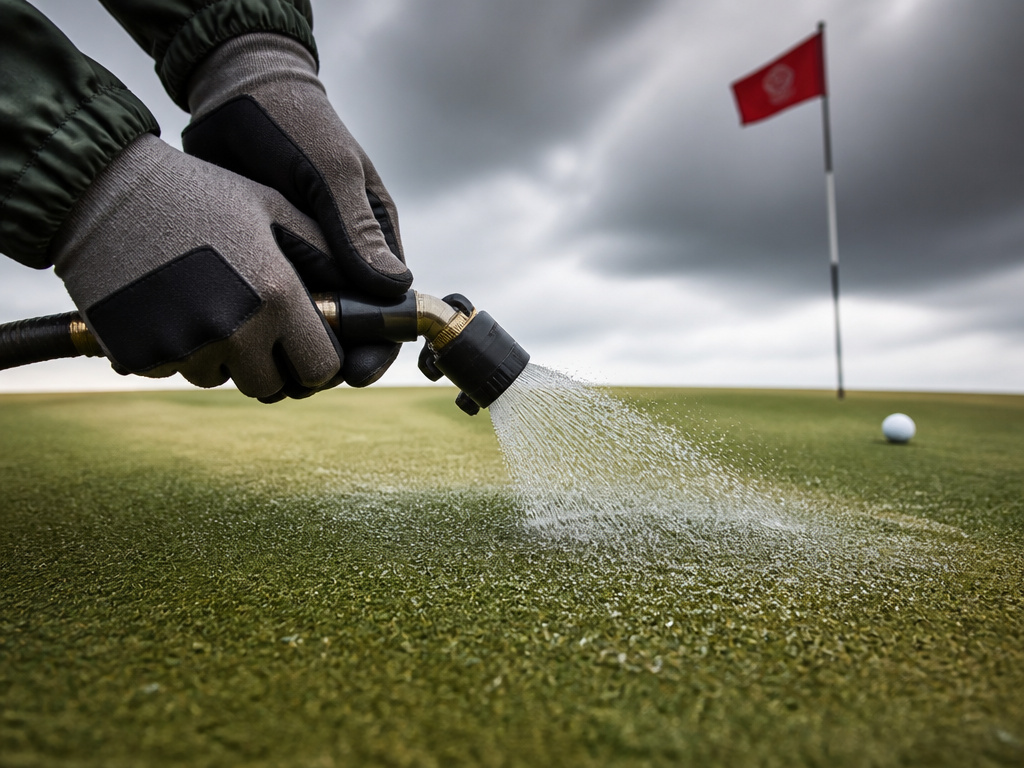
At Shinnecock, the weather isn’t a factor, it’s the co-designer. The course sits between Peconic Bay and the Atlantic Ocean. The sandy soil and perched greens offer no reservoir for water. When the wind blows, which is almost always, it doesn’t just affect ball flight; it acts as a giant blow-dryer on the playing surfaces.
The forecast for the 2026 opening round predicted sustained winds of 12 to 24 mph with gusts over 40 mph. John Bodenhamer noted that wind speeds in the mid-30s mph become “problematic” because golf balls may not stay still on the putting green. This direct physical interference is unique among the major championships.
Common mistake: Assuming morning and afternoon conditions are similar. At Shinnecock, a player with a 7:30 a.m. Tee time faces a green with 16% moisture. A player in the same group, but off at 2:30 p.m., might face the same green at 8% moisture with 20 mph more wind. It’s a different golf course.
To combat this, the USGA implemented a specific “syringing” protocol. They moved morning tee times up by 10 minutes to create a 30-minute window between the morning and afternoon waves. Grounds crews use this window to lightly water the greens, not to make them soft, but to keep them from dying and becoming unplayable for the later wave. It’s a deliberate intervention to maintain competitive fairness, a nuance deeply understood by the USGA after past failures.
From “Par is the Goal” to “Tough but Fair”
The final element of the toughest test is philosophical. For decades, the USGA’s unofficial goal was to have the winning score hover around even par. This mindset led to setup decisions that forced a specific outcome, sometimes crossing the line into unfairness, as at Shinnecock in 2004 and 2018.
After 2018, then-USGA executive director Mike Davis ordered a deep review. John Bodenhamer, who led it, recounted a conversation with two-time US Open champion Curtis Strange. Strange told him that when he sees a winning score over par today, he wonders if the USGA “did something to force a setup to get to a score and make it about them.”
That feedback changed the calculus. The new philosophy, as Bodenhamer puts it, is “tough but fair.” The aim is to set up a great championship course like Shinnecock, Pebble Beach, or Oakmont to test every club in the bag, then let the weather and the players determine the score. If that leads to a winner at 10-under, so be it. The identity of the test is in the completeness it demands, not the number on the scoreboard.
This shift is profound. It means the US Open is no longer trying to trick the best players in the world. It’s trying to expose them. The winner will be the player who manages their game through the 48-yard fairways, who reads the changing moisture in the greens, who battles the wind, and who makes the fewest mental errors under a pressure that builds over 72 holes. That’s the definition of a complete champion, the kind who contends for the Career Grand Slam.
The short version: Width, grass, wind, and philosophy. The USGA controls all four to build a wall only the most precise and patient player can scale.
Frequently Asked Questions
What is the single hardest thing about the US Open?
The compounding pressure of mistakes. A slightly missed fairway doesn’t just mean a longer rough shot, it means a likely bogey before you even reach the green. A misjudged approach on a firm green doesn’t just leave a long putt; it can roll into a collection area where par is nearly impossible. Every error is magnified, and the tournament feels like it’s constantly pushing you backward.
Why is Shinnecock Hills considered so difficult for a US Open?
Its coastal environment is uniquely volatile. The combination of sandy soil, perched greens, and constant wind from the Atlantic Ocean causes conditions to change faster than at any other venue. A green can go from acceptable to unplayable in a matter of hours, as documented in the BBC Sport US Open preview. This makes it the least predictable and most difficult course for the USGA to manage.
Has the US Open gotten easier in recent years?
No, it has gotten fairer. The winning scores are sometimes lower because the setup philosophy has shifted from “par at all costs” to “tough but fair.” The courses are still brutally demanding, but they no longer feature gimmicky hole locations or greens watered to the point of death. The test is more pure, which can allow the best ball-strikers to separate themselves and post lower scores, as seen in recent finishes at Pebble Beach.
Do players like the US Open setup?
They respect it. Players understand it’s meant to be the ultimate examination. They may complain about a specific hole or condition in the moment, but the consensus among champions is that a US Open victory carries unique weight because it tests every facet of the game under maximum stress. It’s the title that validates a player’s completeness, a key topic when discussing golfers with the most majors.
How does the USGA decide on green speed?
It’s a balance between challenge and playability, heavily influenced by weather. They use the Stimpmeter to get an objective measurement. The target speed (e.g., 10.5 at Shinnecock) is set days in advance based on the forecast. If high winds are predicted, they will deliberately slow the greens down. The goal is to have the greens fast enough to require perfect putting, but slow enough that a ball won’t be blown off the surface by the wind, a constant concern per the AP News US Open coverage.
Before You Go
One rule that reframes the entire event: if the forecast calls for sustained wind over 20 mph, the winning score will be over par. That’s the threshold where the USGA’s control meets nature’s chaos. Everything covered here, the narrowed fairways, the grass science, the syringing, is the organization’s attempt to manage up to that line.
The modern US Open isn’t about protecting par. It’s about protecting the integrity of the test. The player who wins will have demonstrated a level of control that simply isn’t required to win a regular tour event. That’s why the trophy means more. It’s why the list of champions is a who’s who of golf’s most disciplined players. And it’s why, every June, the toughest test in golf still gets everyone’s attention.
