
What is a Stimpmeter? Explaining Green Speed & Measurement
This post contains affiliate links. As an Amazon Associate, we earn from qualifying purchases.
This post contains affiliate links. As an Amazon Associate, we earn from qualifying purchases.
A Stimpmeter is an extruded aluminum device, 36 inches long with a 145-degree V-groove, used to measure putting green speed by releasing a golf ball from a precise notch when raised to a 20-degree angle. The distance the ball rolls in feet is the green’s “stimp” rating. The standard “1X” notch is 30 inches from the tapered end; a second “2X” notch for undulating greens was added to models made after 2012.
That 20-degree angle is the whole game. It applies a consistent, known velocity to the ball every single time, about 6 feet per second. Without that mechanical repeatability, the number you get is just a guess. This tool turned green maintenance from subjective feel into something a superintendent can track, chart, and manage against agronomic limits.
What follows breaks down the device’s invention, the exact official procedure, and what the numbers actually tell you, and your course superintendent, about the surface you’re putting on.
Key Takeaways
- The Stimpmeter’s 20-degree release angle delivers a consistent ball velocity, making green speed measurement repeatable and objective.
- Always use the standard “1X” notch (30 inches from the end) unless the green is too sloped; the alternate “2X” notch (14 inches) is for half-length runs on severe undulations.
- A valid measurement requires two sets of three rolls in opposite directions; the balls in each set must finish within 8 inches of each other for the reading to be trustworthy.
- Green speed targets are not universal; a “fast” green for daily member play (over 8.5 feet) is often slower than a “fast” tournament green (over 9.5 feet).
- The Stimpmeter is a management tool for consistency, not a competition for the highest number, pushing speeds above 10 feet consistently damages turfgrass health.
How a Stimpmeter Actually Works (The Physics in Your Hand)
The device isn’t a fancy gadget. It’s a calibrated ramp. An extruded aluminum bar, 36 inches long, with a V-shaped groove running its length. That groove has an included angle of 145 degrees, cradling a ball at two points half an inch apart. This design ensures the ball rolls without wobbling.
The magic is in the notch. On the standard side, a precisely milled “1X” ball-release notch sits exactly 30 inches from the tapered end. You place a ball in it, rest the tapered end on the green, and slowly lift the handle. The moment the center of gravity of the ball passes over the notch’s edge, at precisely 20 degrees of elevation, gravity takes over. The ball rolls down the groove and onto the green at a repeatable velocity of roughly 6 feet per second.
This 20-degree release angle is the non-negotiable. It standardizes the initial energy imparted to the ball. Any variation in how fast you lift it changes the result, which is why the official USGA green speed measurement guide emphasizes a slow, steady raise. The device does the physics; your job is to not mess with it.
The alternate “2X” notch, added to Stimpmeters made after 2012, is only 14 inches from the tapered end. It uses the same 20-degree principle but produces a half-speed roll for use on greens where finding a 12-foot level area is impossible. You multiply the result by two. This was a practical update for measuring severely undulating tournament greens.
From a Wooden Ramp to an Aluminum Standard: A Brief History
The need for this tool was born from frustration. Edward S. Stimpson, the 1935 Massachusetts Amateur champion, was at the 1935 U.S. Open at Oakmont. He watched a putt from Gene Sarazen, a top pro, roll straight off a green. Stimpson was convinced the greens were unfairly fast but had no objective way to prove it.
His solution was a homemade wooden ramp. It was a simple concept: if you give a ball the same push every time, how far it rolls tells you about the surface. For decades, it remained his personal tool.
The game changed in the mid-1970s. The USGA’s technical department, led by Frank Thomas, refined Stimpson’s design into the durable, standardized aluminum device we know today. They formalized the dimensions, the notch placement, and the procedure. In 1978, the USGA Stimpmeter was made available to every golf course superintendent and official.
Its release coincided with advances in agronomy and mower technology. Green speeds began to creep up. The Stimpmeter gave superintendents a number to chase, for better or worse. It created a common language between the maintenance staff, the golf professional, and the tournament committee.
The Official Measurement Protocol (Step-by-Step)
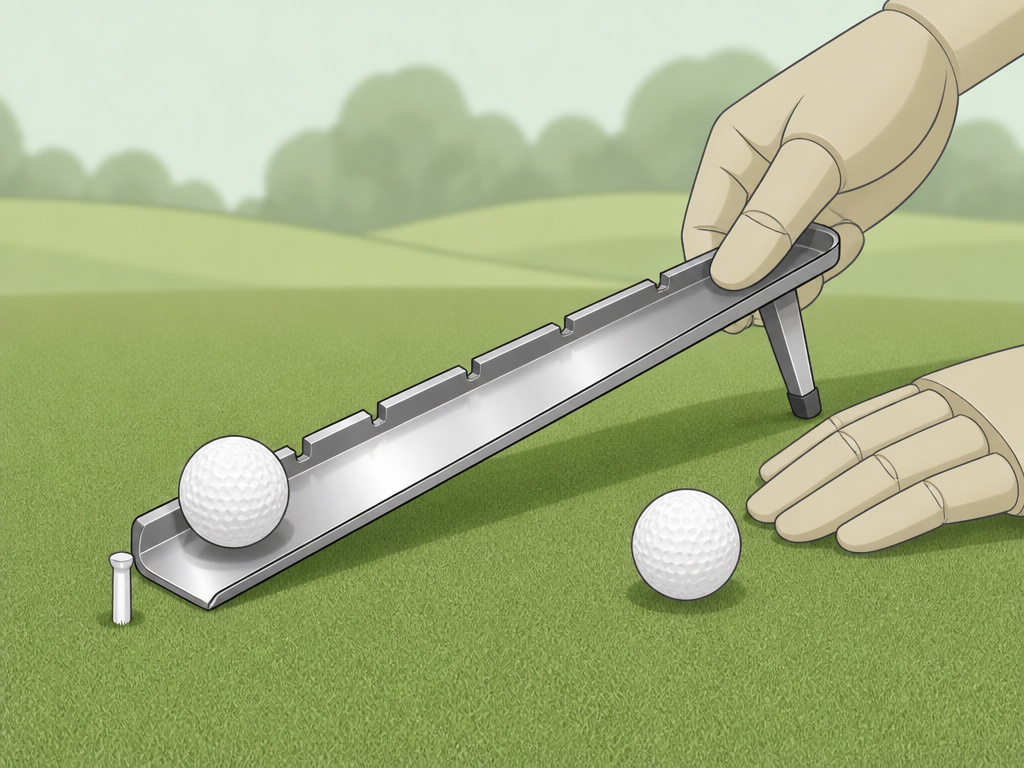
This isn’t a casual exercise. The official method is strict to ensure the number means something. You need a level area on the green about several feet wide and 10-12 feet long in one direction. The test measures the green’s inherent speed, not how a slope will accelerate or decelerate a putt.
Step 1: Establish Your Line.
Find your level area and place a tee at the “start” end. Rest the Stimpmeter’s tapered end on the green right next to this tee, aiming down your chosen line. The device must stay in this exact spot for all three rolls.
Step 2: Roll the First Series.
Place a ball in the standard “1X” notch. Slowly raise the far end until the ball releases, remember, a smooth lift to that 20-degree angle. Let the ball come to rest. Repeat with two more balls from the same spot.
Where this goes sideways: Lifting the Stimpmeter too quickly. You’re not throwing the ball down the ramp; you’re letting gravity take it at the designed moment. A jerky lift adds velocity and inflates the number, sometimes by over a foot.
Step 3: Check for Consistency.
The three balls must finish within 8 inches of each other. If they’re more spread out, your area isn’t level enough, you moved the device, or conditions are too variable (like heavy dew). The test is void. Start over or try the “2X” notch.
Step 4: Mark and Measure.
Place a second tee at the average stopping point of the three balls. Measure the distance from the starting tee to this second tee. Record it.
Step 5: Roll the Opposite Series.
Now reverse everything. Place the Stimpmeter’s tapered end at the second tee, aiming back toward the first tee. Roll three more balls. They must also finish within 8 inches of each other. Place a tee at their average stopping point and measure back to the original start tee.
Step 6: Calculate the Green Speed.
The two measurements should be within 18 inches of each other. If they are, add them together and divide by two. That average, in feet, is the Stimpmeter reading for that green.
| Step | Action | Tolerance / Key Point |
|---|---|---|
| 1. Setup | Find 10-12 ft level area, place start tee. | Must be truly level; slope ruins the test. |
| 2. First Series | Roll 3 balls from “1X” notch. | Lift slowly to 20°; let gravity release ball. |
| 3. Validate Series | Check ball grouping. | Balls must be within 8 inches of each other. |
| 4. Measure Series | Mark average stop point, measure distance. | Gives you “Direction A” measurement. |
| 5. Opposite Series | Roll 3 balls back the other way. | Same tolerance: within 8 inches of each other. |
| 6. Final Calculation | Average the two measurements. | The two measurements must be within 18 inches of each other. |
What Do the Numbers Mean? Interpreting Stimp Readings
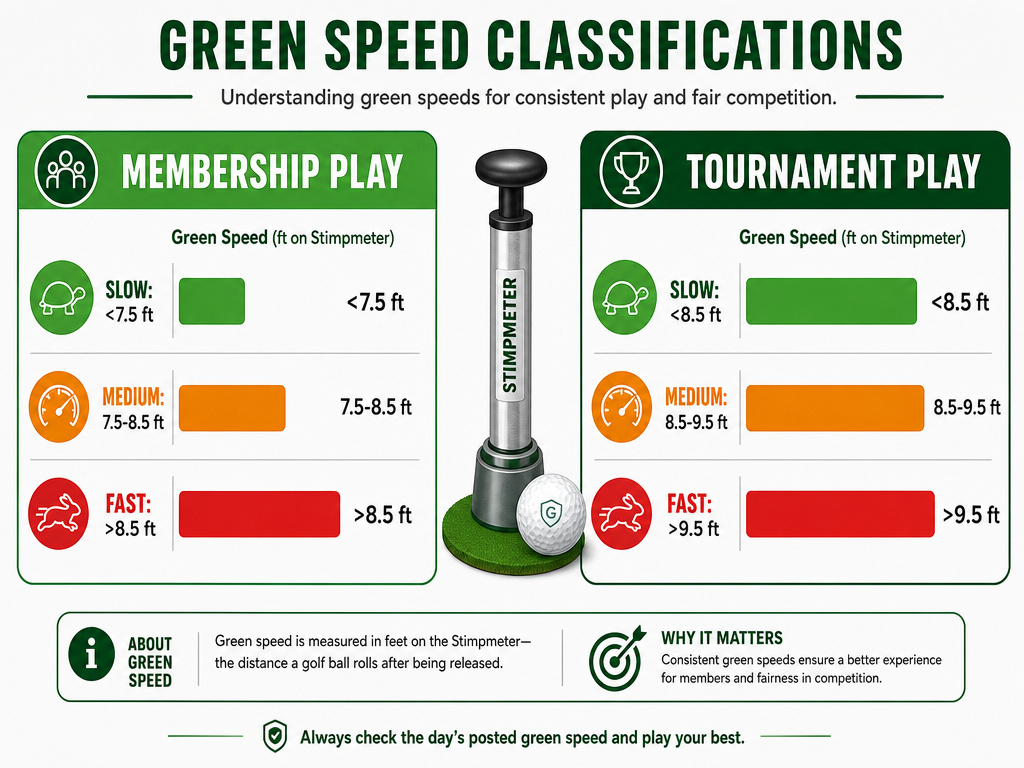
A number by itself is meaningless. It needs context: who is playing, what is the grass, what is the weather, and what is the course’s design?
For daily membership play, a common classification from agronomic sources like the Penn State Extension is: * Slow: Less than 7.5 feet * Medium: Around 7.5 to 8.5 feet * Fast: Greater than 8.5 feet
For tournament play, the thresholds jump. The same source suggests: * Slow: Less than 8.5 feet * Medium: 8.5 to 9.5 feet * Fast: Greater than 9.5 feet
Tournament greens often run between 10 and 12 on the Stimpmeter. Pushing beyond 12 feet, like the legendary 14+ foot speeds at Oakmont, requires perfect conditions, specific grasses, and significant agronomic stress. The Penn State Extension green speed factors resource details how mowing height, moisture, fertilization, and rolling all interact to produce these numbers.
The main point is that “fast” is relative. An 8.8-foot green might feel lightning quick to a weekend player but slow to a tour pro. This is where your feel for putting speed becomes critical. The number tells the superintendent what they’ve produced; your job is to adapt your stroke to it.
Why Consistency Matters More Than a High Number
I’ve seen committees demand “tournament speed” for a member-guest, only to watch the greens turn brown and patchy by the back nine on Saturday. The Stimpmeter’s greatest value isn’t in chasing a high score; it’s in achieving uniformity.
A superintendent’s goal is to get all 18 greens rolling within a foot of the same number. There’s nothing more frustrating for a player than nailing their pace of putts on an 11-foot green, then three-putting the next hole because it’s secretly running at 9. The device allows for daily tracking. They can measure before and after mowing, rolling, or topdressing to see the exact impact of each practice.
The official USGA Stimpmeter instruction booklet warns that consistently trying to keep speeds above 10 feet usually causes “difficult-to-manage turf problems.” It’s a balancing act between playability and plant health. The tool helps find that balance by replacing guesswork with data.
Factors That Change Green Speed (Beyond the Mower)
The cut is the biggest lever, but it’s not the only one. As a player, understanding these helps you predict how the greens will play from morning to afternoon, or day to day.
- Moisture: This is the most obvious daily variable. Wet turf, whether from irrigation, dew, or rain, is slower. The water creates surface tension and resistance. A green can measure 2-3 feet slower in the morning dew than in the afternoon sun.
- Grain: The direction the grass blades lean affects roll. Putting into the grain (against the lie of the blades) is significantly slower than putting down-grain. This can complicate Stimpmeter readings if the test isn’t conducted cross-grain.
- Rolling: Superintendents use heavy rollers to compact the surface slightly, which increases speed without lowering the mowing height. The effect is immediate but temporary.
- Temperature & Health: Stressed, dormant, or unhealthy grass tends to be grainier and slower. Lush, actively growing grass provides a smoother, faster surface.
These variables are why the Stimpmeter is used to establish a “baseline” speed under optimum conditions. Subsequent measurements show how much things like weather or moisture are affecting play on any given day. This data directly informs a superintendent’s decisions, impacting everything from morning irrigation schedules to pre-tournament preparations.
The Superintendent’s Toolbox: How the Data is Used
The number isn’t just posted in the pro shop. It’s logged, charted, and analyzed. This is where the Stimpmeter transitions from a measuring stick to a genuine management tool.
A superintendent might track speeds weekly, creating a chart that shows the impact of cultural practices. They can answer questions with data: “How much faster did rolling make the greens today?” or “What is the cost, in green speed, of letting the greens get a little extra water to survive this heat wave?”
This record-keeping is vital for tournament preparation. They can plan a precise schedule of mowing, rolling, and moisture management to have the greens hit a specific target speed right on time for the first tee shot. It also provides defensible evidence. If a green committee demands faster speeds, the superintendent can show the chart and explain the agronomic trade-off: “We can hit 11 feet, but here’s the wear pattern and disease risk that followed last time we held it there for three days.”
It connects directly to other aspects of course management. Faster greens often necessitate firmer conditions, which changes how approach shots react on landing. It’s all part of the intended course design and the broader concept of golf course etiquette, which includes maintaining a reasonable pace of play that extreme green speeds can destroy.
Frequently Asked Questions
What is a typical Stimp reading for a public course?
Most well-maintained public courses aim for a speed between 8 and 9.5 feet. This provides a test for better players with firm, undulating greens and strategic bunkering, without being punishingly fast for the average golfer, helping to maintain a steady pace of play.com/pace-of-play-and-ready-golf-explained/). You’ll often find slower speeds, in the 7-8 foot range, at municipal or budget-oriented courses.
Can I buy a Stimpmeter for personal use?
Yes, official USGA Stimpmeters are sold through turf supply companies. They are a significant investment, typically costing several hundred dollars. For most golfers, it’s not a practical tool. Your time is better spent practicing distance control on greens with your own putter rather than measuring exact speeds.
Why do Stimpmeter readings sometimes seem inaccurate?
If the procedure isn’t followed exactly, the number is garbage. The most common errors are using a non-level area, lifting the device too fast, or testing on a surface with heavy dew or noticeable grain. The tight tolerances (8 inches for ball grouping, 18 inches between opposite directions) are built-in accuracy checks.
How does green speed relate to my putting stroke?
Faster greens demand a shorter, more controlled backstroke and a smoother acceleration. The margin for error on pace is smaller. On slower greens, you must make a more assertive stroke. This is why mastering speed control is a foundational skill, it allows you to adjust to whatever number the Stimpmeter spits out that day.
Did the Stimpmeter make greens too fast?
It provided a number to target, which certainly contributed to the upward trend in green speeds since the 1980s. However, the device itself is neutral. It’s a measurement tool. The pursuit of extreme speed is a human decision, one that the Wikipedia article on Stimpmeter notes has sparked ongoing debate about playability and course sustainability.
The Bottom Line
The Stimpmeter demystified green speed. It replaced terms like “quick” or “tricky” with a objective foot measurement. For you, the player, the key is to ask for the day’s Stimp number when you check in, many pro shops will have it. An 8.5 means one thing, a 10.5 means another. Use that intel to calibrate your feel on the practice green.
Remember, the tool’s real purpose is consistency, not leaderboards. A course where every green rolls within a foot of the same speed is a far better test than one with a single 12-foot monster and seventeen 9-foot neighbors. That uniformity is what Edward Stimpson wanted back in 1935, and it’s what the aluminum device he inspired delivers when used as intended: not as a weapon, but as a guide.
