
History and Legacy of The Open Championship | Golf’s Major
This post contains affiliate links. As an Amazon Associate, we earn from qualifying purchases.
This post contains affiliate links. As an Amazon Associate, we earn from qualifying purchases.
The Open Championship is the oldest major in golf, founded in 1860 to crown a successor to the game’s best player. Its legacy is built on a series of improvised solutions, a lost trophy, a canceled year, a format change, and an equipment revolution, that transformed a small Scottish contest into a global institution. The championship has crowned 92 different champion golfers, with Harry Vardon holding the record of six victories.
That phrase “improvised solutions” is the key to the whole story. The Open didn’t launch with a perfect plan. It responded to crises, solved them, and grew stronger each time.
What follows is a walk through those turning points: the trophy that was won outright, the year the championship wasn’t held, the ball that changed the game, and the champions who turned a local event into a worldwide spectacle. By the end, you’ll see why its history is less about static tradition and more about smart adaptation.
Key Takeaways
- The Open began in 1860 as a professionals-only event to find a successor to the late great Allan Robertson; it only became “open” to amateurs the following year.
- Young Tom Morris winning the original Challenge Belt outright in 1870 caused a trophy crisis, leading to a canceled championship in 1871 and the creation of the iconic Claret Jug.
- The shift from 36 to 72 holes in 1892 fundamentally changed what the championship tested, favoring sustained performance over a single hot round.
- Sandy Herd’s 1902 victory using the new Haskell ball forced the game’s rapid technological modernization, demonstrating the championship’s role in validating equipment.
- Harry Vardon’s record six wins, the American arrival led by Walter Hagen, and the global roster of modern champions trace the tournament’s evolution from a Scottish affair to a global major.
The Improvised Beginning: Filling a Champion’s Shoes
Golf in 1859 had a problem. Its undisputed best player, Allan Robertson, had died. There was no formal structure to anoint a successor. The solution, proposed by members of Prestwick Golf Club, was a one-off tournament for professionals. They called it “The Open Championship,” but that first event in October 1860 wasn’t truly open, it was by invitation only. Eight professionals showed up.
Willie Park Sr. Won, posting a score of 174 over Prestwick’s 12-hole course, which he played three times in one day. The prize was a red leather Challenge Belt, donated by the Earl of Eglinton. The concept of an “open” field, welcoming amateurs, arrived a year later in 1861. This origin story is crucial. The championship didn’t start as a grand, global vision. It started to answer a simple, urgent question: who’s the best now?
The inaugural Open was not originally conceived as an annual international championship. It began with a more immediate question: Who should succeed Allan Robertson as the acknowledged Champion Golfer?
That personal beginning shaped its early character. For the first 29 editions, the winner was always Scottish, and the event rotated between just three Scottish courses: Prestwick, St Andrews, and Musselburgh. It was a local game solving a local problem. The expansion of the Open rota to England and beyond was a consequence of the championship’s growing prestige, not its initial design. You can trace the entire history of the game through this event’s early, club-centric days.
The Claret Jug vs. The Challenge Belt: A Trophy Story
The first major crisis hit in 1870. Young Tom Morris won his third consecutive Open. The rules stated that three wins in a row meant you kept the Challenge Belt. He did. The organizers had not planned for this. With no trophy to award, there was no Open Championship in 1871.
It took a full year for the three hosting clubs. Prestwick, the Honourable Company of Edinburgh Golfers, and The Royal and Ancient Golf Club, to agree on a solution. On September 11, 1872, they decided to chip in £10 each for a new silver trophy: the Claret Jug, officially named The Golf Champion Trophy. There’s a fascinating edge case here. The Jug wasn’t ready in time for the 1872 championship, which Young Tom Morris also won. He received a commemorative medal instead. His name was the first engraved on the Claret Jug, but the physical trophy wasn’t handed to a winner until Tom Kidd in 1873.
| Trophy | Material & Origin | Years Awarded | Key Fact |
|---|---|---|---|
| Challenge Belt | Red leather with silver buckle, donated by Earl of Eglinton. | 1860–1870 | Won outright by Young Tom Morris after 3 consecutive wins, causing the 1871 cancellation. |
| Claret Jug (The Golf Champion Trophy) | Silver, funded by three golf clubs at £10 each. | 1873–Present (first awarded) | The current jug was first presented to Walter Hagen in 1928; winners keep it for one year. |
The Claret Jug is more than a prize. It’s a symbol of the championship’s resilience. The clubs fixed a problem, and the new trophy became an icon. The winner’s name is engraved each year in a tense ceremony watched by millions, the engraver waits for the final putt to drop before starting. This tradition connects directly to the modern era of global television coverage and the major championships as we know them.
Format Wars and the First Forfeit
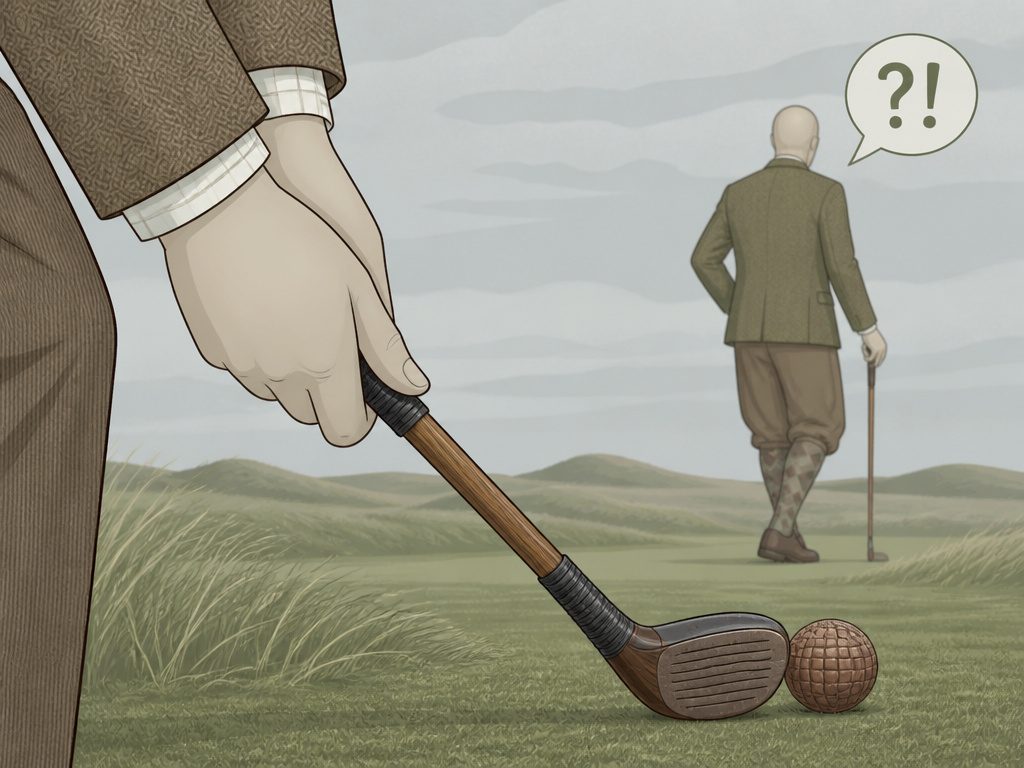 For its first three decades, The Open was a 36-hole sprint played in a single day. That changed in 1892 when the championship moved to Muirfield. Pressure from players and golf publications led to an expansion: four 18-hole rounds over two days. This was a monumental shift.
A 36-hole contest could be won with one brilliant performance. A 72-hole championship demanded consistency, recovery, and stamina. It became a test of a complete golfer, not just a hot hand. This format is now standard for all men’s major championships, but The Open was the first to adopt it for the long haul.
Where this goes sideways: The first-ever Open playoff in 1876 ended in a forfeit. David Strath refused to continue playing after a rules dispute over a shot was left unresolved by the committee. The championship had no clean procedure for a tie.
That 1876 incident at St Andrews is a perfect example of the championship’s growing pains. Bob Martin won by forfeit. The messy episode forced a refinement of rules and procedures, another improvisation that made the tournament more robust. It’s a far cry from the slick, multi-hole playoffs we see today at the U.S. Open or the PGA Championship.
The Great Triumvirate and American Arrival
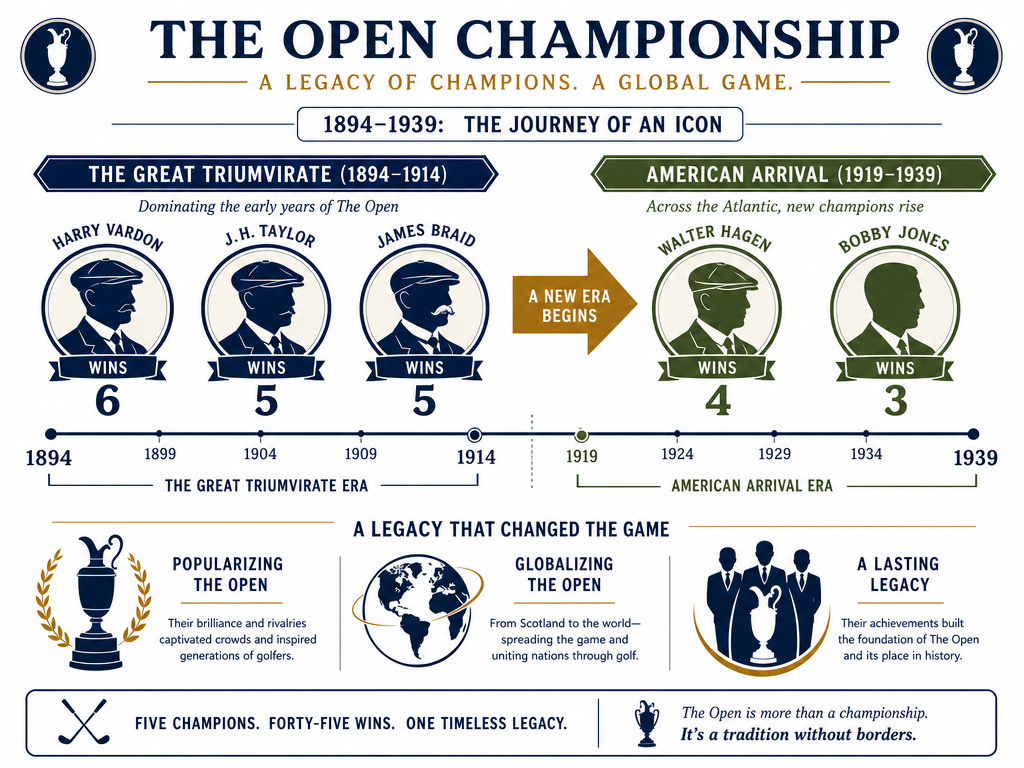 The period from 1894 to 1914 is dominated by three men: Harry Vardon (Jersey), John Henry Taylor (England), and James Braid (Scotland). They won 16 of the 21 Opens in that span. Vardon’s record six titles still stand. This “Great Triumvirate” did more than collect trophies. Their rivalry captured the public’s imagination and expanded the championship’s appeal beyond Scotland.
Vardon’s smooth, rhythmic swing became the model for generations. Taylor and Braid were his fierce competitors. They were the first true golf celebrities, and their success helped standardize the game. World War I interrupted their reign, and when The Open returned in 1920, a new force arrived: America.
Walter Hagen won in 1922, becoming the first American-born champion. He didn’t just win; he won with swagger, changing the perception of the touring professional. Bobby Jones, the great amateur, won three Opens in the 1920s. The American invasion, solidified by players like Hagen and later Arnold Palmer in the 1960s, globalized the championship’s competitive field for good.
| Era | Dominant Figures | Number of Open Wins (Era) | Legacy & Impact |
|---|---|---|---|
| Early Founders (1860-1893) | Old Tom Morris, Young Tom Morris, Willie Park Sr. | 21 combined wins among a small group | Established the event, created its first crises and solutions. |
| The Great Triumvirate (1894-1914) | Harry Vardon (6), J.H. Taylor (5), James Braid (5) | 16 wins in 21 years | Popularized the game, set performance standards, first true rivals. |
| Interwar & American Arrival (1920-1939) | Walter Hagen (4), Bobby Jones (3), Henry Cotton (3) | Mix of American and British champions | Globalized the field, introduced modern sports celebrity. |
The official Wikipedia entry on The Open Championship details this transitional period, showing how the tournament’s administration was formally taken over by The R&A in 1920, who also standardized the three-day format with a cut in 1926.
The Haskell Ball: The Open’s Technology Tipping Point
In 1902, most competitors at Royal Liverpool were using the gutta-percha ball, or “gutty.” Sandy Herd showed up with the new Haskell ball, which featured a wound rubber core inside a gutta-percha cover. It flew farther. Herd won.
His victory wasn’t just a personal triumph; it was a technological referendum. The Haskell ball was superior, and winning the championship proved it. Resistance from traditionalists crumbled almost overnight. Within a few years, the Haskell was standard. This moment is a core part of the Open’s legacy: it doesn’t just resist change; it often validates it. The championship acts as a proving ground, separating gimmicks from genuine advancements. This pattern continues today with debates over equipment standards still governed by the R&A.
I’ve seen more than one player who practices beautifully on the range but falls apart on the first tee. That’s performance anxiety, and it’s not new. Sandy Herd must have felt a version of that in 1902, trusting an unproven ball in golf’s biggest event. His win changed every bag in the field. Sometimes the pressure reveals what actually works.
The Modern Rota and Global Champions
The list of courses hosting The Open, the rota, is itself a historical document. Prestwick hosted the first 12 Opens but was dropped in 1925. The official reason was that it was too short, had too many blind shots, and couldn’t handle the growing crowds. The championship had outgrown its birthplace.
Today’s rota is a collection of classic links courses, primarily in Scotland and England, with occasional visits to Northern Ireland (Royal Portrush). The heart of the rota remains the legendary St Andrews links, the “Home of Golf.”
The champions tell a similar story of expansion. After the first 29 Scottish winners, the champion’s nationality diversified: English, Jersey, American, South African, Australian, Spanish, and more. Since 1999, American golfers have won 13 times. The championship that began to find Scotland’s best golfer now finds the world’s.
This global talent pool is reflected in the modern list of Open champions. Names like Tiger Woods (3 wins), Seve Ballesteros (3 wins), and Nick Faldo (3 wins) stand alongside the historic greats. The quest to join the golfers with the most major titles often runs directly through an Open victory.
Why Has The Open Survived for 160+ Years?
Three reasons stand out. First, it solved practical problems as they arose. No trophy? Create a better one. Format too short? Lengthen it. A tie causes chaos? Improve the rules.
Second, it embraced meaningful change while guarding its core identity, links golf, the Claret Jug, the brutal weather. It allowed the Haskell ball but kept the courses firm and fast. It welcomes global stars but makes them play the ground game.
Third, it has always been about the champion. From replacing Allan Robertson to crowning Harry Vardon, Jack Nicklaus, or Tiger Woods, the central question remains: who is the best golfer right now? That question never gets old.
The Open’s legacy isn’t a museum piece. It’s a living system that adapts. It’s the major that was canceled for a year, changed its trophy, lengthened its test, and validated new technology. Every time it faced a problem, it found a solution that made it stronger. That’s why it’s still here.
Frequently Asked Questions
Why is it called The Open and not the British Open?
The official name is The Open Championship. “British Open” is a term used primarily outside the UK to distinguish it from other national opens, like the U.S. Open. Purists and the governing R&A prefer the original title, as it was the world’s first “open” golf tournament.
Who has won The Open the most times?
Harry Vardon holds the record with six victories (1896, 1898, 1899, 1903, 1911, 1914). James Braid, J.H. Taylor, and Tom Watson have each won five times.
What happens to the Claret Jug after a player wins?
The champion keeps the original Claret Jug for one year, until the next Open. They are given a full-scale replica to keep permanently. The original is always returned to the R&A official championship page for engraving and display.
Has The Open ever been canceled?
Yes, several times. It was not held in 1871 due to the trophy crisis after Young Tom Morris kept the Challenge Belt. It was canceled from 1915-1919 and 1940-1945 for the World Wars, and again in 2020 due to the COVID-19 pandemic.
What is the oldest course in The Open rota?
The Old Course at St Andrews, used for golf since the 15th century, is the oldest and most iconic venue. It first hosted The Open in 1873 and remains the most frequent host site.
The Bottom Line
The Open Championship’s history is a checklist of near-disasters that became strengths. A trophy was won outright, so they created a better one. The format felt insubstantial, so they doubled it. New technology threatened tradition, so they let the winner decide. This pragmatism is its legacy.
For a player, winning it means solving the same winds and burns that Tom Morris did, but under a global spotlight. For a fan, it’s watching history repeat and innovate simultaneously. The next time you see the Claret Jug, remember it exists because a 21-year-old from St Andrews was too good for the original prize. Everything since has been an improvisation on that theme.
