
Grand Slam vs. Career Grand Slam: Key Differences in Golf
This post contains affiliate links. As an Amazon Associate, we earn from qualifying purchases.
This post contains affiliate links. As an Amazon Associate, we earn from qualifying purchases.
The Grand Slam in golf is winning all four major championships, the Masters, PGA Championship, U.S. Open, and The Open, within a single calendar year. A Career Grand Slam is winning those same four majors at any point across a player’s entire career. Only six men in history have completed the Career Grand Slam: Gene Sarazen, Ben Hogan, Gary Player, Jack Nicklaus, Tiger Woods, and Rory McIlroy.
That distinction between a single perfect year and a lifetime of excellence is the whole game. It frames every conversation about golf’s greatest players. The calendar-year Grand Slam is the sport’s white whale, last achieved in the pre-modern era. The Career Grand Slam is the highest realistic peak, a test of range and longevity that has defined legends.
What follows is a breakdown of both achievements: the specific tournaments that count, the tiny club of players who’ve joined it, and the stubborn realities that make completing the set so difficult. By the end, you’ll know exactly why a player with a dozen majors might still be chasing one specific trophy.
Key Takeaways
- The Career Grand Slam is the more common (but still extremely rare) achievement, requiring wins at the Masters, PGA Championship, U.S. Open, and The Open at any time.
- Only six male golfers have ever completed the Career Grand Slam: Gene Sarazen, Ben Hogan, Gary Player, Jack Nicklaus, Tiger Woods, and Rory McIlroy.
- The true calendar-year Grand Slam has not been accomplished in men’s professional golf since Bobby Jones’s 1930 feat with a different set of tournaments.
- Tiger Woods’s “Tiger Slam” (2000-2001) is the closest modern equivalent, holding all four titles concurrently, but across two calendar years.
- The hardest major to win for Career Grand Slam seekers is usually the one played on a surface that contradicts their natural game.
The Core Difference: Grand Slam vs. Career Grand Slam
One requires a flawless year. The other demands a complete career. Getting this right matters, because the terms get tossed around loosely.
A Grand Slam (often called the calendar-year Grand Slam) is the simultaneous capture of all four modern major championships within one January-to-December cycle. It is an annual quest that resets every Masters Sunday. No man has done it in the professional era. The sheer logistical and mental burden, peaking four times across eight months on three different continents and course types, has proven insurmountable.
The Grand Slam is a sprint of perfection. The Career Grand Slam is a marathon of adaptation.
A Career Grand Slam has no time limit. It’s the career achievement of winning each of the four majors at least once. The order doesn’t matter. The gaps between wins don’t matter. It’s a binary checklist: either a player has won all four, or they haven’t. This is the benchmark for all-around greatness, proving a player can win on Augusta’s slick greens, the U.S. Open’s brutal rough, the PGA’s varied setups, and The Open’s windswept links.
The confusion often starts because other sports, like tennis, use the same terms differently. In tennis, a calendar-year Grand Slam has been achieved several times. Their Wikipedia entry on tennis Grand Slam clearly states it requires all four titles in one year. Golf’s standard is stricter in the modern era.
The Four Majors: The Pillars of the Slam
You can’t understand the feat without knowing the tests. Each major has a distinct personality, and conquering all four proves a player isn’t a specialist.
| Major Championship | When & Where | Key Challenge | Why It’s Different |
|---|---|---|---|
| The Masters | April, Augusta National Golf Club (Augusta, Georgia) | Undulating greens, precise approach shots | The only major played at the same course every year. Knowledge and feel are cumulative. |
| PGA Championship | May, various courses across the USA | Often the strongest field, demanding all-around game | Tends to set up the fairest but sternest test of professional shot-making. |
| U.S. Open | June, various courses across the USA | Extreme difficulty: narrow fairways, thick rough, fast greens | The championship is designed to identify the most complete, patient, and gritty player. |
| The Open Championship | July, various links courses in the UK | Unpredictable weather, firm ground, strategic creativity | The only major played on traditional links land, rewarding low-trajectory control and imagination. |
Winning one major means you mastered a specific style of golf. Winning all four means you rewired your game three separate times to master styles that actively conflict. A power player built for the PGA Championship must learn the finesse of Augusta. A shot-maker who thrives at the U.S. Open must learn to play the bump-and-run at St. Andrews. That adaptation is the real work.
The Six Men Who Have Done It (The Career Grand Slam)
The list is short for a reason. Each name represents a different era and a different path to completeness. The table below shows the major where each player finally checked the last box.
| Player | Masters | PGA Championship | U.S. Open | The Open | Final Major Won (Year) |
|---|---|---|---|---|---|
| Gene Sarazen | 1935 | 1922, 1923, 1933 | 1922, 1932 | 1932 | Masters (1935) |
| Ben Hogan | 1951, 1953 | 1946, 1948 | 1948, 1950, 1951, 1953 | 1953 | The Open (1953) |
| Gary Player | 1961, 1974, 1978 | 1962, 1972 | 1965 | 1959, 1968, 1974 | U.S. Open (1965) |
| Jack Nicklaus | 1963, 1965, 1966, 1972, 1975, 1986 | 1963, 1971, 1973, 1975, 1980 | 1962, 1967, 1972, 1980 | 1966, 1970, 1978 | The Open (1966) |
| Tiger Woods | 1997, 2001, 2002, 2005, 2019 | 1999, 2000, 2006, 2007 | 2000, 2002, 2008 | 2000, 2005, 2006 | The Open (2000) |
| Rory McIlroy | 2025 | 2012, 2014 | 2011 | 2014 | Masters (2025) |
Gene Sarazen completed the set with his famous 1935 Masters win, which he secured with a double eagle on the 15th hole. He was the first to show it could be done with the modern majors. Ben Hogan’s completion came at Carnoustie in 1953, in his only appearance at The Open, a legendary performance given his limited schedule after a near-fatal car accident.
Gary Player was the first international player to achieve it, with his 1965 U.S. Open win at Bellerive. His relentless global schedule built the versatility the Slam demands. Jack Nicklaus didn’t just complete it; he set the standard. His Jack Nicklaus’s career is defined by completing the Career Grand Slam three separate times over, a record of sustained excellence that may never be matched.
Tiger Woods completed his with a dominant 2000 Open win at St. Andrews, becoming the youngest to do so. He then immediately embarked on the “Tiger Slam.” Rory McIlroy is the most recent member, ending an 11-year wait by winning the 2025 Masters. His journey highlighted the psychological weight of that one missing trophy.
Where this goes sideways: Fans often confuse a high major count with a Career Grand Slam. A player can have six majors but still be missing one leg of the Slam. That missing trophy defines their legacy gap more than the total number ever will.
The “Tiger Slam” and Other Edge Cases
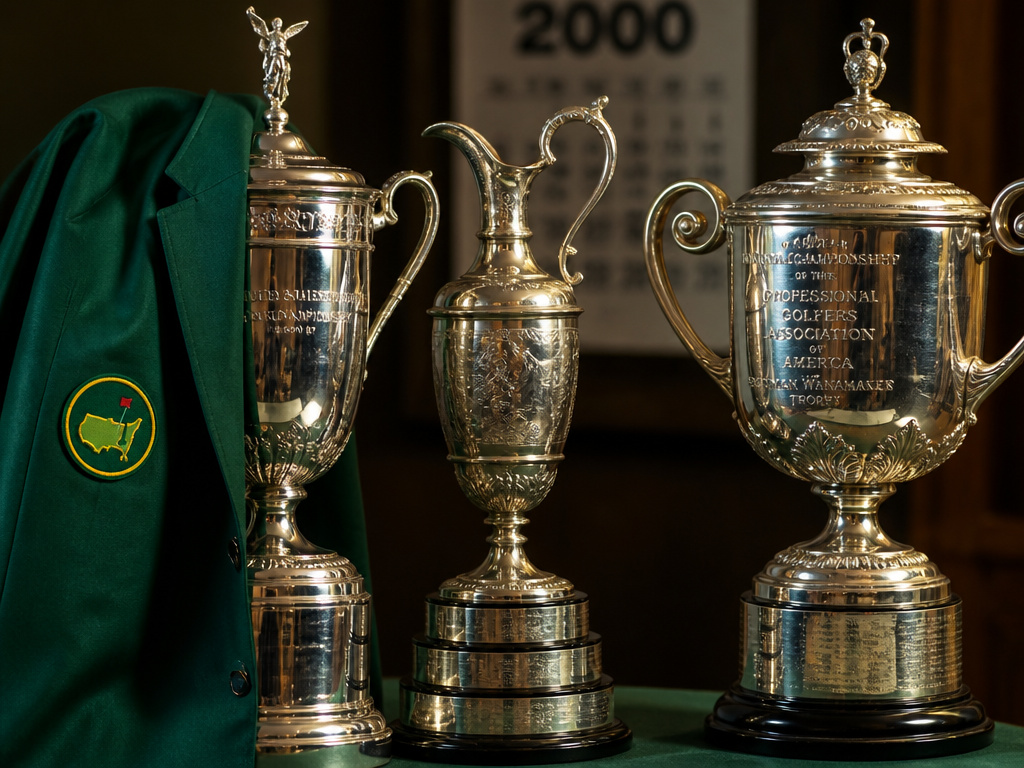 The modern era has produced near-misses that sharpen the definition. The most famous is the “Tiger Slam.”
From June 2000 through April 2001, Tiger Woods held all four major championship trophies simultaneously. He won the U.S. Open, The Open, and the PGA Championship in 2000, then completed the set by winning the 2001 Masters. Because the streak straddled two calendar years, it is not recognized as an official Grand Slam. It is, however, arguably the greatest sustained run of golf ever played. It proved that holding all four titles was possible in the modern game, even if the calendar-year alignment wasn’t.
Further back, Bobby Jones achieved the original Grand Slam in 1930. His feat involved winning the U.S. Amateur, British Amateur, U.S. Open, and The Open in one year, a different set of tournaments from today’s professional majors. His achievement is the reason the term exists in golf, and you can read more about Bobby Jones’s historic 1930 Grand Slam to understand its context.
Other legends, despite towering careers, fell short. Arnold Palmer won seven majors but never the PGA Championship. Sam Snead captured a record 82 PGA Tour events and three Masters, but the U.S. Open eluded him. Their careers show that the Career Grand Slam doesn’t measure total wins, it measures completeness. The absence of that one title is a louder part of their story than a dozen other victories.
Why Is It So Hard? The Surface and Style Problem
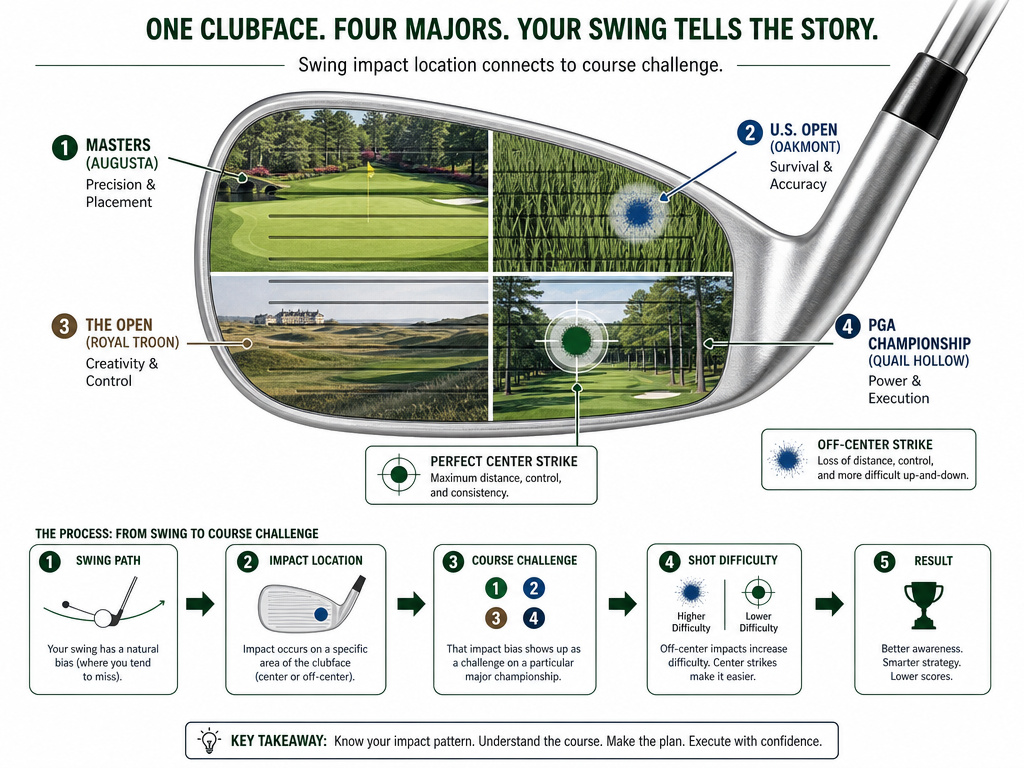 The majors aren’t just four big tournaments. They are four different sports.
The core conflict is surface. Golf is played on grass, but the grass and the ground beneath it change everything. Augusta National is manicured, soft, and demands high, spinning shots that stop dead. A U.S. Open course is long, penal, and rewards survival. A British Open links course is firm, fast, and requires players to keep the ball low and use the ground.
A player’s signature strength often becomes a liability at one of the four. A superb wind player might struggle with the tree-lined precision of the PGA Championship. A genius putter on bentgrass might be confounded by the grainy Bermuda greens at a U.S. Open in the south.
I learned this through equipment feedback, not tournament pressure. For years, I’ve used impact tape on clubfaces during lessons. The instant, visual proof of strike location is undeniable. A player who consistently strikes the driver center-face might show heel-biased marks with a long iron. That tiny mechanical difference, amplified over 72 holes on a course that punishes it, is the margin between a top-10 and holding the trophy. The Career Grand Slam demands a player find and fix those hidden biases for four different competitive environments.
This is why the final major is so often the one that contradicts a player’s upbringing. It’s not an accident. It’s the sport demanding they become a more complete golfer.
Who Is Close? The Active Pursuit
The quest continues. Several elite players are one major away, and their pursuit shapes the narrative of every season.
Scottie Scheffler, with multiple Masters and one win each at The Open and PGA Championship, needs only a U.S. Open to complete the set. His ball-striking dominance suggests it’s a matter of time, but the U.S. Open’s punitive setup has been his consistent hurdle.
Jordan Spieth completed three legs of the Slam early in his career (Masters, U.S. Open, The Open) but has yet to win the PGA Championship. His recent form makes this the most tantalizing and frustrating active chase.
Other major winners like Brooks Koepka (PGA, U.S. Open) or Jon Rahm (Masters, U.S. Open) have multiple wins but are still two majors short, highlighting how difficult it is to even get within one trophy of the club.
Their battles are a public laboratory for the adaptation thesis. Every time Scheffler enters a U.S. Open, he’s not just playing for a trophy. He’s playing to rewrite a skill in his game that 156 other players already have. That pressure is unique, and it’s why watching a player chase their final major is one of golf’s great dramas. For a deeper look at the records these players are chasing, explore the stories behind the most PGA Tour wins and the lowest scores in golf history.
Frequently Asked Questions
Has any golfer ever won the Grand Slam?
In the modern professional era (post-1934), no male golfer has won the Masters, PGA Championship, U.S. Open, and The Open in a single calendar year. Bobby Jones won the pre-modern Grand Slam in 1930, which consisted of the U.S. And British Amateurs and Opens. Tiger Woods came closest with his “Tiger Slam,” holding all four titles consecutively from 2000-2001.
What is the difference between a Grand Slam and a Career Grand Slam?
Grand Slam refers to winning all four majors in one calendar year. A Career Grand Slam means winning each of the four majors at least once at any point in a player’s career. The Career Grand Slam is a career achievement; the Grand Slam is a seasonal one.
How many golfers have a Career Grand Slam?
Six male golfers have completed the Career Grand Slam in the modern era: Gene Sarazen, Ben Hogan, Gary Player, Jack Nicklaus, Tiger Woods, and Rory McIlroy. This information is detailed in resources like this BBC Sport golf career Grand Slam article.
Which major is hardest to win for a Career Grand Slam?
It depends entirely on the player’s skillset. For many American players who grew up on parkland courses, The Open Championship’s links style is the biggest hurdle. For powerful players who rely on distance, the U.S. Open’s emphasis on accuracy and patience is often the final, stubborn challenge.
Do women golfers have a Career Grand Slam?
Yes, but the set of tournaments considered majors has changed over time. Seven women are recognized as having won a Career Grand Slam across different eras: Pat Bradley, Juli Inkster, Inbee Park, Annika Sörenstam, Louise Suggs, Karrie Webb, and Mickey Wright. The Wikipedia page on golf Grand Slam covers this in its section on women’s golf.
Does winning The Players Championship count toward a Grand Slam?
No. The Players Championship, while often called the “fifth major,” is not officially a major championship. Winning it is a prestigious feat but does not contribute to completing a Grand Slam or Career Grand Slam.
The Bottom Line
The Grand Slam is a ghost, a theoretical peak that defines a perfect season. The Career Grand Slam is a monument, built shot by shot across decades. It’s the difference between a player who was unbeatable for a year and a player who was undeniable for a career.
For the six men on the list, the achievement is a final stamp of versatility. For everyone else, that one missing major is the story that won’t end. It’s why we watch Scottie Scheffler at the U.S. Open or remember that Arnold Palmer’s legacy is inseparable from the PGA Championship he never won.
So when you hear the term, listen closely. Is it about a single year of magic, or a lifetime of mastery? That question is what makes golf’s greatest prize not a trophy, but a proof of completeness.
