
How Brooks Koepka Wins Majors: The Key Stat He Switches On
This post contains affiliate links. As an Amazon Associate, we earn from qualifying purchases.
This post contains affiliate links. As an Amazon Associate, we earn from qualifying purchases.
Brooks Koepka wins major championships by flipping a quantifiable performance switch: his driving accuracy jumps from 56.8% to 75.5%, his greens in regulation rate climbs from 67.3% to 73.6%, and his putting improves by over a full stroke gained per round compared to his regular PGA Tour performance. He combines these statistical surges with a mindset that treats difficult, chaotic conditions as a competitive advantage.
That gap between his regular-season baseline and his major-championship peak is the whole story. It’s not a vague notion of “clutch.” It’s a documented, repeatable pattern where three specific parts of his game elevate in unison under the highest pressure. Other players see their stats dip on tougher setups; Koepka’s get better.
What follows is a breakdown of the three statistical levers he pulls, the mental framework that lets him do it, and the specific tournament failures that taught him how to lock in this process. By the end, you’ll see why his five major wins are a blueprint, not an accident.
Key Takeaways
- Koepka’s major wins are built on a measurable performance spike: he hits 18.7% more fairways, 6.3% more greens, and gains over 1.0 more strokes putting per round in majors versus his five-year PGA Tour averages.
- His mental edge comes from a “chaos theory”, he believes difficult, unpredictable conditions slow the game down for him while distracting his competitors.
- He can win even when a core strength falters, as proven by his 2018 U.S. Open win at Shinnecock where he ranked 40th in driving but first in approach shots. Learning from failure is essential to his process; his loss at the 2023 Masters directly informed his winning adjustment at the PGA Championship weeks later.
- His record of finishing first or second in nine of the 24 majors from 2017-2023 shows this is a repeatable system, not a hot streak.
The Three Statistical Levers Koepka Pulls
Forget the idea of a mysterious “clutch gene.” Koepka’s dominance in major championships is built on three specific, measurable parts of his game that consistently improve. A Golfweek statistical analysis compared his stats in his four major wins (2017-2019) against his cumulative five-year PGA Tour averages. The deltas are not small.
In his four major victories, Koepka averaged hitting 75.5% of fairways, a staggering 18.7 percentage-point jump from his 56.8% tour average. His greens in regulation climbed from 67.3% to 73.6%, and his strokes gained putting improved by over 1.0 stroke per round.
This isn’t just playing well. It’s systematically playing better when it matters most.
Lever 1: Fairways Hit (+18.7%)
On the regular PGA Tour, Koepka is a power-over-precision driver. He’s long, ranking 8th in driving distance in 2018, but often wild, ranking 148th in accuracy that same year. In majors, that calculus flips. The fairways tighten, the rough grows, and the penalty for missing is severe. His response is to find more short grass.
At the 2017 U.S. Open at wide-open Erin Hills, he hit 87.5% of fairways. Even at the brutish, narrow Bethpage Black for the 2019 PGA, he hit 57.1%, still above his tour average. This discipline off the tee sets up the entire round. It’s the first proof point that he alters his strategy for the biggest stages, prioritizing position over pure distance.
Lever 2: Greens in Regulation (+6.3%)
Hitting more fairways naturally leads to hitting more greens. But Koepka’s iron play elevates independently, too. His ability to “gouge” shots from the rough onto the green, a noted asset, becomes a superpower on major layouts where everyone is missing fairways.
The numbers show it. He hit 86.11% of greens at Erin Hills. More tellingly, at the 2018 U.S. Open at Shinnecock, a course so firm and fast that hitting any green was an achievement, he still found 68.06%. That ability to consistently give himself a putt for birdie or par, even from poor positions, builds scorecard stability that breaks fields over 72 holes.
Lever 3: Strokes Gained Putting (+1.0+ per round)
This is the quiet killer. Koepka’s tour putting average is solid but not elite (0.217 strokes gained). In his major wins, that number rockets to 1.28 strokes gained per round. That’s a difference of more than four strokes over a tournament, often the margin of victory.
He doesn’t suddenly become a technical putting savant. He makes more mid-range putts for par and capitalizes on the birdie looks his ball-striking creates. The pressure, which causes others’ strokes to quicken, seems to steady his pace. It’s the final piece of a three-part machine that only gets assembled for the majors.
| Performance Metric | PGA Tour Average (5-Yr) | Major Win Average | Improvement |
|---|---|---|---|
| Fairways Hit | 56.8% | 75.5% | +18.7 percentage points |
| Greens in Regulation | 67.3% | 73.6% | +6.3 percentage points |
| Strokes Gained: Putting | +0.217 per rd | +1.28 per rd | +1.063 strokes per rd |
The Mindset: Treating Chaos as an Advantage
The statistical leap is the what. Koepka’s mentality is the how. While most players dread the punishing conditions of a U.S. Open or a windswept PGA Championship, he leans into them. He calls it his “chaos theory.”
“The more chaotic things get the easier it gets for me,” he’s said. “Everything starts to slow down, and I am able to focus on whatever I need to focus on while everybody else is dealing with distractions.” He pointed to the 2018 U.S. Open at Shinnecock, where players publicly criticized the course setup, as a perfect example. He was focused on winning; they were focused on complaining.
This mindset transforms pressure from a threat into a filter. He believes the difficulty of a major championship venue automatically eliminates a large portion of the field mentally before a shot is struck. His goal isn’t to shoot a spectacular number, it’s to survive better than everyone else. Par is his friend.
Where this goes sideways: Trying to force a low score on a major Saturday. That’s when amateurs (and many pros) make big numbers. Koepka’s patience lets him accept that a string of pars on a tough stretch is actually gaining ground.
It’s a worldview shared by the greats. He’s openly studied the careers of Jack Nicklaus and Tiger Woods, not for their swing techniques, but for their major championship mentality. He knows you’re judged by trophies, not top-10s. This clarity simplifies his decision-making under fire. Every shot is evaluated through one lens: does this help me win the major?
Winning When a Strength Fails: The Shinnecock Blueprint
A true test of any champion’s system is whether it can hold up when a primary weapon breaks. For Koepka, whose game is built on powerful driving, the 2018 U.S. Open at Shinnecock provided that test. And it proved his system has redundancy.
That week, he ranked a mediocre 40th in Strokes Gained: Off-the-Tee, essentially breaking even with the field. His short game was subpar, losing half a stroke per round. By his standards, he was having a poor week driving the ball. Yet, he won.
He did it by turning his other levers to maximum. He led the field in Strokes Gained: Approach, gaining a massive 2.6 strokes per round with his irons. He ranked 3rd in putting, gaining 2.0 strokes per round. Afterward, his coach Claude Harmon III noted the significance: “Nice to see Brooks win a major without having a great week driving the ball.”
That victory is a masterclass in adaptive execution. It shows his major formula isn’t dependent on one thing going perfectly. If the driver is off, the irons and putter can carry the load. This flexibility under duress is what separates contenders from closers at the highest level.
Learning from Failure: The Masters-to-PGA Adjustment
Koepka’s process isn’t infallible. His ability to dissect and learn from failure is what makes it sustainable. The clearest example is the one-two punch of the 2023 Masters and PGA Championship.
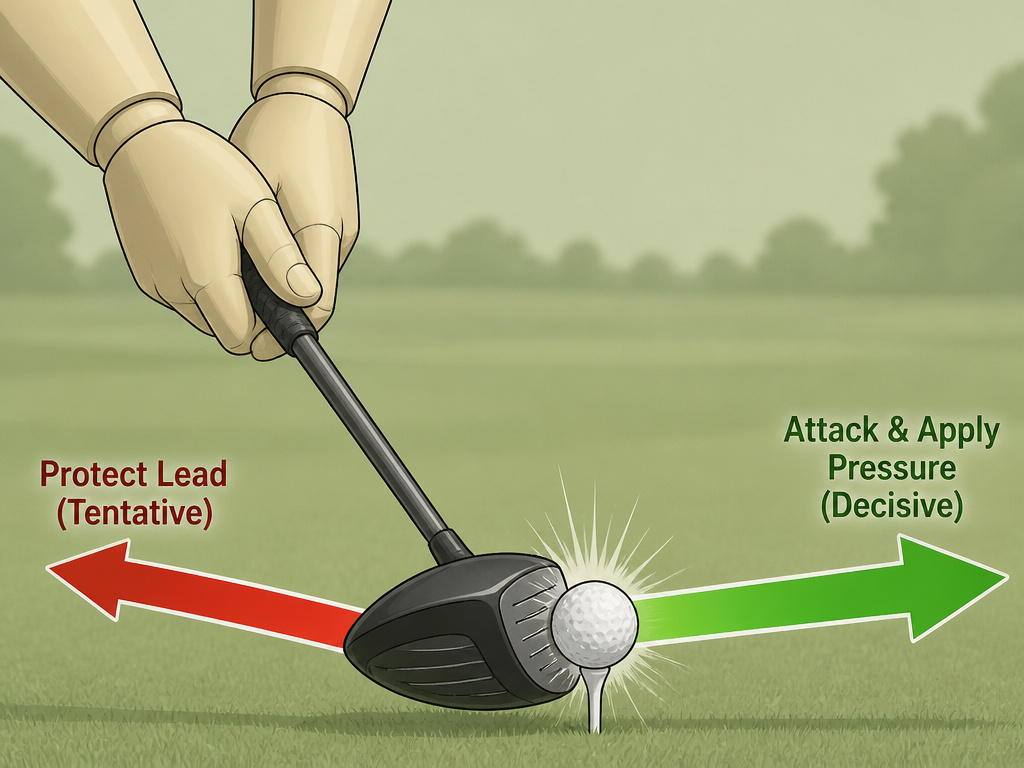
At Augusta, he took a two-shot lead into Sunday and played tentatively, shooting a 75 to lose to Jon Rahm. He described his mindset that day as playing not to lose. The experience ate at him. At the PGA Championship at Oak Hill just weeks later, he found himself in a similar 54-hole lead position.
“What I learned at Augusta kind of helped today,” he said after winning at Oak Hill. “I won’t do it again the rest of my career… I’ll never have that mindset.” The adjustment was immediate and decisive. He opened the final round with three birdies in his first four holes, applying pressure instead of protecting. He closed with a 67, securing his fifth major title.
Common mistake: Treating a final-round lead as something to protect. Koepka’s lesson was that a proactive, aggressive mindset is the only way to seal a major. Protection is a passive instinct that invites disaster.
This rapid, successful adjustment underscores a key trait. He doesn’t ignore failure or make excuses. He uses it as a diagnostic tool. “I’ve always learned more from the four times I finished second than, I guess, the five times I’ve won now,” he has said. Each runner-up finish provided a specific mistake to correct, making his winning process more robust.
How His Major Record Compares to the Legends
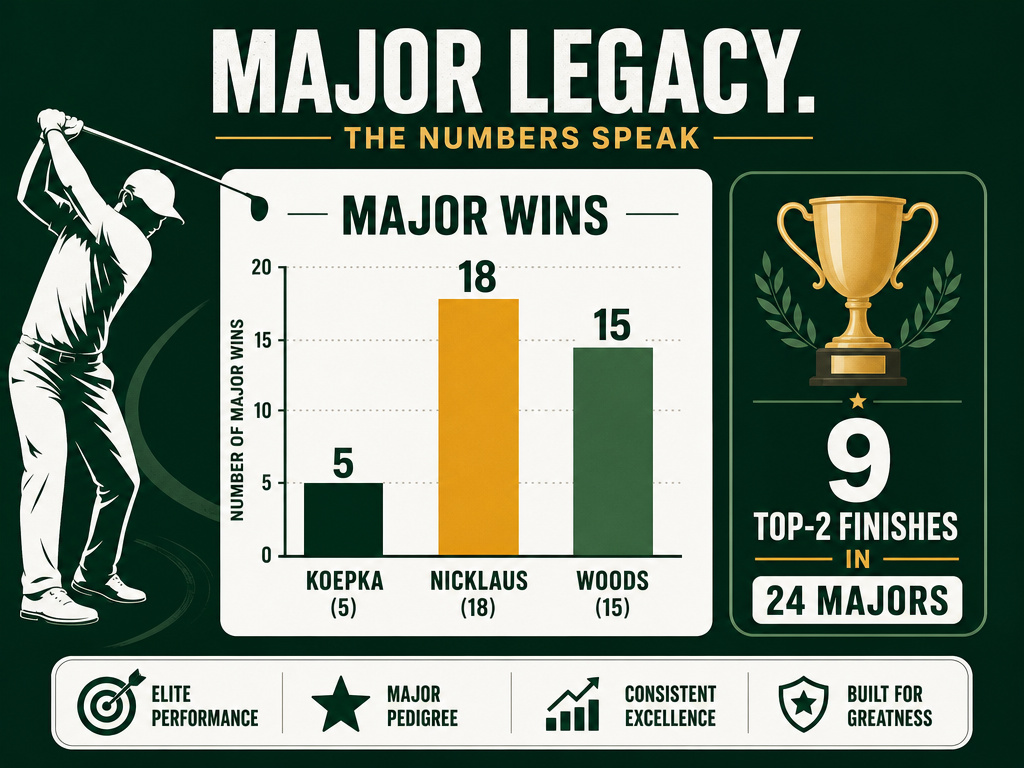
With five major wins and four runner-up finishes in a concentrated period, Koepka has etched his name into a rare tier of modern golfers. Since the 2017 U.S. Open, he has finished first or second in nine of the 24 majors contested. That’s a 37.5% rate of being in the final fight.
This consistency in the biggest events invites comparison to the players he studied. He is one of only 20 men to win five or more professional majors. He’s the third player to win three or more PGA Championships in the stroke-play era, joining Nicklaus and Woods. When he won at Oak Hill, an AP News PGA Championship report noted he became the first player born after 1975 to reach five major wins.
| Achievement | Koepka | Historical Context |
|---|---|---|
| PGA Championships Won | 3 (2018, 2019, 2023) | Joins Jack Nicklaus (5) & Tiger Woods (4) as only players with 3+ in stroke-play era. |
| Majors Before Age 34 | 5 | One of seven players since 1950 to do this (Woods, Nicklaus, Player, Palmer, Watson, Ballesteros). |
| Top-2 Finishes (2017-2023) | 9 in 24 majors | A 37.5% rate. Since 1990, only Woods, Mickelson, and Els have more top-2s. |
While the sheer volume of a Nicklaus (18) or Woods (15) remains a distant horizon, Koepka’s peak dominance, winning four of eight majors from 2017-2019, echoes the most dominant runs in the sport’s history. It’s a record built on a specific, repeatable formula, not a fleeting moment of inspiration.
Frequently Asked Questions
How many majors has Brooks Koepka won?
Brooks Koepka has won five major championships. His victories are the 2017 and 2018 U.S. Opens, and the 2018, 2019, and 2023 PGA Championships. This places him in a tie for 14th on the all-time list and makes him the most successful major winner of his generation.
What is Brooks Koepka’s best major?
Statistically, his most dominant major win was the 2017 U.S. Open at Erin Hills. He led the field in both driving accuracy (87.5%) and greens in regulation (86.11%), winning by four strokes with a record-tying score of 16-under par. However, his 2019 PGA Championship win at Bethpage Black, where he held off a charging Dustin Johnson despite a late scare, is often cited as his most mentally resilient.
Why is Brooks Koepka so good at majors?
Koepka excels in majors due to a combination of a statistical performance spike and a tailored mindset. His driving accuracy, greens in regulation, and putting all improve significantly in majors. Mentally, he embraces difficult, chaotic conditions as an advantage, believing they slow the game down for him while frustrating his competitors. He also prepares for and views majors with a singular focus that he doesn’t apply to regular tour events.
Has Brooks Koepka won a Grand Slam?
No, Brooks Koepka has not won the Grand Slam (all four modern majors in a single calendar year). He has also not completed the Career Grand Slam, as he has never won the Masters or The Open Championship. His best Masters finish is second place (2019, 2023).
What is Brooks Koepka’s major winning percentage?
Defining a “winning percentage” is tricky, as it depends on the timeframe measured. In his absolute peak period from the 2017 U.S. Open to the 2019 PGA Championship, he won four of the eight majors played (50%). Across his entire career through 2025, he has five wins in 44 major starts, giving him a major victory rate of approximately 11.4%.
The Bottom Line
Brooks Koepka’s major championship blueprint is demystified by data and mindset. The numbers show a player who doesn’t just rise to the occasion, he methodically elevates three specific facets of his game by a measurable margin every time. The mindset shows a competitor who reframes the very pressure that breaks others into his primary weapon.
The lesson isn’t that you need his swing or his power. It’s that sustainable success at the highest level requires a system. Identify the two or three things you must do well to compete, build a mentality that thrives in adversity, and be ruthless about learning from every setback. Koepka’s five majors are proof that process, repeated under fire, eventually looks like genius.
