
The Factors That Made Tiger Woods a Dominant Golf Force
This post contains affiliate links. As an Amazon Associate, we earn from qualifying purchases.
This post contains affiliate links. As an Amazon Associate, we earn from qualifying purchases.
Tiger Woods dominated professional golf by building a 3.20-stroke per round scoring advantage over the average field, with 65% of that edge coming from his long game. Academic research quantifies an additional “intimidation factor,” showing players paired with him scored 0.462 strokes worse. His reign was a fusion of statistical supremacy, psychological pressure, and a ruthless willingness to overhaul a winning swing four separate times.
The 3.The 20-stroke number is the conclusion of a strokes-gained analysis of PGA TOUR data from 2003 to 2010. That figure breaks down into specific, measurable contributions from driving, approach play, short game, and putting.It tells us exactly where his advantage lived.
What follows is a breakdown of that blueprint: the peer-reviewed stats on his scoring and intimidation, the mechanical evolution behind his power, and the strategic mindset that treated a winning swing as something to be torn down and rebuilt.
Key Takeaways
- Woods gained 3.20 strokes per round on the field from 2003-2010; 2.08 strokes came from shots over 100 yards.
- Players paired with Woods scored 0.462 strokes per round worse than their baseline, a quantified intimidation effect.
- His 1997 Masters win by 12 shots was followed by a two-year swing overhaul; he rebuilt his swing four times to reach World No. 1.
- In his peak year (2000), playing his “normal” game would have netted an average finish of 2nd place in every event.
- From 2004-2006, he made 1,463 out of 1,466 putts from 3 feet and in.
The Statistical Blueprint of Dominance
Forget vague praise about clutch putting or mental strength. Woods’s edge is documented in strokes-gained data. Between 2003 and 2010, his total scoring advantage was 3.20 strokes per 18-hole round against an average tournament field.
A 2012 strokes-gained analysis of PGA TOUR data found Tiger Woods gained 3.20 strokes per round on the field from 2003-2010. Of this, 2.08 strokes came from the long game (shots over 100 yards), 0.42 from the short game (under 100 yards, excluding putting), and 0.70 from putting. His long game contributed 65% of his total advantage.
This table breaks down where those strokes came from, showing that his legendary driving and iron play were the true engines of his dominance, not just a complementary skill.
| Shot Category | Strokes Gained (per round) | Percentage of Total Advantage | What It Means |
|---|---|---|---|
| Long Game (Shots >100 yards) | 2.08 | 65% | Driving distance/accuracy and long-iron precision created most of his lead. |
| Putting | 0.70 | 22% | Excellent, but contributed less than shots from 150-250 yards (1.01 strokes). |
| Short Game (Shots <100 yards, excluding putts) | 0.42 | 13% | Strong around the greens, but a smaller piece of the overall puzzle. |
The 0.70 strokes gained putting is a telling detail. It’s an elite number, but it was actually less than the 1.01 strokes he gained specifically on shots starting between 150 and 250 yards from the hole. His putting sealed victories; his ball-striking built the leads that made those putts matter.
Where this goes sideways: Assuming his dominance was mostly about clutch putting. The data says his iron play from distance was a bigger factor. If you want to build a game that travels, the long game is the foundation.
The Mind Game: Quantifying Intimidation
The stats on paper are one thing. The effect he had on competitors standing next to him is another, and it’s been measured. A 2008 academic study analyzed the 1998-2001 PGA Tour seasons to isolate the “Tiger effect.”
The research found that players who were paired with Woods scored an average of 0.462 strokes per round worse than their normal performance. The pressure of direct competition with him had a measurable, negative impact on their games. The study also noted that his presence in a tournament had a small adverse effect on the entire field, but the side-by-side intimidation factor was far more significant.
This wasn’t just aura. It was a predictable outcome. When you know the person you’re chasing gains three strokes on the field from ball-striking alone, the pressure to match them shot-for-shot warps decision-making. It leads to forced aggression, tight swings, and missed putts.
Common mistake: Chasing a leader by changing your game plan. The data on players paired with Woods shows that trying to match an opponent’s aggressive style often leads to compounding errors. Sticking to your own proven process is harder under that spotlight, but it’s the only thing that holds up.
His win rate as a 54-hole leader, 95.7% (44 for 46), feeds this cycle. Knowing he almost never faltered with a lead added another layer of psychological pressure. Beating him meant you had to be perfect on Sunday, and the numbers said he usually was.
The Engine Room: Swing Evolution as Strategy
Most players find a swing that works and spend a career trying to preserve it. Woods treated a successful swing as a prototype. He reached World No. 1 with four distinct swings, each rebuilt from the ground up with a different coach. This wasn’t tinkering. It was strategic reinvention to address physical wear, exploit new equipment, and stay ahead of technical trends.
His first major overhaul came shockingly early. After winning the 1997 Masters by 12 shots, he and coach Butch Harmon embarked on a two-year rebuild to add control and consistency to his powerful, rotational move. The result was the peak “Tiger Slam” swing, a more connected, powerful action that led to winning seven of eleven majors between August 1999 and June 2002.
| Swing Era | Key Coach | Hallmark Characteristics | Peak Achievement |
|---|---|---|---|
| 1997 Masters | Butch Harmon (Early) | Wide stance, huge shoulder turn (120°), powerful coil. | 12-shot Masters win, first World No. 1 ranking. |
| “Tiger Slam” (1999-2002) | Butch Harmon (Refined) | More compact, synchronized, immense control through impact. | Won 7 of 11 majors. |
| 2005-2009 Dominance | Hank Haney | “Rounder” backswing, emphasis on club position at the top. | Won 6 majors, including 2008 U.S. Open on broken leg. |
| 2012-2013 Comeback | Sean Foley | Shorter, flatter swing, “squat” move in downswing for power post-injury. | 5 wins in 2013, returned to World No. 1. |
Each change carried risk. The shift to Sean Foley, for instance, produced a more violent, compact move that experts noted robbed him of some grace but generated the power he needed after major injuries. He still won three times in 2012 and five times in 2013. That ability to win while rebuilding is perhaps his most underrated skill.
The drive to change a winning formula speaks to a mindset foreign to most. It’s the mindset of someone who views mastery as a moving target. Understanding the types of golf clubs and how swing changes interact with them is a lifelong study.
The Unseen Foundation: Practice and Precision

The spectacular shots and major wins were the product of a brutal, granular practice ethic. The stats hint at this: making 1,463 of 1,466 putts from three feet is the result of thousands of repetitions under simulated pressure.
I learned this through trial and error early in my teaching. I used to see students spend 80% of their range time with the driver. Their long game would plateau while their scores stayed high. I started tracking where shots were lost during weekend rounds with members. The answer was almost always inside 100 yards, pitches, chips, and lag putts. Now, the first rule I give any amateur is to spend most of their practice time inside that range. It’s the single fastest way to lower a handicap.
Woods’s practice was famous for its intensity and specificity. He wouldn’t just hit putts; he’d create games where every three-footer had to be made to avoid a consequence. He’d practice shots from extreme lies he might see once a year. This built a library of feels and a confidence that translated directly to Sunday afternoons. His fitness regimen, which changed golf completely, wasn’t just for power. It was for endurance to maintain that precision over 72 holes, and for resilience to withstand the torque of his swing for decades.
This discipline extended to equipment. While he wasn’t defined by his gear, he worked meticulously with manufacturers to optimize it. Knowing how a golf club set composition affects gapping and shot options is a professional advantage. He treated his tools as part of the system.
How Does Tiger’s Dominance Compare to Other Legends?
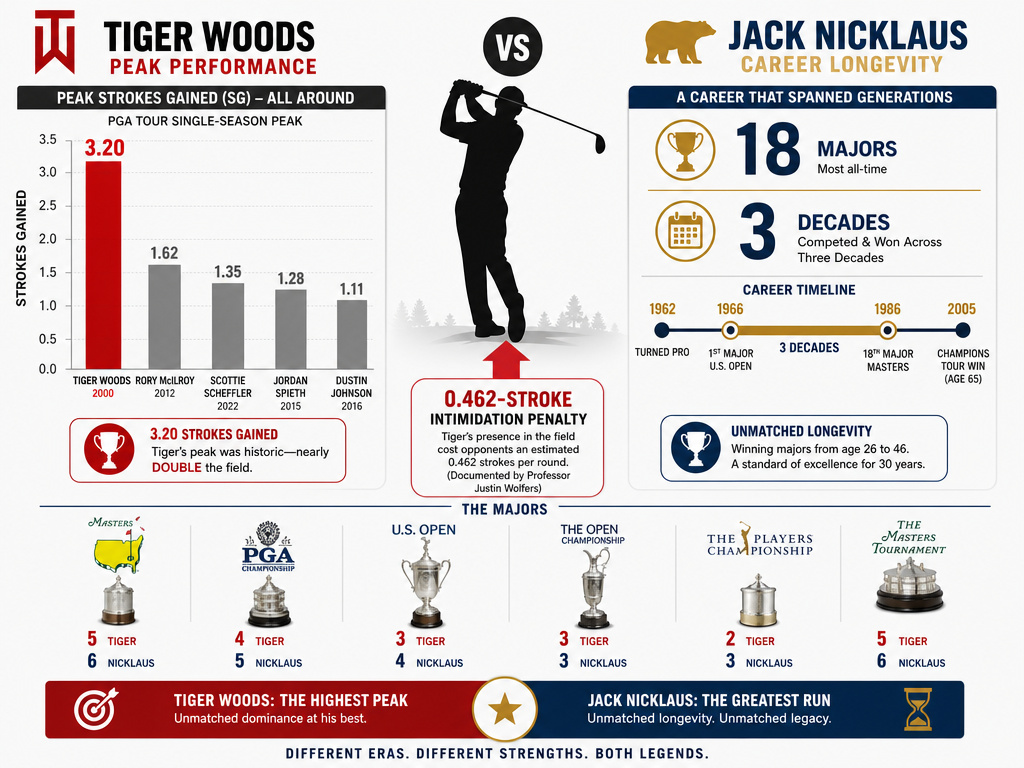
Comparing eras in golf is complex, but the data provides a framework. Woods’s statistical peak, measured in strokes gained, is the highest ever recorded in the modern ShotLink era. His 3.20-stroke advantage is a massive margin in a game where tenths of a stroke separate the top 10.
When stacked against Jack Nicklaus’s legendary career, the comparison shifts from pure stats to longevity and major counts. Nicklaus’s record of 18 professional majors and 19 second-place finishes speaks to a different kind of dominance, one of sustained excellence over three decades. Woods’s peak was sharper and more statistically overwhelming, while Nicklaus’s was broader.
The intimidation factor also sets Woods apart. While all great champions apply pressure, the academic quantification of a 0.462-stroke penalty for playing alongside him is unique. It turned every pairing into a two-player contest where the opponent started nearly half a shot behind per round.
His record in the most major championships, 15 wins, places him second only to Nicklaus. His pursuit of the Career Grand Slam (winning all four majors) was a central narrative, completed with his 2000 U.S. Open win. Victories at tournaments known for their brutality, like the US Open, underscore his ability to win under the most demanding conditions.
Modern players like Viktor Hovland show how swing changes, similar to Viktor Hovland’s swing changes, are now a standard part of career development. Woods was the prototype for this approach, proving that technical reinvention could be a weapon, not a last resort.
Frequently Asked Questions
Was Tiger Woods really that much better than his peers statistically?
Yes, and the margin is precisely quantified. From 2003-2010, he gained an average of 3.20 strokes per round on the field. For context, the difference between the 1st and 50th ranked player in a given season is often less than two strokes. His advantage was enormous and consistent.
What was Tiger Woods’s biggest strength?
While his putting and mental game were legendary, his biggest measurable strength was his long game, shots from over 100 yards. This contributed 2.08 strokes of his 3.20-stroke advantage, or 65%. His driving and long-iron play built leads that his short game and putting protected.
How did Tiger Woods change the game of golf?
He changed it in three concrete ways: 1) He made elite fitness and athleticism an absolute requirement for professional golfers. 2) He popularized the use of data and the strokes-gained framework to understand performance, as detailed in the peer-reviewed study of Tiger Woods. 3) He demonstrated that aggressive, strategic course management could dominate traditional, conservative play.
Did other players really “choke” when playing with Tiger?
The academic research suggests it was less about choking in a dramatic sense and more about a predictable decline in performance under pressure. The academic study of intimidation in golf found a 0.462-stroke per round penalty, indicating players simply performed below their baseline when paired with him, likely due to the psychological burden of competing against his statistical supremacy.
How many different swings did Tiger Woods have?
He had four distinct championship swings, each associated with a different coach and a return to World No. 1: the 1997 Masters swing with Butch Harmon, the refined “Tiger Slam” swing (also Harmon), the Hank Haney swing (2005-2009), and the Sean Foley swing (2012-2013).
The Bottom Line
Tiger Woods’s dominance wasn’t a mystery. It was a multi-layered fact. The first layer was a 3.20-stroke statistical hammer, built mostly from his long game. The second was a 0.462-stroke psychological weight he placed on anyone standing next to him. The third was a relentless engine of reinvention, the willingness to tear down a winning swing four separate times to build a better one.
For golfers today, the lesson is to understand the structure of his success. Dominance comes from building a major advantage in one area (like his long game), hardening your mind and short game to protect leads, and having the discipline to practice with a purpose that matches the pressure you’ll face.His story is captured in everything from the history of the PGA Championship to the dynamics of team events like the Presidents Cup. It’s a blueprint written in data, psychology, and relentless will.
