
Origins and History of Golf: A Journey from Medieval Roots
This post contains affiliate links. As an Amazon Associate, we earn from qualifying purchases.
Modern golf is a Scottish invention that evolved over centuries, not an ancient game imported from elsewhere. The first written mention was a 1457 ban by King James II of Scotland. The first standardized rules, the “13 Articles,” were written in 1744 in Edinburgh. The game spread globally in the 19th century after key innovations like the gutta-percha ball and the establishment of the 18-hole standard at St Andrews.
That 1457 ban is the whole story in a nutshell. King James II wasn’t outlawing a foreign pastime; he was trying to stop Scots from neglecting their archery practice for a game they were already playing in the streets. The ban failed, of course. By 1502, King James IV was buying his own clubs, making him the first golfing monarch and cementing the game’s place in Scottish culture.
What follows is not just a timeline, but a look at the three things that had to come together for golf to become the game we know: the land, the rules, and the technology. By the end, you’ll see why every debate about the game’s true origin circles back to the windswept links of Scotland.
Key Takeaways
- The first official record of golf is a 1457 Scottish parliamentary ban, proving the game was already established and popular enough to be seen as a distraction.
- The “13 Articles” written in 1744 are the oldest surviving rules and established core principles like playing the ball as it lies, which still underpin the modern game.
- St Andrews established the 18-hole standard in 1764, not by design, but by consolidating its 22 holes into 18, creating the template for all courses.
- The invention of the gutta-percha ball in 1848 made golf affordable and consistent, directly fueling the game’s first international boom.
- While ancient stick-and-ball games existed worldwide, modern golf is defined by its Scottish-developed combination of specialized clubs, a standardized ball, and play over natural linksland.
The Scottish Seedbed: Where Golf Actually Grew
You can find stick-and-ball games in the histories of China, the Netherlands, and ancient Rome. The Dutch game of colf is often cited as a direct ancestor. But those games were typically played on frozen canals or in courtyards to a single target. They lacked the essential DNA of golf: the use of multiple specialized clubs to play across many different holes.
The game that became golf needed a specific type of land to evolve. It needed the links, the sandy, wind-swept strips of coastal ground between the beach and arable farmland. This terrain was naturally drained, provided tight turf, and was largely useless for agriculture. It was free, public, and perfect.
The sea-side links in Scotland were the perfect playing ground for golf, with good drainage and hard turf. Playing in fields of mud would never have produced modern golf. In the days before mechanised lawn mowers or course agronomics, it was no links, no golf.
Historical records from the Scottish court show King James IV purchased golf clubs and balls in 1504, confirming the game was a established royal pastime by the turn of the 16th century. This is the critical, non-commodity pivot point. While others had games, the Scots had the land, the climate, and the social structure to develop a game of distance, terrain, and strategy. The story of golf’s origins in Scotland is a story of environment shaping sport.
The First Rules: The 13 Articles of 1744
Without written rules, a game is just a pastime. The moment golf became a sport you could officiate and spread can be pinned to March 7, 1744. On that date, the Honourable Company of Edinburgh Golfers drafted the “Articles and Laws in Playing at Golf” to govern a competition on the Leith Links. These 13 Articles are the sport’s birth certificate.
They are remarkably familiar. Article 1 states “You must Tee your Ball within a Club’s length of the Hole.” Article 3 introduces the foundational principle: “You are not to change the Ball which you Strike off the Tee.” This is the early form of “play the ball as it lies.” Other articles covered lost balls (a five-minute search limit), broken clubs (no replacement), and interference.
This wasn’t just a local code. Over the next century, more than 30 clubs adopted or adapted these rules. The Society of St Andrews Golfers (later the Royal and Ancient Golf Club) used them for their first competition in 1754. The rules evolved in real-time. The 1759 St. Andrews code added the concept of an unplayable lie. The 1773 Edinburgh Burgess rules dealt with outside agencies. The 1783 Aberdeen code formally defined a “stroke.”
| Rule Innovation | Year & Club | Modern Equivalent / Impact |
|---|---|---|
| Tee within club-length of hole | 1744 (Leith) | Established the teeing ground. |
| Cannot change your ball | 1744 (Leith) | “Play the ball as it lies” principle. |
| Unplayable lie procedure | 1759 (St. Andrews) | First relief option from a bad spot. |
| Five-minute search for lost ball | 1783 (Aberdeen) | Set the pace of play and loss standard. |
| Definition of a “stroke” | 1783 (Aberdeen) | Clarified what constitutes a shot. |
This period of organic, club-by-club rulemaking lasted 150 years. It created a patchwork of local interpretations that would eventually demand the unification the R&A history is known for.
Standardization and Spread: The 19th Century Revolution
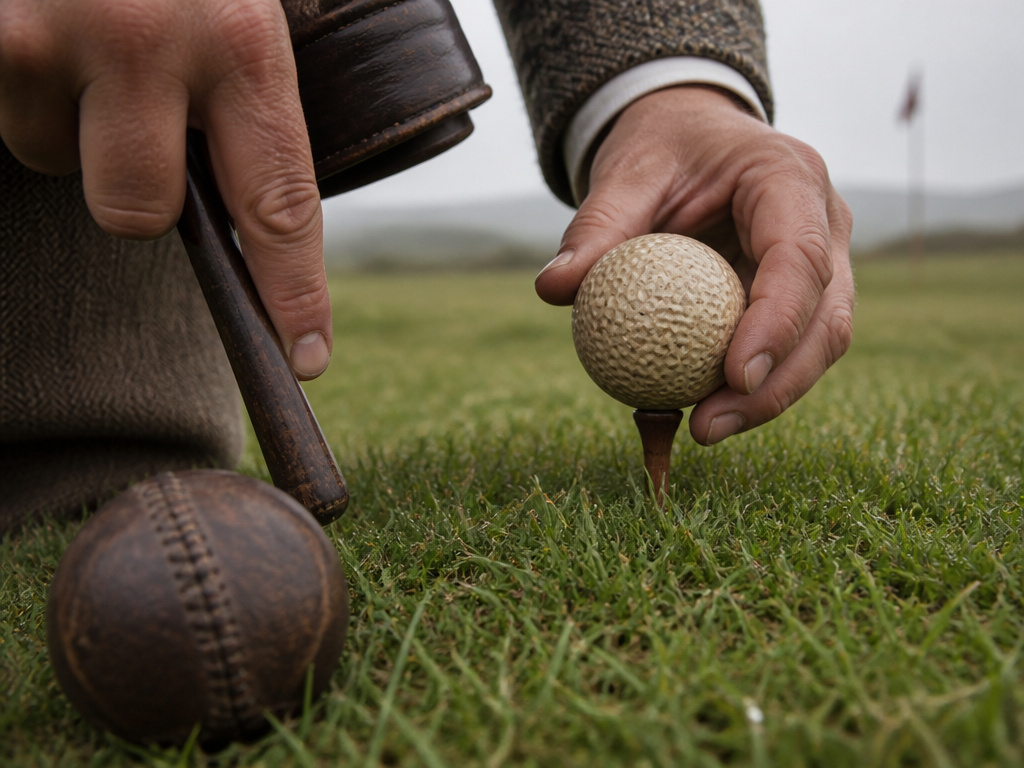 Three parallel revolutions in the 1800s turned a Scottish regional game into a global sport: course standardization, equipment innovation, and institutional governance.
First, the course. St Andrews originally had 22 holes. In 1764, the club decided that the first four and last four holes were too short, and combined them into two holes each. This created an 18-hole course entirely by accident. This 18-hole layout became the model, especially after the Royal and Ancient Golf Club adopted it as the standard for its competitions.
Second, the ball. For centuries, the “featherie” ball, a leather pouch stuffed with wet goose feathers, was the standard. It was expensive, time-consuming to make, and performed poorly in wet conditions. In 1848, the gutta-percha ball (or “guttie”) was introduced. Made from the dried sap of a tropical tree, it was cheap, durable, and could be mass-produced. The sound of a well-struck guttie was a solid thwack, unlike the softer thud of a featherie. Its consistency meant players could finally develop repeatable swings, directly influencing the evolution of golf club design toward more specialized, iron-headed clubs.
Third, the institutions. The Royal and Ancient Golf Club‘s Rules of Golf Committee was formed in 1897. In 1899, it published the first consolidated code of rules, aiming to end local variations. Across the Atlantic, the United States Golf Association (USGA) was founded in 1894. The two bodies would spend decades reconciling differences before issuing the first unified code in 1952.
The combination was explosive. Railways meant people could travel to play. The cheap, durable ball meant they could afford to. Standardized rules meant they could compete anywhere. Golf clubs sprang up across the British Empire and the United States. The era of the professional golfer, like Old Tom Morris and his son Young Tom, had begun.
Debunking the Myths: China, the Netherlands, and Acronyms
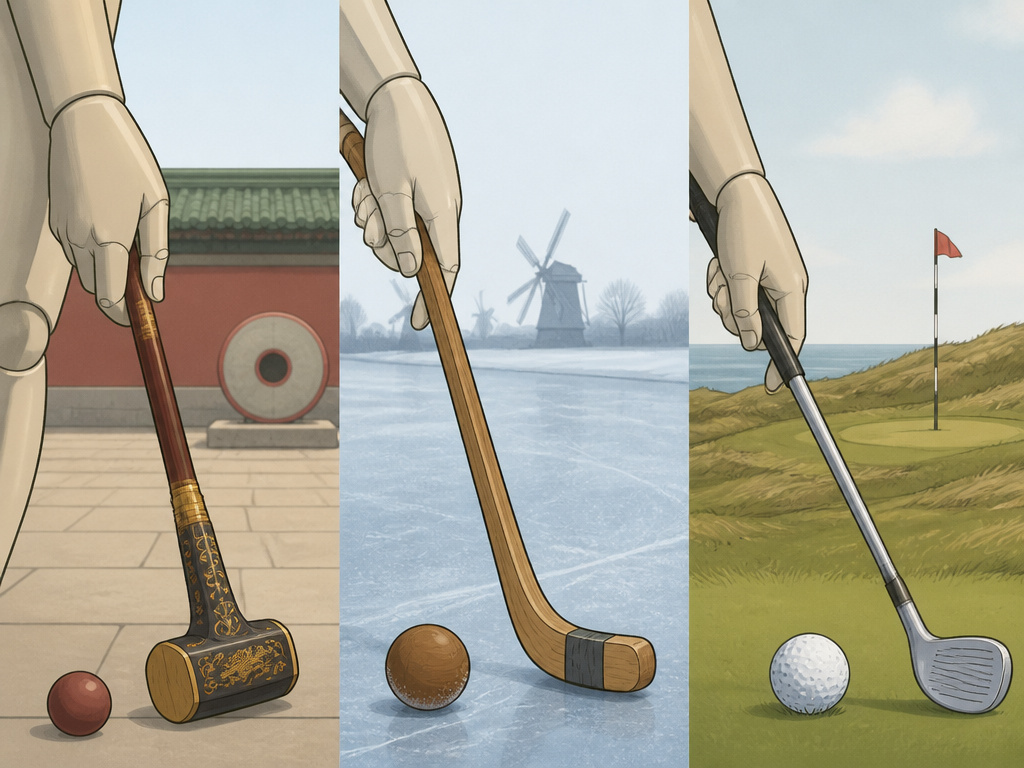 Any discussion of golf’s origins and evolution of golf runs into persistent myths. Let’s clear two of them up.
The Chinese Claim (Chuiwan): In the 2000s, a museum exhibit highlighted chuiwan, a Ming Dynasty game involving hitting a ball into a hole. The evidence is a scroll and a 1282 manual. However, most golf historians, including the USGA’s Rand Jerris, maintain a key distinction. Chuiwan was typically played in courtyards with a single club to a single target. Golf is defined by the use of multiple clubs over a varied landscape of 18 holes. Similar? Superficially. Ancestral? Not directly.
The Dutch Ancestry (Colf): The Dutch word colf (meaning “club”) is the clear linguistic root of “golf.” The game was played on ice and in town squares. Trade between the Netherlands and Scotland’s east coast was busy, making cultural transfer likely. The Scots probably imported the name and the basic concept of hitting an object with a stick. But they transplanted it onto their linksland, which changed everything. The game transformed from a short-target game to a long-distance, terrain-navigating challenge. The Dutch had the word and the concept; the Scots had the land that created the sport.
The GOLF Acronym: This is a 20th-century joke with no historical basis. “Gentlemen Only, Ladies Forbidden” is a backronym, a phrase invented to fit the word. Ladies’ golf clubs have existed since at least the 1860s.
Common mistake: Pointing to an ancient stick-and-ball game and calling it “early golf.” The format, multiple clubs, varied holes, natural terrain, is what makes golf golf, and that format is Scottish.
The Modern Game: Unification and Global Domination
The 20th and 21st centuries have been about refinement, professionalization, and global reach. The R&A and USGA finally achieved a truly unified set of rules in 1952, ending decades of transatlantic differences over things like the size of the ball. This collaboration continues today, with major revisions every four years.
Technology continued to drive change. The Haskell wound rubber-ball in 1898 dramatically increased distance. Steel shafts replaced hickory in the 1930s. The modern professional tour system, centered initially in the US and UK, created global stars and turned tournaments into major televised events. The history of the golf handicap system allowed players of different skill levels to compete meaningfully, a social innovation that fueled the game’s amateur growth.
Today’s debates, about driver distances, golf ball rollbacks, and the use of green-reading books, are just the latest chapters in the sport’s long history of adapting rules to technology. The core tension remains the same as in 1744: how to preserve the fundamental challenge of the game while embracing innovation.
| Era | Key Development | Catalyst for Growth |
|---|---|---|
| Pre-1744 | Informal play on Scottish links | Availability of public land. |
| 1744-1899 | Codification of rules by clubs | Need for standardized competition. |
| 1848-1900 | Gutta-percha ball & steel shafts | Affordable, consistent equipment. |
| 1899-1952 | R&A & USGA rule unification | International play and commerce. |
| 1952-Present | Professional tours & TV | Commercialization and global stars. |
Frequently Asked Questions
Did golf really originate in Scotland?
Yes, modern golf as defined by its use of multiple clubs, play over a multi-hole natural course, and its foundational rules is a Scottish invention. While simpler stick-and-ball games existed elsewhere, the combination of elements that makes golf unique developed on Scotland’s linkslands in the late Middle Ages.
What is the oldest golf course in the world?
The Old Course at St Andrews in Scotland is considered the oldest and most iconic. While the Musselburgh Links claims evidence of play from 1672, St Andrews has the longest continuous history as a golfing site since the early 1500s and is known as the “Home of Golf.”
Why are there 18 holes in a round of golf?
It’s a historical accident. St Andrews had 22 holes. In 1764, the club combined the first four and last four holes into two holes each, leaving 18. This layout was later adopted as the standard by the prestigious Royal and Ancient Golf Club, and everyone else followed.
What was the first major change in golf equipment?
The gutta-percha ball (1848) was the first revolution. It replaced the expensive, hand-made featherie ball with a cheap, mass-produced, and more consistent alternative. This made the game accessible to the middle class and directly led to the first worldwide golf boom.
Who governs the rules of golf today?
The rules are jointly governed by The R&A (based in St Andrews, overseeing everywhere except the USA and Mexico) and the United States Golf Association (USGA). They collaborate on a single unified code, revised every four years.
Before You Go
The history of golf isn’t a straight line from an ancient inventor to the PGA Tour. It’s a messy, centuries-long story of geography, rules, and technology colliding. The next time you tee it up, remember you’re participating in a tradition shaped by Scottish shepherds, Edinburgh gentlemen, and a rubber-like sap from Malaysia. The game’s soul is still found in the fundamental challenge laid out in 1744: take these clubs, navigate this ground, and get the ball in the hole. Everything else is commentary.
For more detail on the specific tools of the trade, explore our articles on the history and evolution of the golf ball.com/history-and-evolution-of-the-golf-ball/) and the history and revival of hickory golf to understand how equipment shaped the playing experience.
