
Master How to Chip in Golf with the Data-Driven 4x3x5 Method
This post contains affiliate links. As an Amazon Associate, we earn from qualifying purchases.
This post contains affiliate links. As an Amazon Associate, we earn from qualifying purchases.
To chip in golf, you must match three things: the right club loft for the needed trajectory, a ball position that controls the angle of attack, and a swing length that delivers the precise speed for your carry distance. Data from 6,000 Trackman shots shows a chip shot is defined by a landing angle under 37° and spin below 3750 rpm, which promotes roll.
The numbers from that research reframe chipping from a guessing game into a system of sixty repeatable options. You have four trajectory shapes, three ball positions, and five swing speeds. Combine them, and you cover every situation from a tight lie to a fluffy collar.
What follows is the breakdown of that system—the Trackman specs that define a chip, the legal equipment rules, and the step-by-step method to turn anxiety into a reliable, pars-saving skill.
Key Takeaways
- A true chip shot, per Trackman data, has a landing angle under 37° and spin below 3750 rpm; anything else is a pitch.
- Your 7-iron through lob wedge are your primary chipping clubs; choose based on the 8° loft gaps that create four distinct trajectories.
- Ball position isn’t about stance width—moving it back delofts the club for a lower flight, moving it forward adds loft.
- Maximum club speed for a chip is 30 mph; visualize five swing lengths from 7:00 to 9:00 on a clock to control distance.
- A chip that penetrates the chrome on your iron needs a steel-reinforced epoxy fill; less than 0.5 grams of repair weight won’t change your swing weight.
What a Chip Shot Actually Is (The Trackman Definition)
Most golfers call any shot around the green a chip. The data says that’s wrong. According to the “Chip Shot Code” research—6,000 shots measured with a Trackman 4—a chip has two specific technical requirements.
A chip shot maintains enough tendency to roll when its landing angle is a maximum of 37° and its spin rate stays below 3750 rpm. This distinguishes it from a pitch shot, which must have a landing angle greater than 45° to stop the ball quickly.
If your shot launches high and spins hard, it’s a pitch. A chip is a lower, running shot. The research recorded launch angles between 6° and 35°, with spin rates from 1000 rpm to 3750 rpm. The ball’s peak height ranged from 0.25 feet to 12.5 feet.
Why does this definition matter? Because it tells you the shot’s intent. A chip uses the ground. You’re not trying to stop it dead; you’re picking a landing spot and letting the ball release. This mindset alone cuts down on the fat and thin shots that come from trying to help the ball into the air.
The Core Mechanics of a Chip Shot
Three physical factors dictate your chip’s outcome: dynamic loft, angle of attack, and club speed. The Trackman study mapped how changing your setup alters them.
Moving the ball back in your stance encourages a steeper angle of attack, between -8° and -10°. This delofts the clubface by about 18-20°. The result is a lower launch, less carry, and more roll. Moving the ball forward produces a shallower attack angle, around -2° to 0°, and only 10-12° of deloft. This gives you more height and carry, with less roll.
Club speed is your distance control. The study found the maximum speed for a true “running” chip is 30 mph. Every 5 mph change in speed alters carry distance by roughly 2.5 to 6 yards. This is controlled by the length of your backswing, which can be visualized as positions on a clock face.
The 4x3x5 Chipping Method Explained
This method, derived from the Trackman data, gives you a framework for every chip. You have 4 trajectory choices, 3 ball positions, and 5 swing lengths. That’s 60 possible combinations, but you’ll use only a handful regularly.
The Four Trajectories (Choose Your Loft)
Your club’s loft dictates the initial shape. The data showed you need an 8° loft gap to see a clear difference in flight.
| Loft Range | Example Club | Trajectory | Roll on Medium-Fast Green |
|---|---|---|---|
| 30° – 36° | 7-iron | Low | 3.5x the carry |
| 38° – 44° | 9-iron | Medium/Low | 2.5x the carry |
| 46° – 52° | Gap Wedge (50°) | Medium/High | 1.5x the carry |
| 54° – 60° | Lob Wedge (58°) | High | 1x the carry |
Pick the trajectory based on the green between you and the hole. Need to carry a bunker and stop quickly? That’s a high trajectory with your lob wedge. Have 20 feet of fairway to work with? Use a low trajectory with a 9-iron and let it run.
The Three Ball Positions (Fine-Tune the Flight)
Once you’ve chosen your club, use ball position to adjust for the lie or slope. – Back (under back shoulder): For a lower, running chip from a tight lie or to combat a slight downhill slope. – Center: The neutral, go-to position for most standard lies. – Forward (under front shoulder): For a higher, softer landing from a fluffy lie or for an uphill chip.
Common mistake: Using only one ball position for every chip. A centered ball from a buried lie often leads to a fat shot because the club bottoms out too early. Move it back to ensure ball-first contact.
The Five Swing Lengths (Control Your Distance)
Distance is about swing length, not effort. Visualize your backswing endpoint using a clock face, with your trail side as 9:00.
| Hand Position | Club Speed | Approx. Carry |
|---|---|---|
| 7:00 | 10 mph | 2.5 yards |
| 7:30 | 15 mph | 5 yards |
| 8:00 | 20 mph | 10 yards |
| 8:30 | 25 mph | 15 yards |
| 9:00 | 30 mph | 20 yards |
Make a practice swing or two to feel the length needed for your carry. The rhythm should be a pendulum: a two-count back, a one-count through.
The Setup and Technique for Clean Contact
All the strategy in the world fails if you don’t strike the ball cleanly. The setup is non-negotiable.
Step 1: Grip and Stance. Use your putting grip or a slightly weaker version of your full-swing grip. Stand close to the ball—your eyes should be directly over it or just inside. This upright posture minimizes wrist hinge. Your feet should be narrow, no wider than your hips, with about 60% of your weight on your front foot.
Step 2: Lean the Shaft Forward. Your hands must be ahead of the ball at address and must stay ahead through impact. This forward press ensures a descending blow and prevents scooping. If your hands are even with the ball, you’ll likely hit it thin.
Step 3: The Motion. The chip swing is a rocking of the shoulders with quiet wrists. Imagine your arms and shoulders forming a triangle that rotates back and through. The clubhead should not pass your hands. The finish is low and short, with your belt buckle facing the target.
Where this goes sideways: Letting the right hand flip over the left through impact. That adds loft, kills consistency, and is the main cause of skulled chips across the green. Keep the back of your front hand moving toward the target.
Choosing Your Weapon: Club Rules and Recommendations

You can chip with almost any club, but some are designed for it. The Rules of Golf define a “chipper” as an iron club with a loft greater than ten degrees. It must have its shaft attached at the heel, a plain-shaped head, and a single, round grip.
For most players, a dedicated chipper isn’t necessary. Your existing amateur irons and wedges are perfect. The key is knowing which one to use. As a rule, mid and high handicappers should be cautious with a 60-degree wedge around the green. The margin for error is slim.
Your best chipping clubs are often your 8-iron, 9-iron, and pitching wedge. They provide the low-to-medium trajectories that are easiest to control. The Vokey Design SM8 gap wedge (50°) is a tour favorite for medium-high chips that need to carry a bit of trouble and still release.
The ball matters, too. A 2-piece ball will release more, while a 3-piece ball or the best all-round golf balls will generally check up slightly more on the green due to their softer cover and higher spin potential.
Practice Drills That Actually Work
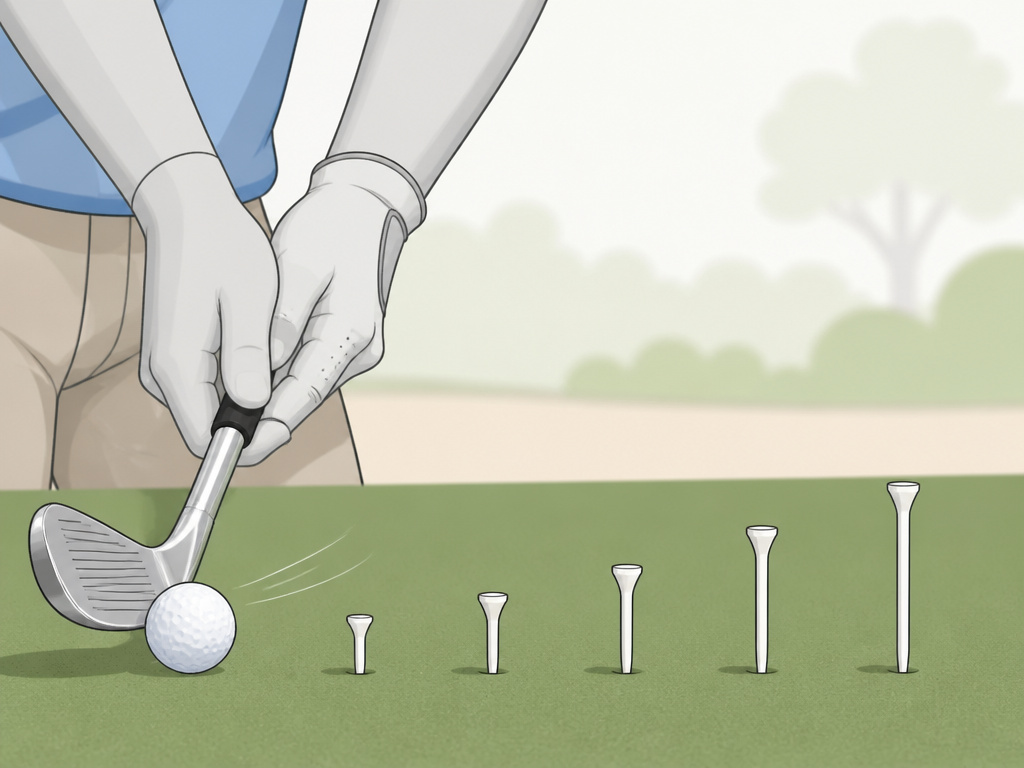
You can’t learn feel without repetition. These drills build the system into your instincts.
The Ladder Drill. Place five tees at 5, 10, 15, and 20 yards. With one club (start with your gap wedge) and a centered ball position, hit shots to each target. Focus solely on changing your swing length (7:00, 8:00, 9:00) to hit each distance. This trains your speed control.
The Three-Trajectory Drill. Pick a target 10 yards away. Hit one chip with your 8-iron (low), one with your pitching wedge (medium), and one with your sand wedge (high). Observe how each lands and rolls out. This teaches you the roll-out ratios from the table above.
The Almost Golf Ball Drill. If you can’t get to the course, buy a pack of Almost Golf Balls. They fly about a third of the distance but mimic real ball flight. Use them in your yard to practice the 4x3x5 method without breaking windows. It’s the fastest way to build a repeatable motion.
Worth knowing before you start: Chipping practice is boring. Embrace it. Hit 50 chips with one club before you ever switch. Consistency comes from monotony.
FAQ: Repairing Your Tools and Rule Quirks
Can you repair a chip in your golf iron?
Yes, and you should. A deep chip that exposes the raw steel will rust underneath the chrome, causing more plating to flake off. The proper fix involves cleaning with acetone, filling with a steel-reinforced epoxy, and sanding flush. The good news? A typical repair uses less than 0.5 grams of filler. It takes a 2-gram change at the clubhead to alter swing weight by one point, so a professional repair won’t affect your club’s feel.
Is a “chipper” club legal?
Yes, provided it conforms to The R&A and USGA Equipment Rules. Legal chippers must have a loft over 10°, a shaft attached at the heel, a generally plain head shape, and a single, round grip. They also have maximum length limits based on their loft.
What’s the biggest mistake amateurs make chipping?
They use a lofted wedge for every shot and try to help the ball into the air. This leads to inconsistent contact. The simplest fix is to choose a less-lofted club, like a 9-iron, and let the loft do the work. Make a ball-first strike with a descending blow, and the ball will pop up on its own.
How does ball construction affect chipping?
A softer, multi-layer performance golf ball will generally generate more spin on chip shots, allowing for a little more check-up. A harder, durable golf ball will release and roll more predictably. For most amateurs, the predictable roll of a 70 compression ball or a 2-piece ball is an advantage around the greens.
Can you change your club’s characteristics during a round?
No. Rule 4.1a(3) states you must not make a stroke with a club if its playing characteristics have been deliberately changed during the round. You can clean it, but you can’t adjust loft, lie, or add weight. If your club is damaged during the round, you may use it in its damaged state, repair it, or replace it under penalty.
Before You Go
Chipping isn’t magic. It’s physics and a simple system. Stop guessing. Pick a trajectory based on the green you see. Set up to strike the ball first. Control your distance with the length of your swing, not the force of it.
The 4x3x5 method turns an infinite number of scary shots around the green into 60 knowable options. You only need about six of them. Practice with purpose for twenty minutes a week, and this part of your game will stop costing you strokes and start saving them. Go lower.
