
How to Play Your First Round of Golf: A Beginner’s Essential Guide
This post contains affiliate links. As an Amazon Associate, we earn from qualifying purchases.
This post contains affiliate links. As an Amazon Associate, we earn from qualifying purchases.
To play your first round of golf, focus on two official rules and one practical adaptation. The USGA Rules of Golf limit you to 14 clubs, give you three minutes to search for a lost ball, and recommend taking no more than 40 seconds to play a shot. For your first round, adapt the “hole out” rule by setting a maximum score per hole, like 8, so you can pick up and keep pace. Everything else is logistics and a mindset to enjoy the walk.
That 40-second guideline is the hinge. It’s not a hard limit, but it’s the rhythm that keeps a four-hour round from stretching to five. The rule exists because golf is a game of continuous motion, not of standing over the ball until the perfect swing thought arrives.
What follows is the playbook for that motion. We’ll strip it back to the logistics that actually matter, what to bring, where to go, and how to move, and give you the one field-tested adjustment that turns a potentially overwhelming day into a fun introduction.
Key Takeaways
- You are limited to 14 clubs, but a half-set of 7-8 is perfect for a first round. More clubs just mean more decisions you’re not ready to make.
- Tell the pro shop staff it’s your first round. This simple sentence gets you pointed to the forward tees and often a quieter tee time.
- Play “ready golf” in stroke play. When it’s safe and you’re ready, hit your shot, don’t wait for honors. This is explicitly allowed by Rule 5.6 to help pace.
- Set a maximum score per hole (e.g., double par) and pick up when you reach it. This is the single biggest thing you can do to maintain pace and enjoy your day.
- Your goal isn’t a score. It’s finishing 18 holes wanting to play again. Everything about your preparation should serve that.
Before You Start: The Logistics That Aren’t About Your Swing
Your first round is 10% golf swing and 90% knowing where to go next. Overthinking the swing while under-preparing the logistics is the standard beginner mistake. Let’s fix the logistics first.
Arrive at least 30 minutes early. Forty-five is better if you’ve never been to the course. You need time to find parking, lug your bag to the clubhouse, and figure out the check-in process without a panic sweat. Your first stop is always the pro shop. Walk in, give the name on the booking, and say this: “Hi, I’m checking in for the 9:00. It’s my first round.” That last part is crucial. Staff will immediately switch to guide mode.
This is also where you pay. Have a credit card ready. If you need rental clubs, ask here. A pro shop will set you up with a standard game-improvement beginner golf set from a brand like Wilson or Callaway.com/best-beginner-golf-sets/)** like a Callaway Edge or a Strata package, these are designed to be forgiving.
The part nobody mentions: If you booked as a single or a pair, you will likely be paired with strangers. Shake hands, give your first name, and mention it’s your first round. This disarms any tension and turns strangers into de facto guides.
What’s in Your Bag? (The Short List)
You do not need 14 clubs. The rule sets a ceiling, not a floor. A half-set is smarter, cheaper, and less confusing. Here’s what a functional first bag looks like:
| Club Type | Why It’s Here | If You Skip It |
|---|---|---|
| Putter | The club you’ll use the most. | You literally cannot finish a hole. |
| Sand Wedge (56°) | Gets the ball airborne from short range and rough. | You’ll blade chips across every green. |
| Pitching Wedge | Your standard short-range club. | You have no reliable 100-yard option. |
| 8-Iron | A versatile mid-iron for approach shots. | Your gap between wedge and hybrid is too large. |
| 6-Iron | For longer approach shots. | You’ll have to try to muscle a hybrid too often. |
| Hybrid (19-22°) | Easier to hit than a long iron, good for tee shots. | Long par 3s and second shots on par 5s become guesswork. |
| Driver | For the fun of it on wide-open holes. | You’ll be fine. Many beginners leave it in the bag all day. |
Pack at least six golf balls. You will lose some. Bring a water bottle, sunscreen, a glove, and tees. That’s the whole inventory. Filling a brand-new bag with 14 shiny clubs is a classic error; a used, sensible first set of clubs is a far better investment.
The Two Rules That Matter Most (and One You Can Ignore)
The official USGA rulebook for golfers is 200 pages. You need to know three things from it, and you have official permission to bend a fourth.
1. The 14-Club Limit (Rule 4). You cannot have more than 14 clubs in your bag during a round. If you start with 15, you get a penalty. As we’ve covered, start with 7 or 8.
2. The Lost Ball Timer (Rule 18). If you hit a ball into the woods or tall grass, you have three minutes to search for it. Not five. Start the clock when you or your partner begin the search. If you don’t find it in three minutes, it’s lost. Take a penalty stroke, drop a new ball, and keep moving.
3. The Pace of Play Guideline (Rule 5.6). The rule recommends you make a stroke in no more than 40 seconds after you are able to play without distraction. This is the rhythm. Take your practice swings, pick your target, and go. The silence while you stand over the ball is where anxiety grows.
A player is expected to play continuously and at a prompt pace. It is recommended that a stroke be made in no more than 40 seconds after the player is able to play without interference or distraction, and usually more quickly. . USGA Rules of Golf, Rule 5.6
The Rule You Can Adapt: Holing Out. Rule 3.3c says you must hole out on every hole. For your first round, I give you permission to ignore this. Set a maximum score per hole, like 8 on a par 4. If you reach that score, pick up your ball, write an “X” on the scorecard, and move to the next tee. This is standard beginner practice. It’s the guardrail that keeps one nightmare hole from ruining your pace and your mood.
Your First-Tee Playbook
The walk from the pro shop to the first tee is where nerves live. Your mouth goes dry. Your hands feel slick. This is universal. Here’s the sequence that gets you from the practice green to your first drive.
First, find the starter. This is the person near the first tee with a clipboard. They manage the tee sheet. Tell them you’ve checked in and confirm your tee time. If there’s a wait, they’ll tell you.
Do a five-minute warm-up. Not a practice session. Hit a few putts to get a feel for the green speed. Take a few easy swings with a wedge or short iron. You’re loosening muscles, not rebuilding your swing.
When it’s your group’s turn, step onto the tee box. The formal order of play is that the player with the honor (lowest score on previous hole) hits first. On the first tee, someone usually just volunteers or you toss a tee. Here’s the truth: in casual stroke play, you should play ready golf. If you’re ready and it’s safe, hit. Don’t stand there waiting for a ceremony.
Play from the forward tees. Not the middle ones. The front ones. The card will call them the “Forward” or “Red” tees. This single choice does more for a beginner’s enjoyment than any equipment hack. It turns unreachable par 4s into manageable ones.
The 4-Step Routine for Every Hole
Once you tee off, this pattern repeats 18 times. Internalize it.
- Tee Shot: Hit from between the tee markers. Find your ball.
- Advance the Ball: Get it as close to the green as you can. Don’t try hero shots. Use your hybrid or mid-iron and make clean contact.
- Chip/Pitch: When near the green, use your wedge. Use a putting stroke with your shoulders, don’t scoop.
- Putt: Once on the green, mark your ball with a coin, clean it, and put it back. When putting, the player farthest from the hole goes first. Avoid stepping on another player’s putting line, the imaginary path their ball will take.
After everyone holes out (or reaches their max score), move quickly to the next tee. This is the pace of play engine. Watch the group ahead, not behind.
How to Handle the Inevitable Mishaps
You will hit bad shots. You will lose balls. The difference between a frustrating story and a funny one is how you handle the next two minutes.
- Lost Ball: Announce it, start your phone’s timer for three minutes, and search. If time expires, say “I’m taking a penalty.” Drop a ball where you think the original was lost, take a one-stroke penalty, and play on.
- Out of Bounds (OB): If you hit it into a yard or a parking lot (usually marked by white stakes), that’s OB. You must go back to where you last played and hit again, adding a penalty stroke. This is the “stroke-and-distance” penalty. It’s a round-killer. When in doubt, hit a provisional ball.
- Water Hazard (Penalty Area): If you see red or yellow stakes near water, you have relief options. The simplest: take a one-stroke penalty and drop a ball behind the hazard, keeping the point where it last crossed the margin between you and the hole.
- On the Green: If your ball lands on the green and leaves a dent (a pitch mark), repair it. Use a divot tool or a tee to push the edges inward, then smooth it with your putter. Always rake a bunker after you play from it.
The unifying principle: keep moving. Take your penalty, drop quickly, and hit. The group behind you will appreciate it.
The Mindset That Makes You Want to Play Again
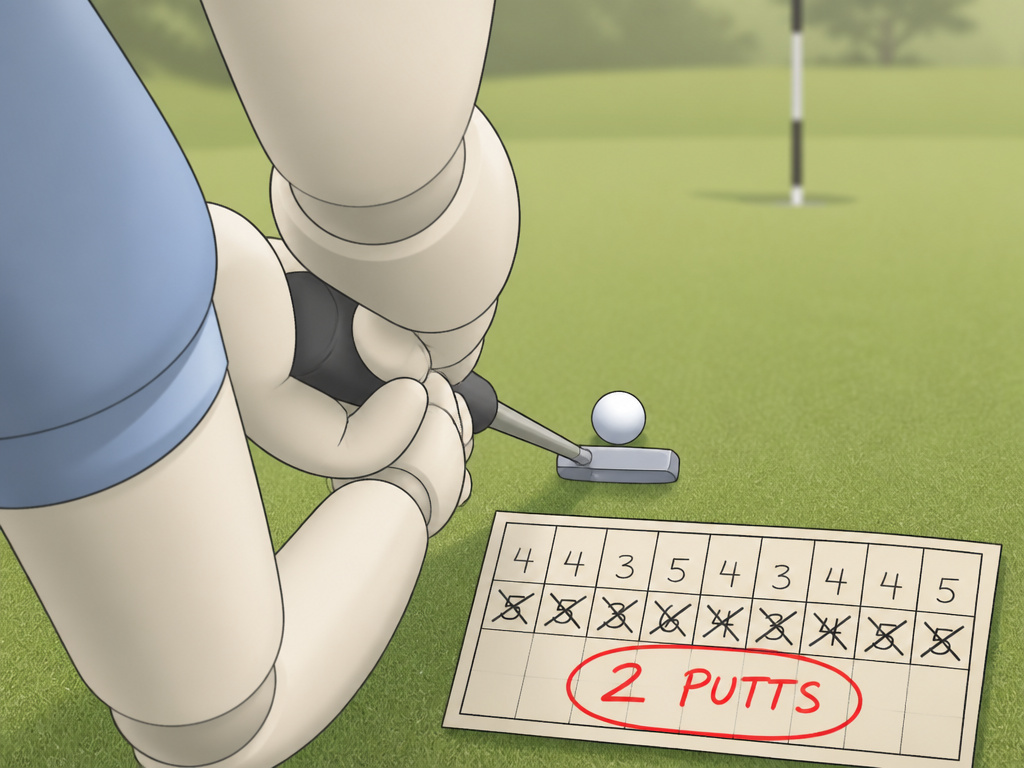 The physical part of golf is hitting the ball. The mental part is not letting the bad shots infect the next three hours. This is where most first rounds are won or lost.
I learned this from a student who could only practice in his backyard. He hung a net and drew a chalk circle ten yards away. Every day, he’d hit fifty shots with his wedge, trying to land the ball in the circle. No full swing, no driver. When he finally came to the course, his short game was the most reliable part of his day. He’d get near the green and actually expect to get down in two or three shots. That expectation, that competence in one small area, carried him through the wild drives.
That’s the mindset. Find one thing you can do reasonably well today, maybe it’s taking only two putts on every green, or maybe it’s just finishing every hole with the same ball you started with. Make that your scorecard. The official numbers are irrelevant.
Your concentration will fray around the 13th hole, especially if you’re walking. Your legs will get heavy. This is when simple golf nutrition matters, a banana or a granola bar at the turn (after the 9th hole) and steady sips of water fight the fatigue that turns minor errors into meltdowns.
Frequently Asked Questions
How long does a first round of golf take?
Plan for four to four and a half hours for 18 holes. A nine-hole round takes about two hours. This assumes a reasonable pace of play. If you’re falling behind, let faster groups play through.
What should I wear for my first round?
Collared shirt (golf polo) and shorts or pants without jeans is the standard. Many public courses allow athletic shorts. Avoid tank tops. Golf shoes with soft spikes help with traction but aren’t mandatory for a first round; clean athletic shoes work fine.
Do I need a golf glove?
Not strictly, but it helps. A glove on your lead hand (left hand for right-handed players) improves grip and prevents blisters. It’s a $20 investment that pays off.
What if I’m really bad and people are waiting?
First, they were bad once too. Second, if you’re clearly holding up play, implement the maximum score rule immediately. Pick up, move to the next tee, and wave the group behind through. This is the ultimate act of good golf etiquette.
How do I keep score?
One person in your group keeps everyone’s score on a card. Write down the number of strokes (including penalties) for each hole. At the end, total it up. For your first round, I’d focus more on the experience than the number.
Before You Go
Strip it back. Your first round is a success if you leave knowing where the pro shop is, what a tee box looks like, and how to fix a pitch mark. The 40-second guideline and the three-minute search rule are the only timers you need to mind.
One concession: everything here assumes a standard public course. If your first round is at a high-end private club, the etiquette expectations are tighter. In that case, lean even harder on the pro shop staff for guidance.
The practical point is what matters. Don’t buy 14 clubs. Do tell the starter it’s your first time. Play from the front, pick up at double par, and keep your head up. Good golf feels less complicated the more you understand it, and understanding starts with just getting through 18 holes in good spirits. Now go book that tee time.
