
Ireland Golf Travel Guide | The Pro’s Plan for a Real Trip
This post contains affiliate links. As an Amazon Associate, we earn from qualifying purchases.
This post contains affiliate links. As an Amazon Associate, we earn from qualifying purchases.
To plan a successful Ireland golf trip, focus on three things: fly into Shannon Airport for the southwest links, book tee times 4-6 months ahead for summer play, and embrace walking, buggies are rarely allowed on the great courses. Build your itinerary around one round per day with a rental car, and pack waterproofs for weather that changes by the hole.
That’s the framework. Now, let’s strip it back to the practical details most guides gloss over because they’re selling a dream, not preparing you for the reality of narrow roads, left-hand turns, and links turf that doesn’t forgive a bad plan.
What follows is the map I wish I’d had: the regional weather splits that actually matter, the booking links that skip the agent fees, and the one packing mistake that ruins more trips than a lost club.
Key Takeaways
- Fly into Shannon, not Dublin, for the southwest links. It saves 3+ hours of driving each way and puts you minutes from Lahinch.
- May and September are the sweet spots. You get long daylight, firm courses, and better availability at courses like Ballybunion without peak summer crowds and prices.
- You will walk. Buggies (carts) are restricted or unavailable on most championship links; plan for a caddie (€60-80) or a pull trolley.
- Book an automatic rental car early and size up. Manual transmissions dominate, and four golfers with bags need an estate or SUV.
- One great round per day is the perfect pace. Trying to play 36 holes while navigating unfamiliar roads burns you out and wastes the experience.
The Single Biggest Adjustment: Driving and Logistics
Let’s be clear about this. Your trip hinges on the car. If you’re coming from North America, you’re driving on the left on roads that are narrower and slower than any map app suggests. A journey it calls an hour will take ninety minutes with a tractor or a flock of sheep. That’s not a problem, it’s part of the charm, but it requires a specific plan.
First, book an automatic transmission months in advance. The vast majority of hire cars in Ireland are manual. If you’re not comfortable shifting with your left hand while processing left-hand traffic, the limited automatics sell out fast. Second, size up. A standard sedan will not fit four golfers, four bags, and luggage. You need an estate wagon or a mid-size SUV. Confirm it takes the clubs. I’ve watched groups start their trip with a 45-minute repack in the rental lot, and it sets the wrong tone.
Where this goes sideways: Underestimating drive times. A transfer from Killarney to Donegal looks feasible on paper but will consume a full travel day after a round. Cluster your golf by region, base in Clare for Lahinch and Doonbeg, then move to Kerry for Ballybunion and Waterville.
Your arrival airport is the first major logistical choice. For the classic southwest trip, Shannon Airport (SNN) in County Clare is the only correct answer. It receives direct flights from East Coast hubs like Boston and New York. From Shannon, you’re 45 minutes from Lahinch and 90 minutes from Ballybunion. Flying into Dublin adds three and a half to four hours of driving before you see a links course. If your dream is the Northern Ireland giants like Royal Portrush, then Belfast is your entry point. Don’t try to combine both regions in a single week; the island may look small, but the roads dictate the pace.
| Region | Key Airport | Sample Drive to First Course | Best For |
|---|---|---|---|
| Southwest (Clare/Kerry) | Shannon (SNN) | Lahinch: 45 min | First-time visitors, concentration of world-class links |
| Northern Ireland | Belfast (BFS or BHD) | Royal Portrush: 75 min | Bucket-list trips to Royal Portrush & Royal County Down |
| East Coast | Dublin (DUB) | The European Club: 90 min | Mix of parkland and links, easier logistics |
When to Go: It’s Not Just About the Weather
Everyone tells you summer is best. They’re not wrong, but they’re not giving you the full picture. July delivers up to 17 hours of daylight and the best odds of dry spells, but it also brings the highest green fees, the most crowded courses, and the need to book tee times at Ballybunion or Old Head 12 to 18 months out. The atmosphere is fantastic, but you’re paying for it.
Here’s the truth nobody sells: May and September are the pro’s choice. Daylight is still long (16+ hours in May, 13+ in early September), the courses are in prime condition, and you can often book the famous tracks 4-6 weeks in advance instead of half a year. Green fees are typically 15-25% below peak summer rates. May offers firmer, faster-running conditions that reward the ground game links golf is built for. Early September still feels like summer, but with fewer visitors.
The west coast. Clare, Kerry, Galway, is the wettest and windiest part of Ireland. May and September are your best hedge against sustained rain here. For a meaningfully lower weather risk, look southeast to counties like Wexford and Waterford. They’re statistically drier and sunnier, though you trade some of the most famous links for excellent, less-traveled courses.
Winter golf (November-March) is a different beast entirely. Most courses stay open, fees are low, and you’ll have the place to yourself. The constraint is daylight, maybe 8 hours, and the raw, windswept conditions. It’s not for a first trip, but for a return visitor seeking a pure, solitary links experience, a January morning at Ballybunion is unforgettable.
Booking Your Tee Times: Direct vs. Agent
The old model was to pay a travel agent a significant premium to make calls and secure times. That made sense before the internet. Now, it’s often an unnecessary cost.
Most Irish clubs use the BRS Golf online booking system. When you use a free planner like the one from Edge of the World Golf or go direct to a club’s website, you’re seeing real-time availability and paying the exact green fee you would at the pro shop, no agent markup. You also maintain flexibility; cancellation terms are between you and the club, not buried in a third-party’s policy.
Common mistake: Over-scheduling. I see itineraries packed with 36-hole days. These are world-class links that demand your energy. One round per day is the perfect pace. It leaves time for a long lunch, exploring a town, or simply recovering before dinner. A trip should feel like a holiday, not a marathon.
A handful of marquee courses, including Royal Portrush and Royal County Down, still require booking by phone or email. Their links are provided on their sites. The key is lead time. For summer play at a top course, 3-6 months is the safe window. For the absolute peak dates at Ballybunion or Old Head, operators are already booking into 2027.
On the Course: Walking, Caddies, and What to Pack
This is the classic surprise for American visitors: Irish golf is a walking game. On the great links, buggies are usually restricted to genuine medical need. Some clubs, like many in the Ballybunion area, don’t offer them at all. Arriving expecting to ride is a sure way to start your round off on the wrong foot.
You have two good options. Electric or pull trolleys are widely available for rent. The better choice, if your budget allows, is a caddie. Budget €60-80 per round, plus a €20-30 tip for a caddie with a valid PGA or local association card. On a blind, windswept links, their local knowledge of lines, hidden bunkers, and wind reads is worth real strokes. Some clubs even require groups to take at least one forecaddie. Book them when you secure your tee time.
Your packing list is essential. The weather can deliver sun, wind, and horizontal rain within three holes. – Waterproof jacket and trousers: Not water-resistant, fully waterproof. You’ll live in them. – Layers: A moisture-wicking base layer, a warm mid-layer (fleece or lightweight down), and your waterproof shell. Warmth is less critical than managing wind and wet. Waterproof gloves: Essential from October through April, and a wise choice if the forecast calls for rain or temperatures below 10°C. – Golf shoes: Ensure they are waterproof and have soft spikes. Many clubs require them to protect the fragile links turf. – A spare glove (or two): A wet glove is useless.
The sensory reality? You’ll hear the constant, low roar of the Atlantic on every coastal hole, even on a calm day. You’ll feel the sudden, chilling slap of a wind-driven rain shower that soaks you in 30 seconds if you’re not layered up. The turf looks firm but feels surprisingly spongy underfoot after a shower, which is why soft spikes are a year-round rule.
Building Your Itinerary: The 7-Day Shannon Circuit
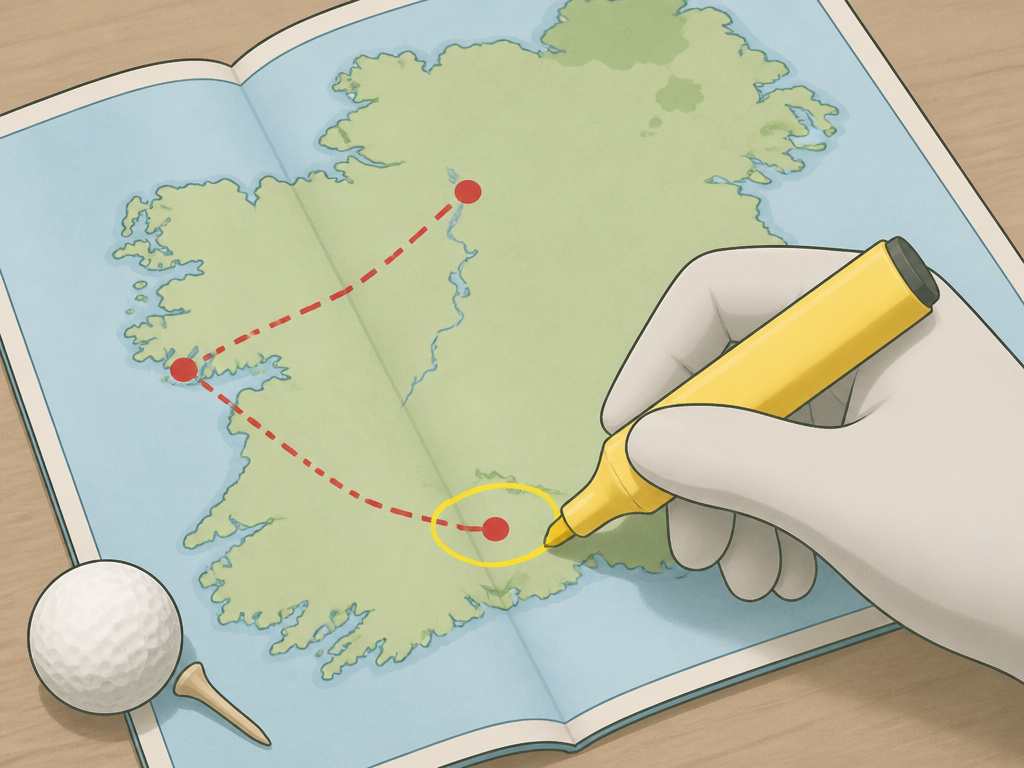
If you have a week and it’s your first time, this is the route that works. It’s the classic 7-day Shannon circuit, and it exists because it balances great golf, manageable driving, and the rhythm of a real holiday.
You fly into Shannon and work your way down the coast. The pace is deliberate: five or six rounds in seven days, with time built in to actually see the place you’ve flown to.
| Day | Base | Course | Notes |
|---|---|---|---|
| 1 | Arrive Shannon, drive to Lahinch (1 hr) | – | Settle in, maybe a jet-lag putt on the short course. |
| 2 | Lahinch, County Clare | Lahinch (Old Course) | A true links baptism. Book well ahead. |
| 3 | Lahinch, County Clare | Doonbeg (Trump International) | Or a rest day exploring the Cliffs of Moher. |
| 4 | Drive to Killarney, County Kerry (2 hrs) | – | Travel day. Base in Killarney for 3 nights. |
| 5 | Killarney, County Kerry | Killarney (Killeen Course) | Stunning parkland setting, a beautiful contrast. |
| 6 | Killarney, County Kerry | Waterville | A remote, majestic links. A long drive, but worth it. |
| 7 | Killarney, County Kerry | Ballybunion (Old Course) | The grand finale. Allow 90 mins to drive up. |
This isn’t about checking every box. It’s about choosing a region like southwest Ireland or Northern Ireland and exploring it properly. Trying to stitch together a tour from Royal County Down to Ballybunion to Galway in a week means you’ll spend more time in the car than on the course. A well-planned Scotland golf guide follows the same regional logic, and it’s why those trips succeed.
Handicaps, Etiquette, and Money
You do not need a formal handicap certificate to play most courses in Ireland. It’s wonderfully accessible. However, for the most challenging championship tests, clubs recommend a handicap of 18 or less for men and 28 or less for women to ensure you enjoy the round and maintain pace of play. It’s a guideline, not a rule, but a respectful one.
The dress code is smart but standard: collared shirt, tailored trousers or shorts (no denim), proper golf shoes. The clubhouse often has a separate, smart-casual code for the bar and restaurant, so pack one non-golf outfit for evenings.
Currency is straightforward: the Republic uses the Euro (€), Northern Ireland uses Pounds Sterling (£). You’ll cross the border without delay, but your money and speedometer signs will change. Credit cards are accepted almost everywhere, but having some cash for caddie fees, smaller pubs, or tolls is wise.
And on the subject of gear, investing in a reliable golf travel bag is the first step to a stress-free journey. For maximum protection, a hard-sided travel bag is the way to go, while many prefer the lighter weight and easier storage of a soft golf bag. Whatever you choose, ensure it has sturdy wheels, you’ll be hauling it across parking lots, through airports, and into small hotel lobbies.
Frequently Asked Questions
What is the best month for golf in Ireland?
May and September. You avoid the peak summer crowds and prices while still getting long daylight and courses in excellent, firm condition. Early October can also be superb value.
Do I need to rent a car for an Ireland golf trip?
Yes, it’s the only practical way to access the best courses outside major cities. Book an automatic transmission and a vehicle large enough for your group and clubs well in advance.
Can I use a golf cart (buggy) in Ireland?
On most championship links courses, buggies are restricted to those with a medical need and are often not available at all. Plan to walk, use a pull trolley, or hire a caddie.
How far in advance should I book tee times?
For peak season (June-August) at courses like Ballybunion, Lahinch, or Royal Portrush, aim for 3-6 months. For the absolute prime times, 12 months is safer. For May or September, 4-6 weeks can be sufficient.
Is it better to book through a travel agent or directly?
For most courses, booking direct online (often via the BRS Golf system) is easier, cheaper, and offers more flexibility. It saves the agent markup and lets you see live availability.
What should I pack that I might not think of?
Waterproof gloves, a spare golf glove, and a windproof mid-layer. The rain is predictable; the wind is the constant that chills you. Also, ensure your golf shoes have soft spikes, as many clubs require them.
The Bottom Line
A great Ireland golf trip isn’t about playing the most courses. It’s about playing the right ones at the right pace. Fly into Shannon, book an estate car, and build a week around five rounds in Clare and Kerry. Pack for four seasons in one day, expect to walk, and leave the afternoon free for the pub.
That’s the recipe. It’s the same principle I apply when looking at a golf in Australia itinerary or planning for South Africa golf, depth over breadth, experience over exhaustion. Ireland’s magic is in the moments between shots: the view from a dune, the story from your caddie, the pint after a battle with the wind. Don’t schedule that out.
