
Understanding How Altitude Impacts Your Golf Ball Distance
This post contains affiliate links. As an Amazon Associate, we earn from qualifying purchases.
This post contains affiliate links. As an Amazon Associate, we earn from qualifying purchases.
Altitude changes your golf ball’s distance because lower air density reduces aerodynamic drag and lift. For every 1,000 feet above sea level, expect a 1.5% to 2.5% increase in carry. A 150-yard sea-level 7-iron will fly 159 yards at 3,000 feet and 165 yards at 5,000 feet. The PGA Tour study found a 2,361-foot elevation gain adds about 7 yards to a pro’s drive, and playing in Reno (5,280 ft) instead of Los Angeles adds roughly 16 yards.
That drag equation is the master variable. Every yard you gain or lose at altitude traces back to the density of the air molecules your ball must push through. The physics are absolute, but your adjustment doesn’t have to be guesswork.
What follows is the breakdown of the force at work, a precise chart for translating your sea-level yardages, and the on-course strategy that keeps you from flying every green in the mountains. We will also cover what happens to your spin, why wedges behave strangely, and the critical reverse adjustment for when you travel back down to the coast.
Key Takeaways
- Expect a 1.5% to 2.5% distance increase per 1,000 feet of elevation. At 5,000 feet, your sea-level yardages are 7.5% to 12.5% longer.
- The effect is not equal across your bag. Your driver gains more total yards, but your wedges see a higher percentage increase due to their reliance on aerodynamics.
- Low humidity and high temperature amplify the altitude effect. A hot, dry day in Denver makes the air even thinner.
- If you live at altitude and play at sea level, you must add a club. Your 5,000-foot 7-iron becomes your sea-level 6-iron.
- Trust the calculation, not your gut. It takes a few rounds to believe the 8-iron you’re holding for a 165-yard shot.
The Physics: Air Density, Drag, and Lift
Your golf ball is an aerodynamics experiment. The moment it leaves the clubface, two forces fight for control: drag, which slows it down, and lift, generated by backspin, which keeps it in the air. Both are governed by air density.
The fundamental aerodynamics equation for drag force is F_drag = 0.5 × C_d × ρ × A × v². The only atmospheric variable in that equation is ρ (rho), which represents air density. Lower density means less drag.
At sea level, the air is packed with molecules. Your ball wastes energy pushing them aside. Climb a mountain, and those molecules are more spread out. The ball meets less resistance, maintains its speed longer, and carries farther.
The lift force, known as the Magnus effect, also weakens in thin air. This leads to a flatter trajectory and a shallower descent angle. You get more roll on your drives, but your approach shots hold greens less effectively. The ball won’t slice or hook as dramatically either, because the air has less force to push it offline.
How Much Distance Do You Actually Gain?
The standard rule of thumb is a 2% increase per 1,000 feet. That’s a useful starting point, but real-world data shows a range. The variation comes from your swing speed, the club you’re using, and the specific atmospheric conditions that day.
A peer-reviewed study in the International Journal of Golf Science provides concrete numbers from the professional level. Their analysis of PGA Tour performance found that a 2,361-foot increase in elevation added an estimated 7 yards to average driving distance. Their model showed that playing in Reno (5,280 ft) instead of a sea-level venue could extend a pro’s drive by approximately 15 to 16 yards.
For everyday golfers, Arccos shot-tracking data offers a clear picture. It shows that a 10-handicap player who averages 220 yards with a driver at sea level will see that jump to nearly 240 yards at 5,000 feet—a gain of almost 20 yards.
| Elevation (Feet) | Approx. Distance Increase | 150-Yd Shot Becomes… | Notes |
|---|---|---|---|
| Sea Level | Baseline (0%) | 150 yards | Reference point. |
| 1,000 | 1.5% – 2.5% | 152 – 154 yards | Barely noticeable. |
| 3,000 | 4.5% – 7.5% | 157 – 161 yards | Start adjusting club selection. |
| 5,000 | 7.5% – 12.5% | 161 – 169 yards | One full club difference. Denver, Albuquerque. |
| 7,500 | 11% – 19% | 167 – 179 yards | One and a half to two clubs. Mexican mountain courses. |
The short version: If you’re playing above 3,000 feet, you need a system. Below that, the change often falls within normal shot dispersion.
Club-by-Club: Why Your Wedge Gains More Than Your Driver
The altitude effect is a percentage game. This means longer clubs, which cover more absolute yards, gain more total yardage. But shorter, high-spin clubs see a larger percentage change because their ball flight depends more heavily on aerodynamic forces.
Driver & Fairway Woods: You’ll see a significant yardage boost, but a slightly lower percentage than the 2% rule. A driver is already aerodynamically efficient. The real gain here is in total distance, as the lower trajectory leads to more roll. A 250-yard sea-level carry can become a 265-yard carry with rollout at 5,000 feet.
Mid to Long Irons (4-7 iron): This is where the rule holds most true. Expect a consistent 1.5-2% gain per 1,000 feet. A 6-iron that goes 160 yards at home will fly 168-170 yards at 5,000 feet. That’s a full club.
Where this goes sideways: Not adjusting your mid-irons at elevation. You will hit what feels like a pure 7-iron, watch it sail over the green, and blame your swing for the next three holes.
Short Irons & Wedges: Here’s the surprise. Your scoring clubs gain the highest percentage. A wedge shot relies heavily on spin for lift and control. In thin air, that spin is less effective. The ball launches higher, carries longer, and stops less. A 100-yard sand wedge at sea level can easily become a 108-yard shot at 5,000 feet. You need less club, and you must plan for more release.
Build Your Own Altitude Adjustment Card
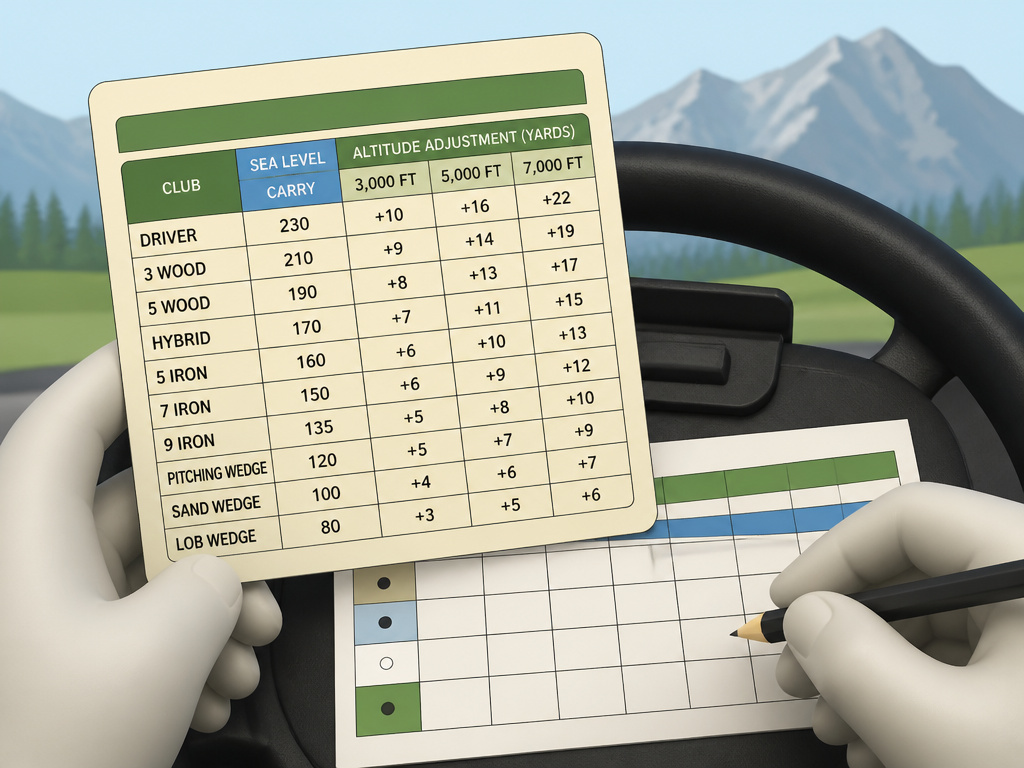 Guessing doesn’t work. You need a written reference. This is how to build one.
First, know your real sea-level carry distances. If you live at altitude, use an online calculator to reverse-engineer your baseline. Next, calculate the elevation of the course you’re visiting. Most course websites or GPS apps list it.
Now, apply the adjustment. Use the chart below as a template, plugging in your own yardages.
| Club | Sea Level Carry | +3,000 ft (5%) | +5,000 ft (10%) | +7,500 ft (15%) |
|---|---|---|---|---|
| Driver | 240 yds | 252 yds | 264 yds | 276 yds |
| 7-Iron | 155 yds | 163 yds | 171 yds | 178 yds |
| Pitching Wedge | 125 yds | 131 yds | 138 yds | 144 yds |
Write these numbers on a note card or in your phone. On the course, commit to them. The mental hurdle is real. That 165-yard shot will look and feel like a 7-iron, but your card says 8-iron. Hit the 8-iron.
Temperature, Humidity, and Other Weather Layers
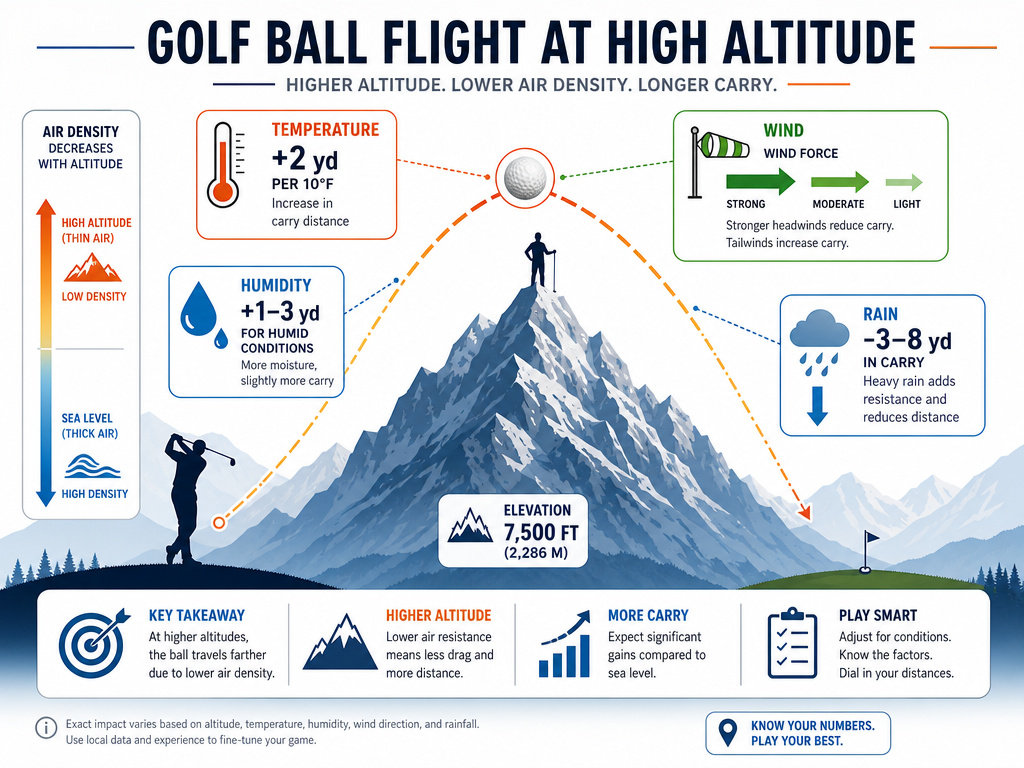 Altitude is the main event, but other weather factors sit on top of it. They change the air density further, fine-tuning your adjustment.
Temperature: Hot air is less dense than cold air. A 90°F day in Denver will give you more distance than a 50°F day at the same elevation. The common rule is an extra 2 yards of carry per 10°F increase for a driver. Combine high heat with high altitude, and the ball absolutely rockets.
Humidity: This one contradicts intuition. Humid air is actually less dense than dry air because water molecules are lighter than nitrogen and oxygen. A muggy day at altitude can add another 1-3 yards compared to a dry day.
Wind: Wind has less force in thin air. A 15 mph headwind at 7,000 feet won’t hurt you as much as the same wind at sea level. Don’t over-compensate.
Rain & Wet Conditions: All bets are off. A wet ball and wet clubface increase drag and kill spin. Any air-density benefit is wiped out, and you’ll lose 3-8 yards. Play for less distance when it’s damp.
These layered effects are why simply checking the elevation isn’t enough. You have to feel the day. This is where understanding temperature effects becomes a critical companion skill to altitude adjustment.
The Pro’s Edge: How Tour Players Adjust
The best in the world don’t guess. They quantify. At events like the former WGC in Mexico City (7,600 ft), players and caddies had explicit systems.
Bubba Watson’s caddie, Ted Scott, said they added 10% for Bubba’s low shots and closer to 15% for high shots. This nuance matters because high-launching shots spend more time in the thin air, gaining more benefit. This kind of precise distance control is what separates a good round from a winning one.
They use TrackMan’s normalization function to simulate sea-level conditions during practice. This lets them rebuild their yardage gaps from the ground up. Some players, like Tiger Woods at that event, even adjusted their equipment, adding loft to their drivers to increase spin and optimize launch in the low-density air.
The takeaway is that a systematic approach beats instinct every time, and your system can be a notecard.Theirs is a $20,000 launch monitor. The principle is identical.
The Reverse Adjustment: Playing at Sea Level
This scenario is trickier. If you live in Denver and travel to play Pebble Beach, you will lose distance. Your body and brain are wired for your home elevation.
That 168-yard 7-iron you hit in Colorado will travel about 153 yards at sea level. If you don’t add a club, every approach will come up short. Coming up short is almost always worse than being long—bunkers and water guard the front of greens.
Common mistake: A mountain golfer playing at sea level and constantly coming up short. The frustration builds, they swing harder, and their game unravels. Add one club as your default starting point.
The adjustment is the same math, in reverse. If you gain 10% at 5,000 feet, you lose about 9% going back to sea level. For a trip from Denver to the coast, plan on needing one more club for every shot inside 150 yards.
Frequently Asked Questions
Does altitude affect putting?
No, not in any meaningful way you need to adjust for. The ball is rolling on the ground, so air density is irrelevant. Focus on the faster, drier greens you often find at mountain courses.
Do I need different golf balls at high altitude?
Your ball’s compression and construction can interact with the conditions.High-spin tour balls may see a slightly larger percentage gain. The R&A’s research on golf ball performance notes that aerodynamic forces are proportional to the ball’s cross-sectional area. The main thing is to use a ball you trust and adjust your yardages accordingly.
How does altitude relate to my swing speed?
Altitude doesn’t change your swing speed, but it changes the reward for it. The maximizing distance equation shifts. In thin air, a well-struck shot will simply go farther because it decays less in flight. Higher swing speeds yield even greater absolute yardage gains.
Why does the ball curve less at altitude?
Thinner air applies less force to the side of the ball. A slice or hook will have less lateral movement. This can make the course feel more forgiving off the tee but can also make it harder to intentionally shape shots.
What’s the highest elevation for a golf course?
Extreme examples exist, like Angel Fire Resort in New Mexico at 8,600 feet. At that elevation, the 2% rule starts to stretch, and gains can approach 18-20%. It’s a unique experience where every club feels like a rocket launcher.
The Bottom Line
Altitude is physics. The air is thinner, so your ball flies farther.The mistake is treating it like a vague concept instead of a calculable variable.
Take ten minutes before your mountain golf trip. Write down your sea-level yardages. Use a 10% multiplier for 5,000 feet, 15% for 7,500 feet. Put those new numbers on a card. Then, during your round, have the discipline to trust the math over the muscle memory. That discipline turns confusion into confidence, and lost balls into looks at birdie.
The mountains make the game different, not harder. Embrace the adjustment.
