
Unlock Golf Distance: Technique vs Strength, Revealed by Data
This post contains affiliate links. As an Amazon Associate, we earn from qualifying purchases.
This post contains affiliate links. As an Amazon Associate, we earn from qualifying purchases.
Technique beats raw strength for golf distance because the swing happens faster than your muscles can reach peak force. A peer-reviewed review in the Journal of Sports Science & Medicine found that trunk power correlates more strongly with swing speed (r = 0.63) than grip strength (r = 0.29). You have about 250 milliseconds in the downswing; strength builds your potential ceiling, but technique determines how much of that ceiling you actually use on every shot.
That 250-millisecond window is the whole game. Your nervous system can’t recruit all your muscle fibers that fast. So the swing becomes a race to transfer ground force through a stable sequence before the clubhead passes the ball. Strength without that sequence is like a powerful engine with a slipping clutch, lots of noise, not much forward drive.
What follows is not another “it’s both” cop-out. We’ll break down the research on how much each factor actually moves the needle, the proven training lifts that transfer, and a phased plan that puts technique in the driver’s seat where it belongs.
Key Takeaways
- A 17-meter increase in driving distance can cut 0.75 to 2.2 strokes per round, according to classic biomechanical analysis. Technique is the most reliable way to find those meters.
- The downswing takes 200–290 milliseconds; maximal muscle force takes about 300 ms to develop. Your swing is over before your strength peaks, making efficient sequencing non-negotiable.
- Trunk rotational power has a much higher correlation to club head speed (0.63) than isolated limb strength. Train rotation, not just static lifts.
- Strength training’s primary value is raising your rate of force development (RFD), how fast you can express power, not just your one-rep max.
- Smash factor (ball speed ÷ club head speed) is a pure technique metric. A 1.50 smash is efficient; below 1.45 means you’re leaving yards on the table regardless of strength.
The 17-Meter Rule: Why Technique Beats Brute Force
Forget vague promises of “more yards.” The stakes have a number. Research from the classic Search for the Perfect Swing by Cochran and Stobbs quantified it: a 17-meter (about 56-foot) gain in driving distance, with no loss of accuracy, can improve your score by 0.75 to 2.2 strokes per round.
That’s the target. Not maximum muscle, but repeatable, efficient mechanics that add concrete meters.
Where this goes sideways: Chasing strength alone for distance. If your swing sequence is off, hips outracing shoulders, early wrist release, adding muscle amplifies the flaws. You’ll hit the ball harder, but often farther offline, turning potential birdies into recovery shots.
The physics are clear. Distance is a product of club head speed and center-face contact. Club head speed itself is an output of kinetic chain efficiency, how well you use the ground, rotate your pelvis and torso, and delay the wrist release. Strength supports this chain but does not build it. A study cited in the Journal of Sports Science & Medicine showed trunk power correlation with swing speed (0.63) was more than double that of grip strength (0.29). Your core is the engine; your hands are just the steering wheel.
How Club Fitting Masks (or Reveals) Technique Gaps
Modern equipment is fantastic. It’s also a crutch. A high-MOI, forgiving driver can stabilize a poor strike, giving you a playable result from a mishit. That’s good for enjoyment, terrible for feedback. You never feel the true cost of your swing flaw.
Real technique work demands honesty. That’s where a smash factor reading from a launch monitor is invaluable. It’s ball speed divided by club head speed. A perfect strike with a driver is around 1.50. If you’re swinging 100 mph but your smash is 1.42, your ball speed is only 142 mph. You’ve lost about 15 yards of carry purely from off-center contact. No amount of strength training fixes that. Only better strike patterns do.
This is why chasing driving distance on the range without a monitor is guesswork. You might be swinging harder but hitting it worse. The data doesn’t lie.
The Biomechanical Stopwatch: You Can’t Out-Muscle a Millisecond
Let’s talk timing. The entire downswing, from the top of the backswing to impact, takes between 200 and 290 milliseconds. For perspective, a blink takes about 100 milliseconds.
The golf swing is a sub-maximal effort in terms of pure strength. It’s a maximal effort in terms of speed and coordination. Your body cannot produce its absolute peak force in under 300 milliseconds. Therefore, the swing is not a test of how strong you are, but of how quickly you can organize and deliver the strength you have.
This is the concept of rate of force development (RFD). It’s why two golfers with the same max squat can have wildly different swing speeds. The one with higher RFD can fire those muscles faster, matching the swing’s brutal time constraints.
| Training Focus | What It Improves | Transfer to Swing Speed | Key Exercise Example |
|---|---|---|---|
| Maximal Strength | Overall force ceiling | Low direct transfer | Heavy Back Squat |
| Rate of Force Development (RFD) | Speed of force production | High transfer | Power Clean, Medicine Ball Throws |
| Rotational Power | Core sequencing speed | Highest transfer | Cable Woodchops, Rotational Med Ball Slams |
| Mobility/Stability | Range of motion & control | Essential for technique | Hip Rotations, T-Spine Mobility |
The table shows the disconnect. Raw maximal strength (like a heavy 1RM squat) builds a bigger reservoir of power. But to fill that reservoir quickly in a quarter-second, you need RFD and rotational training. This is the scientific basis for blending weights with plyometrics.
The Strength That Actually Translates: A No-BS Exercise Menu
Forget bodybuilding. Golf strength is about movement patterns, not muscle size. If an exercise doesn’t make you a more powerful, stable rotator, it’s probably just adding dead weight.
The Non-Negotiables:
- Rotational Power: This is king. Medicine ball rotational throws against a wall train your core to fire fast and in sequence. Start light (4-6 kg) and focus on violent, speedy rotation from the ground up.
- Posterior Chain Speed: Your glutes and hamstrings initiate the downswing. Kettlebell swings are perfect, they teach explosive hip extension without squatting. The feeling is a snap, not a push.
- Upper-Back Stability & Mobility: You need a strong, mobile upper back to create a wide swing arc and resist collapsing. Face pulls with a resistance band reinforce good posture and shoulder health.
Common mistake: Loading up the barbell for slow, heavy squats and calling it “golf training.” That builds general strength, not golf speed. It has its place, but it’s the foundation, not the finish. The finish is speed.
Where does a classic lift like the 1RM squat fit? It’s the foundation. A stronger lower body provides a more stable platform to push against. But it’s step one of a three-step process: 1) Build capacity (strength), 2) Learn to use it fast (RFD), 3) Apply it rotationally (golf-specific power). Most amateurs get stuck on step one.
This is where using the right golf training aids can bridge the gap. A simple heavy club or a speed training stick lets you practice applying your new-found power in a swing-specific motion, ingraining the feel of speed.
Phased Training Plan: Merging the Gym with the Range
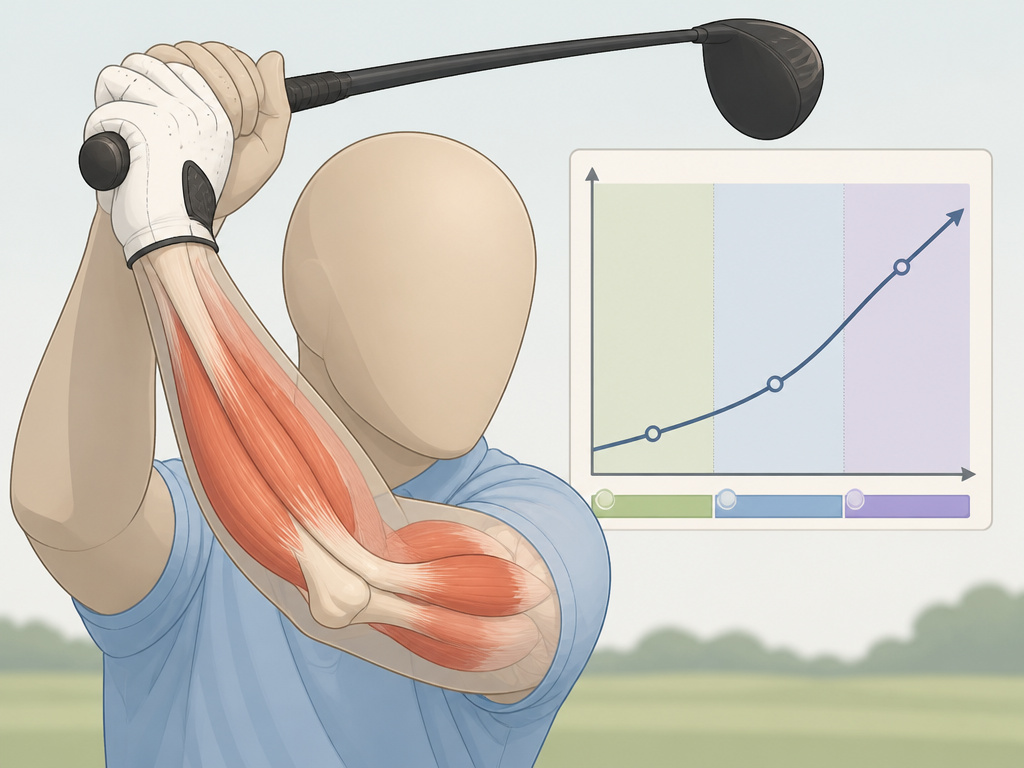
You can’t train everything at once. This 12-week template prioritizes phases so strength gains actually convert to club head speed. It follows a simple cycle: Build, Explode, Transfer.
| Phase (Weeks) | Primary Goal | Gym Focus (2x/week) | Range/Speed Focus (2x/week) |
|---|---|---|---|
| 1-4: Foundation | Build maximal strength & mobility | Heavy compound lifts (Squat, Deadlift), Mobility work | Technique drills, low-speed swing work with golf training aids for path and face control. |
| 5-8: Power | Increase Rate of Force Development | Power cleans, box jumps, medicine ball throws | Speed training sessions (e.g., SuperSpeed Golf protocols), focusing on swinging fast with relaxed technique. |
| 9-12: Integration | Transfer power to swing | Rotational power exercises, maintain strength | On-course simulation, hitting drivers with intent, monitoring ball speed with a launch monitor. |
The critical link between Phase 2 and 3: In the Power phase, you’re teaching your nervous system to be fast. In Integration, you’re teaching your golf swing to accept that speed. This is where you’ll feel the urge to “muscle” the ball. Don’t. Use the same driving technique thoughts from Phase 1, but with the faster body you built in Phase 2.
A study in the Journal of Strength and Conditioning Research on low-handicap golfers found an 18-week combined program improved drive performance significantly. The successful programs all paired strength with on-range technical or speed work. One without the other is incomplete.
Technique vs. Strength: The Verdict for Different Golfers
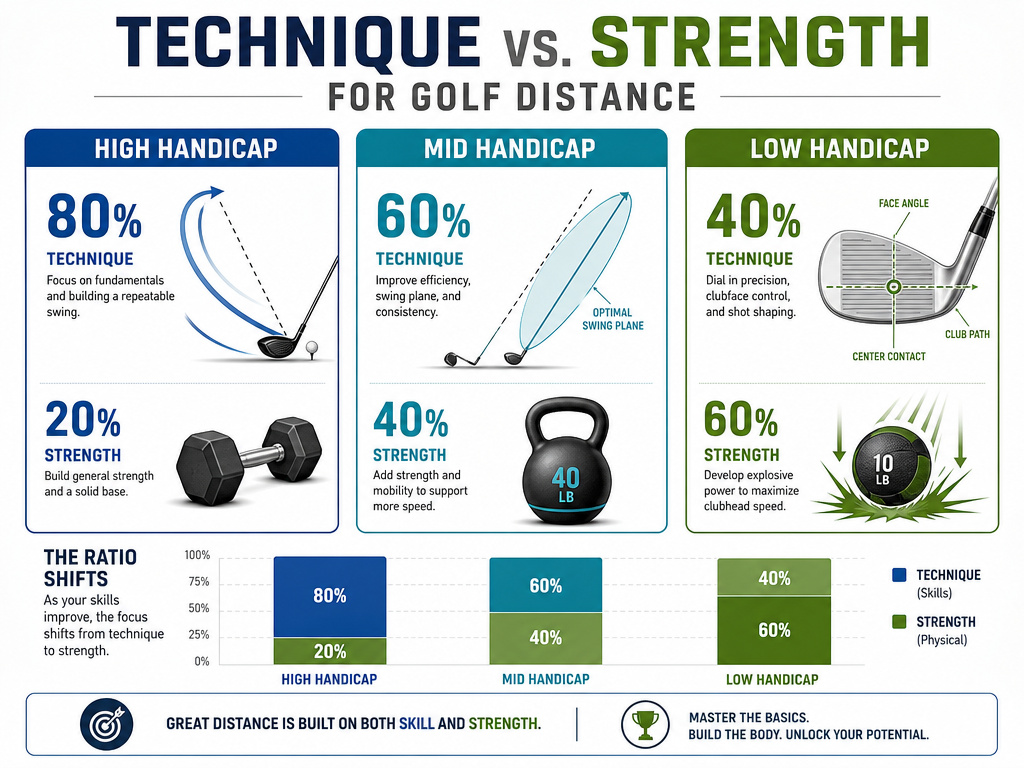
So, who needs more of what? It’s not one answer.
High Handicap / Beginner: 80% Technique, 20% Strength
Your first distance gains are almost free. Improving your smash factor from 1.38 to 1.45 through better contact adds immediate yards. Focus on basic sequence, starting the downswing with your lower body, not your arms. General fitness helps, but a pure strength block is a distraction. Game improvement clubs are wise here, as they provide forgiveness while you learn.
Mid Handicap (10-18): 60% Technique, 40% Strength
You likely have a repeatable swing but with a leak or two. This is the sweet spot for blended training. Use a launch monitor to identify your leak (e.g., low smash, excessive spin). Simultaneously, start a foundational strength plan. Your technique work becomes more targeted, and your new strength lets you stabilize new moves faster.
Low Handicap (<10): 40% Technique, 60% Strength
Your swing is efficient. To find the next 10 yards, you need more speed, and that requires a higher power ceiling. Your technique work is micro-adjustments, delivery angles, strike location. Your training shifts toward advanced power and technique development like that seen in Jon Rahm‘s workout regimen, focusing on explosive rotational power. The marginal gains are in the gym.
The part nobody mentions: Weather and course conditions are the final variable. Your distance at altitude increases dramatically, a ball flies about 10% farther at 5,000 feet. That’s a free technique boost just by taking a golf trip to the mountains. Conversely, cold, wet conditions kill distance, requiring even more efficient contact to maintain yardage.
Frequently Asked Questions
Can you gain distance without getting stronger?
Absolutely. Most amateurs lose distance from poor contact and inefficient sequencing, not lack of strength. Improving your distance control through consistent center-face contact often adds 15-20 yards before you touch a weight. Using golf balls for distance that fit your swing speed also maximizes your current output.
What is the fastest way to add 10 yards to my drive?
For most players, the fastest way is three-fold: 1) Ensure your driver is properly fitted for loft and lie. 2) Dedicate two range sessions a week to hitting drivers with the sole goal of maximizing ball speed, not perfect form. 3) Add a 10-minute weekly routine of medicine ball rotational throws to build fast-twitch core power.
How does club head speed relate to ball speed?
Club head speed is the input; ball speed is the output. The relationship is governed by smash factor (technique). For a driver, multiply your club head speed by 1.5 to see your potential ball speed. If your actual number is lower, you’re losing energy to mishits. This is why monitoring ball speed is more important than obsessing over swing speed alone.
Should I use lighter clubs to increase speed?
Swinging a lighter club (like speed training sticks) can train your nervous system to move faster. However, playing with too-light clubs can wreck your timing and feel. The best approach is to use golf training aids like weighted clubs for specific speed drills, but play with standard-weight, properly fitted clubs.
Does flexibility matter more than strength for distance?
It matters differently. Adequate flexibility (especially in the hips and thoracic spine) allows you to create a full, powerful turn. Strength allows you to control and explosively unwind from that turn. You need both, but a lack of mobility is a hard ceiling, no amount of strength can overcome a backswing that’s 30 degrees short of its potential.
The Bottom Line
Stop asking whether technique or strength is more important. Start asking which one is limiting you right now. For 8 out of 10 golfers, the answer is technique, specifically, the kinetic sequence of their downswing. The evidence from biomechanical research is clear: the swing happens too fast for raw strength to dominate.
Invest in a single launch monitor session to get your baseline smash factor and ball speed. That number tells you everything. Then, build a plan that addresses your specific leak, whether that’s strike pattern, sequence, or physical capacity. The longest hitters aren’t always the strongest; they’re the ones who waste the least energy between the ground and the clubface. Your job is to reduce the waste.
