
Control Your Ball: The Complete Guide to Shot Shaping in Golf
This post contains affiliate links. As an Amazon Associate, we earn from qualifying purchases.
This post contains affiliate links. As an Amazon Associate, we earn from qualifying purchases.
Shot shaping in golf is the controlled manipulation of a ball’s left or right curve, governed by the relationship between your club path and club face angle at impact. The club face angle dictates the ball’s starting direction, while the difference between the path and face creates the sidespin that produces the curve. On the PGA TOUR, players used a left-to-right shape 53% of the time in the 2026 season, averaging 48 feet of curve.
That 48-foot average comes with a critical detail: when those shots hit the fairway, the average curve dropped to 41 feet. When they missed, it ballooned to 61 feet. Control isn’t about the biggest curve; it’s about the smallest, most predictable one. The rest of this guide breaks down the exact physics, the data-driven realities from the tour, and the situational choices that separate a useful shape from a hopeful guess.
Key Takeaways
- Face angle is the dominant variable. For a right-handed draw, your club face must be closed relative to your target at impact, but open relative to your club path. Mess this up and you get a pull or a hook, not a controlled draw.
- Pros shape shots less than you think. PGA TOUR data shows only 4% of tee shots are intentionally hit straight, but the average curve for a shaped shot that finds the fairway is a manageable 34-41 feet.
- Shaping into a crosswind costs distance. Titleist R&D confirms that imparting sidespin robs the ball of backspin, reducing carry. Many pros accept this trade-off for tighter dispersion into small greens.
- Your equipment changes the math. Lower-lofted clubs (driver, long irons) curve more easily than wedges. Super Game Improvement (SGI) iron heads often require more exaggerated path changes to shape the ball compared to a blade.
- A neutral “straight” intention is a valid strategy. Dispersion patterns matter more than shot shape purity. If your mix of accidental draws and fades lands in a tighter circle than your intentional shapes, play the mix.
The PGA TOUR’s Shot Shape Reality
Forget the highlight reels of bending it around trees. At the highest level, shot shaping is a game of percentages and fairway finding. The 2026 PGA TOUR data from the Wyndham Championship paints a clear picture.
Players favored a left-to-right shot shape (a fade for a right-handed player) 53% of the time off the tee. The average curve on those shots was 48 feet. But the key insight is in the breakdown: when the shot hit the fairway, the average curve was 41 feet. When it missed, the average curve was 61 feet.
The data shows a direct correlation between control and curvature. A shot that misses the fairway curves, on average, 20 feet more than a shot that finds the short grass. Excessive curve is often a symptom of a miss, not a demonstration of skill.
The same pattern holds for right-to-left shots (draws), which were used 43% of the time. The average curve was 41 feet, shrinking to 34 feet for fairway hits and expanding to 52 feet for misses.
| Shot Shape | Usage % | Avg. Curve (All) | Avg. Curve (Fairway Hit) | Avg. Curve (Fairway Missed) |
|---|---|---|---|---|
| Left-to-Right (Fade) | 53% | 48 feet | 41 feet | 61 feet |
| Right-to-Left (Draw) | 43% | 41 feet | 34 feet | 52 feet |
| Straight | 4% | < 1 yard | — | — |
What does this mean for you? The tour’s best are not hitting 50-yard hooks and slices. They are managing a 30-40 foot bend to work the ball into the safe side of a fairway. Your goal should be predictability, not extremity. A reliable 10-yard draw you can count on is infinitely more valuable than a 20-yard draw that shows up once a round.
The Physics of Curve: Club Path vs. Face Angle
The ball doesn’t care about your intentions. It obeys two measurable forces at impact: club path and club face angle.
The club face angle is the boss. It determines roughly 70-85% of the ball’s starting direction. The club path is the collaborator. The difference between the path and the face angle generates sidespin, which dictates the ball’s curvature in the air.
For a right-handed player to hit a draw: 1. The club face must be closed to the target line (aiming slightly right of where you want it to start). 2. The club path must be more in-to-out (further to the right) than the face angle is closed.
Think of it as a ratio. If your face is 2 degrees closed to the target, your path needs to be, say, 4 degrees in-to-out. That 2-degree difference (path 4° right, face 2° right) creates the right-to-left sidespin. Get the ratio wrong, like a face 4 degrees closed with a path only 2 degrees in-to-out, and you get a violent hook that starts left and dives further left.
A golf ball’s curvature is dictated by the spin axis, which is determined by the difference between the club path and the club face angle at the moment of impact. This relationship is non-negotiable physics.
This is why changing your stance is a more reliable method than manipulating your swing. An open stance (feet left of target for a righty) naturally encourages an out-to-in path and an open face, setting up a fade. A closed stance does the opposite for a draw. You alter the geometry first, then swing normally along your body lines.
To Shape or Not to Shape? The Dispersion Debate
A persistent myth in golf instruction is that you must intentionally curve every shot. The logic goes: since hitting it perfectly straight is impossible, you should always plan for a curve. The data on dispersion patterns calls this into question.
Imagine two players. Player A tries to hit a 10-yard draw into every green. Player B tries to hit it straight at the flag. Both have the same margin for error in their face angle at impact, say, a 4-degree window.
Player A’s “draw” pattern will consist of shots that curve the intended amount, shots that over-draw, and shots that under-draw (resulting in a push-fade). Player B’s “straight” pattern will consist of accidental draws, accidental fades, and the rare straight ball. Research from Adam Young Golf and others shows that the size of the dispersion pattern, the circle where all the balls land, is often very similar for both players.
| Intention | Typical Shot Mix | Dispersion Outcome |
|---|---|---|
| Intentional Draw | Draws, Over-draws (Hooks), Under-draws (Push-Fades) | A lateral spread centered on the target. |
| “Straight” Target | Accidental Draws, Accidental Fades, Rare Straight Shots | A lateral spread centered on the target. |
The lesson is liberating. You don’t have to shape the ball to play good golf. What matters is which intention, shaping or straight, produces a tighter, more consistent dispersion pattern for you. If you naturally hit a small mix of draws and fades when aiming straight, that’s your shot pattern. Own it. Trying to force a one-way curve might actually widen your misses.
This is where a disciplined pre-shot routine is critical. It allows you to commit fully to your chosen intention, whether that’s shaping the ball or hitting at the target.
When Shaping Makes Sense: The Strategic Shortlist
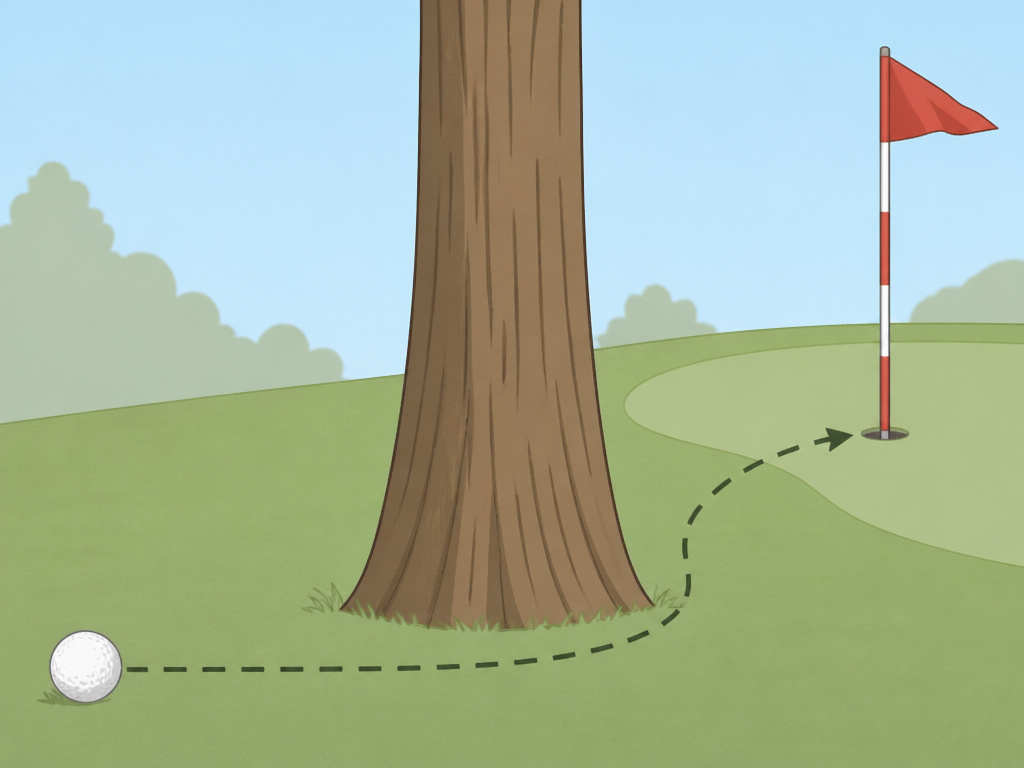
Intentional curvature is a tool, not a religion. Use it when the situation offers a clear advantage.
Navigating Trouble: This is the obvious one. A tree blocking your path to the green demands a curve. The obstacle itself dictates the shape. Your visualization here is key, see the ball starting at one edge of the opening and curving back to the target.
Playing Doglegs: Use the curve to match the hole’s architecture. A draw on a right-to-left dogleg gives you more distance and a better angle into the green. It’s a proactive use of shape to gain a strategic edge.
Controlling Wind: This is where it gets nuanced. Into a left-to-right crosswind, you have two choices: aim left and let the wind blow it back (a straight shot), or hit a draw that fights against the wind. According to Titleist’s R&D engineers, the straight shot is technically more efficient.
“From a pure distance standpoint, you would probably be better off angling it against the wind and trying to hit a straight shot,” says Titleist’s Courtney Engle. “All your impact forces are delivered in a forward motion. You rob yourself of some backspin as you impart sidespin, and you lose a little carry.”
Yet, many pros choose to shape into the wind, especially into greens. Why? They are trading distance for dispersion control. They believe a shaped shot is less susceptible to wind gusts and will stay within a smaller target window. It’s a high-level risk-reward calculation.
Important Edge Case: Elevation. Your ability to shape the ball diminishes at higher altitudes. Thinner air provides less force for the sidespin to work against. At elevation, focus more on trajectory control with your pitch shot and chip shot than on trying to bend the ball dramatically.
The Tools That Actually Help

You can’t manage what you can’t measure. To practice shot shaping effectively, you need feedback.
A launch monitor like the FlightScope Mevo+ provides the essential data: club path, face angle, and spin axis. This tells you exactly why the ball curved the way it did. Was your path off? Or was your face angle misaligned? Without this data, you’re guessing.
For face control, the HackMotion swing analyzer is a dedicated tool. It measures wrist angles throughout the swing, giving you drills to learn how to consistently deliver a closed or open face at impact. It turns an abstract feel into a trainable motion.
But tools aside, your club selection matters. As Bubba Watson notes, longer clubs create more spin. Your driver and 3-wood will curve more easily than your 9-iron. If you need a big bend, use a less-lofted club. If you need to minimize curve, use a more-lofted club. And remember, hitting out of thick rough reduces spin across the board, making it harder to shape any shot.
A Simple Formula for On-Course Shaping
When you need to bend one on the course, use this mental framework from coach Danny Malcolm. It keeps you from overcomplicating your swing.
- Decide the needed curvature. How many yards do you need the ball to move?
- Aim the club face where you want the ball to start. If you need a 10-yard draw, aim the club face 10 yards right of your ultimate target.
- Align your body (to create the path) double that distance. For that 10-yard draw, align your feet, hips, and shoulders 20 yards right of the target. This sets an in-to-out path.
- Make your normal swing along your body lines.
This formula works because it externalizes the focus. You’re not thinking “close the face” or “swing in-to-out.” You’re thinking about two simple alignment points. The body alignment creates the necessary path, and a normal swing will typically deliver a face that is closed to the target but open to that path, the exact recipe for a draw. Reverse it for a fade.
Practice this at the range first. Hit ten shots trying to curve it 5 yards. Then ten shots at 10 yards. This builds a library of feels. The final step is integrating it with your full wind strategy and commitment to your club release through impact.
Frequently Asked Questions
Can you shape the ball with any golf club?
Yes, but the amount of curve varies drastically. Lower-lofted clubs like drivers and long irons curve much more easily due to their straighter faces and lower spin rates. A wedge is designed for backspin, not sidespin, so shaping it requires a more extreme path-face difference. For a big bend, choose a less-lofted club.
Do I need a draw or a fade to play good golf?
No. Excellent golf has been played with a consistent fade (Ben Hogan, Jack Nicklaus), a consistent draw (Arnold Palmer, Bubba Watson), and a predominantly straight ball (Moe Norman). Your priority should be finding a ball flight, whether shaped or straight, that produces your tightest, most reliable dispersion pattern. Consistency trumps shape.
Why can’t I hit a draw even when I swing in-to-out?
This almost always comes down to face angle. An in-to-out path with a square face (relative to the path) produces a push, a shot that starts right and goes straight. To draw it, the face must be closed relative to the path. If your path is 5 degrees in-to-out, your face needs to be, for example, 3 degrees closed to that path (i.e., 2 degrees closed to the target). Work on feeling a slightly stronger club release or a firmer grip pressure in your last three fingers to hold the face.
How does golf ball construction affect shot shaping?
According to Titleist R&D, a lower-spinning ball will generally curve less because it has less overall spin to tilt into sidespin. A higher-spinning ball can curve more. The core and cover work together to determine spin. If you struggle with excessive curve, try a lower-spinning model. For more control, a higher-spinning tour ball may hold its line better in the wind.
The Bottom Line
Shot shaping is a skill of precision, not power. The pros use it to manage dispersion, not to show off. Start with the data: a reliable shape is a small shape, often less than 10 yards of curve. Master the face-and-path relationship through setup changes, not swing manipulations. Use technology to get feedback, and practice with a purpose, building a library of small curves for different clubs.
Most importantly, know that a neutral intention is a powerful option. Your goal is to put the ball in the hole in fewer strokes. If that happens with a mix of draws and fades, you’re playing smart, modern golf. The shape is just the vehicle. The destination is the scorecard.
