
How to Pitch the Golf Ball Consistently From 30 to 80 Yards
This post contains affiliate links. As an Amazon Associate, we earn from qualifying purchases.
This post contains affiliate links. As an Amazon Associate, we earn from qualifying purchases.
To pitch a golf ball consistently from 30 to 80 yards, use the clock system: fix your stance and tempo, then vary only your backswing length. A 7 o’clock swing goes 40 yards, a 9 o’clock goes 60, a 10 o’clock goes 80. Your sand wedge (54-56°) is the workhorse for these distances, with 55-65% of your weight on your lead foot and the shaft leaning 5-10 degrees forward. Tempo never changes; only the length of the swing back does.
That 40-60-80 yardage map isn’t a guess. It’s the result of calibrating a single club, your sand wedge, through the clock system. This method turns a nebulous “feel” shot into a repeatable mechanical action. The backswing is the only variable you control; the club’s loft and your fixed tempo handle the rest.
What follows is the breakdown of that system: the non-negotiable setup that makes clean contact automatic, the precise mechanics of the clock, and the practice drill that shows you whether you’re getting better or just hitting balls.
Key Takeaways
- Distance is controlled by backswing length, not effort. The clock system (7, 9, 10 o’clock) with a constant tempo delivers repeatable yardages.
- Set up with 55-65% weight forward and hands ahead of the ball. This 5-10 degrees of shaft lean de-lofts the club slightly, ensuring ball-first contact and engaging the bounce.
- Use your sand wedge (54-56°) as your primary pitching club. Its loft covers the 40-70 yard range most amateurs face, providing optimal height and stopping power.
- Let the club’s bounce work; never scoop. Trying to help the ball into the air is the root cause of fats, thins, and zero spin.
- Practice with a score. Hit 10 balls to a 50-yard target and count how many land within a 5-yard circle. This turns practice into measurable improvement.
The Clock System: Your Distance Control Engine
Forget trying to manufacture speed or guess how hard to swing. Inconsistent pitching comes from varying too many things at once: tempo, effort, wrist action, body turn. The clock system eliminates the guesswork by making backswing length the sole variable.
Imagine your lead arm is the hour hand of a clock centered on your shoulder. A swing where your hands stop at hip-high is 7 o’clock. Shoulder-high is 9 o’clock. Just above shoulder-high is 10 o’clock. Your downswing tempo and follow-through length remain identical for all three.
The clock system fixes distance control by making backswing length the only variable. Tempo stays the same. Effort stays the same. The backswing position changes, and that alone controls how far the ball flies. Tour pros have used this method for decades because it works.
This works because the length of your backswing directly determines the clubhead speed you can generate with a smooth, consistent tempo. A longer arc creates more speed, which sends the ball farther, without you ever trying to hit it harder.
| Clock Position | Lead Arm Position | Approx. Carry (56° SW) | Use Case |
|---|---|---|---|
| 7 o’clock | Hip height | 40 yards | Short-sided, high-loft required |
| 9 o’clock | Shoulder height | 60 yards | Standard 50-70 yard pitch |
| 10 o’clock | Above shoulder | 80 yards | Full pitch, maximum carry |
Your first job is to build your personal yardage chart. Go to the practice area with your sand wedge and hit ten balls for each clock position. Note the average carry distance for each. These are now your three reliable numbers. The system’s power is its simplicity: you never have to think about distance, only which “time” to swing to.
The Setup That Stops Fat and Thin Shots
A reliable pitch starts before you take the club back. Your setup dictates where the club bottoms out. Get it wrong, and you’ll chunk it behind the ball or blade it over the green every time.
Ball position is just forward of center in your stance. This is non-negotiable for standard pitches. Playing it too far back delofts the club and promotes a low, running shot. Too far forward makes it nearly impossible to strike ball-first and leads to thin contact. For a higher shot, don’t move the ball forward; simply open the clubface slightly at address.
Your weight must be forward. Set 55-65% of your weight on your lead foot. This pre-sets your low point ahead of the ball, which is where you want the club to brush the turf.
Hands must lead the clubhead. Your grip should be ahead of the ball at address, creating that 5-10 degrees of shaft lean toward the target. This is not an aggressive forward press; it’s a static position that slightly de-lofts the club, ensuring you hit down on the ball.
Common mistake: Centering the club in your stance with no shaft lean. This sets the club’s sole flat, which can cause the leading edge to dig. The correct setup has the handle forward, so the bounce, the rounded rear sole, is preset to glide.
This setup accomplishes one critical thing: it positions the club’s bounce to work for you. The bounce is the angled relief on the bottom of the wedge. When the shaft leans forward, the bounce is exposed. This prevents the sharp leading edge from digging into the turf, allowing the club to slide through the grass instead of getting stuck.
The Swing: Rotation, Not Hands
The pitching motion is a body rotation, not a hand-and-arm scoop. The most destructive move in the short game is trying to help the ball into the air by flipping your wrists.
Start your backswing by turning your chest and shoulders. Your arms and hands move as one unit with your body. There should be no independent wrist hinge, let it happen naturally as a result of the turn. For a 7 or 9 o’clock swing, you may feel almost none.
The downswing is initiated by rotating your lead side back through. Your weight stays on that lead foot. The feeling is that your belt buckle is turning toward the target. Your arms and the club are simply along for the ride.
Where this goes sideways: Decelerating through impact. Fear of hitting the ball too far causes a slow-down, which guarantees heavy contact. Your backswing and follow-through must be mirror images in rhythm. Think “one” back, “two” through with matching speed.
The moment of truth is impact. Your hands must still be ahead of the clubhead. This maintains the shaft lean you set at address and ensures the ball is compressed between the clubface and the turf. You will hear a crisp “thump” as the club brushes the ground after striking the ball. That’s the sound of a clean pitch.
Hold your finish until the ball lands. If you can’t hold your balance, your tempo or sequence was off.
How to Actually Generate Spin (It’s Not a Trick)

Spin comes from clean, downward contact, not a magic wrist move. When grass or dirt gets between the clubface and the ball, spin evaporates.
For maximum spin, you need two things: a clean lie and a slightly more descending blow. PGA Tour pro Billy Horschel’s method is to open the clubface slightly at address. This does two things: it presents more loft to help the ball get up, and it exposes more bounce to improve turf interaction.
“When you hit the ground, you can feel that bounce,” Horschel says. “Don’t be afraid to hit the ground.” That engagement of the bounce is what allows you to strike down aggressively while still gliding through the turf. The combination of a clean strike, a descending blow, and a square-to-open clubface path generates the friction needed for spin.
This is why understanding golf ball construction matters. A multi-layer urethane-covered ball, like a Titleist Pro V1 or a TaylorMade TP5, is designed to grab the grooves of a clean wedge strike. A two-piece surlyn ball won’t spin nearly as much, regardless of technique. If spin is a priority, your equipment choice starts with the right golf ball.
Choosing Your Weapon: Which Wedge and When
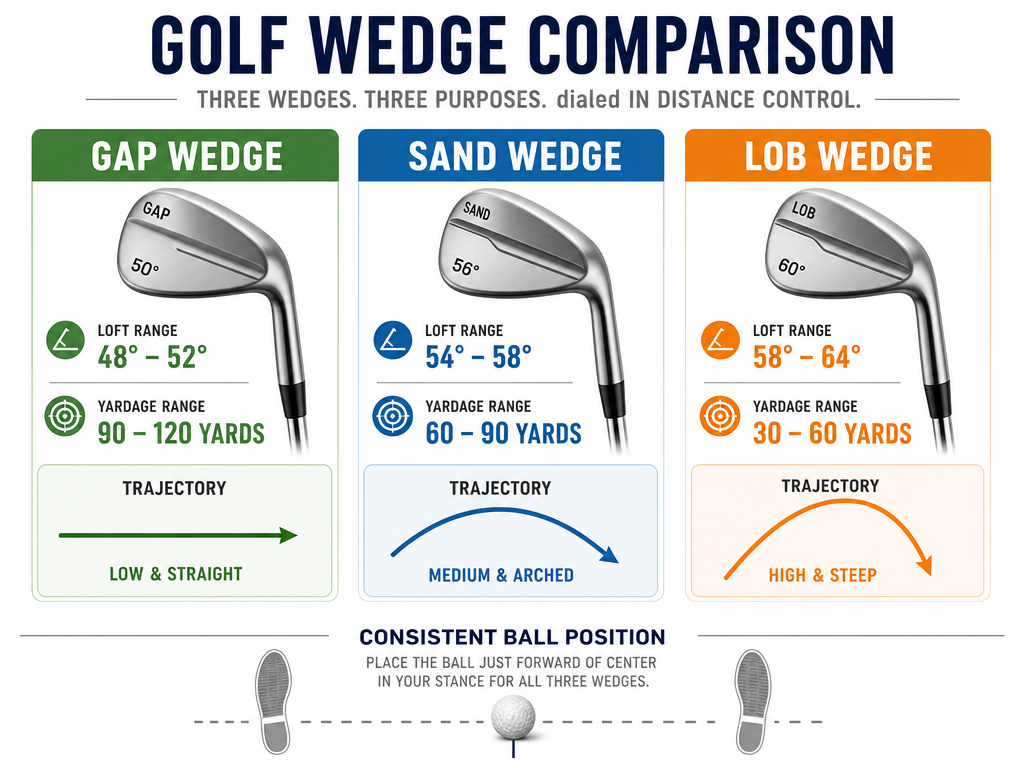
You carry three wedges for a reason. Each has a job. Using the right one simplifies the shot.
- Gap Wedge (GW / 50-52°): Your 60-90 yard club. Use it for longer pitches where you want some rollout. It flies lower than your sand wedge.
- Sand Wedge (SW / 54-56°): Your 40-70 yard workhorse. This should be your most-used pitching club. It offers the ideal blend of loft for stopping power and versatility for different lies.
- Lob Wedge (LW / 58-60°): Your 30-50 yard specialist. Use it when you are short-sided with no green to work with, or when you need to hit a ultra-high, soft shot over a bunker. It requires the most precise strike.
The higher the loft, the steeper the required angle of attack and the less margin for error. If you’re struggling with consistency, put the lob wedge away and use your sand wedge for everything inside 70 yards until your strike is dependable.
Your golf ball position is consistent for all wedges: just forward of center. The club changes, the setup does not.
The Scored Practice Drill That Beats Mindless Hitting
Unfocused wedge practice is a waste of time. You need a drill that gives you a score, a benchmark you can improve.
Go to a practice area with a clear 50-yard target. Take your sand wedge and your three clock positions (7, 9, 10 o’clock). Hit ten balls total, using the swing you think will carry 50 yards.
Count how many balls land within a 5-yard circle of your target. That’s your score out of ten.
- 0-3: Your setup or strike is inconsistent. Revisit the fundamentals before worrying about distance.
- 4-6: You have the basics. Work on tempo and solidifying your clock positions.
- 7-10: You have a reliable pitch. Start practicing from uneven lies and working on trajectory control.
This drill does two things. First, it exposes whether you can control distance. Second, it pressures you just enough to simulate a course situation. Do this drill once a week and track your score. That number tells you more about your short game than any other metric.
Troubleshooting Common Pitch Shot Mistakes
Even with a good system, things go wrong. Here’s how to diagnose and fix the most common errors.
| Symptom | Likely Cause | The Fix |
|---|---|---|
| Fat / Chunk Shot | Low point is behind the ball. Weight fell back. | Rehearse setup with 60% weight forward. Feel chest over ball at impact. |
| Thin / Bladed Shot | Standing up through impact; scooping with hands. | Focus on maintaining spine angle. Drill: hit shots with a headcover under trail armpit. |
| No Spin | Grass between ball and face; glancing blow. | Check lie. If it’s clean, focus on a more descending strike with body rotation. |
| Inconsistent Distance | Varying tempo and effort with each swing. | Commit to the clock system. Use a metronome app to groove identical tempo. |
| Shot Always Goes Left | Over-rotation of body, closing clubface. | Feel like your chest stops rotating at impact. Let arms release past body. |
Many pitch problems stem from a poor lie. A plugged ball in soft ground requires a completely different, more violent strike. Knowing the rules for relief can save you strokes. Similarly, always take the time to fix your pitch mark on the green, it’s the right thing to do, and it prevents the next player from facing an unfair lie.
Frequently Asked Questions
What’s the difference between a chip and a pitch?
Chip is a low-running shot used close to the green with a less-lofted club like an 8-iron or pitching wedge. A pitch is a higher-flying shot with a wedge from 30+ yards out, designed to land soft with minimal roll. The pitch has more air time than ground time.
How do I stop decelerating on short pitches?
The deceleration is caused by fear of the outcome. Commit to a specific finish position (like 9 o’clock in front) and swing to that finish, regardless of where the ball goes. Your brain will learn that accelerating through is necessary to achieve the finish.
Should I use a different ball for pitching?
If you’re serious about short-game spin, you should use a urethane-covered tour ball (e.g., Titleist Pro V1, Callaway Chrome Soft). These balls are designed to generate more spin on wedge shots. A two-piece distance ball will not check up as reliably. Your entire understanding of golf ball compression and spin characteristics influences this choice.
Why do my pitch shots sometimes hook or slice?
Side spin on a pitch is almost always caused by an offline clubface path relative to your swing direction. For a right-hander, an out-to-in path with a closed face hooks it; an in-to-out path with an open face slices it. Focus on swinging your arms down the target line with your body rotation. Understanding the basic ball flight laws can help diagnose this.
Can I pitch with a hybrid or iron?
Yes, but it’s a different shot called a “bump and run.” It’s effective when you have a lot of green to work with and no hazards to carry. Use a putting-style stroke with a mid-iron to keep the ball low and let it run. It’s not a true pitch, but it’s a valuable tool.
The Bottom Line
Pitching isn’t about artistry; it’s about applied geometry and repeatable mechanics. Lock in your setup with weight forward and hands ahead. Adopt the clock system and build your personal yardage chart for your sand wedge. Your only thought over the ball should be “7 o’clock” or “9 o’clock.” Let your body rotation deliver the club, trust the bounce, and accept the crisp thump of a clean strike.
The difference between a 15-handicap and a 5-handicap is often this single shot from 50 yards. It’s not a mystery. It’s a system. Go chart your distances.
