
Mastering Risk Reward Assessment in Golf for Lower Scores
This post contains affiliate links. As an Amazon Associate, we earn from qualifying purchases.
This post contains affiliate links. As an Amazon Associate, we earn from qualifying purchases.
Risk reward assessment in golf is a data-driven decision between an aggressive line that shortens the hole and a conservative line that increases safety. For university golfers on dogleg holes, choosing the aggressive route was associated with a penalty of approximately half a stroke per hole. The right choice depends on three things: your skill level, the tournament situation, and the specific course penalty for missing.
That half-stroke penalty comes from a 2026 study in Frontiers in Psychology that tracked 81 male university golfers with a mean handicap of 25.99.The finding flips a common assumption, that being aggressive is just a player’s personality. The data says it’s a costly, situational mistake. Your job is to know when the cost is worth it and when it’s a guaranteed bogey.
What follows is the breakdown of when to take the shot. We’ll cover the dogleg math, how tournament pressure warps your incentives, the specific lie conditions that change everything, and how to build a personal strategy that doesn’t rely on hope.
Key Takeaways
- On dogleg holes, deviating toward an aggressive tee shot is credibly associated with giving up half a stroke per hole (0.51 strokes) for the average amateur.
- Professional golfers’ risk-taking is highly dynamic, shifting measurably around the halfway cut line in tournaments, not just based on leaderboard position.
- Low-handicap players accept more risk when facing a likely bogey than high-handicap players, a counterintuitive finding from Prospect Theory.
- The presence of a dominant player like “Superstar Tiger Woods” altered the risk calculus of entire fields, adding a strategic peer-pressure effect.
- Your equipment, like your choice of 2-piece golf balls for durability or 3-piece golf balls for greenside control, should match your intended risk profile.
The Dogleg Decision That Costs Half a Stroke
Look at any dogleg. The aggressive line cuts the corner, promising a shorter iron into the green. The conservative line follows the bend, leaving a longer approach from the fairway. Your brain sees the reward. The data sees the trap.
For 81 male university golfers (mean handicap 25.99), within-player deviations toward aggressive decisions on dogleg holes were associated with an average penalty of 0.51 strokes per hole [95% CrI (0.11, 0.90)]. The stable between-player strategic tendency was inconclusive.
This is the core of modern risk assessment. It’s not that “aggressive players lose.” It’s that choosing aggression on a specific hole, when it’s not the right fit for your skill that day, costs you. The study found no conclusive evidence for stable “aggressive” or “conservative” player types. The penalty came from the situational choice.
The mechanism is simple but brutal. The aggressive line demands a precise carry over trouble, trees, bunkers, out-of-bounds. The landing zone is smaller. For the average 25-handicap golfer, the dispersion pattern is wide. A slight miss left or right turns a potential birdie look into a punch-out, a penalty stroke, or a lost ball. The conservative line trades distance for a massive increase in fairway width. The longer club in on your approach is a known variable. A 7-iron from the fairway beats a wedge from the pine straw every time.
When does the aggressive line work? When your skill narrows your dispersion enough to fit the required landing zone. If you can’t reliably shape a high draw over the corner or your miss with the driver is a two-way monster, the conservative line is smart. This is where understanding your own game through data, like knowing if your best amateur golf irons are truly forgiving on off-center hits, pays direct strokes.
| Scenario | Aggressive Line Rationale | Conservative Line Rationale | Likely Outcome for 15+ Hcp |
|---|---|---|---|
| Dogleg over water | Reachable par 5 in two. | Lay up to a full wedge distance. | Aggressive: Ball in water (+1 stroke). Conservative: Bogey at worst. |
| Dogleg with fairway bunker | Short iron into green. | Avoid bunker, mid-iron approach. | Aggressive: Greenside bunker (tough up/down). Conservative: GIR opportunity. |
| Dogleg with OB left | Shorten hole significantly. | Keep ball in play at all costs. | Aggressive: Lost ball & provisional (+2). Conservative: Playable second shot. |
The lesson is to remove ego from the tee box. Calculate the actual width of the fairway you’re aiming for. If it’s 30 yards wide and your typical driver dispersion is 40 yards, you are not playing the percentages. You are gambling. Take the club that finds the 60-yard wide part of the fairway. The principles of golf course routing often deliberately present these options to test decision-making, not just power.
Tournament Pressure Changes the Math
A Saturday match with your friends is one thing. A tournament with a cut line is another. The incentives shift, and so should your strategy. Research into ten years of professional tournament data shows risk-taking is highly dynamic, especially around the halfway cut mark.
Golfers on the right side of the cut line, those safely advancing, play more conservatively. They have something to protect. Golfers on the wrong side, or those right on the bubble, take measurably more risk. They have nothing to lose and need birdies to survive. This isn’t just gut feeling; it’s observed in their decisions on par-5 second shots, where going for the green in two is the ultimate risk-reward gamble.
Where this goes sideways: Assuming your final-round strategy should mirror your first-round strategy. The cut line changes the value of every stroke.
This dynamic is backed by an analysis in the Journal of Economic Behavior & Organization study on professional golf tournaments. For the amateur, the translation is about “personal cut lines.” Are you trying to break 90 for the first time? That’s your cut. On the 16th tee sitting at 12 over par, the aggressive dogleg that could lead to a double bogey isn’t worth it. Your goal is to secure the 89. Play conservatively, take your bogey, and move on. The risk you took on the 4th hole when you were even par has a different cost now.
The pressure also warps perception. That forced carry over water looks wider when you need a birdie. Your brain discounts the penalty. The data says this is when you’re most likely to make the 0.51-stroke mistake. Have a pre-round rule. Decide which holes, based on your game and the conditions, are automatic “conservative” plays regardless of score. Write them down.
How Your Lie Dictates Your Options
The textbook risk-reward calculation assumes a perfect fairway lie. Golf is rarely textbook. Your risk assessment must start with the lie of the ball. This is the most common amateur oversight.
A ball sitting down in the rough changes everything. The rough isn’t just longer grass; it’s a material that wraps around the clubface, reducing spin and control. A USGA equipment standards report on simulated rough penalties quantified this: it significantly affects both distance and dispersion. Going for a green from 180 yards out of thick rough is a different shot than from the fairway. The reward (hitting the green) is smaller because your chance of hitting it is lower. The risk (a flier that goes over, a chunk that goes short) is higher.
Here’s a quick lie assessment guide:
- Fairway (Clean Lie): All options are open. Proceed with your standard risk calculation.
- Light Rough (Ball Sitting Up): You can likely get a wood or hybrid on it. Expect a slight distance loss and reduced spin. Be cautious of front bunkers.
- Heavy Rough (Ball Sitting Down): The most common risk trap. Take your medicine.
- Do not attempt a long wood or low-lofted hybrid. The grass will grab the hose.
- Do take a lofted club (7-iron or higher) to simply advance the ball back to the fairway.
- Recalculate from there. A 50-yard wedge from the fairway is better than a duffed 3-wood from the junk.
- Fairway Bunker: Your only goal is to get out and on the grass. Unless you have a perfect lie and a lip well below the ball’s trajectory, the green is not the target. The fairway is.
- Uphill/Downhill Lie: These lies change your effective distance and curvature. An uphill lie adds loft and can cause a shot to go left. A downhill lie delofts the club and can cause a shot to go right. Always take more club for an uphill lie and less for a downhill lie.
Choosing the right tool for recovery is part of strategy. This is where a versatile 3-hybrid club can be more reliable from iffy lies than a long iron, and why a consistent all-round golf ball helps you predict behavior.
The Psychology of Gains vs. Losses
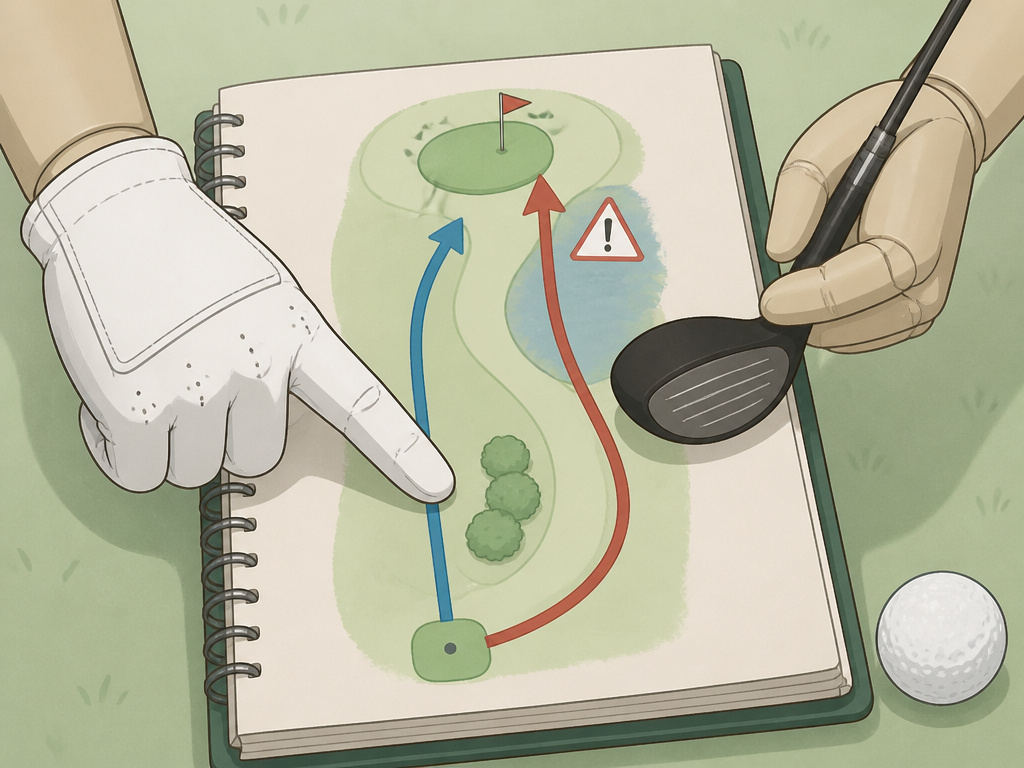
Are you more aggressive trying to save bogey or to make birdie? Your answer reveals your risk bias, and it’s not what you think. A study of over 2,100 avid golfers, published in the International Journal of Golf Science article “A Birdie in the Hand,” found that players were willing to take greater risks when facing a likely loss (a bogey) than when facing a likely gain (a birdie).
This is Prospect Theory in cleats. The pain of losing a stroke feels worse than the joy of gaining one. So, from 220 yards out, you’re more likely to go for a par-5 green in two if you’ve just hit your third shot into a penalty area and are lying four. You’re trying to avoid the double-bogey loss. Conversely, from the same distance with a chance for eagle, you might lay up more conservatively to protect your sure birdie.
The twist? The study found low-handicap (high-ability) players were willing to accept even more risk playing for a likely bogey than high-handicap players. They trust their skills to pull off the recovery. This is a critical insight for course management. You must identify your own “loss aversion” triggers.
- Do you three-putt more after a double bogey? That’s frustration leading to rushed decisions.
- Do you always go for the hero shot after a penalty? That’s loss aversion overriding logic.
The fix is pre-commitment. Before the round, decide: “On par-5s, I only go for the green in two if I have a perfect fairway lie inside 210 yards.” Write it down. When the moment comes and you’re lying three after a chip-out, the rule stands. You lay up. You fight the emotional urge with a pre-made, rational rule. This discipline is what separates a player who manages their way to a score from one who hopes their way to one.
Building Your Personal Risk Profile
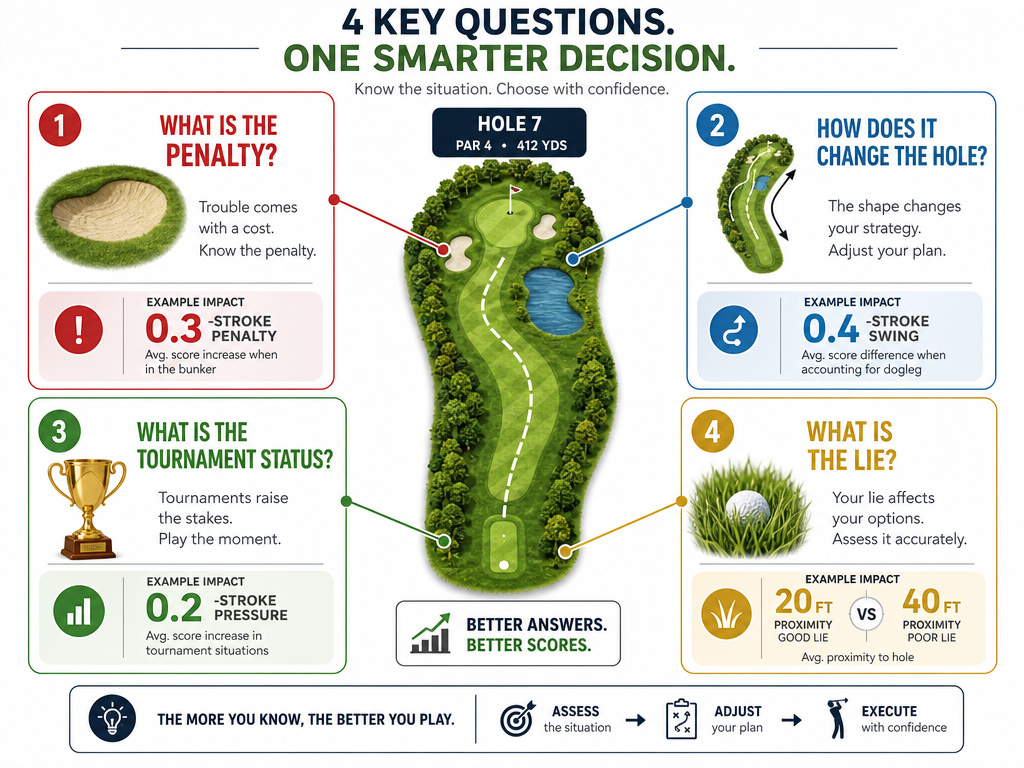
Strategy is built. You need a framework that turns course features into clear yes/no decisions.Start with these four questions on every non-par-3 hole:
- What is the exact penalty for missing my target? Is it a bunker (0.3-stroke penalty), heavy rough (0.5-stroke penalty), water (1 stroke), or out-of-bounds (2 strokes)? The harsher the penalty, the wider the safe zone needs to be.
- Does this shot change the hole? A successful aggressive drive on a dogleg par-4 turns it into a wedge hole. A conservative drive leaves a 6-iron. How much does that improve your expected score? If your proximity to the hole with a wedge is 20 feet and with a 6-iron is 40 feet, the math might favor the drive, if the risk is low.
- What is my current “tournament status”? Are you protecting a good score? Chasing a personal best? Just out for fun? Your objective sets the acceptable risk level.
- What is my lie? This is the gatekeeper. A bad lie overrides all other factors and forces a conservative play.
To answer question #2, you need to know your own averages. If you don’t know your average proximity to the hole from 150 yards versus 100 yards, you’re guessing. Use a GPS app or a watch that tracks shots. After 10 rounds, you’ll have your personal data. You might find that your 8-iron from the fairway is actually more reliable than your lob wedge from the rough. That changes everything.
Your equipment is part of this profile. A 70 compression golf ball helps slower swing speeds maximize distance safely, while the right 2-hybrid club can be your safest option off the tee on a tight hole. This isn’t about buying a game; it’s about fitting your tools to the strategy you’ve chosen to play.
The “Superstar” Effect and Match Play Dynamics
Your opponents matter. Research on tournament dynamics found that the presence of “Superstar Tiger Woods” altered the risk-taking behavior of the entire field. When a dominant player is in contention, others feel pressure to match their aggressive play, often to their detriment. This isn’t just about effort; it’s a strategic miscalculation.
In your world, this is the club champion effect. If you’re paired with the long-hitting scratch player who cuts every corner, the temptation to mimic their strategy is strong. Resist it. Their skill ceiling is different. Their 80% power shot is your 100% shot. Their margin for error is larger. Play your game, not the game you see someone else playing.
Match play introduces a completely different risk calculus, as detailed in a Journal of Corporate Finance research on competition. Here, risk is relative to your opponent’s position on the hole.
- If you’re 1-up: Your strategy shifts to conservative, high-percentage plays. Force your opponent to beat you.
- If you’re 1-down: You must apply pressure. This is where calculated aggression on reachable par-5s or risky pin positions is justified.
- If you’re 2-down with 3 to play: Your back is against the wall. All moderate risks become high-percentage plays because a safe par likely loses the match anyway.
The key is to know the status before every tee shot and green approach. Match play isn’t about posting a number; it’s about winning more holes than your opponent. Sometimes, a smart bogey that forces your opponent to make a tricky par putt is a win.
Frequently Asked Questions
Does risk-reward strategy differ for high handicappers?
Absolutely, and more than they think. The half-stroke penalty for aggressive doglegs was measured on golfers with a ~25 handicap. The penalty for a 15-handicap might be smaller, and for a 5-handicap smaller still, but the direction is the same. High handicappers have wider shot dispersion, making the safe landing zone disproportionately valuable. Their biggest gains come from eliminating big numbers (OB, water) more than from making more birdies.
How do I practice risk-reward decision making?
Use your practice rounds. Play two balls. On each dogleg or par-5, play one aggressively and one conservatively. Keep separate scores. After five rounds, you’ll have real data on which strategy works better for you on your home course. Also, on the range, don’t just hit at a blank yardage sign. Place two targets 20 yards apart. Practice hitting to the left one, then the right one, simulating shaping shots around a dogleg.
What’s the biggest mistake amateurs make in risk assessment?
They evaluate the reward but not the actual risk. They see the green on a par-5 and think “I can get there.” They don’t see the 10-yard wide gap between bunkers they must carry, or the water short that’s in play if they don’t pure a 3-wood. Always identify the specific, worst-case outcome of a failed aggressive shot. If that outcome is a lost ball or an unplayable lie, the shot is almost never worth it.
Do professional golfers use data like this?
Yes, extensively. The PGA Tour’s ShotLink system provides every player with detailed analytics on their performance from every lie and distance. They know their exact proximity from 100 yards in the rough vs. The fairway. They use Markov Decision Process models, like those discussed in academic strategy optimization papers, to plan their way around a course before a tournament. They are playing a quantified game.
How does course setup affect risk?
Dramatically. A US Open setup with thick rough and firm greens turns every aggressive shot into a potential disaster. A resort course with wide fairways and soft greens invites aggression. Always adjust your strategy during your warm-up by noting the firmness of the greens and the thickness of the rough. A versatile golf ball that performs in varied conditions supports this adaptive approach.
The Bottom Line
Risk reward assessment in golf is about being right. The data gives you a clear mandate: the aggressive line is usually a tax on inconsistency.Pay it only when the reward, a significantly easier next shot, outweighs the proven cost.
Start with the half-stroke rule on doglegs. Factor in your tournament standing and the harshness of the lie. Fight the psychological urge to chase losses. Build your personal profile around your actual dispersion patterns, not your best-ever shot. Whether you’re selecting game improvement irons or a 4-hybrid club for confidence, let the decision serve your strategy, not your ego.
The scorecard doesn’t care how you got the number. It just records it. Make your choices count.
